Erwin Rommel
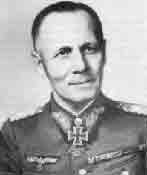
(1891 - 1944)
His sense of valor and chivalry were the stuff of King
Arthur's knights, but it was his "boldness, use of surprise, readiness
to accept risks" and above all his "intuitive sense of the
battlefield" that made Rommel one of the greatest generals in military
history. "Brilliantly successful in attack, and remarkably resourceful
in defense," the "Desert Fox" raced his armies through
France in 1940 and then repeatedly outwitted the British in North Africa.
(Blumenson, 293).
Only a few months into World War I, Rommel won the
Iron Cross Second Class for bravery in the field when he was injured
in the leg after running out of ammunition and then attacked three French
soldiers in the woods. But his first great strategic triumph is the
disastrous defeat he helps inflict on the Italian Army at Caporetto
in which he captures 150 Italian officers, 9,000 soldiers, and 81 guns.
Captain Rommel is awarded the decoration pour le merite - a medal reserved
only for senior generals. He is promoted to Major in 1933 and later
to Colonel in 1937 while teaching at the War College.
Throughout the 1930s, Rommel develops a close working
relationship with Hitler,
whom he initially comes to admire for progressively thwarting the Versailles
Treaty and restoring Germany's strength. He is seen more and more by
Hitler side. He accompanies Hitler into the Sudetenland in October 1938
and then into Prague in March
1939. But Rommel is anything but a Nazi.
In fact, early on he starts to harbor "serious reservations"
about the Nazi regime. (Blumenson, 297).
During World War II
Like Germany's other legendary battle front commander
of World War II, Field Marshal Heinz Guderian, Rommel is obsessed with
mobility and insists on leading his troops at the front. The speed with
which Rommel's force speaheads the 1940 German invasion of France causes it to be nicknamed the Ghost Division and himself as the knight
of the Apocalypse. At one point, Rommel's army covers 150 miles in one
day setting a world record. During the six week campaign, Rommel's force
alone captures nearly 100,000 French prisoners and 450 enemy tanks losing
in the process less than 42 tanks. He returns to Germany acclaimed by
Hitler and the population and promoted to lieutenant general.
In North Africa, Rommel's "brilliant quick-thinking,
opportunism, and leadership" on the battlefield outwits the "slow,
ponderous, and remote" British chain of command despite logistical
inferiority. (Blumenson, 303). In June 1942, Rommel defeats the British
8th Army at Tobruk destroying more than 260 tanks and bagging 30,000
prisoners of war. At 49, he attains the rank of Field Marshal - the
youngest in the Wehrmacht. But as Germany's fortunes wane, Rommel repeatedly
pleads Hitler for permission to evacuate his Afrika Korps from North
Africa while there is still time and to use this force to beef up fortress
Europe. In the face of Hitler's constant refusals, Rommel confides increasingly
to his wife about his loss of faith in Hitler's sanity.
Prevented from evacuating the Afrika Korps, Rommel
leads his army on a masterful 1,400 mile retreat while his arch-nemesis
in the field, General Montgomery, is unable to pin him down. In his
first encounter with U.S. forces that land in North Africa, Rommel inflicts
losses of 6,000 men, 183 tanks, and 200 artillery pieces at a cost to
his force of 1,000 men and only 20 tanks. But as the combined Anglo-American
enemy grows ever more powerful in numbers and logistics while the supplies
of the Afrika Korps dwindle, Rommel sees disaster fast approaching.
Locked in a no-retreat posture, Hitler continues to ignore Rommel's
pleas to save the 250,000-man Afrika Korps from annihilation. Following
the inevitable disaster, Hitler sends Rommel to France to inspect the
coastal defenses against the long-anticipated Anglo-American landing
on the continent.
Throughout the first half of 1944, Rommel devotes himself
full-time to improving the coastal defenses and reviving the morale
of the Normandy garrisons. Following D-Day, both he and Field Marshal
Gerd von Runstedt repeatedly try to impress upon Hitler that the battle
for France will be lost unless the Wehrmacht withdraws to a stabler
and shorter front line. In the face of Hitler's angry refusals to accept
this strategic reality, Rommel is now convinced that Hitler harbors
a death wish intends to drag Germany down with him. In late June both
von Rundstedt and Rommel go to see Hitler only to be rebuffed yet again
and return empty handed. Runstedt is sacked as Commander-in-Chief-West
and replaced with the compliant Field Marshal Guenther von Kluge.
| "His devotion to the profession of
arms was in the best tradition of the gentleman. In a total war
fought savagely and brutally, he inspired admiration for his treatment
of prisoners. He was not tainted by Nazism....With his troops
he enjoyed a deep rapport. He cared for them, and although he
demanded their best and more, he never squandered them. Without
pretension, modest, he tackled all his tasks with clarity, energy,
and common sense." (Blumenson, 315) |
The Conspiracy
Because virtually none of the military conspirators
are in command of large armies, they desperately seek to win over a
battlefront general who has an army at his disposal to lend the required
pivotal support for the coup. But so far the top brass of the Wehrmacht
— Brauchitsch,
Halder, von Runstedt, Manstein, Guderian, Kluge — have either
refused to lend their support or revealed a fence-sitting attitude.
Rommel however has long harbored an increasingly rebellious attitude
towards Hitler. If the most popular and admired battlefield commander
of the war can be won over, the coup might definitely succeed. With
this in mind, Colonel Claus von Stauffenberg (who has taken over from
Colonel Henning von Tresckow as leader of the conspiracy in late 1943)
gets General Karl-Heinrich von Stuelpnagel (the military governor for
Paris and the leader of the conspirators based in France) to invite
Rommel to Paris for secret talks aimed at recruiting the desert fox
into the plot.
Rommel agrees with Stuelpnagel that Hitler has long
since lost touch with reality and must be forced to concede or else
be removed from power. But he declares himself morally opposed to assassination.
He wants Hitler arrested and tried by a German court for his crimes.
Rommel tells Stuelpnagel he will give Hitler one last chance by sending
the fuehrer a "blitz" telegram outlining the war in the starkest
possible terms and urging Hitler to take immediate action on the diplomatic
front or cut Germany's losses and authorize the Werhmacht to evacuate
France and fall back to Germany's borders. Rommel however is certain
his warning will be ignored, in which case he declares himself prepared
to support a coup. He also agrees that Guenther von Kluge may be more
of a liability than an asset to the conspirators. He then gives Stuelpnagel
his word of honor that even if Kluge refuses to stand up and be counted,
he will act "openly and unconditionally" with the conspirators.
(Lamb, 406).
On July 16, 1944, Rommel wrote his blitz message to
Hitler and asked Kluge to have it delivered immediately. The next day
RAF fighters strafed Rommel's motorcade along a French country road,
killing his driver. Rommel's car spuns out of control and the field
marshal was hurtled into a ditch with severe head injuries. Rommel can
be of no help to the conspirators when Stauffenberg plants his bomb
three days later at Hitler's headquarters. Kluge meanwhile fails to
immediately forward Rommel's blitz telegram, sending it to Hitler two
weeks later.
His Fate
Owing to his close association with the Paris-conspirators,
it is only a matter of time before Rommel is implicated. Two different
stories describe how this happened. According to the first, Luftwaffe
Colonel Caesar von Hofacker (Stauffenberg's cousin) divulged Rommel's
name under torture. According to a second story, General von Stuelpnagel,
who had tried to commit suicide and had been revived and brought to
a German field hospital, was heard crying out Rommel's name repeatedly
in delirium.
On October 7, 1944, Rommel declines a summons from
Hitler to come to Berlin. On October 14, two generals visit Rommel at
his residence in Errlingen and hand him a cyanide capsule and a message
from Hitler: commit suicide and be buried with honors, or stand trial
for high treason and be hanged, which implied the loss of his family's
livelihood. Rommel bid farewell to his wife and son and was driven off
in an army car after swallowing the capsule. According to Blumenson,
"those who saw his body noted the look of contempt on his face."
(Blumenson, 314). Rommel was buried with full-military honors and given
a hero's farewell.
Bibliography
Martin Blumenson, "Field Marshal Erwin Rommel,"
In Hitler's Generals. Edited by Corell Barnett. New York: Grove
Weidenfeld, pp.293-316.
Sources: Joric Center |