Joseph Soloveitchik
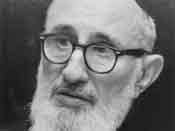
(1903-1993)
Joseph Ber (Yosef Dov) Soloveitchik was an Orthodox rabbi, Talmudist and modern
Jewish philosopher.
Over the course of almost half a century he ordained
close to 2,000 rabbis who took positions in Orthodox synagogues across
America; they were able to relate to their less traditional congregants,
drawing them closer to traditional Jewish observance with quite a few
becoming religiously observant. He served as an advisor, guide, mentor,
and role model for tens of thousands of Modern Orthodox Jews as their
favorite Talmudical Scholar and religious leader.
In the following picture, Rabbi Soloveitchik can be
seen at the extreme right, pointing up, giving a class in Talmud :
 Rabbi
Soloveitchik inherited his father's, Rabbi Moses (Moshe), position as
head of the RIETS rabbinical school at Yeshiva University in 1941 .
He was a scion of the famous Soloveitchik Lithuanian rabbinical dynasty
going back some 200 years and grandson of the renowned rabbinical scholar
Rabbi Chaim Soloveitchik, grandson as well as name-sake, of his great
grand-father Rabbi Yosef Ber Soloveitchik known for his work as the
Bais HaLevi on Talmud . Rabbi
Soloveitchik inherited his father's, Rabbi Moses (Moshe), position as
head of the RIETS rabbinical school at Yeshiva University in 1941 .
He was a scion of the famous Soloveitchik Lithuanian rabbinical dynasty
going back some 200 years and grandson of the renowned rabbinical scholar
Rabbi Chaim Soloveitchik, grandson as well as name-sake, of his great
grand-father Rabbi Yosef Ber Soloveitchik known for his work as the
Bais HaLevi on Talmud .
Rabbi Joseph Ber Soloveitchik was educated in the
traditional manner at a Talmud Torah, an elementary yeshiva, and by
private tutors as his parents realized his great mental powers. Soon
after marriage to Tonya, he moved to Berlin in Germany where he remained
for almost a decade studying at the University of Berlin obtaining a
Ph.D. based on the philosophy of the great German philosopher Herman
Cohen, and simultaneously maintaining a rigorous schedule of intensive
Talmud study. During his years in Berlin, he made the acquaintance of
two other young scholars pursuing similar paths to his own. One was Rabbi Menachem Mendel Schneerson who was destined to command the Chabad
Lubavitch movement centered in Brooklyn , New York and the other
was Rabbi Yitzchok Hutner who would become the Dean of the Yeshiva Rabbi
Chaim Berlin also in Brooklyn, New York. Each developed a system of
thought that bridged the Eastern European way of traditional scholarship
with the new forces of modernity in the Western World.
During his tenure at Yeshiva University in addition
to his Talmudic lectures, he deepened the system of "synthesis"
whereby the best of religious Torah scholarship would be combined with
the best secular scholarship in Western civilization. This has become
known as the Torah U'mada - "Torah and Science" philosophy
unique to Yeshiva University. He authored a book on Jewish thought called
"The Lonely Man of Faith" that has somehow been associated
with his own stance on issues, the willingness to stand alone in the
face of monumental challenges. Through public lectures, writings, and
his policy decisions for the moderate Modern Orthodox world, he strengthened
the intellectual and ideological framework of Modern Orthodoxy.
In his early career in America he joined with the
traditional movements such as Agudath Israel of America and the Agudat
Harabanim - the Union of Orthodox Rabbis of North America. However as
he became entrenched in the Modern Orthodox outlook, he removed himself
from the former organizations, and instead joined with the Mizrachi
Religious Zionists of America (RZA) and the centrist Orthodox Rabbinical
Council of America (RCA), where many of his students were to be found
in leadership positions. Whilst he was bound scholastically and through
family connections to the more Haredi Agudath Israel group, his world-view
had placed itself at the center of Modern Orthodox Judaism , with its
stress on excellence in secular studies, the professions, and active
Zionism .
He thus became a "lightning rod" of criticism
from two directions: From the "left" he was viewed as being
too connected to the Old World of Europe, whilst for those to the "right"
he was seen as legitimizing those wanting to lower their religious standards
in the attempt to modernize and Americanize. He was staunchly proud
of his connections to the Soloveitchik rabbinic dynasty, speaking fondly
of his "uncles" and chiding them from time to time in public.
To his relatives and namesakes who now lived in Jerusalem where they
had established their own branch of the staunchly anti-Zionist Brisk Yeshiva, he
was respected for his supreme genius in Talmudic scholarship which few
could challenge, yet they saw him as their wayward cousin who had departed
from the family Haredi "party line."
His independence became very clear when in 1956, all
the major Haredi rabbinical heads of the Yeshivot, including two from
his own Yeshiva University signed and issued a proclamation forbidding
any rabbinical alumni of their yeshivot from joining with Reform Judaism and Conservative Judaism rabbis in professional organizations. Rabbi Soloveitchik refused
to sign it outright, maintaining that there were areas, particularly
relating to problems that threaten all of Judaism that required co-operation
regardless of affiliation.
Since he was accepted as the pre-eminent leader of
politically conscious pro-Zionist modern
Orthodox Judaism, out of respect for this, many leaders and politicians
from Israel sought his advice and blessings in state affairs. Prime
Minister Menachem Begin reputedly offered him the position of Chief Rabbi of Israel, but he
quietly and consistently refused this offer. Ironically, despite his
open and passionate love for the modern State
of Israel, he never visited the country. Perhaps because the name
Soloveitchik meant something entirely different in Israel than it does
in America.
He unfailingly captured the adoration of his students.
He was known as the "Rav", he became the greatest leader of
Modern Orthodoxy in the twentieth century, often espousing relatively
very liberal positions on educational, political, and social issues
within the Orthodox world. His ordination of over 2000 Orthodox rabbis
at Yeshiva University, during forty years at the helm, attests to his
power and efficacy as well as his consistency and determination.
He would refer to himself as "The Soloveitchik
of Boston". He pioneered one of the first Hebrew day schools in
Boston in 1936 where he originally intended to settle and resided there
when not teaching in New York. He involved himself in all manner of
religious issues in the Boston area. He was at times both a rabbinical
supervisor of kosher slaughtering - shchita- and gladly accepted invitations
to lecture in Jewish and religious philosophy at prestigious New England
colleges and universities. His own son-in-law was on the faculty of
Harvard.
Not satisfied that young Orthodox women were granted
the opportunity to study at their own academic college (Stern College
of Yeshiva University) ,he advocated more intensive textual Torah studies
for Jewish women, giving the first class in Talmud inaugurated at Stern
College, the women's division of Yeshiva College - University. With
his enlightened outlook, he attracted and inspired many young men to
become rabbis and educators, together with their wives coming with similar
education and values. They in turn went out with the education of Yeshiva
University to head synagogues, schools and communities, where they influenced
many Jews to remain Orthodox. He attracted many others to the cause
of Orthodoxy. Among his alumni are Rabbis Nachman Bulman, Shlomo Riskin,
and Ephraim Buchwald and many others who became leaders of the Baal
teshuva movement.
His children married prominent academics and Talmudic
scholars, one to Rabbi Dr. Aaron Lichtenstein Dean of Gush Etzion Yeshiva
in Israel (with a Ph.D from Harvard University), another to the late
Rabbi Dr. Isadore Twersky former head of the Jewish Studies department
at Harvard University (also served as the Talner Rebbe in Boston), and
his son Rabbi Dr. Haim Soloveitchik is a professor of Jewish History
at Yeshiva University. His grandchildren have maintained his heritage
and also hold high scholarly positions. As he got older he suffered
several bouts of serious illness. Family members cared for his every
need and distinguished people came to visit him in his last years in
Boston, where in 1993 he was laid to rest at the age of ninety.
Sources: Wikipedia.
Photo courtesy of Yeshiva University. |