Leo Szilard
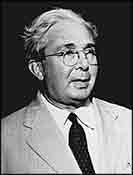
(1898 - 1964)
Leo Szilard is best known for his pioneering work in
nuclear physics, his participation in the Manhattan Project during World
War II, and his opposition to the nuclear arms race in the postwar era.
The son of an engineer and the scion of an affluent
Jewish family, Szilard was born Leo Spitz on February 11, 1898 in Budapest, Hungary. His family name
was changed to Szilard in 1900. Szilard was a precocious child, and
he took an interest in physics at the age of thirteen. He attended public
school in Budapest before being drafted into the Austro-Hungarian army
in 1917. In the army he was sent to officer's training school, but he
was spared from active duty by a severe case of influenza. After the
war he remained in Budapest but, due to political unrest and a lack
of suitable educational opportunities, he left for Berlin in 1919.
In Berlin Szilard studied engineering at the Institute
of Technology (Technische Hochschule), but his primary interest was
physics. He was attracted to the work of great physicists like Albert
Einstein, Max Planck, Max Von Laue, Erwin Schroedinger, Walter Nernst,
and Fritz Haber — most of whom were teaching in Berlin at that
time.
In 1921 Szilard gave up his engineering studies and
enrolled at the University of Berlin, where he studied physics under
Max von Laue, among others. He earned his doctorate — cum laude
— in August 1922 after submitting his dissertation entitled Uber
die thermodynamischen Schwankungserscheinungen. In this work Szilard
showed "that the Second Law of Thermodynamics covers not only the
mean values, as was up to then believed, but also determines the general
form of the law that governs the fluctuating values." The dissertation
presented ideas relating to what would become the foundation of modern
information theory.
Szilard began postdoctoral work at the Kaiser Wilhelm
Institute in Berlin with Hermann Mark. Szilard's studies focused on
the anomalous scattering of X-rays in crystals and the polarization
of X-rays by reflection on crystals. Between 1925 and 1933, he applied
for numerous patents, often with Albert Einstein. One of the Szilard-Einstein
patents covered the invention of a new refrigeration system based on
a method for pumping metals by a moving magnetic field. The two physicists
hoped to interest the company A.E.G. (the German General Electric company)
in producing a practical refrigerator based on their patent. Although
this refrigerator was never produced, the refrigeration system was used
effectively in the U.S in 1942 to develop an atomic reactor.
In 1933, with Hitler's rise to power in Germany,
Szilard moved to England.
In London he collaborated with T.A. Chalmers at St. Bartholomew's Hospital.
There they developed the Szilard-Chalmers process, a technique to chemically
separate radioactive elements from their stable isotopes. Much of Szilard's
activity during this period related to his efforts to register his patents
in England and to secure income with the help of the firm of Claremont,
Haynes, and Company. Szilard's associates in various ventures included
Isbert Adams, Arno Brasch, T.M. Vogelstein, R. Kammitzer, and Benjamin
Liebowitz. Szilard also influenced Sir William Beveridge to found the
Academic Assistance Council, an organization created to help persecuted
scientists leave Nazi Germany. Between 1935 and 1937 he worked as a
research physicist at the Clarendon Laboratory, Oxford University.
It was on a street corner in London, in October 1933,
that Szilard first conceived of the possibility of a nuclear chain reaction.
The possibility of such a chain-reaction -- the process essential for
the releasing of atomic energy -- had been dismissed by the eminent
physicist Lord Ernest Rutherford. Szilard successfully proved Rutherford
wrong.
Szilard visited the United States several times in
the mid-1930s, and he began to consider a move to America as the prospects
for war in Europe increased. In 1938, at the time of the Munich pact,
Szilard was a visiting lecturer in the United States. He decided to
shift his residence to New York in anticipation of England's weakening
policy toward Germany and the impending world war.
At the Pupin Laboratories at Columbia University,
Szilard collaborated with Walter Zinn to research neutron emissions.
They discovered that two fast neutrons are probably emitted in the fission
process, and that the element uranium might sustain a chain reaction.
Subsequent investigations with Enrico Fermi and Herbert Anderson, also
at Columbia, demonstrated that a system composed of water and uranium
oxide approached the requirements for a self-sustaining chain reaction.
Szilard elaborated on a graphite uranium system in his manuscript entitled
"Divergent Chain Reactions in a System Composed of Uranium and
Carbon" (later expanded into the "A-55 Report" for the
Metallurgical Laboratory in Chicago) which was submitted and accepted
(although withheld) for publication in the Physical Review on February
16, 1940.
With the start of World War II, Szilard became intensely
concerned about the applications of the new atomic theories to the development
of weapons. Knowing that German nuclear research was at an advanced
stage, he felt that the work being conducted by him and his colleagues
should be withheld from publication. Szilard and his colleagues Eugene
Wigner and Edward Teller hoped to gain the financial support of the United States Government
in underwriting the cost of a definitive, large-scale experiment to
prove that a sustained nuclear chain reaction was possible. Together
they enlisted the assistance and influence of Albert Einstein. With
Einstein's consent, Szilard drafted a letter, which was signed by Einstein
and delivered to President Roosevelt by Alexander Sachs in October 1939.
This letter outlined the possibility of the chain reaction and its implications
for national defense.
Szilard's work on atomic energy intensified during
World War II. With governmental support approved by President Roosevelt
and with the assistance of the National Bureau of Standards, Szilard
began to procure graphite and uranium through negotiations with suppliers
like the National Carbon Company. These materials were necessary components
for a large scale chain-reaction experiment. From February 1942 to July
1946, Szilard worked as "Chief Physicist" for Arthur H. Compton
at the Metallurgical Laboratory of the University of Chicago. This Laboratory
was one of the chief research centers for the development of the atomic
bomb, in what would come to be called the Manhattan Project.
On December 2, 1942, Szilard and his colleagues demonstrated
the first nuclear chain reaction. This demonstration took place in the
graphite block reactor built under the grandstand at the University
of Chicago's Stagg Field. This successful experiment was in part the
result of Szilard's atomic theories.
Throughout the Manhattan project, Szilard was often
frustrated by cumbersome government administration and security regulations.
Like other scientists involved in the project, he felt uneasy about
the dominant role played by the military in the project. Many of his
memoranda from the period reflect these concerns. Szilard viewed the
production of the atomic bomb as a necessary counter-measure to the
possibility of German nuclear development and deployment, but he foresaw
the global consequences of the proliferation of this weapon. After Germany
surrendered, Szilard organized his colleagues to press for limitations
in the use of the atomic bomb. He drafted a letter to President Roosevelt
urging restraint in the use of the bomb, but the President died before
the letter could be delivered. In the spring of 1945, Szilard influenced
a group of scientists to produce the Franck Report, which outlined the
dangers of a nuclear arms race. The report advised against the use of
an atomic bomb against Japanese civilians, advocating instead a non-combat
demonstration.
In July 1945 Szilard circulated a petition urging
President Truman not to drop the atomic bomb on Hiroshima. A revised
version of this petition was eventually signed by 68 scientists at the
Metallurgical Laboratory. It was strongly opposed by General Groves,
head of the Manhattan Project, on the grounds that such a petition would
breach security and expose the existence of the atomic bomb. The petition
did not reach the president. After Japan's surrender Szilard worked
to defeat the May-Johnson bill, which sought to place atomic energy
in the hands of the military.
After the war Szilard began to focus on biology, a
field he had long been interested in. He resigned from the Metallurgical
Laboratory on June 1, 1946, and became a part-time professor of biophysics
at the Institute of Radiobiology and Biophysics at the University of
Chicago. He also worked part-time for the University's Division of Social
Sciences as Adviser to the Office of Inquiry into the Social Aspects
of Atomic Energy. For the academic year 1953-1954, Szilard served as
a visiting professor of biophysics at Brandeis University. In 1956,
he became a professor of biophysics at the Enrico Fermi Institute for
Nuclear Studies at the University of Chicago. To broaden his knowledge
of biology he often attended seminars and conferences, such as the Cold
Springs Harbor Symposium in New York.
Throughout the 1950s Szilard continued his biological
research. In Chicago he collaborated with Aaron Novick to develop the
"chemostat," a device for "maintaining a multiplying
population of bacteria under conditions not changing in time."
Numerous articles resulted from his research, including "Experiments
with the chemostat on spontaneous mutation of bacteria," "Anti-mutagens,"
and "On the nature of the aging process." Szilard's theory
of aging, a major outgrowth of his research, became a continuing interest
in his later life. Much of Szilard's research funding came from contracts
and grants with organizations such as the National Advisory Health Council
and the Office of Naval Research. He also worked as a consultant to
private industry, and his patents for a "liquid-liquid extractor"
were used by Podbielniak, Inc.
Szilard became increasingly active in public political
activities during the Postwar period. In his lectures he advocated nuclear
arms control, world government, and an elite leadership role for the
international scientific community. Many of his ideas were inspired
by the works of H.G. Wells, which he had read avidly as a young man.
Wells's book The World Set Free (London, 1914), which had predicted
the development of atomic power, had made a great impression on Szilard
when he read it in 1932.
In 1947, Szilard published a "letter to Stalin"
in the Bulletin of the Atomic Scientists. In the letter he urged world
leaders to openly exchange ideas in an effort to mitigate the growing
Cold War. In his appeal he took a balanced view of the peace process,
blaming neither the U.S. or the Soviet Union for the situation. In the
late 1950s Szilard's ideas inspired Albert Einstein and Bertrand Russell
to organize an international conferences of concerned scientists. The
first conference took place at Pugwash, Nova Scotia in 1957, and subsequent
conferences, named after the location of the first meeting, have been
held throughout the world since then.
After 1958, with the increasing threat of nuclear
war, Szilard's political activities intensified. Between October 1959
and October 1960 he carried on a series of interactions with Soviet
Premier Nikita Khruschev which culminated in a two hour interview in
New York. Szilard proposed the development of a Moscow-Washington "hot
line," which could facilitate communications between super-power
leaders in the interest of global peace. With the election of President
Kennedy, Szilard moved to Washington, D.C., taking up residence at the
DuPont Plaza Hotel. He criticized Kennedy's handling of the Bay of Pigs
debacle and the President's bomb shelter program. Szilard offered to
personally intercede with Khruschev during the Berlin Crisis in 1961.
Throughout the early 1960s Szilard continued his advocacy
of global cooperation. In 1961 he began a lecture tour which would take
him to eight college campuses. His first lecture, at the Harvard Law
School Forum on November 17, 1961, was entitled "Are We on the
Road to War?" From these and other efforts came an organization
known as the Council for a Livable World, a political action committee
which encouraged members to donate two percent of their income to designated
political candidates. In 1962, Szilard attempted unsuccessfully to organize
informal meetings between lesser officials of both the United States
and the Soviet Union in what he termed the "Angels Project."
Szilard wrote extensively during this period. He suggested
rules for nuclear age living in "How to Live with the Bomb and
Survive" (1960). He wrote a futuristic work of fiction entitled
The Voice of the Dolphins (1961). In this work Szilard had the dolphins
describe the debacle of human society, out of which they have inherited
the earth. He carried on his writing during two courses of radiation
treatments for bladder cancer in 1960 and 1962. While undergoing these
treatments in New York City's Memorial Hospital, Szilard also made an
extensive series of tape recordings relating to his life and his involvement
in the Manhattan project.
In July 1963, Szilard was appointed as a non-resident
fellow at the Salk Institute for Biological Studies in La Jolla, California.
He had known Jonas Salk since the late 1950s, and many of Szilard's
ideas had influenced Salk in the planning of the Institute. Szilard
moved to La Jolla in February 1964. There he intended to work in biophysics
as a Resident Fellow of the Salk Institute. But three months later,
on May 30, 1964, he died of a heart attack.
Szilard lived a peripatetic life. After leaving Budapest
in 1919 he had no true permanent residence. He stayed mostly in hotels,
and his associations with various universities were usually tenuous.
Because he had no long-term institutional affiliations, Szilard had
difficulty in marshalling the material forces -- such as a clerical
and laboratory staff -- needed to follow through on many of his important
ideas. Szilard was essentially a thinker, and he preferred to leave
for others the tasks involved in implementing his ideas.
Szilard's life gained some stability through his relationship
with Dr. Gertrude Weiss. Weiss was a physician who had fled Nazi Germany
in 1930s. She met Szilard before the war, and the two were married in
the United States in 1951. Still, the couple often lived apart, and
Szilard considered himself a "bachelor at heart."
Sources: Courtesy of the Leo
Szilard Papers, part of a 12 series collection of memoirs, research
papers, and personal letters of both Szilard and others. The collection
best documents Szilard's work on the atomic bomb and his efforts on behalf
of arms control and world cooperation.
Photo Credit: AIP Emilio Segrè Visual Archives of the Center
for History of Physics Copyright © 2001 American Institute of
Physics |