Rav Ashi
(352-427 CE)
Rav Ashi (Hebrew: רב אשי)
(“Rabbi Ashi”)
was a Jewish Talmudist who lived in Babylonia,
known as an amora, who reestablished the
academy at Sura and was first editor of
the Babylonian
Talmud. According to a tradition
preserved in the academies, Rav Ashi was
born in the same year that Rava, the great
teacher of Mahuza, died, and he was the
first teacher of any importance in the
Talmudic Academies in Babylonia after Raba's
death.
Rav Ashi not only elevated
Sura till it became the intellectual center
of the Babylonian Jews, but contributed to
its material grandeur also. He rebuilt Rav's
academy and the synagogue connected with
it, sparing no expense and personally superintending
their reconstruction. As a direct result
of Rav Ashi's renown, the Exilarch came annually
to Sura in the month after the New Year to
receive the respects of the assembled representatives
of the Babylonian academies and congregations. To
such a degree of splendor did these festivities
and other conventions in Sura attain that
Rav Ashi expressed his surprise that some
of the Gentile residents of Sura were not
tempted to accept Judaism.
The Tomb of Rav Ashi
 |
According to traditional Jewish belief, the tomb
of Rav Ashi is situated on a hill overlooking
Kibbutz Manara, Israel. Muslims claim that it is the tomb of a Shi'ite Muslim, Sheikh Abbad, considered a founder of
the Shi'ite movement in Lebanon who lived around
500 years ago.
When Israel withdrew
from South Lebanon in May
2000, the main obstacle holding up the deployment
of United Nations peacekeepers
along the border was the allocation of this disputed
site. It was among the last to be settled between
Israel and Lebanon. One option was to erect a
barricade around the tomb to prevent Muslims
and Jews from visiting the site.
Subsequent to the Blue Line drawn by the United
Nations, the border fence cuts through the middle
of the disputed tomb.
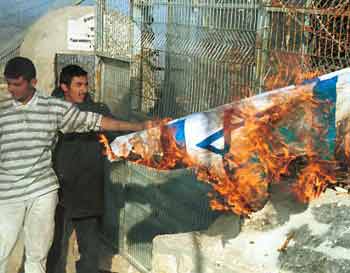
In August 2000, it was reported in the Jordan
Times that fifteen unarmed Hezbollah fighters
in civilian clothes knelt in prayer at the tomb.
After prayers, the fighters chanted slogans such
as “Death to Israel!
March! March on Israel.” The militants also chanted
the praises of Ayatollah Ruhollah Khomeini, the
late leader of Iran's Islamic Revolution, and
Hizbollah leader Sheikh Hassan Nasrallah. UN
peacekeepers who guard the tomb made no attempt
to interfere with the fighters, who left after
15 minutes.
Sources: Jewish
Encyclopedia, Wikipedia |