Rabbi Meir Simcha HaKohen of Dvinsk
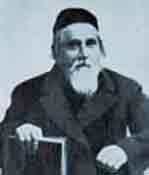
(1843-1926)
Reb Meir Simcha was one
of the most unique of the Torah giants of
this century. He is renowned for two works: Ohr
Samayach, a brilliant commentary on the Rambam’s Mishne
Torah and Meshech Chochmah, a
profound commentary on Chumash. Rabbi Yehudah
Copperman, editor of the latter work, describes
it as a unique blend of “Halacha, thought
and commentary”. In it R. Meir Simcha
demonstrates the unity between the written
and oral laws and presents strikingly original
interpretations of both Biblical verses and
Talmudic passages.
His unusual mastery of the
entire philosophic and kabbalistic literature
is reflected throughout. In a famous near
prophetic passage written before 1926, he
presents a brilliant theory of Jewish history
in the Golah and refers to those who forget
their origins and think “Berlin is Jerusalem”,
and are doomed to destruction (B’chukosai).
He wrote that it is not surprising that a
Jew willingly gives his life to sanctify
G-d’s name because it is natural that
when one is confronted with an opposite force,
his essence comes to the fore (Va’eschanan).
His mastery of the Jerusalem
Talmud was such that when in 1906 Shlomo
Friedlander alleged to have discovered
the missing Talmud on Kodoshim he was able
to immediately determine that it was a
forgery.
Reb Meir Simcha served as
Rabbi of Dvinsk for nearly 40 years and was
deeply loved by his congregants. He frequently
helped couples to become reconciled. A couple
once visited him to discuss their problem
and after a lengthy period there was a noise
of singing and dancing. R. Meir Simcha’s
secretary peered in to see the strange sight
of the Rav dancing with the couple to help
them in their reconciliation.
During World War I, when
many Jews fled from Dvinsk, he said that
if there were only nine Jews left, he would
be the tenth, and that each bomb has a specific
address. He was respected by all segments
of the population and was once described
by Chaim
Nachman Bialik as “a walking encyclopedia”.
In 1906 he was offered the
position of rabbi of Jerusalem but
bowed to the entreaties of his congregants
to remain in Dvinsk. In relation to this
proposal 20 prominent leaders of Dvinsk wrote
to Jerusalem as follows: “We of the
Russian Golah in the city of Dvinsk rise
up in response to the report that the sons
of Jerusalem wish to take away our master,
our teacher ... not only will they destroy
us but the entire Golah for whom he is the
teacher and the respondent for all who seek
the word of G-d.”
Reb Meir Simcha was a strong
supporter of the settlement of Eretz
Yisrael and greeted the Balfour
Declaration with enthusiasm. He also
believed that in order for a Rav to be a
true leader of his community, he needed to
be fluent in the language of the land.
Beside the above mentioned
works, he also wrote novellea on the Talmud and
a volume of responsa which were recently
found and printed.
Sources: Orthodox
Union, Photo courtesy of The Association of Latvian
and Estonian Jews in Israel and www.Rumbula.org |