Abe Fortas
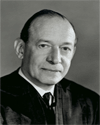
(1910 - 1982)
Abe Fortas was an Associate Justice on the U.S. Supreme Court from 1965 to 1969.
Fortas was born in Memphis, Tennessee on June
19, 1910. His parents, Woolfe (who later changed his first name to William)
and Rachel Berzansky, were born in Russia and Lithuania, respectively.
The Fortases were part of the massive immigration to the United States
of Jews and Catholics from Eastern and Southern Europe during the first
decade of the twentieth century. Fortas's parents settled in Memphis
because Woolfe's brother was already living there. Fortas was raised
as an Orthodox Jew in Memphis,
although as a adult he was not a religious person. Fortas studied hard,
and obtained a scholarship to attend Southwestern College in Memphis,
where he excelled both academically and socially.
In 1930, at the age
of 20, Fortas entered Yale Law School as a scholarship student. Fortas
finished second in his class, and was the editor-in-chief of the Yale
Law Journal. In 1933, although appointed to the Yale Law School faculty
as a teaching fellow, he moved to Washington and the Agriculture Department,
working with the legal realist Jerome Frank. Although Fortas alternated
between Yale and Washington for most of the rest of the 1930s, he left
Yale permanently for a position in the Department of the Interior, where
he eventually was named under secretary. In January 1946, Fortas entered
the private practice of law with Thurman Arnold, a former Yale Law School
professor, legal realist par excellence and New Dealer. They were joined
shortly thereafter by Paul Porter, and the firm of Arnold, Fortas and
Porter was created. It is known today as Arnold & Porter, one of
Washington, D.C.'s largest and most well respected law firms.
Lyndon Baines
Johnson (LBJ) ran for Senator from Texas in 1948. His opponent in
the Democratic primary (then a one party state, contested elections
occurred in primaries, not the general election), Coke Stevenson, had
been a popular governor of Texas. LBJ had appeared to win the primary
by 87 votes. Charges of voting fraud in south Texas led Stevenson to
obtain an injunction preventing LBJ's name from appearing on the ballot
for the general election, pending a hearing. Although a number of lawyers
were involved in determining LBJ's strategy, it was Fortas who managed
the litigation and succeeded in having the injunction overturned. Thereafter,
LBJ viewed Fortas as the best lawyer in America, and the relationship
between LBJ and Fortas, which began in 1937, became stronger during
the 1950s and 1960s. That relationship would eventually lead to Fortas's
nomination to the Supreme Court in 1965. Arthur
Goldberg, who had been named to the Court by President John F. Kennedy
in 1962, found the Court not to his liking. He resigned from the Court
to become Ambassador to the United
Nations. Fortas initially declined the nomination, apparently because
he was concerned about his personal financial situation. But LBJ told
Fortas he was going to nominate him, and, rather reluctantly, Fortas
accepted the appointment.
Fortas's appointment in 1965 ensured the continuation
of the Court's liberal majority. Between 1965 and 1969, the Court decided
a number of cases expanding the protections of individual rights in
criminal procedure, privacy and juvenile rights cases. Fortas's general
view of judging was to find legal authority to support the conclusion
to which he was predisposed. This "realist" approach to jurisprudence
was one of the reasons why Fortas and Justice Hugo Black found themselves
at odds with one another.
During his time on the Court, Fortas continued to advise
LBJ on political matters, both foreign and domestic. In foreign affairs,
the Vietnam War was becoming a more contentious and divisive issue.
In domestic affairs, the treatment of black Americans, including the
protection of civil rights of black Americans, was a defining topic
of the 1960s.
In June 1968, at the end of the 1967 Term of the Supreme
Court, Chief Justice Earl Warren had Fortas arrange an appointment at
the White House, at which time Warren announced his retirement, effective
upon the confirmation of his successor. On June 26, LBJ nominated Fortas
as Chief Justice. To Fortas’s seat, LBJ nominated a friend from
Texas, Homer Thornberry. In July, Fortas erred, appearing before the
Senate Judiciary Committee despite the fact that no sitting Justice
had ever done so. During those hearings, Fortas lied to the Committee,
although he had not yet been caught in that lie. The Senate recessed
without voting on the nomination. When Senator Robert Griffin learned
in September that Fortas had accepted $15,000 to give some summer school
lectures at American University’s law school, money that had been
raised by Fortas’s former partners and clients, the nomination
was in trouble. In early October, after a vote to end the filibuster
on the nomination failed, Fortas asked that his nomination be withdrawn.
By 1969, further revelations led Fortas to resign from the Court. A
convicted financier named Louis Wolfson had agreed to pay Fortas $20,000
per year for the remainder of his life, an amount that continued until
the death of his wife if Fortas died before she did. Fortas received
the first check in January 1966, after joining the Court, and though
he returned it in December, Fortas's actions were condemned as ethically
improper.
After resigning from the Court in May 1969, Fortas
was rebuffed in his attempt to rejoin the law firm he had helped create,
although his wife remained a partner in the firm. In 1970, he started
another law firm. He practiced law until his death in 1982.
Fortas was both extraordinarily intelligent and politically
savvy. He was a great lawyer, and a complex man of many masks.
In 1935, Fortas married Carol Agger. According to Professor
Laura Kalman, a biographer of Fortas, Agger told Fortas at the time
of their marriage that she did not want to have children. Fortas died
on April 5, 1982.
Sources: Michael Ariens |