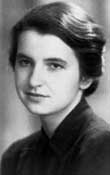
Rosalind Franklin was born in London on July 25, 1920.
She attended St. Paul's Girls' School. When she was growing up, her
parents took in two Jewish children from Nazi Germany to live in their
home as part of the family. Rosalind shared her room with a woman whose
father had been sent to Buchenwald.
Franklin was strongly influenced by her grandfather,
Arthur, who was active in social service and was so committed to Judaism
that his will stipulated that only those descendants married to Jews
would inherit any of his estate. Franklin’s great-uncle, Herbert
Samuel, was the first High Commissioner of Palestine.
Franklin studied chemistry and physics at Newnham
College, Cambridge, and, in 1942, began carrying out research at the
British Coal Utilization Research Association. Over the next four years
she helped develop carbon fibre technology.
In 1947, Franklin went to the Central Government Laboratory
for Chemistry in Paris where she worked on X-ray diffraction. In 1951,
she moved to King's College, London.
As a woman and a Jew, Franklin felt unwelcome at King's
College (the women scientists were not allowed to eat lunch in the common
room where the men did). The combination of anti-Semitism and sexism also was an underlying factor in some criticism of her work.
In James Watson's book, The Double Helix, Franklin is described
as a difficult woman who was unwilling to share her research. She's
characterized as a complainer and her appearance and clothes are criticized.
Franlin worked on a DNA project that she thought was
her own. When the laboratory's second-in-command, Maurice Wilkins, retruned
from a vacation, however, she learned that he expected her to be his
assistant rather than a colleague working as an equal. They had an uneasy
relationship, complicated by the fact she was a woman in a "man's
world" and their conflicting personalities.
Franklin made a number of advances in x-ray diffraction
techniques with DNA that allowed her to discover crucial elements in
what had become a race between competing research teams to discover
the structure of DNA. Franklin produced X-ray diffraction pictures of
DNA which were published in Nature in April 1953. This played
an important role in establishing the structure of DNA. In fact, many
scientists believe Franklin played a larger role than previously acknowledged
in the research that led to the 1962 Nobel
Prize that was awarded to Maruice Wilkins, Francis Crick, and James
Watson for the discovery of DNA's double helix.
Wilkins shared Franklin's data, without her knowledge,
with Watson and Crick, at Cambridge University, and they pulled ahead
in the race, ultimately publishing the proposed structure of DNA in
March 1953.
The difficulty in working with Wilkins and the discomfort
of the environment at King's College led Franklin to leave, but the
College insisted that she cease work on DNA. Franklin joined John Bernal
at Birkbeck College to carry out research into the tobacco mosaic virus.
Her group's findings laid the foundation for structural virology.
While visiting the United States, Franklin began to
experience terrible pains that she soon learned were related to ovarian
cancer. She continued working up until a few weeks before her death
on April 16, 1958, at age 37.