Leni Riefenstahl
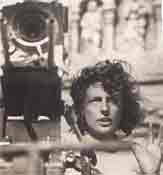
(1902 - 2003)
“They kept asking me over and over
again whether I was having a romance with Hitler. ‘Are you Hitler's girlfriend?’
I laughed and answered the same way each time: ‘No,
those are false rumours. I only made documentaries for him...’”
— Leni Riefenstahl, about her US
tour in 1938, in her book A Memoir
Berlin Beginnings
She was Hitler's favorite director. She was beautiful and talented. She was a woman in
a man's field.
Leni Riefenstahl (REEF-en-shtal), who remained active
into her late 90s, was never able to shed the historical contamination
that attached to her during the last half of her 101 years. Despite
(some say because of) her demonstrated talent as actor, dancer, director,
cinematographer, and still photographer, Riefenstahl could not shake
off her Third Reich associations. Although her films have had enormous
impact on world cinema, the woman herself found it difficult to gain
public respect. Her attempt to revive her directorial career in the
1950s proved futile. The often-imitated, seldom-honored artist remained
a controversial and unrepentant pariah up until her death on 8 September
2003. Ironically, her own well-crafted black-and-white motion-picture
images of Hitler, Nazi pageantry, and the Jesse Owens Olympics helped
keep both her genius and her past alive. In the words of Ray Müller,
director of the documentary The Wonderful, Horrible Life of Leni Riefenstahl,
“Her talent was her tragedy.”
Riefenstahl's story begins in the Wedding district
of Berlin, near the start of the twentieth century. Her father, Alfred
Riefenstahl, was a prosperous businessman dealing in heating and ventilation.
Her mother, Bertha Sherlach, had been a part-time seamstress before
she married. Their first child, Helene (Leni) Bertha Amalie Riefenstahl,
was born on August 22, 1902 in the family's apartment on Prinz-Eugen-Straße
in Berlin. Leni's younger brother, Heinz, was born three and a half
years later. He would later die in Hitler's war at age 38 on the Russian
front.
“Mountain of
Destiny”
Young Leni grew up in Berlin and lived at home until
she was 21. Against the wishes of her father, she studied dance and
was soon performing in Munich, Berlin, and Prague. But according to
her memoirs, the course of her life was changed dramatically one day
as she was waiting for a subway train at the Nollendorfplatz U-Bahn
station in Berlin. In a daze, thinking about the whirlwind of her dance
appearances over the last six months, Riefenstahl could feel the pain
in her injured knee that was threatening to end her dancing career in
its early stages. She was on her way to yet another doctor, trying to
find one who could finally put her back on her dancing feet. Her gaze
happened to fall upon an advertising poster on the wall opposite the
platform. Suddenly the image of a man climbing a jagged mountain came
into focus. The colorful poster was promoting a movie with prophetic
name Berg des Schicksals ("Mountain of Destiny"). Its letters
further spelled out the words: “Ein Film aus den Dolomiten von
Dr. Arnold Fanck” (“A film from the Dolomites by Dr. Arnold
Fanck”). The picture was currently playing at a nearby cinema.
Riefenstahl stood in a trance, staring ahead blankly
as her train came into the station and departed without her. Instead
of going to the doctor, she left the station and soon found herself
in a completely different world watching vivid, lifelike images of majestic
mountains. Dr. Fanck's "Mountain of Destiny" held her so much
in its spell that the young woman returned for repeat viewings every
night for a week. It was the beginning of her own mountain film destiny
and a new career as both film actress and director.
Amazingly, Riefenstahl appeared in her first film,
Der heilige Berg (“written for the dancer Leni Riefenstahl”),
directed by Dr. Arnold Fanck, only some 18 months after that fateful
day at the Nollendorfplatz U-Bahn station. Within weeks of seeing Fanck's
Mountain of Destiny she had happened to meet the director himself in
Berlin. Following a successful operation on her knee, Riefenstahl met
with Fanck at his home in Freiburg near the Black Forest. Soon she would
be appearing in movies directed by Fanck and co-starring Luis Trenker.
Her dream was coming true, but the day would come when she regretted
having ever met either of these two men.
After appearing in several films, Riefenstahl turned
to directing—remarkable for a field so dominated by men, then as
now. An admirer by the name of Adolf Hitler asked her to film a documentary
of his Nazi party's rally in Nuremberg, and the rest is indeed history.
Riefenstahl was put in charge of filming the 1936
Berlin Olympics, no minor undertaking. For Olympia she had to manage
a total crew of 60 cinematographers. Three different types of black-and-white
film stock—Agfa (architectural shots), Kodak (portraits), Perutz
(fields, grass)—were used to shoot over 1.3 million feet of film
(400,000 meters, over 248 miles). In the process, Riefenstahl invented
or enhanced many of the sports photography techniques we now take for
granted: slow motion, underwater diving shots, extremely high (from
towers) and low shooting angles (from pits), panoramic aerial shots,
and tracking systems for following fast action. The result is considered
a classic cinematic masterpiece. Olympia premiered at Berlin's UFA Palast
am Zoo cinema on Hitler's birthday, April 20, 1938.
The America Tour
In 1938 Riefenstahl embarked on a trip to America,
including Hollywood, to promote Olympia. The visit was marred by several
factors, not the least of which was the infamous Kristallnacht – the Nazi burning of synagogues and the vicious persecution of
Jewish shopkeepers in Germany on November 9. No less disruptive for
Riefenstahl's U.S. tour were the efforts of the Anti-Nazi League as
well as a spy in her own entourage, one Ernst Jäger, who turned
out not to be the loyal colleague Riefenstahl thought he was. Too late
she would discover that it was Jäger who helped sabotage her efforts
to arrange the U.S. distribution of her award-winning Olympia documentary.
For her Hollywood stay Riefenstahl booked a bungalow
at the Beverly Hills Hotel. Despite a hostile press and the billboard
equivalent of “Leni Go Home!,” the world's most famous (or
infamous) female director gained an audience with Walt Disney, although
he did refuse her offer of a private showing of Olympia. He was just
too afraid of a possible boycott of Disney films. Other studio heads
treated her like the pariah she had become, refusing to see her at all.
An invitation to meet with Gary Cooper was suddenly and “regretfully”
cancelled. Even Disney would later make the unconvincing claim that
he hadn't known who Riefenstahl really was.
Interrupted by war and other problems, Tiefland - 14
years in the making - premiered February 1954 in Stuttgart. It would
be the last release of a motion picture directed by Leni Riefenstahl
until 2002, when Riefenstahl's Impressionen unter Wasser was to be released.
However, Riefenstahl did finally manage to arrange
a private screening of Olympia for an exclusive audience of some 50
press people and Hollywood insiders, some of whom felt compelled to
sneak into the darkened theater incognito. Despite the Riefenstahl boycott,
the press reviews for Olympia were enthusiastic. The Los Angeles
Times wrote: “This picture is a triumph of the camera and an
epic of the screen. Contrary to rumour, it is in no way a propaganda
movie, and as propaganda for any nation, its effect is definitely zero.”
Such praise notwithstanding, the Third Reich-tainted Olympia never found
a U.S. distributor, and a dejected Riefenstahl sailed for Germany. It
must have been very depressing to know that the sneaky Herr Jäger
had betrayed her. And, despite his assurances to the contrary, Jäger
was not aboard for the return voyage. Riefenstahl's betrayal was doubly
painful, since she had gone out of her way to have Jäger accompany
her to America, against the protestations of Minister of Propaganda Joseph Goebbels, who
had earlier kicked Jäger (whose wife was Jewish) out of the Reich
Literature Chamber.
The Denazification
Ordeal
Following the war in 1945, Riefenstahl had to face
Allied charges that she was a Nazi or a Nazi sympathizer. Her close
ties to Hitler and her propaganda films, most notably Triumph of the
Will, made her an obvious target. She endured post-war chaos and was
imprisoned (and escaped!) three times trying to get to her mother's
house in Austria where she was reunited with her husband and arrested
again – not once but twice. This time she sat in a real prison
as a guest the Seventh American Army, in the company of people like Hermann Göring and
Sepp Dietrich (of the SS). But after her interrogation the Americans
officially “denazified” Germany's most notorious film director
and released her “without prejudice” on June 3, 1945.
A relieved Riefenstahl returned to her film library
and editing suite in Kitzbühel in the Austrian Tyrol, where she
had moved during the war to avoid Allied bombing in Germany and to continue
her work on the long-delayed Tiefland, which she had begun in 1940.But
she had not reckoned on the French. The Americans were leaving Tyrol,
which was to become part of the new French occupation zone. Despite
being advised to move to the American zone, Riefenstahl was reluctant
to move her massive film library (including the Olympia negatives) and
she believed that her American denazification was valid for all the
Allied powers.
That soon proved to be a mistake. Before long Riefenstahl
found herself under arrest once again, this time by the French. They
decided to move Riefenstahl to the French zone in Germany, where she
ended up in the bombed-out ruins of Breisach near Freiburg. Her old
“friend” there, Dr. Fanck, refused to have anything to do
with her, and she and her husband lived under house arrest in Breisach
and later in Königsfeld in the Black Forest. Eventually Riefenstahl
was placed in an insane asylum in Freiburg for three months before her
release in August 1947. But it was not until July 1949 that she was
officially denazified by a French tribunal. Even that “final”
decision was appealed by the French military government and the matter
was closed six months later when the Baden State Commissariat classified
Riefenstahl in absentia as a “fellow traveler.”
But Riefenstahl was far from free. Freedom and partial
denazification did not mean she could resume her career as a director,
and she had more legal trials ahead of her. The French were still holding
all the film material taken from her house in Austria. Even her marriage
was falling apart. To top it all, her attempts to get her Tiefland film
back from the French were now being hindered by the release of a so-called
Eva Braun Diary (a fraudulent precursor of the later and equally bogus
Hitler Diary), the work of Luis Trenker, a former co-star with Riefenstahl
in several films, now turned director and con-artist. As is usually
the case, a court ruling that the Eva Braun diary was a fabrication
failed to stop the false rumours and innuendo the diary had produced.
In a bizarre twist, Riefenstahl received an unsolicited affadavit of
support from none other than her former foe Ernst Jäger.
The Nazi Pin-up
Girl
Although she scouted film locations in Africa (where
she had a bad car accident and almost died) and had serious plans to
make other films (one titled “The Red Devils”), it was not
to be. Riefenstahl encountered resistance and protest from too many
quarters. There was almost no prospect of getting a Riefenstahl film
shot, much less shown in most of the world. So, she did the next best
thing; she took up still photography.
She lived for a time with the Nuba tribe in Sudan;
recording images that have appeared in two photographic essay books.
She took up scuba diving in 1970s at the age of 72, and has continued
underwater photo work into her 90s.
To her dying day controversy surrounded Riefenstahl
wherever she went and wherever her work was displayed. In March 1946,
even before the French threw her into an insane asylum, Budd B. Schulberg
wrote an article about Riefenstahl for the Saturday Evening Post. Its
title was a taste of things to come: “Nazi Pin-up Girl: Hitler's
No. 1 Movie Actress.”
An exhibit of Riefenstahl's movie stills and her African
and underwater photographs in Hamburg in late 1997 brought out a whole
new generation of protesters. Their signs read: “Now showing: Nazi
exhibition” and “No commercializing of fascist aesthetics.”
First published in the 1970s, not even her still photographs of naked
Nubians have been immune from controversy. Critics somehow managed to
see fascist tendencies in Riefenstahl's images of African natives–a
race deemed inferior by the Nazis.
The 1993 film documentary about Riefenstahl by Ray
Müller, The Wonderful, Horrible Life of Leni Riefenstahl, is available
in videotape and DVD versions. It's a fascinating, if somewhat long
(188 min.), look at her films and her point of view. The original German
title better conveys the thrust of Müller's film: Die Macht der
Bilder (“The Power of Images”).
Riefenstahl Films
- As Actress
Die Bergfilme/The Mountain Films
In the 1920s and '30s, Riefenstahl appeared in a series
of so-called Bergfilme directed by Arnold Fanck. The plot of such films
was always secondary to the spectacular scenes of the Bavarian and Austrian
Alps. The central theme was always human surrender to the power of nature.
The Bergfilme played a significant role in shaping Riefenstahl's own
approach to filmmaking.
Der heilige Berg (1926, The Sacred Mountain)
Directed by Arnold Fanck. Studio: Ufa. Also known
as Peaks of Destiny.
Der große Sprung (1927, The Great Leap)
Directed by Arnold Fanck. Studio: Ufa. Also known
as Gita, the Goat Girl.
Die Vetsera/Das Schicksal derer von Habsburg (1928,
The Fate of the House of Hapsburg)
Directed by Rolf Raffe. Also known as The Tragedy
of Mayerling.
Die weiße Hölle vom Piz Palü (1929,
The White Hell of Piz Palü)
Directed by Arnold Fanck and G.W. Pabst. Studio: Sokal.
Stürme über dem Mont Blanc (1930, Storms
Over Mont Blanc)
Directed by Arnold Fanck. Also known as Avalanche.
Her first sound film was dubbed in the studio because the sound cameras
of the day were too heavy to use in the mountains.
Der weiße Rausch/Sonne über dem Arlberg
(1931, The White Frenzy)
Directed by Arnold Fanck. Studio: Sokal. Also known
as Avalanche.
Das blaue Licht (1932, The Blue Light)
As Junta, the mountain girl. Riefenstahl also directed.
> Buy this movie on Video
SOS Eisberg (1933, SOS Iceberg)
Directed by Arnold Fanck and Tay Garnett. Studio:
Universal. Riefenstahl as the pilot Hella, who is trying to find her
lost pilot husband in the Arctic ice. A German-American coproduction
shot on location in Greenland.
Tiefland (1954, Lowland)
As Martha. Riefenstahl also directed. Release was
delayed by the war and Riefenstahl's Nazi connections.
Die Macht der Bilder: Leni Riefenstahl (1993, The
Wonderful, Horrible Life of Leni Riefenstahl)
The then-90-year-old Riefenstahl in her own words.
An award-winning documentary with many clips from her own films, directed
by Ray Müller.
Die Nacht der Regisseure (1995, The Night of the Filmmakers)
Directed by Edgar Reitz. Riefenstahl has an uncredited
role as herself in this German production.
Riefenstahl Films
- As Director
Das blaue Licht (1932, The Blue Light)
Riefenstahl's directorial debut, in which she also
played the role of Junta, the mountain girl. Re-edited and re-cut by
Riefenstahl in 1951.
Sieg des Glaubens (1933, Victory of Faith)
A practice run for Riefenstahl's much better Triumph des Willens.
Filmed at the Nuremberg rallies of 1933.
Triumph des Willens (1934, Triumph of the Will)
This documentary of Hitler and the Nuremberg rallies
is considered a masterpiece of cinematic propaganda.
Tag der Freiheit (1935, Day of Freedom)
A 25-minute short consisting of outtakes from Triumph.
Also known as Day of Freedom - Our Armed Forces.
Olympia (1938, Olympia)
Riefenstahl's classic documentary of the 1936 Olympics
in Berlin was released in two parts: Fest der Völker (“Festival
of Nations”) and Fest der Schönheit (“Festival of Beauty”).
It took her almost two years to sort and edit the film. The Olympia
crew of 60 cinematographers had shot over 1.3 million feet of film on
three different types of film stock. The film premiered on Hitler's
birthday, April 20, 1938 - after a month's delay caused by his annexation
of Austria.
Tiefland (1954, Lowland)
Riefenstahl also played the role of Martha. Release
was delayed by the war and Riefenstahl's Nazi connections.
Impressionen unter Wasser (2002, Underwater Impressions)
Riefenstahl planned to release her first film since
Tiefland in 1954 on her 100th birthday.
Sources: The
German Hollywood Connection © 1997-2003 Hyde Flippo. Photo
Documentaires.org
|