Judah Magnes
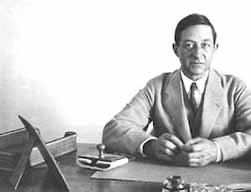
(1877 - 1948)
Judah Magnes' career as a leader in Jewish communal affairs reflected his
lifelong drive to serve his people. Born in San Francisco in 1877, Magnes
spent most of his professional life in New York. There, he helped found the
influential American Jewish Committee in 1906. Magnes was also the guiding
force behind the Kehillah of New York city, serving as president from its
beginning in 1908 until its end in 1922. The Kehillah was an attempt to
form a democratic community for the Jews of New York City.
In addition to dealing with Jewish religious and educational
issues, the Kehillah was also involved with labor relations issues.
Magnes' charisma played a large role in the success of the Kehillah's
mediation, and also helped bridge the gap between America's German and
East European Jews. Like Mordechai
Kaplan, Magnes attempted to create an organic community in New York
City. Despite intense efforts, however, the voluntary nature of American
society made this goal elusive.
As a Reform rabbi, Magnes held several pulpits. The views he espoused were quite
unconventional, particularly where tradition and Zionist were concerned. Magnes advocated a more traditionalist approach to Judaism,
fearing the assimilationist tendencies of his peers. It was a disagreement
over this issue that led him to resign from Temple Emanu-el in 1910.
Magnes also further dissented from the general Reform attitude towards
Zionism by strongly disapproving of the denationalization of Judaism.
To him, Jews living in the Diaspora and Jews living in Eretz Israel were of equal importance to the Jewish
nation. The renewed Jewish community of Eretz Israel would enhance Jewish
life in the Diaspora. Although he himself emigrated to Palestine in
1922, Magnes maintained that aliyah was a matter of individual
choice, and did not reflect any kind of "negation of the Diaspora."
In Israel, Magnes became more intimately involved in the establishment of
the Hebrew University. He served as chancellor and later as president of
the young university. Magnes felt that the university was the ideal place
for Jewish and Arab cooperation, and worked tirelessly to further this
objective.
Magnes had a long history of activity on behalf of reconciliation with the
Arabs. During the pre-state period, Magnes objected to a particularly
Jewish state. In his view, Palestine would be neither Jewish nor Arab.
Instead, he advocated a binational state in which equal rights would be
shared by all. This was the view promoted by the group Berit Shalom, which
Magnes helped found in 1925. Berit Shalom was primarily a movement of
intellectuals, and lacked a mass following. As a devout pacifist, the
principles of compromise and understanding suited Magnes well, and he
continued to work towards these goals until his death in 1948.
Sources: The Jewish Agency
for Israel and The
World Zionist Organization |