Pope Pius XII
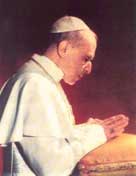
(1876 - 1958)
The Cardinals elected Eugenio
Pacelli the 262nd Pope on his sixty-third birthday, March 2, 1939. He received sixty-one out
of the sixty-two votes because he did not vote for himself, and was
elected Pontiff. After serving the Church under four Popes (Leo XIII,
St. Pius X, Benedict XV and Pius XI) for almost two decades, on March
2, 1939 Eugenio Pacelli took the name of Pius XII and was entrusted
with the keys of supreme jurisdiction given to the Prince of the Apostles:
"Thou art Peter and upon this rock I will build My Church"
The bells of Saint Peter's pealed on March 12, 1939, as the eyes of
countless people turned toward the balcony.
Dressed in a white cope and wearing a silver, gem-studded
mitre on his head Pope Pius XII appeared. Cardinal Nicola Canali removed
the mitre. Cardinal Camillo Caccia-Dominioni replaced it with the papal
tiara and prayed: "Receive the tiara adorned with the three crowns
and know that you are the Father of princes and kings, the Sovereign
of the world, and the Vicar on earth of our Savior Jesus Christ, to
Whom is honor and glory, now and forever. Amen."
Pope Pius XII's coat-of-arms showed the symbol of
peace: a dove with an olive branch. His motto indicated peace to be
a fruit of justice: Opus justitiae pax (Is. 34, 17). His first radio
message to the world was, "Peace, gift of God, desired by all upright
men, the fruit of love and justice.." He was a man of peace.
Immediately after his election, Pius XII issued a
call for a peace conference of European leaders. Documents show that
in a last minute bid to avert bloodshed, the Pope called for a conference
involving Italy, France, England, Germany and Poland. Pius XII's peace
plan was based on five points: the defense of small nations, the right
to life, disarmament, some new kind of League of Nations and a plea
for the moral principles of justice and love. Through his public discourses,
his appeals to governments, and his secret diplomacy, he was engaged
more than any other individual in the effort to avert war and rebuild
peace. His request went unheeded.
Pius XII then met with the German Cardinals who had
been present in the recent conclave, in order to ascertain the real
situation of the Church in Nazi Germany. These meetings provided him
with direct proof and information that motivated the content of his
first encyclical, Summi Pontificatus. Dated October 20, 1939, this encyclical
was a strong attack on totalitarianism. In it, Pius XII singled out
those governments, who by their deification of the state, imperiled
the spirit of humanity. He spoke about restoring the foundation of human
society to its origin in natural law, to its source in Christ, the only
true ruler of all men and women of all nations and races.
In this encyclical Pius XII reprimanded: "What
age has been, for all its technical and purely civic progress, more
tormented than ours by spiritual emptiness and deep-felt interior poverty?"
The world had abandoned Christ's cross for another [the Swastika] which
brings only death. The consecration of the world to Christ the King
celebrates "a penetrating wisdom which sets itself to restore and
to ennoble all human society and to promote its true welfare."
Indeed, Pius XII's encyclicals, discourses and radio messages clearly
assert that the only solid foundation for social order is the law of
God.
On the eve of World War II, the international position
of the Vatican was dangerous and difficult. The anti-Semitic decrees enacted by Mussolini in 1938 were causing bitter conflicts between
Italy and the Holy See.
As a diplomat, Pius XII saw war approaching and instructed
the papal representatives to Germany, Italy, France, Poland and England
to learn whether mediation by the Pope would be considered. He tried
to awaken in world leaders the full realization of what they were about
to do.
On August 24, 1939 he gave each papal representative
the text of a speech asking them to convey it to their respective governments.
That evening he read the speech to the world: "The danger is imminent,
but there is still time. Nothing is lost with peace; all can be lost
with war. Let men return to mutual understanding! Let them begin negotiations
anew, conferring with good will and with respect for reciprocal rights..."
During the North African campaign a boatload of Allied
wounded arrived in Italy for hospitalization and imprisonment. A Vatican
representative boarded the boat and distributed message forms among
the soldiers who immediately filled, signed and addressed them. Within
weeks after their capture the families of these American soldiers received
information sent airmail by the Vatican to the United States. A wounded
son of an Episcopalian family in Washington, DC, was listed by the War
Department as missing, because the Nazis had failed to report him to
the International Red Cross as captured. The soldier was convalescing
in a hospital in Italy, where a Vatican official found him. A Baptist
family in Kansas, as an expression of gratitude for news that their
son was a war prisoner and not dead, sent the Holy Father their weekly
tithe of twenty-two dollars. Communicating with their families, the
Vatican described details of injuries, deaths, internment, and photographs
of the resting- place or turned over to the office of the American charge
d'affaires the belongings of soldiers. This was a sad, yet consoling
work of mercy.
On September 1, 1939, Nazi tanks crossed the Polish
border. This was the beginning of World War II. In his encyclical, Summi
Pontificatus (October 27, 1939), Pius XII condemned Hitler's actions.
On December 28, 1939, the Pope paid a ceremonial call on King Victor
Emmanuel Ill and Queen Elena at the Quirinal Palace. The visit was to
return that made by the King and Queen a week earlier, and also to demonstrate
the Vatican's support of Italy's neutrality
Historical records show that Pius XII acted as a link
to the British government for a number of German dissidents desiring
to overthrow Hitler.
The Pope went beyond his usual caution, and maintained these contacts
until the German invasion of Denmark and Norway in April 1940. The following
month, when the Germans invaded the Low Countries, the Pope sent telegrams
to the leaders of these besieged nations with his prayers for their
deliverance. Soon after, Mussolini joined Hitler. When Nazis occupied Rome in September 1943, the Pope
endeavored to save as many Jews as possible. He immediately issued directives
to all convents and monasteries to open their doors to protect Jews.
Meanwhile, Pope Pius XII invited Jews and other refugees to join the
Vatican Palatine Guards. In a few months, their number increased from
four hundred to four thousand.
Everywhere in Europe, persecuted people, the Jews
especially, appealed to Pius XII. When some five hundred Jews embarked
at Bratislava on a steamer for Palestine, their ship tried to enter
the seaport of Istanbul, but was refused permission to land. Captured
by an Italian patrol boat, the Jews were imprisoned in a camp at Rhodes.
One of the prisoners managed to appeal to Pius XII for help. Thanks
to the Pope's intervention, unknown to the Axis, the refugees were transferred
to an improvised camp (Ferramonti- Tarsia) in Southern Italy, where
they were found safe three years later, in December 1943.
Pius XII's pontificate left a lasting mark on the
history of the Catholic Church. His life was one of action, inspired
by profound piety. Understanding the weaknesses of humanity, the Pope
brought consolation, peace and encouragement everywhere. Striving to
bring men closer to Christ, Pius XII instituted numerous liturgical
reforms: the evening Mass, the new Eucharistic fast regulations and
increased lay participation in liturgical functions. The Eucharistic
Liturgy was the source from which Pius XII drew strength and wisdom
to lead the world.
Pius XII has been called the "Pope of Mary"
for his great devotion to the Mother of God, evidenced in the infallible
definition of the Assumption. In his prayer to Our Lady of the Assumption,
Pius XII asked her to turn her eyes "toward this world, held in
the clutch of wars, persecutions, oppression of the just and the weak.
And from the shadows of this vale of tears, we seek in your heavenly
assistance and tender mercy comfort for our aching hearts and help in
the trials of the Church, and of our fatherland. Comforted by our faith
in future resurrection, we look to you, our life, our sweetness and
our hope." The consecration of Russia and of the whole world to
the Immaculate Heart of Mary, the solemn proclaiming of the Marian Year,
the institution of the feast of the Queenship of Mary, and the proclamation
of the Centenary of the Apparitions of Our Blessed Lady to St. Bernadette
were also made by Pius XII.
Even as a young man, Eugenio Pacelli showed interest
and concern in nature and for all God's creatures. This affinity continued
when he became Pope. At the farm in Castelgandolfo, he would walk about
simply enjoying the presence of the animals, especially the sheep, which
he often gently touched. Later, when he was in the Vatican he would
take brisk walks each day beneath the cypresses and pines, pausing to
admire the beautiful flowers in the Vatican gardens.
 Though
as Pope he would usually eat his meals alone, that changed somewhat
one day after the papal gardener found a helpless bird, which had been
injured in the garden. Knowing the Pontiff's love for nature, the gardener
brought the bird to his apartment. Pacelli was fascinated, helped nurse
the bird back to health and decided to keep it in his apartment. He
named her Gretel. As soon as she was fully recovered, she was given
several companions. While the Pope ate, the birds were released from
their cages. Twittering, the birds would perch on his shoulder or on
the table where they had their own small dishes of seeds. Thereafter
at mealtime he was vicariously back in the natural world he knew in
the summers of his youth. Though
as Pope he would usually eat his meals alone, that changed somewhat
one day after the papal gardener found a helpless bird, which had been
injured in the garden. Knowing the Pontiff's love for nature, the gardener
brought the bird to his apartment. Pacelli was fascinated, helped nurse
the bird back to health and decided to keep it in his apartment. He
named her Gretel. As soon as she was fully recovered, she was given
several companions. While the Pope ate, the birds were released from
their cages. Twittering, the birds would perch on his shoulder or on
the table where they had their own small dishes of seeds. Thereafter
at mealtime he was vicariously back in the natural world he knew in
the summers of his youth.
Pius XII blended casualness with dignity and many
times ignored Vatican protocol during the papal audiences. The story
goes that, on some occasions, people filled with repentance would tremblingly
ask to go to confession. Always a priest and aware of divine grace at
work, the Holy Father never failed to step to a corner with the penitent
sinner and grant him absolution, while others waited in awe.
In those days, women admitted to a papal audience had
to wear long-sleeved, high-necked black dresses with a mantilla and
a veil. A young woman newspaper correspondent during World War II was
in a hurry, so her male companions smuggled her past guards to the great
Consistorial Hall where the Pope would receive them. But when instructed
to form a circle, the conspirators were forced to expose the young lady.
As the guards were rushing her away, the Pope entered and signaled them
to let her stay. He repaid her brashness with the gentle comment: "Ah,
we see you are an American."
Screening for a general audience was not very intense.
In fact, many ladies were not aware they had to dress according to protocol.
One day, when asked to kneel, a young girl in culottes and wedgies and
harlequin glasses refused. "I got a coat on - isn't that enough?
I'm not a Catholic! Why should I kneel?" Everyone was embarrassed.
As the Pope arrived, the girl continued to abuse the
guards. Suddenly the scene changed. The Pope approached her gently;
she burst into tears on her knees. He comforted her and stretched forth
his hands to raise her up, but she shook her head and begged his blessing.
Pope Pius XII blessed her and the rest of the assemblage.
A few days after the liberation of Rome, Lieutenant
General Mark Clark, Commander of the Fifth Allied Army, paid his respects
to the Pope: "I am afraid you have been disturbed by the noise
of my tanks. I am sorry." Pius XII smiled and replied: "General,
any time you come to liberate Rome, you can make just as much noise
as you like."
Leo Longanesi, a renowned Italian journalist and publisher,
was indignant over the anticlerical campaigns against the Church. One
day he suggested to the Pope that a particular day be designated when
all Italian newspapers in Italy would print the full story about the
charitable works of the Church during World War II. Pius XII responded:
"Only God must be testimony to what is done for our neighbor!"
Although Pius XII would not publicize his own good
deeds, others have. It suffices to mention a recent story which is part
of the official Italian war record (International Herald Tribune,
October 22, 2001). This information is one of the many examples of Pius
XII's actions on behalf of Jewish refugees.
From 1943 to 1945, Leonardo Marinelli was a commander
in the Royal Finance Guard in the Aprica internment camp, located in
northern Italy. His Diary records an entry for September 12, 1943. The
Pope sent Giuseppe Carozzi, a young Italian priest to Marinelli requesting
that 300 Jewish Yugoslav internees be given permits to Switzerland.
Despite strict Nazi orders forbidding Jews, prisoners of war, or anyone
who had not joined Mussolini's northern Italian puppet Republic of Salo
from crossing the border, Marinelli complied with the Pope's wishes.
During the next four days as the group crossed the border, guards were
seen "carrying bags for some of the fugitives."
Later, Marinelli himself was placed in an internment
camp by the Nazis. He escaped. In his testimony to the Finance Guard
high command in July 1945, Marinelli confirmed what he had written in
his Diary.
Pius XII reaffirmed the rights of the family, the
rights of parents to supervise their children's education, and the rights
of conscience, stressing the fundamental unity of all mankind under
the fatherhood of God.
When there was danger that Rome would be involved
in serious fighting between the Allied and German troops, the Pope went
to the Church of Saint Ignatius Loyola. He remained on his knees throughout
the night, praying before the sacred image of the Madonna del Divino
Amore. Joining the Pontiff as he prayed for peace were the clergy and
faithful of Rome. The city of Rome was saved!
Pius XII was a minister of peace in a warring world.
When he was told that Stalin inquired about the number of divisions
in his army, he said: "You may tell my son Joseph he will meet
my divisions in heaven." That was Pacelli's secret. Even of Stalin
he could say "my son." And mean it. He spoke many languages,
but the only language that inspired others, was the language of his
heart.
Claims that Pope Pius XII never instructed people
to protect Jews during the
war, are contradicted by the Chief Rabbi of Rome, Israel Anton Zolli.
Israel Zoller was born in Brodj, Galizia, on September
17, 1881. His family name was italianized to Zolli. They were Polish
Jews and had been Rabbis for four centuries. In 1920 Israel was named
Rabbi of Trieste which then belonged to the Austrian-Hungarian Empire.
He also held the Hebrew Language and Literature Chair at the University
of Padova. In 1940 he was deprived of this position by the Fascists
and sent to Rome as Chief Rabbi.
Zolli devoted an entire chapter in his memoirs to
the German occupation of Rome and praised the Pope's leadership: "...
The people of Rome loathed the Nazis and had intense pity for the Jews.
They willingly assisted in the evacuation of the Jewish population into
remote villages, where they were concealed and protected by Christian
families. Christian families in the heart of Rome accepted Jews. There
was money in the treasury for the support of destitute refugees thus
hidden. The Holy Father sent by hand a letter to the bishops instructing
them to lift the enclosure from convents and monasteries, so that they
could become refuges for the Jews. I know of one convent where the Sisters
slept in the basement, giving up their beds to Jewish refugees. In face
of this charity, the fate of so many of the persecuted is especially
tragic."
Rabbi Zolli is the most important non-Catholic witness
to the role of Pius XII in wartime Italy during the Nazi occupation
and persecution of Jews. A biblical scholar whose courage and integrity
cannot be challenged, Zolli, his wife and
his twenty-year-old daughter Miriam, were each hidden my different members of the Roman resistance party Giustizia e Libertà. They were
eye-witnesses of the deportation of Rome's Jews by the Gestapo in 1943.
Zolli asked to be received by the Pope. The meeting
with Pius XII took place on July 25, 1944. Notes by Vatican Secretary
of State Giovanni Battista Montini confirm the fact that on July 23
Rabbi Zolli addressed the Jewish Community in the Synagogue and publicly
thanked the Holy Father for all he did to save the Jewish Community
of Rome. His talk was transmitted by radio. On February 13, 1945, Rabbi
Zolli was baptized by Rome's Auxiliary Bishop Luigi Traglia in the Church
of Santa Maria degli Angeli. Present for the ceremony was Father Agostino
Bea, the Pope's confessor and future protagonist during the Council
with regard to the dialog between religions. In gratitude to Pius XII,
Israel Zolli took the name, Eugenio. A year later his wife and daughter
were also baptized.
Throughout his papacy. Pope Pius XII was almost universally,
regarded as a saintly man, a scholar, a man of peace, a tower of strength,
and a compassionate defender and protector of all victims of the war
and genocide that had drenched Europe in blood. At the end of the war
Western nations paid tribute to his efforts on behalf of the oppressed.
When Pius XII died, Jews praised him for his help and were among the
first to express sorrow and gratitude for his solicitude during the Holocaust.
Documentary evidence and the testimony of his contemporaries
prove that Pius XII was a committed defender and protector of the victims
of war and hatred which drenched Europe in blood. Pius XII ordered the
Congregation of the Holy Office to issue a formal and explicit condemnation
of the mass murder going on in Germany in the name of improving the
race. The decree was published on December 6, 1940, in L'Osservatore
Romano. At the end of World War II, western nations paid tribute
to Pius XII's efforts on behalf of the oppressed. When he died in 1958,
the Jewish communities of Europe praised him for his help and expressed
sorrow and gratitude for his solicitude during the Holocaust. In the
1960s, there began a campaign of vilification against Pius XII. Today,
his detractors continue to claim that he lacked courage, human compassion
and a sense of moral rectitude. Hostile attacks by the media replace
the historical record that showed him as a great leader.
Immediately after his death, the world at large proclaimed
Pope Pius XII worthy of the title, Saint. Referring to Pius XII's sanctity
in his letter to Margherita Marchione (February 22, 2001), Bernard Tiffany
quoted the following letter from Padre Pio's secretary, Reverend Dominic
Meyer, OFM, Cap.: "Padre Pio told me he saw the Pope in Heaven
during his Mass. And many miracles have been attributed to His intercession
in various parts of the world. Pictures of the Pope have been printed
with a prayer for His beatification. But so far I have not seen any
with the prayer in English (June 30, 1959)."
In his Diario, one finds a confirmation of the above
statement. When Pius XII died on October 9, 1958, Padre Pio was consoled
"by a vision of the former pontiff in his heavenly home,"
according to Padre Agostino. A more recent confirmation of this event
comes from Pius XII's niece, Marchesina Elena Rossignani Pacelli, to
whom Padre Pio repeated the same words. On May 19, 2002, Elena Pacelli
confirmed this statement.
Sources: Pope
Pius XII website |