Martin Rodbell
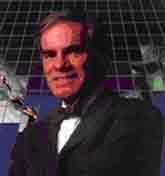
(1925 - 1998)
Martin Rodbell was born on December 1, 1925, in Baltimore, Maryland. He entered
Johns Hopkins University in 1943, with interests in
biology and French existential literature. In 1944,
his studies were interrupted by his military service
as a U.S. Navy radio operator during World
War II. He returned to Hopkins in 1946 and received
his B.S. in biology in 1949. Rodbell received his Ph.D.
in biochemistry at the University of Washington in 1954.
He did post-doctoral work at the University of Illinois
at Urbana-Champaign from 1954 to 1956. In 1956, Rodbell
accepted a position as a research biochemist at the
National Heart Institute, part of the National Institutes
of Health, in Bethesda, Maryland.
In 1985, Rodbell became Scientific Director of the
NIH's National Institute of Environmental Health Sciences
in Chapel Hill, North
Carolina where he worked until his retirement in
1994.
He shared the 1994 Nobel
Prize in Physiology or Medicine with Alfred
G. Gilman for "their discovery of G-proteins and the role
of these proteins in signal transduction in cells."
Rodbell died on in Chapel Hill December 7, 1998, of
multiple organ failure after an extended illness.
Research
Reflecting the increasingly common analogies between
computer science and biology in the 1960s, Rodbell believed
that the fundamental information processing systems
of both computers and biological organisms were similar.
He asserted that individual cells were analogous to
cybernetic systems made up of three distinct molecular
components: discriminators, transducers, and amplifiers
(otherwise known as effectors). The discriminator, or
cell receptor, receives information from outside the
cell; a cell transducer processes this information across
the cell membrane; and the amplifier intensifies these
signals to initiate reactions within the cell or to
transmit information to other cells.
In December 1969 and early January 1970, Rodbell was
working with a laboratory team that studied the effect
of the hormone glucagon on a rat liver membrane receptor-the
cellular discriminator that receives outside signals.
Rodbell discovered that ATP (adenosine triphosphate)
could reverse the binding action of glucagon to the
cell receptor and thus dissociate the glucagon from
the cell altogether. He then noted that traces of GTP
(guanosine triphosphate) could reverse the binding process
almost one thousand times faster than ATP. Rodbell deduced
that GTP was probably the active biological factor in
dissociating glucagon from the cell's receptor, and
that GTP had been present as an impurity in his earlier
experiments with ATP. This GTP, he found, stimulated
the activity in the guanine nucleotide protein (later
called the G-protein), which, in turn, produced profound
metabolic effects in the cell. This activation of the
G-protein, Rodbell postulated, was the "second
messenger" process that Earl W. Sutherland had
theorized. In the language of signal transduction, the
G-protein, activated by GTP, was the principal component
of the transducer, which was the crucial link between
the discriminator and the amplifier. Later, Rodbell
postulated, and then provided evidence for, additional
G-proteins at the cell receptor that could inhibit and
activate transduction, often at the same time. In other
words, cellular receptors were sophisticated enough
to have several different processes going on simultaneously.
The following press release from the Royal Swedish
Academy of Sciences describes Rodbell's work:
It has been known for some time that cells communicate
with each other by means of hormones and other signal
substances, which are released from glands, nerves and
other tissues. It is only recently that we have begun
to understand how the cell handles this information
from the outside and converts it into relevant action
- i.e. how signals are transduced in cells.
The discoveries of the G-proteins by the Americans
Alfred G. Gilman and Martin Rodbell have been of paramount
importance in this context, and have opened up a new
and rapidly expanding area of knowledge.
G-proteins have been so named because they bind guanosine
triphosphate (GTP). Gilman and Rodbell found that G-proteins
act as signal transducers, which transmit and modulate
signals in cells. G-proteins have the ability to activate
different cellular amplifier systems. They receive multiple
signals from the exterior, integrate them and thus control
fundamental life processes in the cells.
Disturbances in the function of G-proteins - too much
or too little of them, or genetically determined alterations
in their composition - can lead to disease. The dramatic
loss of salt and water in cholera is a direct consequence
of the action of cholera toxin on G-proteins. Some hereditary
endocrine disorders and tumours are other examples.
Furthermore, some of the symptoms of common diseases
such as diabetes or alcoholism may depend on altered
transduction of signals through G-proteins.
Sources: Wikipedia,
Nobelprize.org,
Picture courtesy of: National
Institute of Environmental Health Sciences |