Moshe Sharett
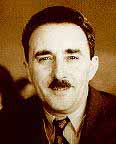
(1894 - 1965)
Moshe Sharett was born in 1894 in Kherson (Ukraine). He moved
to Palestine, then part of the Ottoman Empire, with his family
in 1908, making their first home in the Arab village of Ein Sinia;
the experience left him with a command of Arabic and Arab customs.
Sharett and his family moved in 1910 to Jaffa, where they became
one of the founding families of "Ahuzat Bayit," the
earliest nucleus of the city of Tel Aviv. Moshe was a member of
the first graduating class of the first Hebrew high school in
the country, the Herzliya Gymnasium.
Sharett began studying law in Istanbul, but his studies were interrupted
by service in the Turkish Army in World War I as an interpreter.
He then worked as an Arab affairs and land purchase agent for
the postwar Palestine Jewish Community's Representative Council.
He was a member of "Achdut Ha'Avoda" (Unity of Labor)
and later of "Mapai" (Israel Workers' Party). From 1922
to 1924, he studied at the London School of Economics and was
active in "Poalei Zion" (Workers of Zion). He then became
deputy editor of the Histadrut Labor Federation's daily Davar newspaper in 1925 and edited its English-language weekly
until 1931, when he assumed the post of Secretary of the Jewish
Agency's Political Department.
From 1933 until 1948, Sharett was in effect the Zionist movement's ambassador and chief negotiator vis-a-vis the British
Mandatory Authorities. Though the British incarcerated him for
four months in Latrun detention camp, he later succeeded in establishing
the British Army's Jewish Brigade in 1944, which provided the
postwar lifeline and illegal repatriation route to Mandatory Palestine for tens of thousands of the remnant of European Jewry.
In 1947, he appeared before the United Nations General Assembly in the vital partition debate and was one of the signatories of Israel's Declaration of Independence.
Sharett became Israel's first Foreign Minister in 1949, establishing
the nation's diplomatic service and bilateral relations and embassies
with dozens of countries. As Foreign Minister, he led the Israeli
delegations to the protracted cease-fire negotiations during and
after the War of Independence.
In January 1954, after David Ben-Gurion retired, Sharett
became Premier. As Prime Minister and as Foreign Minister, Sharett
presided over a continuation of the extraordinary pace of national
socioeconomic development and immigrant absorption which characterized
Israel during that era. When Ben-Gurion returned to political
life in November 1955, Sharett yielded the post of Prime Minister
to him, but remained Foreign Minister until June 1956.
Upon retirement, he became the head of the "Am Oved"
(Working Nation) publishing house, Chairman of Beit Berl College
and representative of the Labor Party at the Socialist International.
In 1960 he was elected by the World Zionist Congress to the chairmanship
of the World Zionist Organization and the Jewish Agency.
Sharett passed away at the age of 71 in 1965.
|