Arthur Ochs Sulzberger
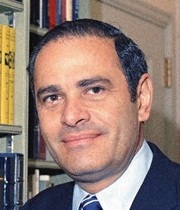
(1926 - 2012)
Arthur Ochs Sulzberger was a Jewish American publisher
and businessman.
Born on February 5, 1926 in New York City to Arthur
Hays Sulzberger and Iphigene Bertha Ochs, Arthur attended the private
Loomis School in Windsor, Connecticut until age 17, when he enlisted in the U.S. Marine Corps during World
War II. In school, he was ambivalent about his studies and struggled
with hereditary dyslexia. His father asked Army General Douglas MacArthur,
the chief leader of the Allied forces in the Southwest Pacific Theater,
to take care of Arthur, so the young Marine accompanied Gen. MacArthur
to Tokyo when the Japanese surrendered.
After the war, Sulzberger graduated with a B.A. in
English from Columbia University in 1951, and was recalled to active
duty during the Korean War to be a public information officer. In 1953,
he joined the staff of the Milwaukee Journal as a junior reporter
and a news editor. The following year he returned to the New York
Times at the foreign news copy desk before becoming a foreign correspondent
in Paris, France. His job in
Paris was not particularly notable and in 1956 he returned to New
York to work as administrative positions at the Times,
starting with assistant to the publisher and assistant treasurer.
Sulzberger married Barbara Grant but the couple divorced
before he moved back from Paris to the U.S. He married Carol Fox Fuhrman
in 1956, and she died in 1995. In 1996, Sulzberger married the widow
of a newspaper publisher in Spokane, Washington named Allison Cowles, who died in 2010.
Sulzberger was born into a prominent media and publishing
family as his grandfather Adolph S. Ochs bought the newspaper in 1896.
In fact, authors Susan E. Tifft and Alex S. Jones called Arthur Ochs
Sulzberger “arguably the greatest” Times publisher
since his grandfather.
Known for making monumental and positive changes to
the New York Times, Sulzberger served as its publisher from
1963 until 1992. Among the most memorable changes he implemented was
the transition of the newspaper to a publicly traded company. Additionally,
he created the op-ed (opposite-editorials) page in 1970, and made the
newspaper available across the nation through satellite printing plants.
He also expanded the paper’s sections to include coverage of arts
and lifestyle news, science, sports, and religion.
Sulzberger died at his home in Southampton, New
York. He is survived by three children, two sisters, and seven grandchildren.
Sources: Patricia Sullivan, “Arthur Ochs Sulzberger, former New York Times
publisher, dies at 86,” New
York Times, September 29, 2012.; Wikipedia; Photo copyright New York Times |