The Beauty of the Ketubah
In his compendium of the 613 biblical commandments, Sefer
Ha-Mitzvot, Maimonides lists first, "Be fruitful and multiply and fill the earth"
(Genesis 1:28). A number of verses later the Bible explains, "it
is not good that the man should be alone: I will make him a helpmeet
for him ... therefore shall a man leave his father and his mother and
shall cleave unto his wife, and they shall be one flesh"
(Genesis 2:18, 24). Love and marriage are lauded in the Bible, and
the prophets Hosea, Isaiah, and Ezekiel use them as a metaphor for
the relationship of God and his people Israel.
It is not surprising, therefore, that the
celebration of a marriage became the most joyous of communal events. The Talmud records that it
was common practice, even for rabbis, to "dance before the
bride." Rabbi Judah danced before the bride, myrtle branch in
hand; to the astonishment or consternation of his colleagues, Rav Aha
danced with the bride on his shoulders; and Samuel ben Rav was
sternly criticized for doing a juggling dance. What may have been
unseemly for rabbis was nonetheless encouraged in others in order to
"bring joy to the bridegroom and bride" at their nuptials.
"To dance before the bride" was not
sufficient for joy which also requires peace of mind. To provide
that, the rabbis enacted the ketubah, a legal document recording the
obligations of a husband to his wife during their marriage: "I
will work for thee, honor, support, and maintain thee as Jewish
husbands are accustomed to do"; and in case of divorce or death,
there is a stipulation for monetary payment to the wife. At the
wedding ceremony the ketubah is presented by the groom to the bride,
and the bride is required by law to keep it during her lifetime.
Because the ketubah was preserved, it became the
lasting memento of the wedding ceremony, and the custom arose to make
it a beautiful memento, a sentiment fortified by the precept of hiddur
mitzvah. A fragment of a tenth-century decorated and colored
ketubah on parchment was found in the Cairo Geniza (a storage space
in a Cairo synagogue for worn unusable Hebrew books and discarded
Hebrew documents). In Vienna's National Library, are preserved four
parchment fragments of a ketubah written in Krems, Austria, in 1392.
Their finely wrought calligraphic text is framed by decorated
borders. At either end of the top comers are the figures of the bride
and groom, he extending his left hand towards her, holding an
enlarged ring, she stretching forth her right hand to accept it. The
custom of illuminated ketuboth disappeared among Ashkenazi Jewry, but
was retained and developed among Sefardi communities from Italy to
Persia. In Italy, influenced by the blooming of art in the
Renaissance, it was raised to an art form in the sixteenth to
nineteenth centuries.
"The influences of the Renaissance can be
found in those of the sixteenth to seventeenth centuries, of the
Baroque in the ketuboth of the eighteenth," David Davidovitch
writes in his The Ketubah (Tel Aviv, 1968), "while those
of the nineteenth century bear the stamp of the Empire,
neoclassicism, etc." He also remarks on the Ancona and Corfu
schools of ketubah illumination. To these and the "etc." we
turn, for the Library of Congress has notable examples of them.
So great was the desire for a splendidly
illuminated ketubah in the Ancona Jewish community in the latter part
of the eighteenth century, that Jewish communal authorities found it
necessary to forbid spending more than forty paoli for ketubah
ornamentation. (Limitations on expenditure for wedding celebrations
are found in the regulations of a number of Jewish communities.) But
artistic ketuboth persisted nonetheless in that Adriatic port. Ancona
was one of the oldest of Italian-Jewish communities, with memories
both of times of relative security and well-being, and times of
oppression and persecution. in this papal city in the fifteenth and
the first half of the sixteenth centuries, the Jews were made welcome
by the papal authorities and they flourished; in the second half of
that century Jews were terrorized by Pope Paul IV's policies and
representatives. Right up to the twentieth century the Jews of Ancona
remembered twenty-four martyrs who were hanged and whose bodies were
burned at the stake in 1555, an act so brutally outrageous that the
rabbis of Turkey decreed a boycott against the Ancona seaport.
Confined to a ghetto, restricted and humiliated by papal decrees as
late as 1775, the Ancona Jews remained determined to beautify their
inner life against the ugliness outside.
This colorful, well-executed ketubah bears
witness that on June 12, 1805, Aaron ben Hayim Cesana of Corfu
and Sarah Rivka bat Mordecai d'Ovadia were wed in Ancona. The
names of the bride and groom are artistically incorporated into
the ketubah, through the depictions of the biblical Sarah and
Aaron, Ketubah, Ancona, 1805, Hebraic Section, Library of Congress Photo).
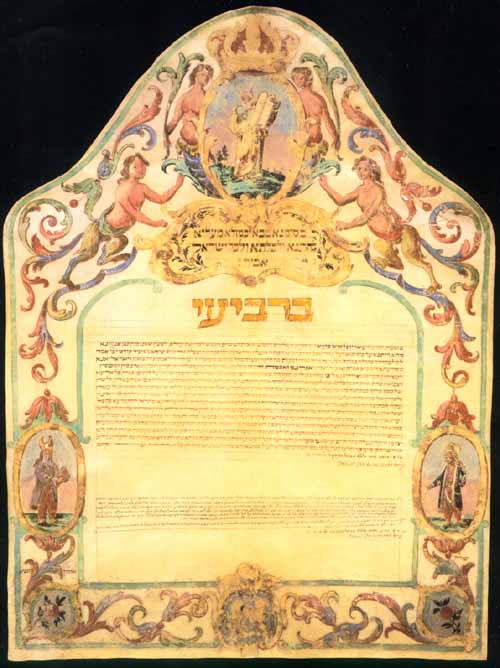 |
The Ancona ketubah of the Library of Congress was
fashioned in a happier time. From 1797 to 1814, the city was under
Napoleon's domination. The ghetto gates were removed, repressive
decrees were abrogated, and three Jews were appointed to the
municipal council. In those "good days," on June 12, 1805,
Aaron ben Hayim Cesana of Corfu was married to Sarah Rivka bat
Mordecai d'Ovadia. The Cesanas were a leading Corfu family who
numbered among their members Samson Cesana, who was granted a coat of
arms (on its escutcheon, Samson is tearing open the mouth of a lion),
and two noted physicians. The Ovadias seem no less distinguished a
family, as indicated by the artistic quality of the ketubah. On
parchment, it is similar in contour, style and artistry to other
distinguished Ancona ketuboth, like the 1772 ketubah now in the
Jewish National and University Library of Jerusalem, and another of
1804 now in the British Library. In all of them biblical figures or
scenes are incorporated which touch upon the names of the celebrants.
In the 1772 ketubah are two cutouts of events in
the life of the biblical Isaac. In the 1804 wedding, where the groom
is also named Isaac, at the top cartouche we find a depiction of Akedat
Yitzhak, the Binding of Isaac. In the Library's ketubah, the
dominant cartouche is given to Moses receiving the Ten Commandments--probably because
the wedding date was the fifteenth of Sivan, a week after the
Festival of Shavuot, the
"Season of the Giving of the Law." in cartouches in the
side panels are portraits of a lady, identified as the biblical Sarah
(the name of the bride), and one of the biblical Aaron labeled, not
"the Priest," but "Aaron the Prophet." Although,
according to rabbinic tradition, Aaron was indeed also a prophet, he
is never called that. Very likely this designation was used to
indicate that the groom named Aaron was not a Kohen, a
descendant of the priestly clan. At the bottom there are two rampant
lions, and under the text of the ketubah there is an addendum,
listing further stipulations. Among these is one stating that a civil
contract is to be drawn up by the parties involved.
The ornate ornamentation of the Ancona
ketubah is replaced by a tasteful decoration of birds and flowers
in this ketubah written and illuminated for a wedding in a small
Italian town near the French border. Nor are biblical figures
used, though the groom, his father, and the bride's father bore
names from the Bible, David, Moses, and Judah, Ketubah, Maddalena
on the Po, 1839, Hebraic Section, Library of Congress Photo).
 |
An Italian ketubah in the Library's collection,
written more than two decades later in the small town of Maddalena on
the Po, in northwest Italy near the French border, shows the economy
and simplicity of both illustration and illumination. It is
tastefully adorned with colored flowers and birds, but though the
names of the groom, his father, and the bride's father--David, Moses,
and Judah--would have easily lent themselves to biblical
illustration, that period is over, as is that of the baroque
illumination and adornment. That era had yielded to a style of
illustration more suited to nineteenth-century life, more classically
direct and simple, and more integrated into the general community.
Sources: Abraham J. Karp, From
the Ends of the Earth: Judaic Treasures of the Library of Congress,
(DC: Library of Congress, 1991).
|