A Menorah and Micrography
Two singularly Jewish art forms are the shivviti plaques
for synagogue or home and micrographic
illustrations. The name for the former is taken from the opening word in
Hebrew of the verse, "I have set the Lord always before me"
(Psalms, 16:8). Most often these were set before the precentor's stand in
the synagogue. Generally profusely decorated and illuminated with verses
forming a menorah, the seven-branched
temple candelabrum, they frequently contained artfully formed verses
pertaining to prayer. For home use, they were hung as amulets on a wall
near the entrance of the house. These contained biblical verses, liturgical
formulas, mystical incantations, and kabbalistic symbols. Especially esteemed were shivviti plaques made in the Holy
Land, featuring drawings of sacred sites.
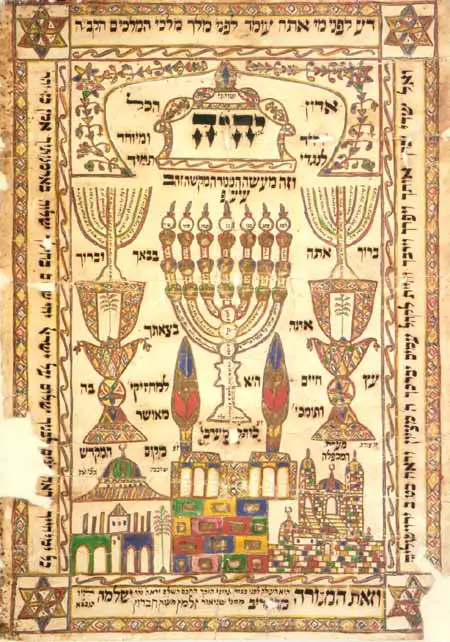
A gaudily colored shivviti for the home is called
a menorah by its artist-scribe, since it features three menorot
(candelabra) and is intended for the home, as indicated by the inscription,
"Blessed be you when you come in, and blessed be you in your going
out." At the four comers are six-pointed Stars of David, enclosing six-petalled
flowers. on the top border is the inscription, "Know before whom you
stand, before the King of Kings, the Holy Blessed One." Below,
flanking a cartouche containing the name of the Lord, is the inscription,
"I have set the Master of All, Single and Solitary [God], before me
always." Beneath are three menorot, one large and knopped-the temple
candelabrum-flanked by two smaller ones standing on double-cupped beakers.
In the menorah stems are verses from the Psalms and the liturgy. Below is
the inscription, "It is a tree of life to those who hold it, and all
who uphold it are rendered happy." At the bottom are depictions of
three holy sites: in the center, the Western
Wall; on one side, the Cave of
Machpelah, and on the other, the Place of the Holy Temple. In the side panels are
blessings for peace made up of citations from the Psalms.
Shivviti plaques, generally decorated with biblical
verses forming a menorah (seven-branch candelabrum), were used in the
synagogue and home; in the former, hung before the precentor's stand, in
the latter, as a religious wall hanging denoting that one is always aware
of the Lord's presence. This colorful artistically executed one was made by
the itinerant charity emissary from Hebron, Shneur Zalman Mendelowitz, and
presented to Solomon ---, a tear in the paper obliterates the rest of the
name, Shivviti Plaque, late nineteenth century, Hebraic Section, Library of Congress Photo).
 |
In the bottom border panel is the artist's dedication:
"This Menorah rises before my honored and cherished friend, a man full
of wisdom, fearing the Lord, Solomon [a tear in paper ... ] from me, Shneur
Zalman, from the Holy City of Hebron,
may she be restored and rebuilt, soon in our time." Shneur Zalman
Mendelowitz was a member of the Habad hassidic community in Hebron, in the nineteenth century. He
spent most of his life traveling as far west as England and as far east as
India, as an emissary of his community to gather funds for the support of
its members and its institutions. These were long, often dangerous journeys
in small ships on stormy seas to lands infested by brigands. Once, after
three and a half years away from home, his community and his own family
urged him to continue on, for the sums he had sent them were not
sufficient. At home, he published a number of books, the most valuable of
which is Zichron Yerushalayim (Jerusalem, 1876), descriptive of the
Holy Land at that time. In it are detailed reports of synagogues, academies
of learning, charitable institutions and various social organizations, as
well as legends. In the second part Mendelowitz writes about the cities he
visited during his travels, among them Damascus, Aleppo, Baghdad, Basra,
Bombay, Calcutta, Cairo, Alexandria, Izmir, Adrianople, Constantinople,
Kremenchug (Russia), London, Paris, Amsterdam, Frankfurt am Main, Hamburg,
Berlin, and Halberstadt. He mentions the names of those who helped him in
his charitable mission and those who extended him hospitality.
Micrography is the forming of pictures of persons or
objects with the words in tiny letters of verses appropriate to the
subject. Thus the story of Jonah, the reluctant prophet, the boat, the
fish, the ocean are all formed from the words of the biblical book bearing
his name. it was fashioned by Moses Elijah Goldstein in 1897 and presented
to Herr Gustave May, ("The Ship of Jonah," Micrography, 1897,
Hebraic Section, Library of Congress Photo).
 |
His chief benefactors were members of the Sassoon family
in the Near East and in Europe, who provided the funds for building two
Habad synagogues in Hebron. In appreciation Mendelowitz presented to
Solomon Sassoon an illustrated menorah tablet similar to the one in the
Library of Congress. We know of no other of his artistic works which have
survived.
This peripatetic emissary, author, and artistic scribe
used his talents to promote his mission, distributing his published works
and rewarding philanthropists with the fruits of his scribal artistry. The
Library's shivviti menorah tablet is just such a gift presented to a
Solomon, whose last name is lost.
The Book of Deuteronomy written in tiny letters forms
this portrait of Moses. The artist's own translation in English of the
Hebrew and French descriptive statement reads:PORTRAIT OF MOISE
Laws giver of the Israelites and
the greatest of the Prophetes ...
(Containing the fifth Book) Written
in small letters by Hilel Braverman,
("Portrait of Moise," Micrography, late nineteenth century,
Hebraic Section, Library of Congress Photo).
 |
Lovely micrographic drawings of "The Ship of
Jonah" by Moses Elijah Goldstein, and Hillel Braverman's
"Portrait of Moise" represent the Library's holdings in this art
form. Micrography draws a design, portrait, or scene associated with the
subject by using words composed of tiny letters, whose forms are barely
legible to the naked eye. Widely used in medieval Hebrew manuscripts,
micrography experienced a revival at the end of the nineteenth and the
beginning of the twentieth century. It has been esteemed by Jews, because
it makes it possible to draw a picture of a sacred event without
"casting away" the sacred words which describe it in a classical
religious text; thus, micrography permits the welding together of the
visage of a saint or sage with the very words he uttered or which were
written in praise of him.
 |
"The Ship of Jonah," completed in 1881, was
presented to "the exalted and notable philanthropist, Herr Gustave
May," in 189 7 by the artist, who had already published micrographic
portraits of Simeon bar Yohai, Esther, and Judith. The ship depicted is a
galleon, Jonah has just been cast from it, and a fish no larger than he
swims toward him, mouth open to swallow him. The reader, magnifying glass
in hand, can follow the story of the prophet who was reluctant to heed
God's injunction to preach repentance to the feared and hated city of
Nineveh; and having been taught by God that He is the father of all, Jonah
accedes and thereby becomes Nineveh's savior. This message of God's loving
concern for all humankind has been incorporated into the Day of Atonement liturgy when the
entire book of Jonah is read at the afternoon service.
Sources: Abraham J. Karp, From
the Ends of the Earth: Judaic Treasures of the Library of Congress,
(DC: Library of Congress, 1991).
|