A Rare Samaritan Ketubah
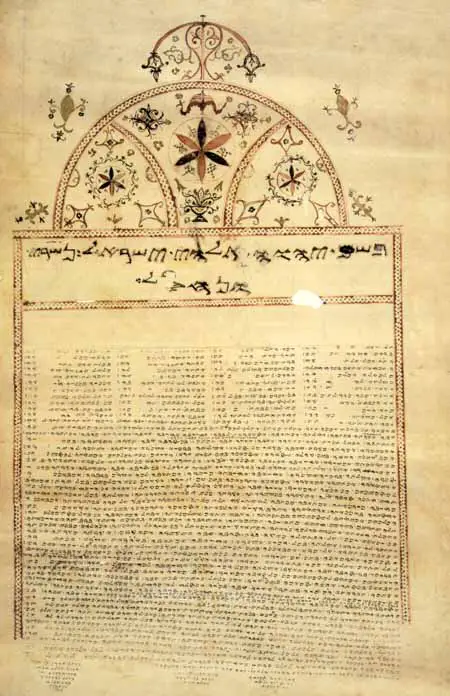
Of greatest interest and rarity is a decorative
Samaritan ketubah, inscribed in the Samaritan language, for the wedding
of the groom, Tamim ben Yisrael ben Yishmael Danafi, and his bride,
Pu'ah bat Abraham ben Marhib Safari, which was solemnized in Shechem (Nablus)
March-April 1901. The Samaritans, an ancient Jewish sect, go back to
biblical days. Their scriptures are the Five Books of Moses, and their
religion centers on the meticulous observance of Pentateuchal law and
worship at Mt. Gerzim, especially the offering up of the Paschal
sacrifice there. They observe kashrut (dietary laws), laws of purity, circumcision, and seven
holidays — among them Passover, Shavuot, Sukkoth, the Day of Atonement, Sh'mini Atzeret and a festival of
the seventh month celebrated on the same day as the first day of Rosh Hashanah.
A Samaritan
ketubah is an oddity and rarity in a display of ketuboth. Unlike
the other ketuboth whose language is Hebrew and Aramaic, this is in
the Samaritan language, the language of an ancient Jewish sect, now
all but extinct. Let us record the name of the bride and groom
whose 1901 marriage was their commitment to Samaritan survival when
they numbered but one hundred and ninety: Tamim ben Yisrael ben
Yishmael Danafi and his bride, Pu'ah bat Abraham ben Marhib Safari,
(Samaritan Ketubah, Shechem, (Nablus), 1901, Hebraic Section, Library of Congress Photo).
 |
On the fourth day of a week of rejoicing which
celebrates a wedding, the groom takes a piece of parchment to a priest
and asks him to write the ketubah. in the evening, the bride arrives
accompanied by singing and instrumental music. The groom hands the
ketubah to the high priest, who reads it aloud slowly, expounding upon
the status of the families and the virtues of the bride and the groom,
and detailing the marital stipulations and agreements. The ketubah is
then presented to a representative of the bride, her father or a
relative, for safekeeping.
In late antiquity, the Samaritans constituted a
significant segment of the population of the Holy Land, but in cruelly
crushed uprisings against the Byzantines in the fifth and sixth
centuries, their numbers began to dwindle. Widescale massacres
accompanying the Arab conquest in the seventh century further
diminished their number, so that in 1163 Benjamin of Tudela found only
about one thousand in Shechem and vicinity. The number of Samaritans at
the time of the writing of the ketubah was, according to a British
consulate census, about 190. They were recognized as Jews by the State
of Israel, and in 1954 those in Israel formed one community in Holon, a
suburb of Tel Aviv. The Six-Day War in 1967 united these with those Samaritans who had remained in Shechem,
marking also a reunification with the Jewish people after some
twenty-five centuries of separation.
Sources: Abraham J. Karp, From
the Ends of the Earth: Judaic Treasures of the Library of Congress,
(DC: Library of Congress, 1991).
|