Born in Ulm, Germany, Einstein grew up in Munich. As a boy, he already showed great interest in and
talent for mathematics and physics. His family moved to Italy,
and young Albert, unhappy with the authoritarian discipline of the German
schools, went on to study at the Swiss Federal Institute of Technology
in Zurich. Of the four graduates in 1900, he was the only one who was
not given a position at the Institute; instead, he became a Swiss citizen
and took a job at the Swiss patent office in Berne.
In 1905, Einstein was granted
a doctorate by the University of Zurich.
His thesis, Eine neue Bestimmung der Molekuldimensionen (A New Determination of Molecular Dimensions),
Berne, 1905, was his first independently
published work (five papers had previously
been published in Annalen der Physik). The
Library's copy of Einstein's twenty-one-page
doctoral dissertation was received on January
18, 1907, as a “Smithsonian Deposit.” In "Subtle
is the Lord . . . ” The Science and Life
of Albert Einstein (New York, 1982),
Abraham Pais, of Rockefeller University,
writes:
It is not sufficiently realized that Einstein's thesis is one of
his most fundamental papers ... It had more widespread application
than any other paper Einstein ever wrote. of the eleven scientific
articles published by any author before 1912, and cited most frequently
between 1961 and 1975, four are by Einstein. Among these four, the
thesis ... ranks first.
In 1921, Einstein accompanied Chaim
Weizmann on a tour of the United States to raise funds for the proposed
Hebrew University in Jerusalem. Among other honors, Einstein was received
at the White House by President Harding, The Library has a photograph
taken at the Farewell Dinner of the American Palestine Campaign. On
it are Professor and Mrs. Einstein, financier Felix Warburg, Zionist
leaders Robert Szold, Morris Rothenberg, and Rabbi
Stephen S. Wise, as well as Jefferson Seligman of the banking family.
The Prints and Photographs Division also contains a print of a pen and
ink drawing of Einstein by Robert Kastor on which is inscribed in Einsteins
own hand in German:
Nature has so wonderful a harmony that at times, one can draw conclusions
from distant facts about not yet observed phenomena, and do so with
such certainty, that he can look forward without fear to comparing
these conclusions with observed reality.
When Hitler came to power in 1933, Einstein resigned his position in the Royal Prussian
Academy of Sciences. On October 17 of that year the Einsteins arrived
in the United States and settled in Princeton, where Einstein had accepted
a professorship at the Institute for Advanced Studies. Five years later,
July 13, 1938, he wrote to Dr. Herbert Putnam, Librarian of Congress:
My good friend, Professor E. Lowe, informs me that you would like
to have one of my manuscripts for the Library of Congress. I am sending
you herewith a specially prepared copy of my newest theory which I
consider particularly worthy.
Einstein, a Jew fleeing Nazi terror, finding refuge
in the United States, expresses his gratitude to this haven which became
his home through a gift to the Library of Congress. The enclosed manuscript
was “Einheitliche Feldtheorie” (Unified Field Theory), inscribed
and dated in Einstein's hand 6 VII (July 6), 1938. Einstein began his
pursuit of a unified field theory in 1919 and continued it to the last
years of his life.
Five years later, in 1943, his new country now at war
with the one he fled, Einstein aided the War Bond campaign by presenting
through it another manuscript to the Library of Congress. (A Kansas
City life insurance company was awarded the honor of being the official
donor for its $6.5 million purchase of bonds.) He described his manuscript
in an accompanying note:
The following pages are a copy of my first paper concerning the theory
of relativity. I made this copy in November 1943. The original manuscript
no longer exists having been discarded by me after its publication.
The publication bore the title Zur Electrodynamic Bewegter Körper.
A. Einstein, 21 XI, 1943
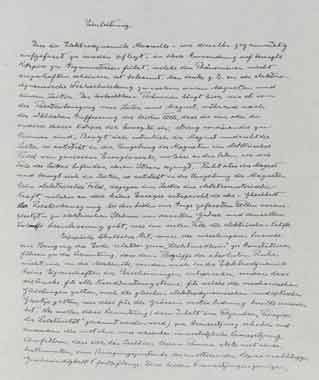
Displayed at left is the
first page of a holograph copy of “Zur
Elektrodynamik bewegter Korper,” which
Einstein described as his first paper concerning
the theory of relativity. He had discarded
the original manuscript after it had been
published in Annalen
der Physic in
1905. In November 1943, Einstein rewrote
this paper so that it might be presented
to the Library of Congress to help promote
the sale of U.S. War Bonds (Albert Einstein. “Zur
Elektrodynamik bewegter Korper,” November
1943, Manuscript Division).
The Library proudly
exhibits its new treasure, noting that
it was first published in the Annalen der
Physic, Leipzig, 1905, and that it was:
Written by Einstein at the age of twenty-six, while
he was living at Berne, Switzerland, the theory, though not immediately
recognized as such, represents the first step toward one of the greatest
intellectual triumphs of modern times.
In March 1955, a month before he died, Einstein wrote
to Kurt Blumenfeld, “I thank you belatedly for having made me conscious
of my Jewish soul.” This consciousness had come forty-five years
earlier when Blumenfeld directed him to Zionism.
Although never a member of a Zionist organization, in 1924 Einstein
did become a member of a Berlin synagogue to declare his Jewish identity
and he served the cause of Zionism throughout his adult life. He visited
Palestine, served on the Board of the Hebrew University, and willed
his papers to it. In 1946, Einstein appeared before the Anglo-American
Committee of inquiry on Palestine and made a strong plea for a Jewish
homeland.

Al Aumuller.
America Gains a Famous Citizen (Albert Einstein),
October 1, 1940.
Gelatin silver print.
New York World-Telegram & Sun Collection.
Prints and Photographs
Division
When Israel's first president, Chaim
Weizmann, died, Israeli Prime Minister David
Ben Gurion invited Einstein to stand as a candidate for the office,
but Einstein declined because, he said, though he was deeply touched
by the offer, he was not suited for the position. During his final illness,
Einstein took with him to the hospital the draft of a statement he was
preparing for a television appearance celebrating the State of Israel's
seventh anniversary, but he did not live either to complete or deliver
it.
Sources:Abraham J. Karp, From
the Ends of the Earth: Judaic Treasures of the Library of Congress,
(DC: Library of Congress,
1991). Portrait photo: Robert Kastor. January
21, 1922,
Pen and ink on paper. Prints and Photographs
Division, Library
of Congress

