|
Myths & Facts OnlineThe 1956 WarBy Mitchell G. Bard“Arab
governments were prepared to accept Israel
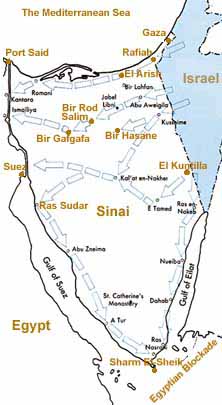
after the Suez War.” “Arab governments were prepared to accept Israel after the 1948 war.” FACT In the fall of 1948, the UN Security Council called on Israel and the Arab states to negotiate armistice agreements. Thanks to UN mediator Ralph Bunche’s insistence on direct bilateral talks between Israel and each Arab state, armistice agreements between Israel and Egypt, Jordan, Lebanon and Syria were concluded by the summer of 1949. Iraq, which had also fought against Israel, refused to follow suit. Meanwhile, on December 11, 1948, the General Assembly adopted a resolution calling on the parties to negotiate peace and creating a Palestine Conciliation Commission (PCC), which consisted of the United States, France and Turkey. All Arab delegations voted against it. After 1949, the Arabs insisted that Israel accept the borders in the 1947 partition resolution and repatriate the Palestinian refugees before they would negotiate an end to the war they had initiated. This was a novel approach that they would use after subsequent defeats: the doctrine of the limited-liability war. Under this theory, aggressors may reject a compromise settlement and gamble on war to win everything in the comfortable knowledge that, even if they fail, they may insist on reinstating the status quo ante. “Israel’s military strike in 1956 was unprovoked.” FACT Egypt had maintained its state of belligerency with Israel after the armistice agreement was signed. The first manifestation of this was the closing of the Suez Canal to Israeli shipping. On August 9, 1949, the UN Mixed Armistice Commission upheld Israel’s complaint that Egypt was illegally blocking the canal. UN negotiator Ralph Bunche declared: “There should be free movement for legitimate shipping and no vestiges of the wartime blockade should be allowed to remain, as they are inconsistent with both the letter and the spirit of the armistice agreements.”1 On September 1, 1951, the Security Council ordered Egypt to open the Canal to Israeli shipping. Egypt refused to comply. The Egyptian Foreign Minister, Muhammad Salah al-Din, said early in 1954 that : “The Arab people will not be embarrassed to declare: We shall not be satisfied except by the final obliteration of Israel from the map of the Middle East.”2 In 1955, Egyptian President Gamal Abdel Nasser began to import arms from the Soviet Bloc to build his arsenal for the confrontation with Israel. In the short-term, however, he employed a new tactic to prosecute Egypt’s war with Israel. He announced it on August 31, 1955: Egypt has decided to dispatch her heroes, the disciples of Pharaoh and the sons of Islam and they will cleanse the land of Palestine....There will be no peace on Israel’s border because we demand vengeance, and vengeance is Israel’s death.3
The escalation continued with the Egyptian blockade of Israel’s shipping lane in the Straits of Tiran, and Nasser’s nationalization of the Suez Canal in July 1956. On October 14, Nasser made clear his intent:
Less than two weeks later, on October 25, Egypt signed a tripartite agreement with Syria and Jordan placing Nasser in command of all three armies. The
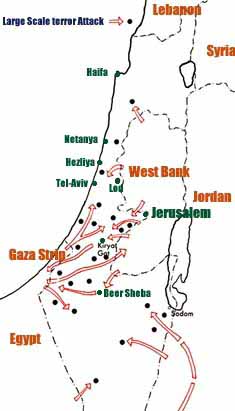
Israeli Ambassador to the UN Abba Eban explained the provocations to the Security Council on October 30: During the six years during which this belligerency has operated in violation of the Armistice Agreement there have occurred 1,843 cases of armed robbery and theft, 1,339 cases of armed clashes with Egyptian armed forces, 435 cases of incursion from Egyptian controlled territory, 172 cases of sabotage perpetrated by Egyptian military units and fedayeen in Israel. As a result of these actions of Egyptian hostility within Israel, 364 Israelis were wounded and 101 killed. In 1956 alone, as a result of this aspect of Egyptian aggression, 28 Israelis were killed and 127 wounded.5 One reason these raids were so intolerable for Israel was that the country had chosen to create a relatively small standing army and to rely primarily on reserves in the event of war. This meant that Israel had a small force to fight in an emergency, that threats provoking the mobilization of reserves could virtually paralyze the country, and that an enemy’s initial thrust would have to be withstood long enough to complete the mobilization. “The United States’ blind support for Israel was apparent during the Suez War.” FACT President Eisenhower was upset by the fact that Israel, France and Great Britain had secretly planned the campaign to evict Egypt from the Suez Canal. Israel’s failure to inform the United States of its intentions, combined with ignoring American entreaties not to go to war, sparked tensions between the countries. The United States subsequently joined the Soviet Union (ironically, just after the Soviets invaded Hungary) in a campaign to force Israel to withdraw. This included a threat to discontinue all U.S. assistance, UN sanctions and expulsion from the UN (see exchanges between Ben-Gurion and Eisenhower). U.S. pressure resulted in an Israeli withdrawal from the areas it conquered without obtaining any concessions from the Egyptians. This sowed the seeds of the 1967 war. One reason Israel did give in to Eisenhower was the assurance he gave to Prime Minister David Ben-Gurion. Before evacuating Sharm al-Sheikh, the strategic point guarding the Straits of Tiran, Israel elicited a promise that the United States would maintain the freedom of navigation in the waterway.6 In addition, Washington sponsored a UN resolution creating the United Nations Emergency Force (UNEF) to supervise the territories vacated by the Israeli forces. The war temporarily ended the activities of the fedayeen; however, they were renewed a few years by a loosely knit group of terrorist organizations that became know as the Palestine Liberation Organization (PLO). Notes1Eliezer
Ereli, “The
Bat Galim Case Before the Security Council,” Middle
Eastern Affairs, (April 1955), pp. 108-9. See also: History
of Israel Previous To order the paperback edition, click HERE.
|
 |