History & Overview
by Mitchell Bard
(Updated August 2015)
The Exodus of 1947-48
The Palestinians left their homes in 1947-48 for a variety of reasons. Thousands of wealthy Arabs left in anticipation
of a war, thousands more responded to Arab leaders' calls to get out
of the way of the advancing armies, a handful were expelled, but most
simply fled to avoid being caught in the cross fire of a battle. Had
the Arabs accepted the 1947
UN resolution, not a single Palestinian would have become a refugee and an independent Arab state would now exist beside Israel.
The beginning of the Arab exodus can be traced to
the weeks immediately following the announcement of the UN partition
resolution. The first to leave were roughly 30,000 wealthy Arabs who
anticipated the upcoming war and fled to neighboring Arab countries to
await its end. Less affluent Arabs from the mixed cities of Palestine
moved to all-Arab towns to stay with relatives or friends.
All of those who left fully anticipated being able
to return to their homes after an early Arab victory, as Palestinian
nationalist Aref el-Aref explained in his history of the 1948 war:
The Arabs thought they would win in less than the
twinkling of an eye and that it would take no more than a day or two
from the time the Arab armies crossed the border until all the
colonies were conquered and the enemy would throw down his arms and
cast himself on their mercy.
By the end of January1948, the exodus was so
alarming the Palestine Arab Higher Committee asked neighboring Arab
countries to refuse visas to these refugees and to seal the borders
against them.
Meanwhile, Jewish leaders urged the Arabs to remain
in Palestine and become citizens of Israel. The Assembly of Palestine
Jewry issued this appeal on October 2, 1947:
We will do everything in our power to maintain
peace, and establish a cooperation gainful to both [Jews and Arabs].
It is now, here and now, from Jerusalem itself, that a call must go
out to the Arab nations to join forces with Jewry and the destined
Jewish State and work shoulder to shoulder for our common good, for
the peace and progress of sovereign equals.
On November 30, the day after the UN
partition vote, the Jewish Agency announced: “The main theme
behind the spontaneous celebrations we are witnessing today is our
community's desire to seek peace and its determination to achieve
fruitful cooperation with the Arabs....“
Israel's Proclamation of
Independence, issued May 14, 1948, also invited the Palestinians
to remain in their homes and become equal citizens in the new state:
In the midst of wanton aggression, we yet call upon
the Arab inhabitants of the State of Israel to preserve the ways of
peace and play their part in the development of the State, on the
basis of full and equal citizenship and due representation in all its
bodies and institutions....We extend our hand in peace and
neighborliness to all the neighboring states and their peoples, and
invite them to cooperate with the independent Jewish nation for the
common good of all.
Caught in the Middle
Throughout the period that preceded the May
15 invasion of the Arab regular armies, large-scale military
engagements, incessant sniping, robberies and bombings took place. In
view of the thousands of casualties that resulted from the
pre-invasion violence, it is not surprising that many Arabs would have
fled out of fear for their lives.
The second phase of the Arab flight began after the
Jewish forces started to register military victories against Arab
irregulars. Among the victories were the battles for Tiberias and Haifa,
which were accompanied by the evacuation of the Arab inhabitants.
A newly released British document indicates officials were aware of the reason Palestinians were fleeing:
The [Palestine] Arabs have suffered a series of overwhelming defeats….Jewish victories … have reduced Arab morale to zero and, following the cowardly example of their inept leaders, they are fleeing from the mixed areas in their thousands. It is now obvious that the only hope of regaining their position lies in the regular armies of the Arab states (Barry Rubin, “How the Palestinians Trap Themselves and Drag the West Along,” PJ Media, (May 5, 2013).
On January 30, 1948, the Jaffa newspaper, Ash
Sha'ab, reported: “The first of our fifth column consists of
those who abandon their houses and businesses and go to live
elsewhere....At the first signs of trouble they take to their heels to
escape sharing the burden of struggle.”
Another Jaffa paper, As Sarih (March 30,
1948) excoriated Arab villagers near Tel Aviv for “bringing down
disgrace on us all by 'abandoning the villages.“
John Bagot Glubb, the commander of Jordan's Arab
Legion, said: “Villages were frequently abandoned even before
they were threatened by the progress of war” (London Daily
Mail, August 12, 1948).
Jewish forces seized Tiberias on April 19, 1948, and the entire Arab population of 6,000 was
evacuated under British military supervision. The Jewish Community
Council issued a statement afterward: “We did not dispossess
them; they themselves chose this course....Let no citizen touch their
property.”
In early April, an estimated 25,000 Arabs left the Haifa area following an offensive by the irregular forces led by Fawzi
alQawukji, and rumors that Arab air forces would soon bomb the
Jewish areas around Mt. Carmel. On April 23, the Haganah captured Haifa. A British police report from Haifa, dated April 26,
explained that “every effort is being made by the Jews to
persuade the Arab populace to stay and carry on with their normal
lives, to get their shops and businesses open and to be assured that
their lives and interests will be safe.” In fact, David
Ben-Gurion had sent Golda Meir to Haifa to try to persuade the Arabs to stay, but she was unable to
convince them because of their fear of being judged traitors to the
Arab cause. By the end of the battle, more than 50,000 Palestinians
had left.
Tens of thousands of Arab men, women and children
fled toward the eastern outskirts of the city in cars, trucks, carts,
and afoot in a desperate attempt to reach Arab territory until the
Jews captured Rushmiya Bridge toward Samaria and Northern Palestine
and cut them off. Thousands rushed every available craft, even
rowboats, along the waterfront, to escape by sea toward Acre (New York Times, April 23, 1948).
In Tiberias and Haifa, the Haganah issued orders
that none of the Arabs' possessions should be touched, and warned that
anyone who violated the orders would be severely punished. Despite
these efforts, all but about 5,000 or 6,000 Arabs evacuated Haifa,
many leaving with the assistance of British military transports.
Syria's UN delegate, Faris el-Khouri, interrupted the UN debate on Palestine to
describe the seizure of Haifa as a “massacre” and said this
action was “further evidence that the 'Zionist program' is to annihilate
Arabs within the Jewish state if partition is effected.”
The following day, however, the British
representative at the UN, Sir Alexander Cadogan, told the delegates
that the fighting in Haifa had been provoked by the continuous attacks
by Arabs against Jews a few days before and that reports of massacres
and deportations were erroneous. The same day (April 23, 1948), Jamal
Husseini, the chairman of the Palestine Higher Committee, told the UN
Security Council that instead of accepting the Haganah's truce offer,
the Arabs “preferred to abandon their homes, their belongings,
and everything they possessed in the world and leave the town.”
The Invasion
As fear and chaos spread throughout Palestine, the
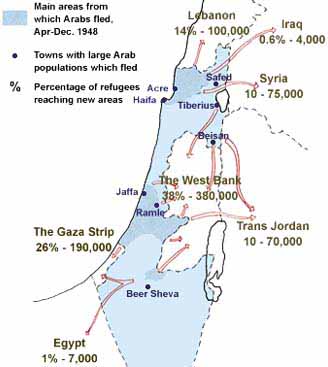
early trickle of refugees became a flood, numbering more than 200,000
by the time the provisional government declared the independence of
the State of Israel.
Once the invasion began in May 1948, most Arabs
remaining in Palestine left for neighboring countries. Surprisingly,
rather than acting as a strategically valuable “fifthcolumn”
in the war, the Palestinians chose to flee to the safety of the other
Arab states, still confident of being able to return. A leading
Palestinian nationalist of the time, Musa Alami, revealed the attitude
of the fleeing Arabs:
The Arabs of Palestine left their homes, were
scattered, and lost everything. But there remained one solid hope: The
Arab armies were on the eve of their entry into Palestine to save the
country and return things to their normal course, punish the
aggressor, and throw oppressive Zionism with its dreams and dangers
into the sea. On May 14, 1948, crowds of Arabs stood by the roads
leading to the frontiers of Palestine, enthusiastically welcoming the
advancing armies. Days and weeks passed, sufficient to accomplish the
sacred mission, but the Arab armies did not save the country. They did
nothing but let slip from their hands Acre, Sarafand, Lydda, Ramleh,
Nazareth, most of the south and the rest of the north. Then hope fled
(Middle East Journal, October 1949).
As the fighting spread into areas
that had previously remained quiet, the Arabs began
to see the possibility of defeat. As the possibility
turned into reality, the flight of the Arabs increased-more
than 300,000 departed after May 15 — leaving
approximately 160,000 Arabs in the State of Israel.
The Arabs' fear was naturally exacerbated
by the atrocity stories following the attack on Deir
Yassin. The native population lacked leaders who
could calm them; their spokesmen, such as the Arab
Higher Committee, were operating from the safety of
neighboring states and did more to arouse their fears
than to pacify them. Local military leaders were of
little or no comfort. In one instance the commander
of Arab troops in Safed went to Damascus. The following day, his troops withdrew
from the town. When the residents realized they were
defenseless, they fled in panic. “As Palestinian
military power was swiftly and dramatically crushed
and the Haganah demonstrated almost unchallenged superiority
in successive battles,” Benny Morris noted, “Arab
morale cracked, giving way to general, blind, panic
or a ‘psychosis of flight,’ as one IDF
intelligence report put it” (The
Birth of the Palestinian Refugee Problem Revisited,
MA: Cambridge University Press, 2004, p. 591).
 |
Although most of the Arabs had left by November
1948, there were still those who chose to leave even after hostilities
ceased. An interesting case was the evacuation of 3,000 Arabs from
Faluja, a village between Tel
Aviv and Beersheba:
Observers feel that with proper counsel after the
IsraeliEgyptian armistice, the Arab population might have
advantageously remained. They state that the Israeli Government had
given guarantees of security of person and property. However, no
effort was made by Egypt, Transjordan or even the United Nations
Palestine Conciliation Commission to advise the Faluja Arabs one way
or the other (New York Times, March 4, 1949).
Arab Leaders Provoke Exodus
A plethora of evidence exists demonstrating that
Palestinians were encouraged to leave their homes to make way for the
invading Arab armies. The U.S. ConsulGeneral in Haifa, Aubrey
Lippincott, wrote on April 22, 1948, for example, that “local
muftidominated Arab leaders” were urging “all Arabs to
leave the city, and large numbers did so.”
The Economist, a frequent critic of the Zionists,
reported on October 2, 1948: “Of the 62,000 Arabs who formerly
lived in Haifa not more than 5,000 or 6,000 remained. Various factors
influenced their decision to seek safety in flight. There is but
little doubt that the most potent of the factors were the
announcements made over the air by the Higher Arab Executive, urging
the Arabs to quit....It was clearly intimated that those Arabs who
remained in Haifa and accepted Jewish protection would be regarded as renegades.”
Time's report of the battle for Haifa (May
3, 1948) was similar: “The mass evacuation, prompted partly by
fear, partly by orders of Arab leaders, left the Arab quarter of Haifa
a ghost city....By withdrawing Arab workers their leaders hoped to
paralyze Haifa.”
Benny Morris, the historian who
documented instances where Palestinians were expelled,
also found that Arab leaders encouraged their brethren
to leave. Starting in December 1947, he said, “Arab
officers ordered the complete evacuation of specific
villages in certain areas, lest their inhabitants
‘treacherously’ acquiesce in Israeli
rule or hamper Arab military deployments.” He
concluded, “There can be no exaggerating the
importance of these arly Arab-initiated evacuations
in the demoralization, and eventual exodus, of the
remaining rural and urban populations” (The
Birth of the Palestinian Refugee Problem Revisited,
MA: Cambridge University Press, 2004,
p. 590).
The
Arab National Committee in Jerusalem, following
the March 8, 1948, instructions of the Arab Higher
Committee, ordered women, children and the elderly
in various parts of Jerusalem to leave their homes: “Any
opposition to this order...is an obstacle to the
holy war...and will hamper the operations of the
fighters in these districts” (Morris, Middle
Eastern Studies, January 1986). Morris also
documented that the Arab Higher Committee ordered
the evacuation of “several dozenvillages,
as well as the removal of dependents from dozens
more” in April-July 1948. “The invading
Arab armies also occasionally ordered whole villages
to depart, so as not to be in their way” (The
Birth of the Palestinian Refugee Problem Revisited,
MA: Cambridge University Press, 2004, p. 592).
Morris also said that in early May units of the
Arab Legion reportedly ordered the evacuation of all women and
children from the town of Beisan. The Arab Liberation Army was also
reported to have ordered the evacuation of another village south of
Haifa. The departure of the women and children, Morris says,
“tended to sap the morale of the menfolk who were left behind to
guard the homes and fields, contributing ultimately to the final
evacuation of villages. Such two-tier evacuation-women and children
first, the men following weeks later-occurred in Qumiya in the Jezreel
Valley, among the Awarna bedouin in Haifa Bay and in various other
places.”
Who gave such orders? Leaders like
Iraqi Prime Minister Nuri Said, who declared: “We
will smash the country with our guns and obliterate
every place the Jews seek shelter in. The Arabs should
conduct their wives and children to safe areas until
the fighting has died down.”
The Secretary of the Arab League Office in London,
Edward Atiyah, wrote in his book, The Arabs: “This
wholesale exodus was due partly to the belief of the Arabs, encouraged
by the boastings of an unrealistic Arabic press and the irresponsible
utterances of some of the Arab leaders that it could be only a matter
of weeks before the Jews were defeated by the armies of the Arab
States and the Palestinian Arabs enabled to reenter and retake
possession of their country.”
In his memoirs, Haled al Azm, the Syrian Prime
Minister in 194849, also admitted the Arab role in persuading the
refugees to leave:
Since 1948 we have been demanding the return of the
refugees to their homes. But we ourselves are the ones who encouraged
them to leave. Only a few months separated our call to them to leave
and our appeal to the United Nations to resolve on their return.
“The refugees were confident their absence
would not last long, and that they would return within a week or
two,” Monsignor George Hakim, a Greek Orthodox Catholic Bishop of
Galilee told the Beirut newspaper, Sada alJanub (August 16,
1948). “Their leaders had promised them that the Arab Armies
would crush the 'Zionist gangs' very quickly and that there was no
need for panic or fear of a long exile.”
On April 3, 1949, the Near East Broadcasting
Station (Cyprus) said: “It must not be forgotten that the Arab
Higher Committee encouraged the refugees' flight from their homes in
Jaffa, Haifa and Jerusalem.”
“The Arab States encouraged the Palestine
Arabs to leave their homes temporarily in order to be out of the way
of the Arab invasion armies,” according to the Jordanian
newspaper Filastin (February 19, 1949).
One refugee quoted in the Jordan newspaper, Ad
Difaa (September 6, 1954), said: “The Arab government told
us: Get out so that we can get in. So we got out, but they did not get
in.”
“The Secretary-General of the Arab
League, Azzam Pasha, assured the Arab peoples that the occupation
of Palestine and Tel Aviv would be as simple as a military
promenade,” said Habib Issa in the New York Lebanese paper, Al
Hoda (June 8, 1951). “He pointed out that they were already
on the frontiers and that all the millions the Jews had spent on land
and economic development would be easy booty, for it would be a simple
matter to throw Jews into the Mediterranean....Brotherly advice was
given to the Arabs of Palestine to leave their land, homes and
property and to stay temporarily in neighboring fraternal states, lest
the guns of the invading Arab armies mow them down.”
Even Jordan's King Abdullah, writing in his
memoirs, blamed Palestinian leaders for the refugee problem:
The tragedy of the Palestinians was that most of
their leaders had paralyzed them with false and unsubstantiated
promises that they were not alone; that 80 million Arabs and 400
million Muslims would instantly and miraculously come to their rescue.
Expulsions of Arabs
The Haganah did employ
psychological warfare to encourage the Arabs to abandon a few
villages. Yigal Allon, the
commander of the Palmach (the “shock force of the Haganah”), said he had Jews talk to
the Arabs in neighboring villages and tell them a large Jewish force
was in Galilee with the intention of burning all the Arab villages in
the Lake Huleh region. The Arabs were told to leave while they still
had time and, according to Allon, they did exactly that.
In the most dramatic example, in the Ramle-Lod area, Israeli troops
seeking to protect their flanks and relieve the pressure on besieged
Jerusalem, forced a portion of the Arab population to go to an area a
few miles away that was occupied by the Arab Legion. “The two
towns had served as bases for Arab irregular units, which had
frequently attacked Jewish convoys and nearby settlements, effectively
barring the main road to Jerusalem to Jewish traffic.”
As was clear from the descriptions
of what took place in the cities with the largest
Arab populations, these cases were clearly the exceptions,
accounting for only a small fraction of the Palestinian
refugees. The expulsions were not designed to force
out the entire Arab population; the areas where they
took place were strategically vital and meant to
prevent the threat of any rearguard action against
the Israeli forces, and to insure clear lines of
communication. Morris notes that “in general, Haganah and IDF commanders
were not forced to confront the moral dilemma posed
by expulsion; most Arabs fled before and during the
battle, before the Israeli troops reached their homes
and before the Israeli commanders were forced to
confront the dilema” (The
Birth of the Palestinian Refugee Problem Revisited,
MA: Cambridge University Press, 2004, p. 592).
How Many Refugees?
Many Arabs claim that 800,000
to 1,000,000 Palestinians became refugees in 194749. The last census was taken in 1945.
It found only 756,000 permanent Arab residents
in Israel. On November 30, 1947, the date
the UN
voted for partition, the total was 809,100.
A 1949 Government of Israel census counted
160,000 Arabs living in the country after
the war. This meant no more than 650,000 Palestinian
Arabs could have become refugees.
A report by the UN Mediator on Palestine arrived
at an even lower figure — 472,000.
Although much is heard about the plight of the
Palestinian refugees, little is said about the Jews who fled from Arab
states. Their situation had long been precarious. During the 1947 UN
debates, Arab leaders threatened them. For example, Egypt's delegate
told the General Assembly: “The lives of one million Jews in
Muslim countries would be jeopardized by partition.”
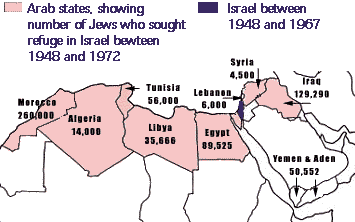
The number of Jews fleeing Arab countries for
Israel in the years following Israel's independence was roughly equal
to the number of Arabs leaving Palestine. Many Jews were allowed to
take little more than the shirts on their backs. These refugees had no
desire to be repatriated. Little is heard about them because they did
not remain refugees for long. Of the 820,000 Jewish refugees, 586,000
were resettled in Israel at great expense, and without any offer of
compensation from the Arab governments who confiscated their
possessions. Israel has consequently maintained that any agreement to
compensate the Palestinian refugees must also include Arab
compensation for Jewish refugees. To this day, the Arab states have
refused to pay any compensation to the hundreds of thousands of Jews
who were forced to abandon their property before fleeing those
countries.
The contrast between the reception of Jewish
refugees in Israel with the reception of Palestinian refugees in Arab
countries is even more stark when one considers the difference in
cultural and geographic dislocation experienced by the two groups.
Most Jewish refugees traveled hundreds — and some traveled thousands
— of miles to a tiny country whose inhabitants spoke a different
language. Most Arab refugees never left Palestine at all; they
traveled a few miles to the other side of the truce line, remaining
inside the vast Arab nation that they were part of linguistically,
culturally and ethnically.
A second refugee population was created in 1967.
After ignoring warnings to stay out of the war, King
Hussein launched an attack on Jerusalem,
Israel's capital. The UN estimated that during the fighting 175,000
Palestinians had fled for a second time and approximately 350,000 left
for the first time. About 200,000 moved to Jordan, 115,000 to Syria
and approximately 35,000 left Sinai for Egypt. Most of the Arabs who
left had come from the West Bank.
When the Security Council empowered U Thant to send
a representative to inquire into the welfare of civilians in the wake
of the 1967 war, he instructed the mission to investigate the
treatment of Jewish minorities in Arab countries, as well as Arabs in
Israeli-occupied territory. Syria, Iraq and Egypt refused to permit
the UN representative to carry out his investigation.
UN Resolution 194
Through November 2003, 101 of the 681 UN resolutions
on the Middle East conflict referred directly to Palestinian
refugees. Not one mentioned the Jewish refugees from Arab countries
(Jerusalem Post,
December 4, 2003).
The United Nations first took up the refugee issue
and adopted Resolution 194 on December
11, 1948. This called upon the Arab states and Israel to resolve all
outstanding issues through negotiations either directly, or with the
help of the Palestine Conciliation Commission established by this resolution.
Furthermore, Point 11 resolves:
that refugees wishing to return to their homes and
live at peace with their neighbors should be permitted to do so at
the earliest practicable date, and that compensation should be paid
for property of those choosing not to return and for loss of or damage
to property which under principles of international law or in equity
should be made good by Governments or authorities responsible.
Instructs the Conciliation Commission to facilitate the repatriation, resettlement and economic and social rehabilitation of refugees and payment of
compensation... (emphasis added).
The emphasized words demonstrate that the UN
recognized that Israel could not be expected to repatriate a hostile
population that might endanger its security. The solution to the
problem, like all previous refugee problems, would require at least
some Palestinians to be resettled in Arab lands.
The resolution met most of Israel's concerns
regarding the refugees, whom they regarded as a potential fifth column
if allowed to return unconditionally. The Israelis considered the
settlement of the refugee issue a negotiable part of an overall peace
settlement. As President Chaim
Weizmann explained: “We are anxious to help such resettlement
provided that real peace is established and the Arab states do their
part of the job. The solution of the Arab problem can be achieved only
through an all-around Middle East development scheme, toward which the
United Nations, the Arab states and Israel will make their respective
contributions.”
At the time the Israelis did not expect the
refugees to be a major issue; they thought the Arab states would
resettle the majority and some compromise on the remainder could be
worked out in the context of an overall settlement. The Arabs were no
more willing to compromise in 1949, however, than they had been in
1947. In fact, they unanimously rejected the UN resolution.
The General Assembly subsequently voted, on November 19,
1948, to establish the United Nations Relief For Palestinian
Refugees (UNRPR) to dispense aid to the refugees. The UNRPR was
replaced by the United Nations Relief
and Works Agency (UNRWA) on December 8, 1949, and given a budget
of $50 million.
UNRWA was designed to continue the relief program
initiated by the UNRPR, substitute public works for direct relief and
promote economic development. The proponents of the plan envisioned
that direct relief would be almost completely replaced by public
works, with the remaining assistance provided by the Arab governments.
UNRWA had little chance of success, however,
because it sought to solve a political problem using an economic
approach. By the mid1950s, it was evident neither the refugees nor
the Arab states were prepared to cooperate on the large-scale
development projects originally foreseen by the Agency as a means of
alleviating the Palestinians' situation. The Arab governments and the
refugees themselves were unwilling to contribute to any plan that
could be interpreted as fostering resettlement. They preferred to
cling to their interpretation of Resolution 194, which they believed
would eventually result in repatriation.
While Jewish refugees from Arab countries received
no international assistance, Palestinians received millions of dollars
through UNRWA. Initially, the United States contributed $25 million
and Israel nearly $3 million. The total Arab pledges amounted to approximately
$600,000. For the first 20 years, the United States provided more than
two-thirds of the funds, while the Arab states continued to contribute
a tiny fraction. Israel donated more funds to UNRWA than most Arab states.
The Saudis did not match Israel's contribution until 1973; Kuwait and
Libya, not until 1980. As recently as 1994, Israel gave more to UNRWA
than all Arab countries except Saudi Arabia, Kuwait and Morocco. In
2003, the United States contributed more than $134 million of UNRWA's
$326 million budget (41%). All of the Arab countries combined contributed less than $11 million (3%) and $7.8 million of that was
from Saudi Arabia, meaning the rest of the Arab world contributed less
than $3 million (1%).
Israel's Attitude Toward the Refugees
When plans for setting up a state were made in
early 1948, Jewish leaders in Palestine expected the population to
include a significant Arab population. From the Israeli perspective,
the refugees had been given an opportunity to stay in their homes and
be a part of the new state. Approximately 160,000 Arabs had chosen to
do so. To repatriate those who had fled would be, in the words of
Foreign Minister Moshe Sharett,
“suicidal folly.”
Israel could not simply agree to allow all
Palestinians to return, but consistently sought a solution to the
refugee problem. Israel's position was expressed by David
BenGurion (August 1, 1948):
When the Arab states are ready to conclude a peace
treaty with Israel this question will come up for constructive
solution as part of the general settlement, and with due regard to our
counterclaims in respect of the destruction of Jewish life and
property, the long-term interest of the Jewish and Arab populations,
the stability of the State of Israel and the durability of the basis
of peace between it and its neighbors, the actual position and fate of
the Jewish communities in the Arab countries, the responsibilities of
the Arab governments for their war of aggression and their liability
for reparation, will all be relevant in the question whether, to what
extent, and under what conditions, the former Arab residents of the
territory of Israel should be allowed to return.
The Israeli government was not indifferent to the
plight of the refugees; an ordinance was passed creating a Custodian
of Abandoned Property “to prevent unlawful occupation of empty
houses and business premises, to administer ownerless property, and
also to secure tilling of deserted fields, and save the
crops....”
The implied danger of repatriation did not prevent
Israel from allowing some refugees to return and offering to take back
a substantial number as a condition for signing a peace treaty. In
1949, Israel offered to allow families that had been separated during
the war to return; agreed to release refugee accounts frozen in
Israeli banks (eventually released in 1953); offered to pay
compensation for abandoned lands and, finally, agreed to repatriate
100,000 refugees.
The Arabs rejected all the Israeli compromises.
They were unwilling to take any action that might be construed as
recognition of Israel. They made repatriation a precondition for
negotiations, something Israel rejected. The result was the
confinement of the refugees in camps.
Despite the position taken by the Arab states,
Israel did release the Arab refugees' blocked bank accounts, which
totaled more than $10 million. In addition, through 1975, the Israeli
government paid to more than 11,000 claimants more than 23 million
Israeli pounds in cash and granted more than 20,000 acres as
alternative holdings. Payments were made by land value between 1948
and 1953, plus 6 percent for every year following the claim
submission.
After the Six-Day
War, Israel allowed some West Bank Arabs to return. In 1967, more
than 9,000 families were reunited and, by 1971, Israel had readmitted
40,000 refugees. By contrast, in July 1968, Jordan prohibited persons
intending to remain in the East Bank from emigrating from the West
Bank and Gaza.
Arab Attitudes Toward the Refugees
The UN discussions on refugees had begun in the
summer of 1948, before Israel had completed its military victory;
consequently, the Arabs still believed they could win the war and
allow the refugees to return triumphant. The Arab position was
expressed by Emile Ghoury, the Secretary of the Arab Higher Committee:
It is inconceivable that the refugees should be
sent back to their homes while they are occupied by the Jews, as the
latter would hold them as hostages and maltreat them. The very
proposal is an evasion of responsibility by those responsible. It will
serve as a first step towards Arab recognition of the State of Israel
and partition.
The Arabs demanded that the United Nations assert
the “right” of the Palestinians to return to their homes,
and were unwilling to accept anything less until after their defeat
had become obvious. The Arabs then reinterpreted Resolution 194 as
granting the refugees the absolute right of repatriation and have
demanded that Israel accept this interpretation ever since.
One reason for maintaining this position was the
conviction that the refugees could ultimately bring about Israel's
destruction, a sentiment expressed by Egyptian Foreign Minister
Muhammad Salah al-Din:
It is well-known and understood that the Arabs, in
demanding the return of the refugees to Palestine, mean their return
as masters of the Homeland and not as slaves. With a greater clarity,
they mean the liquidation of the State of Israel (Al-Misri,
October 11, 1949).
After the 1948 war, Egypt controlled the Gaza Strip and its
more than 200,000 inhabitants, but refused to allow the Palestinians
into Egypt or permit them to move elsewhere.
Although demographic figures indicated ample room for
settlement existed in Syria,
Damascus refused to consider accepting any refugees, except those who
might refuse repatriation. Syria also declined to resettle 85,000 refugees
in 1952-54, though it had been offered international funds to pay for
the project. Iraq was also expected
to accept a large number of refugees, but proved unwilling. Lebanon
insisted it had no room for the Palestinians. In 1950, the UN tried
to resettle 150,000 refugees from Gaza in Libya,
but was rebuffed by Egypt.
Jordan was the
only Arab country to welcome the Palestinians and grant them
citizenship (to this day Jordan is the only Arab country where
Palestinians as a group can become citizens). King Abdullah
considered the Palestinian Arabs and Jordanians one people. By 1950,
he annexed the West Bank and forbade the use of the term Palestine in
official documents.
In 1952, the UNRWA set up a fund of $200 million to
provide homes and jobs for the refugees, but it went untouched.
The plight of the refugees remained unchanged after
the Suez War. In fact,
even the rhetoric stayed the same. In 1957, the Refugee Conference at
Homs, Syria, passed a resolution stating:
Any discussion aimed at a solution of the Palestine
problem which will not be based on ensuring the refugees' right to
annihilate Israel will be regarded as a desecration of the Arab people
and an act of treason (Beirut al Massa, July 15, 1957).
The treatment of the refugees in
the decade following their displacement was best
summed up by a former UNRWA official, Sir Alexander Galloway,
in April 1952: “The Arab States do not
want to solve the refugee problem. They want to keep
it as an open sore, as an affront to the United Nations
and as a weapon against Israel. Arab leaders don't
give a damn whether the refugees live or die.”
Little has changed in succeeding years. Arab
governments have frequently offered jobs, housing, land and other
benefits to Arabs and non-Arabs, excluding Palestinians. For
example, Saudi Arabia chose not to use
unemployed Palestinian refugees to alleviate its labor shortage in the
late 1970's and early 1980's. Instead, thousands of South Koreans and
other Asians were recruited to fill jobs.
The situation grew even worse in the wake of the Gulf
War. Kuwait, which employed
large numbers of Palestinians but denied them citizenship, expelled
more than 300,000 of them. “If people pose a security threat, as
a sovereign country we have the right to exclude anyone we don't
want,” said Kuwaiti Ambassador to the United States, Saud Nasir
Al-Sabah (Jerusalem Report, June 27, 1991). Most of whom were expelled settled in Jordan.
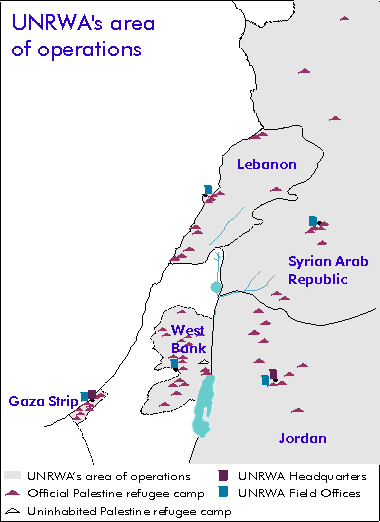
By the end of 2010, the number of Palestinian refugees
on UNRWA rolls had risen to nearly
5 million, several times the number that left Palestine in 1948. In
just the past three years, the number grew by 8 percent. Today, 42 percent
of the refugees live in the territories; if you add those living in
Jordan, 80 percent of the Palestinians currently live in “Palestine.”
Though the popular image is of refugees in squalid camps, less than
one-third of the Palestinians are in the 59 UNRWA-run
camps.
During the years that Israel controlled the Gaza Strip, a consistent
effort was made to get the Palestinians into permanent housing. The
Palestinians opposed the idea because the frustrated and bitter inhabitants
of the camps provided the various terrorist factions with their manpower.
Moreover, the Arab states routinely pushed for the adoption of UN resolutions
demanding that Israel desist from the removal of Palestinian refugees
from camps in Gaza and the West Bank. They preferred to keep the Palestinians
as symbols of Israeli “oppression.”
Palestinian Refugees with UNRWA (Updated January 2013)
| UNRWA Field |
Camps |
Registered Refugees |
Refugees in Camps |
|
10 |
2,034,641 |
369,949 |
|
12 |
441,543 |
238,528 |
|
9 |
499,189 |
159,303 |
|
19 |
741,409 |
216,403 |
|
8 |
1,203,135 |
540,515 |
Agency Total |
58 |
4,919,917 |
1,524,698 |
Now the camps are in the hands of the Palestinian Authority (PA), but little is being done to improve
the lot of the Palestinians living in them. Netty Gross of the Jerusalem
Report (July 6, 1998) visited Gaza and asked an official why the
camps there hadn't been dismantled. She was told the Palestinian Authority
had made a “political decision” not to do anything for the
nearly half a million Palestinians living in the camps until the final-status
talks with Israel took place. In fact, between June 2000 and June 2003,
the number of Palestinians living in camps in the PA has increased by
nearly 50,000 (8 percent) and the overall number of refugees has grown
by 11 percent.
Since 2003 an estimated 19,000 Palestinian refugees have fled Iraq due to harsh, unwelcoming social conditions. Activists in Iraq have reported harassment, attacks, and intimidation from Shiite militias and police forces directed against the Palestinian refugee population.
Syria was home to a large community of Palestinian refugees, who have attempted to flee since the breakout of Syria's civil war. Since the begining of the conflict, an estimated 70,000 Palestinian refugees have fled Syria and have been living undercover in neighboring countries, using fake names and constantly moving. The only country that accepts Palestinian refugees from Syria is Turkey, and if they are caught in Jordan, Lebanon, or Egypt, they face deportation back to Syria.
For decades the refugees have held the UN responsible
for ameliorating their condition. Though many Palestinians are unhappy
with the treatment they have received from their Arab brothers, most
refugees focus their discontentment on “the Zionists,“ whom
they blame for their predicament rather than the vanquished Arab armies.
|