|
The city of Acre (Akko) is one of the
oldest continuously inhabited cities in the world, dating back to the
time of the Pharaoh Thutmose III (1504-1450 BCE).
It is a city
of intrigue, where you can walk through labyrinthine alleys and
streets and explore the remnants of Crusader, Muslim and Ottoman conquerors. Walking along the walls of the city, you also get a
spectacular view of the sea and, on clear days, the city of Haifa.
History
Israel Fact
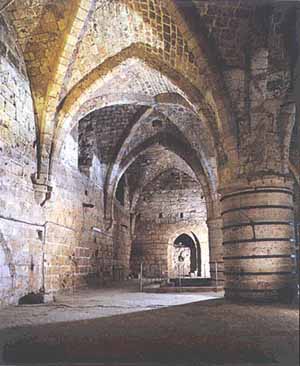
According to legend,
a bulldozer working on the street pavement chipped a corner off a
Turkish building and sand poured out. Archeologists arrived and, as
tons and tons of sand were removed, a huge and magnificent crusader
hall, with three massive columns in the center supporting a
cross-vaulted ceiling, was revealed. |
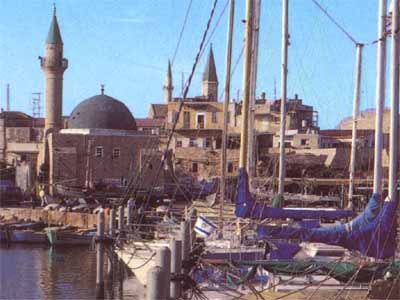
Acre was once a leading port in the Middle East, in
the same league as Alexandria and Constantinople. Today, it is home
primarily to small fishing boats.
A part of the kingdom of Israel, Acre was incorporated into the empire of Alexander
the Great after his conquest in 332 B.C.E. The city was
subsequently seized by the Egyptian king Ptolemy II, who renamed the
city Ptolemais in the 2nd century B.C.E. This name stuck until the Muslim
conquest in the 7th century CE, when its ancient name was
restored. Confusion over what to call the city was compounded by the Crusaders'
conquest in 1104, after which it became known as St. Jean d'Acre, or Acre for short.
In 1291, the Mamluks invaded and destroyed the city, killing every remaining Crusader and
putting an end to the Latin
Kingdom. Acre ceased
to be a major city for almost 500 years. When the Bedouin sheikh Daher
el-Omar carved a small fiefdom out of the Ottoman
Empire in the mid-18th century, he made Acre his capital and built a large fortress. It was subsequently fortified
by the Turkish governor (1775-1804), Ahmad Pasha al-Jazzer ("The
Butcher"). The mosque al-Jazzer built is one of the most
beautiful in Israel and the most distinctive building in the old city.
Israel Fact
King Richard I of
England (1157-99), took Acre in 1191 from the Saracens. He executed
2,700 Muslim prisoners of war; nevertheless, because of his
"valorous" behavior during the Crusade, he became known as
Richard the Lion-Hearted. |
Napoleon landed in Palestine and assaulted Acre in 1799, but he was unable to take the city. His Middle Eastern
campaign subsequently collapsed and he withdrew to France.
Acre fell under Ottoman control until the Turks were defeated in 1918 by the British. The city
subsequently became part of the British
Mandate for Palestine. The British used the ancient fortress,
which had never been breached, as a high-security prison to hold (and
execute) members of the various Jewish
underground groups. On May 4, 1947, members of the Irgun staged a dramatic rescue (dramatized in the film Exodus). Though few Jews escaped, the
audacity of the raid was a serious blow to British prestige and a
tremendous boost for the morale of the Jews. Today, the fort is the
site of the Underground Prisoners Memorial Museum, which depicts the
history of Acre and the
prison. You can go into the death cell where the condemned were kept
and the gallows where a noose still hangs above an open trap door.
Portal to the Past
On May 17, 1948, shortly after the Arab invasion,
Israeli troops took control of Acre and most of the Arab inhabitants fled. It was subsequently
incorporated into Israel after the War
of Independence.
Check out Khan El Umdan, the 18th century structure
where camel caravans once brought grain and produce from Galilee to
the market. The name means "inn of the pillars," for the
fine granite Herodian pillars brought from Caesarea to support the
structure. The clock tower is a much later addition, built in 1906 in
honor of the Turkish sultan Abdul Hamid.
Across
from the mosque is the entrance to the subterranean Crusader city. You can walk down to different levels and see how the Turks built on top of the old city. One of the more spectacular rooms is the
Knights' Halls, which the Hospitallers,
the Order of the Knights of St. John, used as a fortress more than 700
years ago. Today, the main hall is used for concerts. The lowest
level is the Crypt, a great hall that may have been used for great
ceremonies by the Crusaders.
Elsewhere in the city is the home of Baha Allah,
the prophet of the Baha'i faith. His tomb is in a park just outside of town along the Acre-Nahariya
road. As in the headquarters in Haifa, the grounds have spectacular
gardens.
Today, the population of Acre is approximately
40,000 and has one of the higher proportions of non-Jews of any of
Israel's cities, with roughly 25 percent Christians, Muslims, Druze and Baha'is. The city is a magnet for tourists and the home of the
country's steel industry.
Previous
Next
|