The Greeks & the Jews
(332 - 63 BCE)
In the Table of Nations in Genesis 10.1-32, which lists
the descendants of Noah and the nations they founded, the Greeks
appear under the name "Yavan," who is a son of Yaphet.
Yavan is parallel with the Greek word, "Ionia," the Greek
region of Asia Minor; "Yaphet" is parallel with the Greek
word, "Iapetus," who is the mythological father of
Prometheus in Greek legend. Two other Greek nations appear in the
table: Rhodes (Rodanim) and Cyprus (Kittim and Elishah). The sons of
Shem, brother to Yaphet, are the Semitic (named after Shem) nations,
including the Hebrews. Imagine, if you will, the Hebrew vision of
history. At some point, in the dim recesses of time, after the world
had been destroyed by flood, the nations of the earth were all
contained in the three sons of Noah. Their sons and grandsons all
knew one another, spoke the same language, ate the same mails,
worshipped the same god. How odd and unmeasurably strange it must
have been, then, when after an infinite multitude of generations and
millennia of separation, the descendants of Yavan moved among the
descendants of Shem!
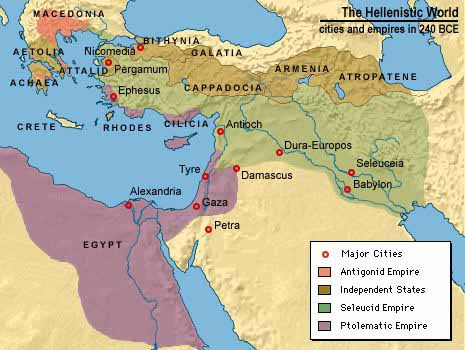 |
They came unexpectedly. After two centuries of
serving as a vassal state to Persia, Judah suddenly found itself the
vassal state of Macedonia, a Greek state. Alexander
the Great had conquered Persia and had, in doing so, conquered
most of the world. For most of the world belonged to Persia; in a
blink of an eye, it now fell to the Greeks.
This great Greek empire would last no longer than
Alexander's brief life; after his death, altercations between his
generals led to the division of his empire among three generals. One
general, Antigonus and then later Ptolemy, inherited Egypt; another,
Seleucus, inherited the Middle East and Mesopotamia. After two
centuries of peace under the Persians, the Hebrew state found itself
once more caught in the middle of power struggles between two great
empires: the Seleucid state with its capital in Syria to the north
and the Ptolemaic state, with its capital in Egypt to the south. Once
more, Judah would be conquered first by one, and then by the other,
as it shifted from being a Seleucid vassal state to a Ptolemaic
vassal state. Between 319 and 302 BCE, Jerusalem changed hands seven times.
Like all others in the region, the Jews bitterly
resented the Greeks. They were more foreign than any group they had
ever seen. In a state founded on maintaining the purity of the Hebrew
religion, the gods of the Greeks seemed wildly offensive. In a
society rigidly opposed to the exposure of the body, the Greek
practice of wrestling in the nude and deliberately dressing light
must have been appalling! In a religion that specifically singles out
homosexuality as a crime against Yahweh, the Greek attitude and even
preference for homosexuality must have been incomprehensible.
In general, though, the Greeks left the Jews
alone; adopting Cyrus's policy, they allowed the Jews to run their
own country, declared that the law of Judah was the Torah,
and attempted to preserve Jewish religion. When the Seleucid king,
Antiochus IV, desecrated the Temple in 168 BCE, he touched off a Jewish revolt under the Maccabees;
for a brief time, Judah became an independent state again.
During this period, Jewish history takes place in
several areas: in Judah, in Mesopotamia and other parts of the Middle
East, and Egypt. For the dispersion of the Jews had begun during the
Exile, and large, powerful groups of Jews lived all throughout the
Persian empire and later the Hellenistic kingdoms
("Hellenistic"="Greek"). The Greeks brought with
them a brand new concept: the "polis," or
"city-state." Among the revolutionary ideas of the polis was the idea of naturalization . In the ancient world, it
was not possible to become a citizen of a state if you weren't born
in that state. If you were born in Israel, and you moved to Tyre, or
Babylon, or Egypt, you were always an Israelite. Your legal status in
the country you're living in would be "foreigner" or
"sojourner." The Greeks, however, would allow foreigners to
become citizens in the polis ; it became possible all
throughout the Middle East for Hebrews and others to become citizens
of states other than Judah. This is vital for understanding the
Jewish dispersion; for the rights of citizenship (or
near-citizenship, called polituemata ), allowed Jews to remain
outside of Judaea and still thrive. In many foreign cities throughout
the Hellenistic world, the Jews formed unified and solid communities;
Jewish women enjoyed more rights and autonomy in these communities
rather than at home.
 |
The most important event of the Hellenistic
period, though, is the translation of the Torah into Greek in Ptolemaic Egypt. The Greeks, in fact, were somewhat
interested (not much) in the Jewish religion, but it seems that they
wanted a copy of the Jewish scriptures for the library at Alexandria.
During the Exile, the Exiles began to purify
their religion and practices and turned to the Mosaic books as their
model. After the Exile, the Torah became the authoritative code of the Jews, recognized first by Persia
and later by the Greeks as the Hebrew "law." In 458 BCE,
Artaxerxes I of Persia made the Torah the "law of the Judaean king."
So the Greeks wanted a copy and set about
translating it. Called the Septuagint after the number of
translators it required ("septuaginta" is Greek for
"seventy"), the text is far from perfect. The Hebrew Torah had not settled down into a definitive version, and a number of
mistranslations creep in for reasons ranging from political
expediency to confusion. For instance, the Hebrew Torah is ruthlessly anti-Egyptian; after all, the founding event of the
Hebrew people was the oppression of the Hebrews by the Egyptians and
the delivery from Egypt. The Septuagint translators—who are, after
all, working for the Greek rulers of Egypt—go about effacing much
of the anti-Egyptian aspects. On the other hand, there are words they
can't translate into Greek, such as "berit,"
which they translate "diatheke," or "promise" (in
Latin and English, the word is incorrectly translated
"covenant").
Despite these imperfections, the Septuagint is a
watershed in Jewish history. More than any other event in Jewish
history, this translation would make the Hebrew religion into a world
religion. It would otherwise have faded from memory like the infinity
of Semitic religions that have been lost to us. This Greek version
made the Hebrew scriptures available to the Mediterranean world and
to early Christians who were otherwise fain to regard Christianity as
a religion unrelated to Judaism. Even with a Greek translation, the
Hebrew scriptures came within a hair's breadth of being tossed out of
the Christian canon. From this Greek translation, the Hebrew view of
God, of history, of law, and of the human condition, in all its
magnificence would spread around the world. The dispersion, or
Diaspora, of the Jews would involve ideas as well as people.
Sources: The
Hebrews: A Learning Module from Washington State University,
�Richard Hooker, reprinted by permission. Maps courtesy of Prof.
Eliezer Segal's site.
|