|
[By: Jacqueline Shields]
Beginnings of a Community
Documents in the archives of the Mexican Inquisition attest to
the presence of Marranos in Guatemala during the colonial period. The
origins of the present Jewish community, however, are from German immigrations who came to the country in the mid-19th-century. The
community formed by these immigrants was small and isolated from the
rest of the Jewish world, and its descendants are mostly no longer Jewish.
The most prominent members of that community were the German Stahl family,
which established cotton mills and for 30 years attended to the government's
banking and financing needs.
Jewish immigrants, whose Jewish traditions are still
present, arrived at the beginning of the 20th century from Germany and Middle East countries, followed
in the 1920s by East European Jews. Many of the latter came via Cuba and considered Guatemala only a transit stop until they could obtain
visas to the United States.
Guatemala was not favorably disposed to Jewish immigration,
and it attempted to limit their arrival. In 1932, the government ordered
the expulsion of all peddlers, the overwhelming majority of whom were
Jewish; although the actual expulsion was averted, peddling was prohibited,
and many Jews faced ruin and were compelled to emigrate. In 1936, under
the influence of the substantial German community in Guatemala, legislation
was enacted to curb immigration of all people of "Asian origin,"
among whom were included Poles, most of whom were Jewish. Due to the
restrictive laws, the Jewish community was reduced to only 800 people
in 1939. Although never formally abolished, these laws have rarely been
enforced since World War II,
and after the war many Jewish refugees entered the country. The majority
of the Jews lived in Guatemala City, the remainder in Quezaltenango
and San Marcos.
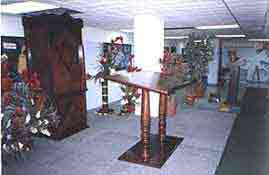 Children's chapel, Centro Hebreo Synagogue
 |
Modern Guatemala
Approximatly 900 Jews live in Guatemala as of 2012, and
the majority of them reside in the capital Guatemala City. The community
comprises three main groups: the German, the Sephardi,
and the East European, each with its own institutions, the Sociedad
Israelita de Guatemala and Bet-El (Reform),
Maguen David, and Centro Hebreo (Conservative/liberal Orthodox) respectively, each
also with their own synagogue. Other organizations, unified under the
Comite Central, include B'nai B'rith, Wizo, and two youth groups, the
Maccabi, and Guafty, a Reform youth movement. The Organizacion Sionista
de Guatemala comprises all Zionist groups.
Jewish school, called Instituto Albert Einstein, founded
in 1957, is authorized by the Ministry of Education and has an enrollment
of 100 children from kindergarten through preparatory levels. The Jewish
press is all but nonexistent. The Spanish-language monthly, which appeared
previously, ceased publication, and only a single communal information
bulletin is published occasionally.
Relations with Israel
Guatemala can boast of two firsts in Israeli history.
It was the first Latin-American country to announce its recognition of Israel,
by Jorge Garcia Granados in the UN immediately after the proclamation of the state. Guatemala was also
the first country to open an embassy in Jerusalem,
under the same Garcia Granados. Later, under international pressure,
the embassy was moved to Tel Aviv.
Israel maintains an embassy in Guatemala's capital, Guatemala City, and has an ambassador that resides there.
Sources:Beker, Avi. Jewish
Communities of the World. Lerner Publications Company,
Minneapolis, 1998.
"Guatemala." Encyclopaedia
Judaica.
Map: CIA
World Fact Book
Childrens Chapel, Courtesy Comunidad
Judia de Guatemala
Tikal Background, Courtesy Bjørn Christian Tørrisse
|