Kovno (Kaunas), Lithuania
by Jono David
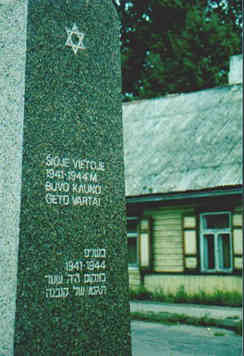 Memorial to the Jews of the Kaunas Ghetto
 |
At the corner of Ariogalos and Linkuvos streets in
the Vilijampole district of Kaunas, Lithuania,
stands a simple, lone granite memorial to those Jews who perished at
the hands of the Nazis in World War II.
It stands like a lone sentinel, keeping a 24-hour watch over the
souls of the dead. Quietly but determinedly, it commands us to heed
its eternal message of remembrance. It was here in this suburban
district known to the Jews as Slobodka that on German orders, the Kovno
(as Kaunas was once called) Ghetto was sealed on August 15, 1941
with 29,000 impounded people. The area had been a Jewish village for
four hundred years.
Jewish history runs particularly deep in
Lithuania. Before the war, some 200 communities across the nation
supported the lives and livelihoods of nearly 240,000 people. More
than ninety percent perished.
History
Jews are first known to have lived in Kovno as
early as 1410 when they were brought forcibly as prisoners of war by
the Grand Duke Vytautas. Many of those Jews were later active as
traders between Kovno and Danzig (today's Gdansk, Poland). Living conditions for many Jews were
squalid. In 1858, archaic living restrictions were relaxed and all
but 6,000 of the city's 35,000 Jews flocked to the Old Town in search
of something better. In July 1941, however, the Nazis expelled all
the Jews from the town and sent them back to Slobodka. The Kovno
Ghetto was thus established.
The first pogrom was on June 25, 1941. On 7 July
1941, Avraham Tory noted in his Kovno Ghetto Diary: "Soviet rule
has disappeared. The Jews are left behind as fair game; hunting them
is not unprofitable, because the houses and courtyards of many of
them brim with riches. Slaughter the Jews and take their property' -
this was the first slogan of the restored Lithuanian rule..." By
October, some 1,800 people were consigned to their deaths in a
smaller Ghetto.
Like other Ghettos, not all the days were tragic.
There were moments of joy betwixt long days of false hope, delivered
with fresh supplies of food or bundles of firewood. Avraham wrote in
his Diary that some cultural events were, remarkably, maintained,
such as a Purim festival and a Passover celebration. On 24
July that year, he wrote that the Zionist party was "a festive occasion, pervaded with splendor."
Remarkably, the Ghetto also organized a symphony orchestra, lectures,
art classes, discussions, and Yiddish classes for children.
Maintaining even a semblance of Jewish life and tradition was as
great a statement of resistance as picking up a gun. But that resistance only lasted so long.
Following the July 1944 liquidation of the Kovno
Ghetto, only a quarter of the Ghetto's original number remained.
Men were then transported to Dachau and women to Stuffhof where they met their barbarous fate.
Kovno Today
Today, not much remains of Kovno but fragments of
that old community: derelict buildings, slanting wooden houses, and
the wonder of what the place was like, both pre- and postwar. It is a
depressed area. If not for the memorial, today's residents of
Vilijampole would apparently be oblivious to the events of fifty-plus
years ago.
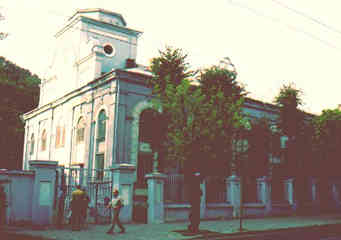 "Die Synagogue"
-- Kaunas
"Die Synagogue"
-- Kaunas |
Today's five hundred or so members of the Jewish
community are certainly not oblivious to their past. On the back wall
of Die Synagogue to the left of the bimah hangs a prominent memorial
to the Lithuanian Jewish communities decimated in the Holocaust.
The names of those communities that were annihilated are spelled out
and presented in tabular form. Whilst appreciating the length of the
list, I stood behind a man who bowed his head in silent memory. When
a fellow community member took a position next to him, they exchanged
a wordless but deep, firm handshake. As it turned out, the first of
three evenings I attended services was quite mirthful despite the
solemn display of remembrance I had just witnessed.
Kaunas has a small though peppery congregation. In
the sanctuary of the synagogue, I
met an aging but spry group of men (no women were present) I had not
expected to meet. The voices of the congregation were particularly
boisterous, rising like a star on a Shabbat evening. I was also impressed with the synagogue's simple beauty, its
stained glass, and grandness, though it appeared somewhat weary from
the outside, fatigued by Soviet occupation. Built in 1871, it is
today the only remaining synagogue in a city which once had some
thirty-six synagogues and prayer houses (the shells of two other
synagogues are located in the Old Town).
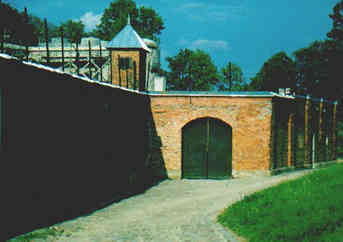 The Path of Death, IX
Fortas, Kaunas
The Path of Death, IX
Fortas, Kaunas |
Kaunas' darkest side is IX Fortas, one of a series
of forts built by the Russians but later used by the Nazis as a
murder factory. Located in Kaunas' northwest outskirts, the fort
failed the Russians in their attempt to defend their western
frontier, falling to the Germans in only eleven days of battle.
Inside, primitive bedding remains firmly behind double meshed bars
covering the windows of the cells. The prison's fortified walls exude
a stale coldness, creating an appropriate somber mood for viewing the
numerous displays of photographs and reports of the gruesome events
which took place here. In addition to the communal cells was the
"Health Room," a 3 meter by 1 meter hole beneath a
stairwell, and the "Wet Room," a fairly spacious but dank
chamber of concrete without a crack of light. I was particularly
drawn to an exhibit on Chiune
Sugihara, the Japanese diplomat in Kaunas (1939-40) who was
personally responsible for issuing 6,000 visas for safe passage out
of Lithuania to Japan.
For those held captive in the IX Fortas, it was a
short shuffle from the front gate down the Path of Death to the Wall
of Death, a corner of a moat-like trench where people were lined up
as targets and shot. Today, this wall is still riddled with bullet
holes and is the fort's starkest reminder of the evil that was
perpetrated here. In all, some 80,000 people from Lithuania, Austria,
France, and other Nazi occupied areas, were slaughtered at the fort,
including most of Kovno's population. Just behind the trench is a
field where the dead were discarded. Today, it is a peaceful spread
of green back-dropped by a new housing development. Adjacent to the
field is the leviathan Monument to the Victims of Fascism, a concrete
crush of desperate faces rising from the earth in immortal
resistance. Behind the synagogue stands a memorial to the 1,800
children who were murdered here.
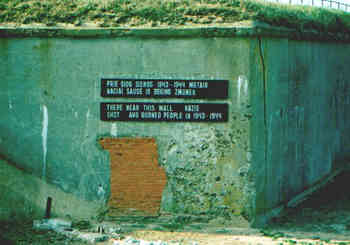 At This Wall Nazis Shot
and Burnt People 1943-1944
At This Wall Nazis Shot
and Burnt People 1943-1944 |
Kaunas became an important center of Jewish
cultural life in the latter half of the 19th century. Distinguished
Jewish leaders moved here from Vilnius,
the capital, to establish yeshivas. Influential thinkers also moved
to Kaunas.
When Vilnius was annexed by Poland during he inter-war years, Kaunas became the provisional capital of
Lithuania. In 1928, there were 1,000 Jewish students at the Vytautas
Magnus University. There was even a Semitic studies program.
In 1931, the Jewish Ethnographic Museum was
opened. Within only a few years, it had collected some 3,000 Jewish
art works and artifacts. By the mid-1930s there were successful
Jewish writers, poets, and artists residing in the city. By 1938, the
Jewish population was nearly 40,000 and the area was a booming hub
for Jewish businessmen, entrepreneurs, artisans, doctors, and
lawyers. Five Jewish newspapers were published daily. There were
schools for all ages, adult training centers, theatres, libraries,
sports clubs, and political groups. Even the Central Jewish Bank of
Lithuania was centered in Kaunas.
The potent influence the Jewish community had in
Kaunas before the war was snuffed out forever but, for their numbers,
the vigor of the remaining Jews most certainly rivals that of past
communities. I was able to discern that energy when Synagogue
President Chatskal Zack zestfully shook my hand on the evening of my
third visit, and eagerly invited me back for the following morning's
Shabbat service.
As I exited, other men standing in the foyer
warmly bid me a "Shabbat Shalom", leaving me with the
impression that all is peaceful again. At that moment, I realized
that those men are the true sentinels of Kovno.
Sources: Jono David. "The Jews of Kovno: Text and Photographs." Jono David Media. Reprinted with permission.
Photos copyright Jono David HaChayim HaYehudim Jewish Photo Library (Jono David Media) |