|
[By: Arye Oded*]
Officially the Republic of Uganda, it is a small land-locked country located in East Africa. Taking its name from the Buganda kingdom, which encompasses a large portion of the south of the country, Uganda gained independence from the British in 1962. It is also home to the Abuyudaya Jewish community.
- Community History
- Semei Kakungulu's Faith To Judaism
- Organization of the Community (1928-1986)
- Abayudaya Observance of the Jewish Laws and Customs
- Contemporary History
Community History
King Mutesa I (1856-1884) of Buganda introduced
far-reaching religious, social, and administrative reforms in his
kingdom. He was motivated by various factors. This shrewd king eager
for knowledge strove to strengthen his kingdom by utilizing the
superior technology that he discovered among the Arab traders and the
Europeans which visited him. His foreign policy was to gain the
friendship of the Sultan of Zanzibar and the support of the Arab
traders; from these he hoped to obtain weapons to establish his
authority over his neighbours and prevent a possible Egyptian
inversion from the North. This is why he declared himself a Christian
and adapted some of the Laws of Islam. This conversion brought about
a drastic change in the traditional local religion and social customs
of the Buganda.
Islam's penetration into Buganda indirectly helped
the spread of Christianity. This struck at the roots of the
established religion and paved the way for a monotheic faith.
Although the first Christian missionaries (Protestants from 1877 and
Catholics from 1879) were generally hostile to the Moslems and Islam,
they admitted that the Moslem religion also had positive aspects and
influences.
The establishment and ultimate triumph of
Christianity over the indigenous religion and Islam were furthered in
the early 1890s by the arrival of the British and by their support of
the Protestant missionaries. Captain F.J.D. Lugard and Captain J.R.
MacDonald, representatives of the Imperial British East African
Company, helped the Christians to rout the Moslems to convert Uganda
into a Christian nation. However, Christianity appeared in Uganda in
Western dress. The Christians not only wanted to teach the principles
of the Christian religion, but also aspired to inculcate Western
Civilization and uproot the local customs. Moreover, Christianity had
a direct political purpose. The Protestant missionaries who came from
England were called Abangereza, i.e. the English, by the local
population, and the Catholic missionaries who came from Algiers,
supported by France, were called Abafaransa, i.e. the French. From
the outset, the two groups fought for key positions and influence in
the state.
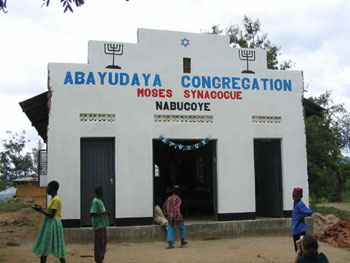
 Namutumba Synagogue
 |
Subsequently, at the beginning of the twentieth
century, religious movements with an Afro-Christian bent began to
appear. These had broken away from the Christian church for
religious, social and political reasons. They opposed the British
administration and the white man's superiority in the Church
hierarchy and demanded the establishment of African leadership.
Moreover, reading the Bible brought to them by missionaries, they
were surprised to notice differences between what is written in it
and the way it was put into practice by the established churches.
The Abayudaya Community arose out of one of these
dissenting groups. Its founder, Semei Kakungulu, broke away from the
church initially because of a personal quarrel with the British.
Subsequently, his adherence to the Old Testament brought him step by
step to Judaism.
Semei Lulaklenzi Kakungulu is one of the most
important and colourful personalities in Uganda history. A successful
military commander, courageous and talented, he rose to fame in
Buganda at the turn of the century. He was a major military and
political figure and played a part in determining....Kakungulu was
born in Koki Kingdom, the son of Semuwemba of the Ganda people who
had emigrated from Buganda. Semuwemba rose to fame rapidly and was
popular with the Koki King. However, before he could be appointed
Prime Minister he fell a victim to a plot in the royal court, and
together with his wife was executed. He was survived by three
daughters and seven sons, one of whom was Semei Kakungulu. The latter
escaped from Koki and reached the Buddu region in the Buganda
kingdom. In 1884, his talented and persuasive personality secured his
appointment by the King of Buganda as a District Chief.
Kakungulu soon proved himself a gifted political
leader and powerful military commander. He began to take an active
part in the King's wars against his neighbours and the religious wars
which broke out in Uganda as a result of the penetration of Islam and
Christianity.
 |
In the 1880's, Kakungulu adopted protestantism and
soon became one of the most distinguished leaders of that community
in Uganda. Between 1888 and 1889, Arab ivory and slave traders
succeeded in imposing their rule in Uganda. They supported the
Moslems but in the war which broke out between the latter and the
Christian, Kakungulus military capability was decisive in routing the
Moslems in 1891. In the wars between the Protestants and the
Catholics that followed, Kakungulu helped to defeat the Catholics in
January 1892. His increasing importance and proximity to the royal
family of Buganda were indicated first by his marriage to the
daughter of King Mutesa I (whom he divorced in 1905), and secondly by
his marriage to the daughter of King Kalema, son of Mutesa I.
Kakungulu led the Buganda successfully in the wars
against Bunyoro, their traditional enemy in the North, and against
the rulers of Busoga in the East. During thes years, the Imperial
British East African Company entered Buganda. One of the obstacles
facing the British administrators was the Moslem-Arab minority, which
despite its defeat in 1889, threatened the British rule. When in 1895
the Moslems rebelled again, Kakungulus help was requested by the
British to subdue them. He gathered an army of seven thousand and
attacked and defeated the Muslems. Lugard called him the first and
most renowned warrior in Uganda.
Kakungulus talented leadership was displayed in
his conquests. He successfully subdued many of the large tribes
surrounding the Buganda Kingdom, and even reached the Sudanese border
in the north. In 1894 Uganda was formally annexed to the British
Empire as a protectorate, and the British, who respected Kakungulus
military abilities, gave him a free hand in his battles against the
tribes. In fact, it was Kakungulu who led the spearhead of the army
which at the end of the 19th century paved way for the British rule
over wide areas of Uganda. There were few British soldiers in Uganda
at that time, and without Kakungulu and his army it is doubtful
whether the British could have controlled the country as easily and
as quickly as they did. Between 1899 and 1902, Kakungulu conquered
Tororo and Palisa Districts, then called Bukedi, to the north of
North-Eastern Buganda and Busoga. In return for his aid, the British
appointed Kakungulu military governor of Eastern province of Uganda
(today Mbale, Tororo, and Palisa Districts). There he found the town
of Mbale which developed rapidly and is now the third largest town of
Uganda.
However, Kakungulus aspirations were more daring
and far-reaching. He cooperated with the British in the hope that
they would recognize him as Kabaka of the Eastern region of Uganda
and treat him like the other kings who ruled in Uganda. Already in
1900 he organized Bukedi as a Kingdom and acted as Kabaka, appointing
chiefs and granting them territory. His position was reinforced by
the British Special Commissioner to Uganda. Sir Harry Johnson, who
visited Kakungulu in 1901 to seek his aid in subduing the Lango
region in northern Uganda and suppressing the Sudanese soldiers
serving in the British army who had rebelled against their officers.
In return, Kakungulu asked the British Government to formally
recognize him as King. According to him, Johnston had agreed to this
request and from the correspondence between Kakungulu and the British
Government on this issue, it appeared that he had good reason to
believe that the British would appoint him Kabaka. In one of his
letters, Kakungulu wrote: My being made Sultan is not my doing but
that of Sir Harry Johnston, the Commissioner. When he saw the good
work I had done for the Government, he made me King of the Bakedi...I
accepted his words in good faith as the words of truthful people are
always to be believed. But the British Government never intended to
recognize Kakungulu as King, and the administrators who succeeded
Johston notified him that his expectations were based on error. The
British Sub-Commisioner of the Central Province remarked that...he [Kakungulu]
had tangible reasons for being under the impression that he was or
would be a Kabaka of Bukedi. As things turned out, he was
disappointed in this respect. In the same letter, the Sub-Commisioner
praised Kakungulu for his constructive efforts for the district: What
was once a dreary waste is now flourishing with gardens and teeming
with life. Good wide roads have been cut, rivers have been bridged
and embankments made through marshy ground, all at his own expense
and for the public use. His past services cannot be over-estimated.
One reason for British opposition to Kakungulus becoming King was the
belief that his Ganda affiliation made it undesirable for him to rule
over other peoples. Another was his jealousy of his rivals, including
the very influential Prime Minister of Buganda, Apollo Kagwa, who
constantly suspected Kakungulu and saw him as a potential competitor.
Moreover, unlike the other kings in Uganda, Kakungulu was not a royal
prince.
The issue of kingship caused tension between
Kakungulu and the British, who threatened to attack him if he
continued to style himself King. In 1902 the British deposed him in
Bukedi, but in 1904 they compromised with him by appointing him a
Saza Chief (Mbale County). In 1906 he was nominated President of the
Lukiko of the Busoga District in Eastern Uganda in order to organize
the local administration.
Kakungulu continued his efforts to gain British
recognition as King but in vein. Eventually he realized that in spite
of all his efforts he would not achieve recognition as a ruler of his
own kingdom and that in fact he had merely been used as a tool to
facilitate the establishment of British rule in Uganda. In 1913
bitterness and disappointment caused him to resign from his positions
in Busoga and to return to Mbale; he abandoned his military
activities and began to concentrate on matters of faith and religion.
In this field also Kakungulu demonstrated boldness and independence.
Semei Kakungulu's Faith to Judaism
The disagreements which Kakungulu had with the British administration
brought him closer to a breakaway from the Christian sect, the Malaki,
so named after its leader Malaki Musajakawa who appeared in Uganda in
1913 and contested the British authorities on religious grounds. The
Bamalaki (followers of Malaki) who called their movement K.O.A.B.--
an abbreviation of Katonda omu ayinza byona which means
"God is omnipotent"-- were dissident protestants whose
faith rested on their devotion to the Bible. Malaki was a disciple of
Joswa Kate Mugema, a rich and influential Buganda chief who refused
to recognize any authority but the Bible and differed from the
protestants on many religious principles. He regarded Saturday as the
Sabbath and requested the British authorities to accept this
officially. To do so would have created difficulties at work and
administrative problems, and thus Mugema clashed with the British on
this issue. He began comparing himself to Moses who was sent by God
to Pharoah (in this case, the British Government) and gave his nation
a new code of laws. Mugema violently fought any sign of idol worship.
He forbade his followers to eat pork, but allowed polygamy, claiming
that the patriarch Abraham married more than one wife. In this too,
he deviated from accepted Christian practice. But the most important
principle in the new faith, which spread rapidly through Uganda (in
1921 there were about 100,000 believers), was violent opposition to
the use of medicines and immunizations for humans and animals.
Doctors were regarded as Satan's representatives. If God could save
man from the burning fiery furnace (Daniel 3), he could definitely
help them in time of illness, no matter how severe. There was no need
for human aid--faith alone would suffice. The Malaki referred to the
Old Testament on this question, quoting amongst many other verses,
Jeremiah 46:11: In vein shall you use many medicines; for you shall
not be cured. Their objection to immunization during an outbreak of
plague resulted in violence between them and the British authorities.
Their leader Malaki was exiled to northern Uganda in 1926 and died
that year of a protracted hunger strike.
Kakungulu, bitterly disappointed by the British
authorities, willingly cooperated with the Malaki and helped to
spread their creed throughout the Eastern Province from his centre in
Mbale.
Kakungulu began to study and meditate on the Old
Testament for long periods. His attitude was stricter than that of
the Abamalaki, and he demanded the observance of all Moses
Commandments, including the law of circumcision. The Abamalaki
opposed this, claiming that Jews did not believe in the New Testament
and Jesus Christ. Kakungulu replied: If this was the case then from
this day I am a Jew (Omuyudaya) This was in 1919. Kakungulu was
circumcised, and he circumcised his first born son (Yuda). He
circumcised his second son on eight days of birth and called him
Nimrod (Nimulodi). He subsequently circumcised all his sons and urged
his supporters and members of his family to observe this rite. Many
of them did so. Kakungulu showed his devotion by calling his children
Biblical names such as: Yuda, Israel, Nimrod, Abraham, Jonah, and
Miriam.
Kakungulu's circumcision of himself and his sons
demanded that his followers observe this practice. The Ganda abhorred
and forbade any mutilation of the body and regarded circumcision as a
violation of their traditional law. (The Baganda are the only Bantu
tribe who do not mutilate their persons.)
Kakungulu compiled a special book of rules and
prayers in Luganda for the members of his community. The book, which
was printed in 1922, is called Ebigambo ebiva mukitabo ekitukuvu
(Quotations from the holy book). The contents of the book show
clearly how far Kakungulu had moved away from Christianity to
Judaism. The book, ninety pages long, is actually a guide to the
Jewish religion and a handbook for the teachers of the community. In
it, Kakungulu continually demanded complete faith in the Old
Testament and all its commandments. It is true, Kakungulu said, some
claims that the Old Testament was old fashioned and anachronistic,
but he himself did not believe this. They say,Kakungulu pointed out,
that the era of Sabbath has passed. To them I say, Open Genesis 2:2-4
where it says And on the seventh day God ended his work which He had
made, and he rested on the seventh day from his work which he had
made. And God blessed the seventh day and sanctified it because that
day he had rested from all his work which God created and made. Here
God appointed the day of rest on the seventh day, Saturday, and one
must not change it. Look also in the Book of Exodus 20:8-10, where it
says in the Ten Commandments, Remember the Sabbath Day to keep it
holy...God himself sanctified this day and commanded that it should
be observed and how can we violate this commandment about the
Sabbath? This is just one example which emphasizes how Bible study
drew Kakungulu away from Christianity and how he regarded the Old
Testament as the basis of his religion. In 1923 he built a small
temple for himself and his followers near his house in Pangama.
Some Christian leaders tried to influence
Kakungulu to return to Christianity and in his book there is a letter
from a Christian minister, L.M. Bingamu, sent from England on 15 July
1921. The Englishman wrote that he had heard of Kakungulu's search
for the true road to God and stressed that Òthere is no true road
other than brought by Jesus. Kakungulu replied that the right way was
that of the Jews, quoting many verses from the Old Testament to prove
this, including Zachariah 8:23: Thus says the Lord of hosts: In those
days it shall come to pass that ten men shall take hold out of the
languages of the nation, even shall take hold of the skirt of him
that is a Jew, saying we will go with you: for we have heard that God
is with you. Kakungulu concluded that this was clear evidence that
one must join Jews. Kakungulu appointed teachers of the law,
Abawereza, from his own mission school near his house. To be a
confirmed Muwereza, one was to be able to read and write the Luganda
language; he was to say the words found in Det. 32:1-44 in sweet
melody at heart. Some of his Abawereza teachers of the law are
mentioned below:
	(1) Yekoyasi Kaweke
	(2) Zakayo Mumbya
	(3) Zakayo Luwandi
	(4) Samson Mugombe
	(5) Yokana Keki (changed his name later to Jonadab)
	(6) Yokana Mulefu
	(7) Eria Musamba
	(8) Kezekia Sajjabi
	(9) Saulo Kutakulimuki
	(10) Zakayo Balozi
	(11) Isaac Kizito
	(12) Yokana Naide
	(13) Yakobo Were
	(14) Yakobo Kasakya
	(15) Yokana Wetege
	(16) Yakobo Bbosa
	(17) Mubale Petero
	(18) Daudi Kamomba
In 1923 Kakungulu was obliged to retire from his last official post
as a Saza Chief of Bukedi, as his religious opinions prevent his
carrying out his duty as a chief. Kakungulu accepted a pension from
the British Government. In 1926 an additional stage began in the
Abayudaya's approximation to Judaism as a result of Kakungulu's
meeting with a Jewish trader named Joseph. In that year Kakungulu
went to Kampala to attend a lawsuit over land ownership, and there he
met Joseph. A strong, sincere friendship developed. Joseph was amazed
to hear of Kakungulu's conversion to Judaism, but was more astonished
at his Jewishness and his confused concepts of Judaism and its
relationship to Christianity and the New Testament. But he agreed to
Kakungulu's request to instruct him in the Jewish faith. Kakungulu
invited Joseph to his home in Mbale, where he stayed for about six
months teaching Kakungulu the principles of Judaism.
Following the meeting with Joseph great changes
took place in the religious life of the Abayudaya: they ceased to
believe in the New Testament and Jesus Christ. In order to prevent
any confusion, Kakungulu instructed them not to use the word Mukama,
meaning Lord, which to him designated Jesus Christ and instead
ordered the use of the word Yakuwa, meaning God. They kept the
Sabbath strictly and transgressors were severely punished; they
prepared their Sabbath food on Fridays; they began to work on
Sundays; they deleted all the Christian prayers from their book
Kakungulu began to compile a new book devoid of quotations from the
New Testament, but he died before he was able to publish it. Joseph
had taught them the blessings and also the customary Jewish prayers.
Head-covering was practiced, and Kakungulu began to wear a white
Jewish robe which he had seen in Joseph's possession. The teachers at
the school which Kakungulu built for the community were turbans
similar to those which Kakungulu had seen in pictures of the early
Jews circulated by the missionaries. The custom of baptizing children
was stopped.
Joseph taught Kakungulu the slaughtering ritual
and the Abayudaya ate only meat slaughtered by themselves. The months
of the year were called by their Hebrew names and all the festivals
and feasts were celebrated. Kakungulu even divorced his wife, whose
marriage was not in accordance with Jewish Laws. She was a Protestant
and refused to become Jewish. Joseph began to teach Kakungulu and the
elders of the community the Hebrew alphabet. None of the elders
remember where Joseph came from although some think it was Ethiopia
or even Jerusalem. Before Joseph left, he presented Kakungulu with a
large Bible written in Hebrew and English. The elders of the
community also tell of Kakungulu's meeting in Kampala at that time
with another Jew called Moses, who used to accompany Joseph when
teaching Kakungulu.
Kakungulu did not force Judaism on his
subordinates, tenants and members of his household, but tried to
persuade them of the truth of his religion through explanations and
deeds. Kakungulu liked to conduct the prayer service, deliver sermons
and explain principles of the Jewish faith. Those of his people who
agreed to accept Judaism were granted easier terms at work and more
honourable status. Kakungulu gave the converts presents and clothes,
paid their taxes and took a paternal interest in them (according to
Samson Mugombe who mentioned that this is one of the reasons for
conversion).
The elders of the Abayudaya community recall that
in 1927 Kakungulu met a third Jew called Isaiah Yari. Isaiah was a
foreman during the construction of the Uganda railway in the town of
Tororo, which is about 28 miles from Mbale. He approached Kakungulu
requesting him to provide labourers. Isaiah treated the Abayudaya
well, rested with them on Sabbath and prayed with them. He and his
son Solomon met Kakungulu several times and taught him more about
Judaism emphasizing that the Jews did not believe in Jesus Christ.
According to the leader of the group of Abayudaya labourers, Elia
Musamba, Isaiah was transfered to elsewhere after a month in Tororo
because he refused to make the Abayudaya work on the Sabbath
(Saturday).
Until his death, Kakungulu maintained his
oppositions to the use of medicines, believing that the Bible forbade
it. He even refused to let his cattle be inoculated. On this issue
there were many misunderstandings between Kakungulu and the British
administrators, and when the latter inoculated 1200 heads of
Kakungulu's cattle against his wishes, he decided to present these
cattle to the Government having been inoculated. Despite his
encounters with Jews, who certainly told him that the use of
medicines was not against the Law, he did not retract his opposition
to doctors and medicines.
Kakungulu died in Mbale on 24 November 1928 by
which time, according to the elders, the Abayudaya numbered
approximately two thousand.
Kakungulu was survived by four sons: Yuda Makabee
(who was apparently sickly, but refused medical care by Kakungulu),
Nimrod, Ibulaim Ndaula, and Israel. Ibulaim Ndaula became a Christian
after his father's death.
Ten years after Isaiah's visit, the Abayudaya met
another Jew, David Solomon, who was born in India and arrived in
Uganda in the late Twenties'. In 1937 Solomon was instructed to
establish a pumping plant near Mbale. he recounts how, when he was in
Mbale, some ten Africans appeared, wearing white robes and head
coverings and watched him with much curiosity. When he asked what
they wanted, they answered that they had heard he was a Jew, and
therefore, they came to visit him because they themselves were Jews.
At first Solomon thought the Africans were mocking him; but when they
showed him a copy of the Bible in Hebrew with an English translation
(received from Joseph) and described some of the principles of the
Jewish religion, he was convinced that they really were Jews. From
then on he visited the Congregation in the course of his work and
sent them Hebrew calenders.
Organization of the Community (1928-1986)
The community was organized along the lines laid
down by Kakungulu. The principle officers in the community were the
secular leader, the religious leaders and teachers.
The secular leader who was in charge of temporal
matters was the most influential man in the community whose loyalty
he commanded. The religious leader was the final authority on
spiritual problems, which he solved on the basis of the Old
Testament. He conducted the prayer services and acted as a
circumciser (mohel). He was called the Levite or Kabona which in
Luganda stands for priest (kohen in Hebrew). This function was
derived from Ezekiel 44:33: You shall give unto the priest the first
of your dough, that he may cause the blessing to rest in thine house.
Kakungulu combined the secular and the religious
leadership. He determined religious questions and conducted the
prayers. Before his death he appointed his friend Isaka Kizito as his
successor. The latter had also belonged to the Malaki sect and had
later become a Jew. However, he refused the appointment and in his
place Kakungulu designated Katikiro (Prime Minister) Yekoyasi Kaweke.
Kaweke was succeeded in 1944 by Samson Mugombe.
The first priest was Paulo (who changed his name
to Saulo). He was later succeeded by Zakayo Mumbya.
As Kakungulu did not clearly define the
organizational structure of the community or the division of
authority, there was often over-mapping in jurisdiction, and
quarrels. Zakayo attempted to acquire the joint position of secular
and religious leader as Kakungulu had. He claimed to be worthy of
this by virtue of his age and learning on matters of Bible and
religion. Samson Mugombe opposed this and claimed the secular
leadership for himself. As a result of this quarrel the community
split into two. It also brought religious differences to the surface.
Zakayo, embittered and disappointed, considered returning to
Christianity. Samson Mugombe, who was younger and more politically
active, succeeded in isolating Zakayo and winning the loyalty of the
community. This division continued until 1962 when Arye Oded visited
the community.
After being briefed about the division, Oded
called on a joint meeting to reconcile the two parties. Both Samson
and Zakayo participated in this meeting. When it became clear that
Samson Mugombe and his followers were observing Jewish Laws with
greater strictness and correctness, Zakayo abandoned his opposition
to Mugombe and the schism was healed. Zakayo had limited authority,
and, because he was in poor health, his influence was almost
negligible. Nevertheless he was regarded as the most important elder
and was consulted on religious matters.
Another clearly defined group is the teachers or
Abawereza. These were responsible for the education of converts who
joined the community. They taught Jewish Laws in the synagogue on
festivals and Sabbaths.
Abayudaya Observance of Jewish Laws & Customs
The Abayudaya regarded themselves as Jews. They realized, however,
that their isolation from the Jewish world had prevented them from
learning all the rules and commandments. Nevertheless, they strove to
be perfect Jews and wished to acquire knowledge of those laws on
which they had been unable to obtain instruction. The Old Testament
had been their only guide and the observance of every law prescribed
in it, including circumcision, fasts, prayers, festivals and
Sabbaths.
The centre of the community life was the Nabugoye
on Nabugoye Hill. Semei Kakungulu ordered a twenty-acre area be set
aside for the synagogue and school, and he also instructed that the
rent from the tenants who lived on that land be solely for the use of
the development of the community. Kakungulu himself began the
foundations for what he called the House of God (Enyumba ya Katonda),
but did not live to complete it.
The synagogue which the Abayudaya built on this
land was poor structure, fifty meters long by ten metres wide,
consisting of a wooden frame and plastered over. Only in 1964, by
means of a contribution of $100 received from the World Union for the
Propagation of Judaism were they able to lay a concrete floor.
The synagogue was long called the Jewish church
until the community learned the Jewish place of worship was called a
synagogue. Since then it has been called Moses Synagogue. It lacked
both the Holy Ark and Scroll of Law, neither of which had been seen
by any Abayudaya elders. The Old Testament was the only holy book
they possessed. Their alter was a simple wooden table traditionally
covered by three cloths coloured light blue, red and white, laid on
on top of the other. This custom was introduced by Kakungulu on the
basis of the verse in the Bible which describes the ephod as gold and
blue and purple and scarlet (Exodus 27:8). Worshippers covered their
heads, most commonly with a white skully turban. Two large drums were
suspended on a tree near the synagogue to call the Congregation for
prayer.
The Congregation met for prayer in the synagogue
on Sabbath and festivals. During the week the Abayudaya prayed at
home. The only prayer book was the Old Testament; the old prayer book
with its strong Malaki influence had been abolished.
The Sabbath and festival prayers included the
section beginning Give ear...(Deuteronomy 32). The Congregation sang
the verses of the section to a pleasant melody, and between each
group of verses Samson Mugombe (or Cantor Yakobo) read excerpts from
various parts of the Old Testament. The melodies were taught by
Kakungulu himself. Near the alter stood Samson Mugombe, next to him
Zakayo, and the teachers; opposite them were two rows of wide
benches. The men sat at the right of the hall and the women at the
left.
During one of the visits made by Arye Oded to the
community in 1965, he was asked if a prayer existed which included
all the articles of faith. He indicated the prayer I believe... which
includes the thirteen principles of the Rambam (Rabbi Moshe ben
Maimonides) and pointed out that these were usually included in the
Jewish prayer books.
These principles were translated into Luganda by
Isaac Kakungulu, grandson of Semei Kakungulu, and since then were
read with the prayers. Samson read each article aloud, and the
Congregation repeated it. A prayer and sermon ended the service. In
the sermon, Samson Mugombe read verses of topical interest and called
on the Congregation to strengthen themselves through belief.
Afternoon and evening prayers were recited at home privately.
 Hadassah School
 |
During the prayers the hands of the people were
open, asking the grace from God. This custom was originated by Semei
Kakungulu. Although they knew about the religious articles, such as
phylacteries and prayer shawls, having seen them in books and
pictures, they did not use them as they were unobtainable. At the
request of Samson Mugombe, Mr. Oded sent him a prayer shawl, and he
alone wrapped himself in it during prayer. Among all the congregants,
only Mugombe had a Mezuzah (Hebrew parchment scroll containing
Deuteronomy 6:4-9 and 11:13-21 fixed to the doorpost in a wooden or
metal case) made of a piece of bamboo fixed to the door of his house.
He apparently received it from David Solomon. The rest of Abayudaya
did not have them because these too were unobtainable.
One of the questions which led to the disagreement
between Samson Mugombe and his deputy Zakayo was the direction in
which to turn during prayer. Samson instructed his followers to face
the West, while Zakayo instructed his to face East, but Mugombe
claimed this would be interpreted as praying to the rising sun.
During one of the visits made by Oded to the community, he explained
that all Jews prayed facing Jerusalem; since then, both Samson and
Zakayo agreed to pray in this attitude.
The Abayudaya observed all the festivals mentioned
in the Bible; they built tabernacles on Succot and slept therein;
they did not eat leaven bread during Passover; during Pentecost, the
harvest festival, they brought in the first fruits of the earth and
then sold them using the money for the needs of the synagogue. The
day of atonement was a sacred day, strictly observed as a fast.
Samson and Zakayo differed over the dates of
festivals, Zakayo claiming the holiday dates fixed by Samson Mugombe
were inexact. Samson determined the dates according to an old
calender which he possessed, and, on examination, these dates proved
to be surprisingly accurate. Arye Oded pointed out this fact to
Zakayo, who then agreed to accept Samson's decision on the matter.
Even in Kakungulu's time, the Abayudaya knew the Hebrew names of the
months of the year, and they used them in their letters.
The community observed the practice of ritual
slaughter. They did not eat meat from animals slaughtered by
strangers or the meat of prescribed animals, nor did they eat blood.
Before the ritual slaughter the Shohet (ritual slaughterer) read
Leviticus 17:13-16: And whatsoever man there be of the children of
Israel, or the strangers that sojourn among you, which huntesth and
catcheth any beast or fowl that may be eaten; he shall even pour out
the blood there of, and cover it with dust....
Circumcision was the first commandment which
Kakungulu accepted at the time of his conversion. Long before he met
Joseph male infants were circumcised when they were eight days old.
During the ceremony the circumciser read from Genesis 17:10-14: This
is my covenant which ye shall keep between me and you and thy seed
after thee every man child among you shall be circumcised.... Jonadab
Keki acted as a Mohel (a circumciser).
Before Joseph's arrival those that wished to
accept the Abayudaya religion were baptized in a river. Joseph
explained to Kakungulu that there was no need for baptism; the
convert needed only to be circumcised and to declare his acceptance
of the Commandments. In accordance with those practices, the
Abayudaya taught the principles of Judaism to whoever wished to
convert. When the teacher was satisfied with the knowledge and
convinced of the sincerity of the applicant, texts from Deuteronomy
were read to him including 26:16-17: This day the Lord thy God has
commanded thee to do these statutes and judgments: you shall
therefore keep them with all they heart and with all they soul... The
convert was sworn that he accepted Judaism and was given a Biblical
name, and if he was not circumcised, this was to be done. The
ceremony was concluded with the reading of the entire chapter Isaiah
44: Ye now hear, O Jacob my servant and Israel who I have chosen...
Parents were required to ensure their children's
education in the Jewish commandments. Instructions were given at the
synagogue.
The Abayudaya did not know about the laws
concerning phylacteries and use them as all Jews do. This desire has
not been fulfilled with the reason that they are not obtainable.
Marriage was permitted only between Abayudaya.
Those who married outside the community and whose spouses did not
convert were no longer considered Jews. Joseph taught the Abayudaya
about obligatory head covering. On Sabbath and festivals the
community wore white robes with full sleeves and colourful sashes,
giving their dress a festival appearance. According to Mugombe this
was how Joseph dressed for festivals.
Kakungulu, influenced by the Malaki usages,
refused to take medicines and would not even immunize the animals he
owned. His grandson, Isaac Kakungulu related that Semei Kakungulu
died of malaria after refusing to take any drugs. Kakungulu based his
refusal on Jeremiah 40:11 and on Job 13:4, But ye are forgers of
lies, ye are all physicians of no value.
The Abayudaya now have repealed this prohibition
having learned that it was not a part of modern Jewish practice.
In the prayer book compiled by Semei Kakungulu in
1922, which included sections from the New Testament and Christian
prayers, Jesus Christ was called Mukama (a translation of Jehovah).
After meeting Joseph, Kakungulu instructed that the word Mukama
should be deleted and the Luganda word Yakuwa be used when God was
mentioned. In 1965 a general meeting of the leaders of the Abayudaya
was held over the discontent that had arisen from the elimination of
the word Mukama. Samson and Zakayo stressed that in many languages
the Creator was called by different names, but in order to emphasize
the Abayudaya's disbelief in Jesus Christ they were not to use the
word Mukama, so as to prevent confusion among the rank and file
Abayudaya. Mugombe and Zakayo's view was unanimously accepted.
Kakungulu's death in 1928 deprived the community
of strong leadership. Some of the Abayudaya returned to the Malaki
sect; others converted to Protestantism or Catholicism. The contest
for succession had a harmful effect. Zakayo, Samson Mugombe's rival,
broke away with several followers and drew nearer to Christianity.
This personal rivalry caused disputes over religious issues. The
Abayudaya did not have the means to maintain the synagogue school
which they had built. Ibulaim Ndaula Kakungulu, son of the founder,
born a Jew and circumcised in accordance with the Law, converted to
Christianity while he was a pupil at an Anglican Church school, but
still felt close to the community and helped it. As most of the
Abayudaya were tenants on the land which he had inherited from his
father, Ndaula dealt with them fairly, often intervening on their
behalf with the authorities.
Another grave danger that threatened them was
intermarriage. Owing to the small number of young men in the
community, the girls married men of other faiths, and thus became
lost to the community. The main factor in its disintegration,
however, was undoubtedly the Abayudaya's complete isolation and lack
of contact with World Jewry. There was no Jewish body to encourage
and help the community, which caused much disintegration and
dependency in it. In 1961 the number of the Abayudaya fell to about
300. Subsequently some contacts were made with World Jewry, an aim
towards which the Abayudaya had been striving for many years.
Following these, some strengthening of the community occured. In 1971
the number had risen to 500 lives and was expected to exceed that due
to the proposal the Israel Embassy to Uganda had made to build a
permanent synagogue for the community.
Contemporary History
In the fall of 1992, the leaders of the
Abayudaya asked to be assisted in achieving four goals:
-
Complete a brick and mortar synagogue to
replace the deteriorating Moses Synagogue. Construction on the
building began in the mid-1980's but the local government,
unsupportive of their religious beliefs, halted the building.
Campus Jewish Appeal of Rappaporte Hillel of Brown University,
led by David Widzer, contributed one-ninth of its campaign in
both 1993 and 1994. These funds (approximately $1500) were enough
to complete the synagogue.
-
Get a Torah. The Abayudaya never had a Kosher
Torah. The new Moses Synagogue included an ark that was carved
into the back wall of the synagogue. Ellen Meyer proposed to
Congregation Beth Shalom, of Wilmington, Delaware, that they
contribute one Torah. Beth Shalom agreed, and in November 1995,
Matthew Meyer brought the Abayudaya their Torah. The community
broke into song.
-
Receive a rabbi. Gershom Sizomu dreams of
studying to be a rabbi. He, and the entire community, was eager
to have a rabbi lead services in Moses Synagogue. In 1995, two
rabbis, Jacques Cukierkorn, of Arlington, Virginia, and Hershy
Worch, of Melbourne, Australia, visited the Abayudaya.
- Become less isolated. The Abayudaya want to
have more interaction with the outside Judaic world. Tell your
friends about the Abayudaya and write them for a pen pal.
Ugandan President Yoweri Museveni sent 200 Ugandan students to Israel for a one-year agriculture internship in Israel in September 2014. Museveni said that the country is looking for farmers in order to improve their economy, and that the government will match 2:1 any money that the students come back and put into agricultural enterprises. They believe that learning from Israeli farmers who prosper even in a dry country will allow them to improve the farming practices in their own country that is plauged by a lack of rain. The students were selected from Ugandan Universities and will be paid a stipend of $60 per day while working the Israeli fields and learning how to best bring successful agricultural practices back to Uganda. When the program ends the students are tested and awarded diplomas in agricultural studies.
In March 2016, the Ugandan people elected their first ever Jewish Member of Parliament. Rabbi Gershom Sizomu, leader of the 2,000 strong Abayudaya Jewish community was declared the winner after a heated race including seven other candidates. The Rabbi will represent Bungokho North, a farming district near the Kenyan border outside of the Ugandan town of Mbale. This marks the first time that Ugandan Jews have had any sort of governmental representation: “Now they will see that we exist, that we are participating in our country's development and growth,” said Sizomu during a phone interview.
Sources: The
Abayudaya Jews of Uganda;
Abayudaya
Community in Uganda.
Photos courtesy of Noam
Katz;
Oded, Arye. “The Bayudaya of Uganda: A portrait of an African
Jewish Community,” Journal of Religion in Africa (1974). Pages 167-186;
Oded,
Arye. Religion and politics in Uganda: A study of Islam and
Judaism Nairobi: East African Educational Publishers, 1995;
Twaddle,
Michael, Kakungulu & the Creation of Uganda 1868-1928
Ohio University Press, 1993;
Kestenbaum, Sam. “How a Rabbi Became the First Jewish MP in Uganda,” Forward (March 4, 2016);
* Dr. Arye Oded joined the Israeli Foreign Ministry 1958 and served in several countries including Uganda and Malawi and as ambassador to Kenya, Zambia, Mauritius, Swaziland, Lesotho, and the Seychelles. He is now senior lecturer at the Institute of Asian and African Studies, and research fellow at the Truman Research Institute.
|