Virtual Jewish History Tour
Jews of the Former Yugoslavia After the Holocaust

By Stephanie Persin
The former Yugoslavia is made up of 5 separate countries:
Serbia
and Montenegro, Macedonia, Bosnia-Herzegovina, Slovenia, and
Croatia. The history of these regions is similar because Jewish communities,
before the Holocaust, were prevalent
throughout Yugoslavia.
There is evidence of a Jewish population in the area
of the former Yugoslavia that dates back to the Roman
Period. Most documentation, however, suggests that Jews were not
prevalent in the former Yugoslavia until the 10th century C.E.
Yugoslavia after WWII
The former Yugoslavia was liberated in 1944. After
the war, the region became known as the Democratic Federal Yugoslavia.
Throughout the entire region, only 14,000 Jews returned. The Jews wasted
no time, and the Federation of Jewish Communities was quickly opened.
Many of the Jewish communities throughout Yugoslavia were reclaimed.
In 1946, the government in Yugoslavia changed again,
and it became known as the Federal People's Republic of Yugoslavia
The Zionist attitude
of the Yugoslav Jews was also reestablished and, in 1948, the Federation
of Jewish Communities gained the right to begin emigration to Israel.
Eight thousand Yugoslav Jews moved to Israel in 1952. With the immigration
to Israel, the population of Jews
in Yugoslavia continued to decrease.
By April of 1963, the government turned over again,
and the area became known as the Socialist Federal Republic of Yugoslavia.
The Jewish community that remained in Yugoslavia was
especially concerned with Jewish cemeteries and the building of memorials
in honor of victims of the war. As is true of many postwar Jewish communities,
the religiosity of Yugoslav Jews diminished upon their return from the
camps. There were no religious services after the Holocaust, and after
1968, the community had no rabbi.
In place of traditional services and holidays, the Jews of Yugoslavia
took to commemorating special days in honor of their family members
who died in the war.
Currently, only 5,500 Jews live in the former Yugoslavia.
While it is a small population, the Yugoslav Jews are fairly well integrated
within the international Jewish community.
While many Jews have left the area of the former Yugoslavia,
their monuments and synagogues remain. One synagogue is particularly
well-known both for its beauty and for its present state of devastation.
The Subotica Synagogue
is located in the city of Subotica (within the area of Serbia and Montenegro).
The synagogue was built in 1902, and while its beauty remains, it is
in need of major renovations. The synagogue is one of the last architectural
structures built in the Secessionist style of the early 1900s. Yhe World
Monuments Fund listed the Subotica Synagogue as one of the 100 most
endangered memorial sites. Both the World Monuments Fund and the Jews
of Serbia and Montenegro are attempting to restore the Subotica Synagogue
and are asking for donations from the international community.
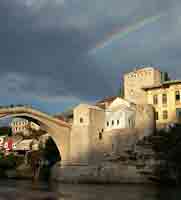
Mostar in Bosnia-Herzegovina
|
The Breakup of Yugoslavia
In 1991, Yugoslavia's republics began their violent
breakup. While the entire region was negatively affected by the breakup,
Jews, in particular, were thrown into the middle of the situation. Anti-Semitism
was not blatant during the 1990s, but rather, it was used as a way
to win Jewish favor. Both the Croatians and the Serbs accused each other
of anti-Semitism, hoping to bring Jews to their own side. By 1992, the
countries of Macedonia, Croatia, Bosnia-Herzegovina, and Slovenia had
broken from Yugoslavia.
This caused another structural change in Yugoslavia,
and in 1992, the region became known as the Federal Republic of Yugoslavia.
Thousands of Yugoslav citizens, including many Jews,
were forced to leave their homes because of the violence. The civil
war in Yugoslavia destroyed many Jewish landmarks including famous synagogues
and memorials to the Holocaust.
Because of the continuing violence in the area, the
American
Jewish Joint Distribution Committee (JDC) coordinated evacuations to Israel. In 1992, almost
all of the Jews in Sarajevo were flown to Israel.
The breakup of the former Yugoslavia led to a breakup
of the Yugoslav Jewish communities. Jewish towns in Serbia and Montenegro
as well as Bosnia and Croatia became completely autonomous after 1992.
There is no umbrella organization to The Jewish communities of Yugoslavia
are no longer connected to each other.
Sources: American
Jewish Joint Distribution Committee
Centropa
Quarterly
ISJM
Jewish Heritage Report, Vol. II, nos 3-4
Jewish Telegraphic Agency report: June 23,
2005
Slovenia
News, (March 4, 2003)
The
Encylopaedia Judaica
The
Jewish Encyclopedia
Photographs:
Alan
Grant Travel Photography
|