Barcelona, Spain
Barcelona is the second largest city in Spain.
It is located on the Mediterranean coast
between the mouths of the rivers Llobregat
and Besòs.
Jewish History
 Depiction
of Jewish forces
fighting with the army of Muhammed
IX,
Nasrid Sultan of Granada,
at the Battle of Higueruela, 1431.
Depiction
of Jewish forces
fighting with the army of Muhammed
IX,
Nasrid Sultan of Granada,
at the Battle of Higueruela, 1431. |
According to archeological evidence there existed a sizeable Jewish community in the province of Catalonia, where Barcelona is located, from as early as the beginning of the Common Era. For centuries thereafter, the Jews of Barcelona managed their own local affairs and lived relatively well while confined to the Juderia (Jewish quarter).
In 1263, King James I of Aragon convened a religious disputation in Barcelona with the aim of convincing the Jews to convert to Christianity. Nachmanides, the great Jewish sage and bible scholar, was called upon to represent the Jews of Spain. The disputation lasted four days, during which time Nachmanides argued passionately for the validity of Judaism, and the Jewish community of Barcelona waited nervously for the King’s reaction. At the end of the disputation King James I awarded Nachmanides a large some of money for his eloquence and famously stated that he had never heard someone argue so well for such an unjust cause. Yet, despite the King’s kind words, Nachmanides was later forced to leave Spain and eventually went on to settle in the Land of Israel.
By
the fourteenth century the situation of the
Jews of Barcelona and all of Spain had
worsened significantly. Numerous anti-Semitic decrees
were enacted by the monarchy and Catholic
Church, and many Jews converted to Christianity
while secretly adhering to Judaism to
escape persecution. On Ash Wednesday
1391, a series of Church-led riots broke out
across the country. The riots reached Barcelona
in early August, during which time thousands
of Jews were murdered or forcibly converted.
While the Jewish expulsion from
Spain did not occur until the reign of King
Ferdinand and Queen Isabella in 1492, all the
Jews of Barcelona either fled or converted
years earlier following the riots of 1391.
Barcelona
remained devoid of any Jewish presence for
more than five hundred years until several Ashkenazi and Sephardic Jews
came from North Africa and Eastern Europe
at the beginning of the twentieth century. Today,
an estimated 3,500 Jews reside
in Barcelona, making it the largest concentration
of Jews
in Spain. In addition to its two functioning synagogues (one Ashkenazi and
the other Sephardic),
the Barcelona Jewish community also has a
Jewish day school, old age home, Chabad house,
and an annual Jewish film festival.
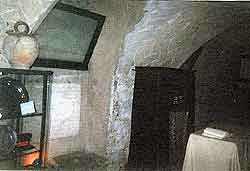 Barcelona Synagogue
 |
Visiting Today
What remains in Barcelona today is but a remnant of the rich Jewish culture that existed during the Golden Age of Spain. One of the main attractions that is still in existence is the ancient Call (Juderia, or ghetto) and the Sinagoga Mayor of Barcelona. Originally built during the fifth century, a new synagogue was later built on top of it in the fourteenth century and additional floors were added to the building in subsequent centuries. Despite perhaps being the oldest synagogue in Europe, the Sinagoga Mayor was forgotten and abandoned until the twentieth century until which point it was used for many purposes including a storage house and dry cleaner.
Lying
just outside Barcelona proper are two other
ancient Jewish sites. The first is the ancient
Jewish cemetery of Montjuic (lit. Jewish
mountain) located on the western edge
of the city. The ancient cemetery houses the
last remains of some of the most notable members
of the pre-expulsion Spanish
community and is officially a city park. The
second site of interest is the old city of
Gerona, which is located approximately 60
miles northeast of Barcelona. While there
are few, if any, Jews currently residing in
Gerona, this small city was once the home of
the great Jewish sage Nachmanides who
defended the Jews
of Spain in the thirteenth century at
the Disputation of Barcelona.
Sources: Associació Call
de Barcelona, Heritage
Tours Online, Wikipedia, Encyclopedia
Judaica, Tigay, Alan. The
Jewish Traveler. NJ: Jason Aaronson,
1995. Photos courtesy of Lisa Fishman, and Wikipedia. |