|
Though we cannot trace the first Jews to have settled in Peru, it is very likely that some came over from Europe in the mid-16th century. Today, the Jewish population of Peru is approximately 1,900.
- Exploration & Colonization
- Enlightenment
- Before & After World War I
- Afer World War II
- Peruvian Indigenous Jews
- Community Contacts
Exploration & Colonization
From the beginning of European exploration of the Americas, with Christopher
Columbus in 1492, there have been Jews
in the "New World." Columbus welcomed New
Christians onto his boats to serve as translators for when he would
arrive in what he thought would be the East Indies. In 1532 the Spanish
set out to conquer South America and settle there, bringing many of
Jewish descent with them. The open land and economic opportunities attracted Conversos who were denied
many economic opportunities in Spain and were under strict watch from the Inquisition.
Many of these "Conversos"
or New Christians were actually Marranos, a term meaning "pigs"
which is what the Spanish called secret Jews. These were Jews who converted
to Christianity but secretly practiced Judaism.
The Inquisition knew that many Conversos were practicing Judaism in secret and therefore kept a close watch on
them. The Inquisition noticed that a large number of Conversos were moving to South America and in 1543 they made quotas on Conversos that could move to the Colonies.
While these quotas limited the Spanish Jews in the New World, the Portuguese were not as strict. Portuguese New Christians started moving into Spanish controlled territories, including
Peru. In the 1580s, the Inquisition watched all Portuguese New
Christians in South America very closely to look for signs of secret
Jews. When suspected of secretly practicing Judaism, the Inquisition would take them and torture them until they forced a confession. No
matter what the outcome was, the person would be killed, usually burned
at the stake. This Jew hunting went on until the end of the 1700s. Not
everyone was caught. There are Catholic families today who are descendents
of New Christians who were secret Jews. There are no practicing Jews
today in Peru who are descendants from the original settlers.
Enlightenment
In the middle of the 1800s the ideas of the enlightenment spread to
South America. This allowed the few Jews that were left to come out
of hiding. They established the Jewish community that is still in existence
today. They called this new community La Sociedad de Beneficencia. There
were very few Jews left at the time the community was established and
those who were left intermarried. These last Jews from the Spanish period passed the ownership of the Jewish establishments to new Central
European Jewish immigrants that came in the 1870s.
The Central European Jews, mostly merchants, came looking to become
wealthy. Some left Peru once they got money to go back to Europe but
most stayed and their descendants make up the majority of the Jewish
community today.
In 1880, a third wave of Jewish immigrants came, this time from North
Africa. They joined the Jewish community, but built their own synagogues separate from the European Jews who came before them. Both these waves
of Ashkenazi and Sefardi came for the economic opportunities in Peru. They wanted to get rich
and live comfortable lives. Some moved back to Europe and Africa and some stayed in Peru.
Before & After World War I
Before and after World War I, Jews from Turkey and Syria came to Lima to escape their countries that were damaged by the war.
They came to Peru having been merchants and peddlers. Unlike the other
groups of Jews that came before them, they just wanted to get out of
their mother countries; they did not come with the intent of getting
rich. They expanded the Jewish community in Peru by establishing small
communities all over the country. In the 1940s, most moved back to Lima
to join the rest of the community so that it would be easier to educate
their children.
After World War II
With most of the Jewish community moving back to Lima, they were able
to set up a few key institutions. There is a Jewish school that was
built in 1946. Ever since about 80% of the community has sent their
kids to this school. One Ashkenazi and two Sefardi synagogues
were built. Two houses for the elderly were set up and a few funeral committees were established.
In 1970 the Jewish community reached a peak of 5,200 members, but it
has slowly declined since then. This is due to several factors. In the
1970s the government of Juan Velasco was elected. He brought socialism
to Peru and did not allow for much private property or freedom of the
press. Socialism was a big deterrent for the Jews who were mostly business
owners. This caused many Jews to emigrate looking for a place that they
could do business freely and not have their children's education censured.
In the 1990s when a new government was reelected, the Jewish emigration
stopped. Since 1990, Jews started to immigrate to Peru from other places
in South America. Intermarriage
has also resulted in a decline in the Jewish population. Most children
go to university and meet non-Jews, whom they end up marrying. A few
Peruvian Jews are very attached to their Judaism and make aliyah to Israel.
The majority of the Peruvian Jews marry non-Jews and stay in Peru. While
many of the children are raised to identify as Jewish, if the mother
of the children is not halachicly Jewish and the children do not convert,
then the children are not Jewish and are not considered part of the
community.
At the turn of this century the economic situation for the Jews in
Peru declined. The recent scandals in Peru as well as the declining
economy have lead to increasing numbers of poor Jews. One scandal by
the holding company Banco Nuevo caused a loss of $40 million American
dollars in Jewish money. Jewish social services in Peru have not been
able to supply the demand for aid because the number of people who need
it has gone up and the money coming in has declined. The economic situation
is attributed to the recent increase in Jewish emigration from Peru.
Even though the Jewish community has been dwindling, they are well
represented in Peru. Jews own many of the important businesses. Many
Jews also serve in the government. One extraordinary case is Efrain
Goldenberg Schreiber, who served as finance minister and prime minister
in the 1990s. The first lady of Peru, Eliane Karp is Jewish and so is
the second vice president, David Waisman.
In
late 2005, the rabbi of
the largest synagogue in
Lima said anti-Semitic attacks
and the number of neo-Nazi groups were increasing
and threatening the country's nearly 3,000
Jews. Rabbi Guillermo Bronstein, cheif rabbi
of Asociacion Judia 1870, noted the
rise in anti-Semitism is compounded by
the rise of a new nationalist movement.
Jewish Politician Pedro Pablo Kuczynski was sworn in as the President of Peru during the first week of August 2016. Kuczynski previously held the position of Prime Minister of Peru from 2005-2006. Israel opened an official trade office in Peru in August 2016, integrating further into the Pacific Alliance trade group.
Peruvian Indigenous Jews
The unique asset of Peru's Jewish community is the
number of indigenous Peruvians who have recently started practicing Judaism. These Jews are descendants of people who were converted to Catholicism
when the Spanish took over Peru. Many of them believe that in order
to observe the laws of the Bible you must practice Judaism. The community
started out as five hundred people in three small towns in Peru. The
Peruvians practiced Judaism, but the Jewish community in Lima would not convert them or accept
them. In 1988 Rabbi Mendel Zuber came to Peru and studied with about
three hundred people and got a Bet Din from Israel to do conversions.
In 1991 the Bet Din converted some of them and helped them make
aliyah to Israel. The Bet Din was supposed to come back few months later,
but they changed their mind because some of the indigenous Peruvians decided to adopt
a more secular life style. However they did not give up. Their efforts
combined with some other leaders of the Jewish community got the Bet
Din to come to Peru again to convert more people and help them move
to Israel. In November 2001, 83 more people were converted and taken
to Israel. The Bet Din says they will come back and convert more people
once these immigrants have been absorbed.
Community Contacts
Chabad Lubavitch de Peru
P.O. Box 27-0076
Lima, PERU
Phone: 51-1-264-6060
Fax: 51-1-264-5499
Rabbi Schneiur Z. Blumenfeld
Mikvah Chabad
Alberto del Campo 290
Lima, 27 PERU
Phone: 51-1-422-0082
Fax: 51-1-221-1628
Sociedad de Beneficencia Israelita 1870 (Conservative synagogue)
Jose Galvez street
Miraflores
Sources: Beker, Dr. Avi. (ed.) Jewish
Communities of the World. Lerner Publication Co. 1998.
Encyclopedia
Judaica
Jews of
Peru
JTA
Wigoder, Geoffrey. (ed) Jewish Art and Civilization. Walker
& Co. 1972
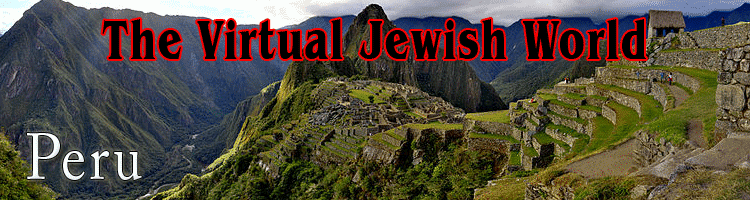
Macchu Picchu Photo courtesy of Martin St-Amant (S23678) |