|
The territory of present-day Romania was
known as Dacia in antiquity and Jewish tombstones
dating from early times have been found there.
The Jews may have come as merchants or in
other capacities with the Roman legions that
garrisoned the country from 101 C.E. and early
missionary activity in Dacia may have been
due to the existence of Jewish groups there. Today, Romania boasts a Jewish population of 9,500.
- Early History
- Communal Institutions
- Independent Romania
- Internal Organization
- The Struggle for Naturalization
- Increasing Anti-Semitism
- Jewish Political Life
- Jewish Social Structure
- Jewish Cultural Life
- Holocaust Period
- Community During World War II
- Jewish Resistance
- Contemporary Period - 1960's
- 1970 - 1981
- 1982 - 1992
- 1990's - Present
Early History
 |
The first real major wave of Jewish immigrants spread
through Walachia (a Romanian principality
founded around 1290) after they had been
expelled from Hungary in
1367. In the 16th century some refugees from
the Spanish
expulsion came to Walachia from the Balkan
Peninsula. A few served as physicians and
even diplomats at the court of the sovereigns
of Walachia. Since it was on the trade routes
between Poland-Lithuania and
the Ottoman
Empire many Jewish merchants
traveled through Moldavia, the second Romanian
principality (in the northeast), founded
in the middle of the 14th century. Some settled
there and were favorably received by the
rulers of this underpopulated principality.
At the beginning of the 16th century there
were Jewish communities in several Moldavian
towns, such as Jassy ( Iasi), Botosani, Suceava,
and Siret. More intensive waves of Jewish
immigration resulted from the Chmielnicki
massacres (1648–49). From the beginning
of the 18th century, the Moldavian rulers
granted special charters to attract Jews.
While still in Poland they
were told about the advantages offered (exemption
from taxes, ground for prayer houses, ritual
baths, and cemeteries). They were invited
either to reestablish war-ravaged towns (1761,
Suceava) or to enlarge others (1796, Focsani).
The newcomers were encouraged by the landowners
to found commercial centers, the so-called
burgs. Among the privileges offered was the
right to be represented on the local council.
In some cases they undertook to attract other
Jews from over the borders. When two counties
of Moldavia were annexed by their neighbors
(Bukovina by Austria in 1775 and Bessarabia
by Russia in 1812), the Jews from these countries
preferred to move to Romanian Moldavia, where
they were not harassed by the authorities
and had both family and business connections.
Jewish merchants exported leather, cattle,
and corn. Many of the Jews were craftsmen,
such as furriers, tailors, boot makers, tinsmiths,
and watchmakers.
From an early date, one of the main components
of anti-Jewish hatred in Romania was commercial
competition. In 1579, the sovereign of Moldavia,
Petru Schiopul (Peter the Lame), ordered
the banishment of the Jews on the grounds
that they were ruining the merchants. In
the Danube harbors, it was the Greek and
Bulgarian merchants who incited riots against
the Jews, especially during Easter. Anti-Jewish
excesses that occurred in the neighboring
countries often extended to Romania. In 1652
and 1653, Cossacks invaded Romania, murdering
a great number of Jews in Jassy.
Greek Orthodox Christianity also preached
intolerance toward Jews and shaped the first
codes of law: the Church laws of Moldavia
and Walachia in 1640. Both proclaimed the
Jews as heretics and forbade all relations
with them. With the exception of physicians,
Jews were not accepted as witnesses in trials.
In the codes of 1746 and 1780, the Jews are
scarcely mentioned. On the other hand, the
first books of anti-Jewish incitement of
a religious character appeared around this
time: the Golden Order (Jassy, 1771)
and A Challenge to Jews (Jassy, 1803).
Communal Institutions
In 1719, a hakham bashi, Bezalel
Cohen, was first appointed for Walachia and
Moldavia by the suzerain, the sultan.
He resided in Jassy and he had a representative
for Walachia in Bucharest. The hakham
bashi's function was hereditary and included
the right of collecting taxes on religious
ceremonies and contributions from every head
of a family — comprising 30,000 taxpayers
altogether in the two principalities in 1803 — as
well as conferring exemption from taxes and
tolls. Yet his prestige was slight, and learned rabbis were
considered by the Jews as their real spiritual
leaders.
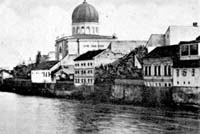 A rendering of the Oradea synagoue
in Romania, c. 1900. |
The growing Russian and Galician element
in the Romanian Jewish population at the
beginning of the 19th century opposed the hakham
bashi, since such an institution was
unknown to them and many of them were followers
of Hasidism and
led by zaddikim. As they were foreign
subjects they asked their consuls to intercede
and, in 1819, the prince of Moldavia decided
that the hakham bashi should have
jurisdiction only over "native" Jews.
Because of strife among the diverse groups
of Jews and their complaints to the authorities,
the hakham bashi system was abolished
in 1834.
The Jews also had a guild, one of 32 guilds
set up according to nationality or profession,
which took care of tax collection proportionately
to the number of persons organized in it.
For the Jews, the guild was really the legal
body of the community. The collective tax
was paid from the tax on kosher meat,
the expenses of the institutions (talmud
torah, hekdesh, cemetery) were
covered by the remainder.
The center of the guild was in Jassy, and
its head was named staroste ("senior";
Heb. rosh medinah). In Bucharest,
this function was carried out by the representative
of the hakham bashi. When the hakham
bashi system was abolished (1834), the
Jews' Guild disappeared as well; the result
was the disintegration of the Jewish communities.
The collective tax, formerly fixed by the
guild, was now imposed by the government.
The functions of the community devolved on
the various prayer houses and the artisans'
guilds and sometimes on the hevra kaddisha or
the Jewish hospital (in Jassy).
Independent Romania
Trouble for the Jews began in 1821, with
the first stirrings of Romanian independence
and unity. In the course of the rebellion
against the Turks, Greek volunteers crossed
Moldavia on their way to the Danube, plundering
and slaying Jews as they went (in Jassy,
Herta, (now Gertsa), Odobesti, Vaslui, Roman).
Between 1819 and 1834, Moldavia and Walachia
were occupied by Russia, which gave them
a unifying constitution (the so-called Organic
Law). From 1835 to 1856, the two principalities
were protectorates of Russia, through whose
influence anti-Semitism increased.
From then on the prevailing attitude was
that the Jews exploited the Christian population
in order to enrich themselves and so their
immigration must be stopped. On the Russian
model, Jews were forbidden to settle in villages,
to lease lands, and to establish factories
in towns. Citizenship was denied to Jews.
The corrupt Romanian administrators used
this legislation to add to their income by
persecuting the Jews. The completions of
the Organic Law promulgated in 1839 and 1843
included special measures directed against
the Jews. Its new provisions conferred on
the authorities the right to determine which
Jews were useful to the country, the others
being declared vagrants and expelled.
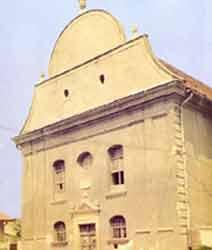
Albaiulas Synagogue, built 1822 |
During the 1821 revolt against the Ottoman-appointed
rulers, and the 1848 revolt against Russia,
the revolutionaries appealed for the participation
of the Jews and proclaimed their civic equality.
Some Jews took part in the 1848 revolt, which
was put down by the Russians. The peace treaty
of Paris (1856), which concluded the Crimean
War and granted the principalities a certain
autonomy under Ottoman suzerainty, proclaimed inter
alia that in the two Danubian principalities
all the inhabitants, irrespective of religion,
should enjoy religious and civil liberties
(the right to own property and to trade)
and might occupy political posts. Only those
who had foreign citizenship were excluded
from political rights. The leaders of the
Moldavian and Walachian Jews addressed themselves
both to the Romanian authorities and to the
great powers, asking for the abolition of
the discrimination against them. However,
the opposition of Russia and of the Romanian
political leaders hindered this. The two
principalities united in 1859; Alexandru
Ioan Cuza, who was a member of the 1848 revolutionaries'
group and not anti-Semitic, became their
sovereign. The number of Jews was then 130,000
(3% of the total population). In 1864, native
Jews were granted suffrage in the local councils
(“little naturalization”), but
Jews who were foreign subjects still could
not acquire landed property. Political rights
were granted to non-Christians but only parliament
could vote on the naturalization of individual
Jews—but not a single Jew was naturalized.
In 1866, Alexandru Ioan Cuza was ousted
by anti-liberal forces. A new sovereign,
Carol of Hohenzollern-Sigmaringen, was elected
and a new constitution adopted. Under the
pressure of demonstrations organized by the
police (during which the Choir Temple in
Bucharest was demolished and the Jewish quarter
plundered), the seventh article of the constitution,
restricting citizenship to the Christian
population, was adopted. Even the visit to
Bucharest of Adolphe Cremieux, president
of the Alliance Israelite Universelle, who
delivered a speech in the Romanian parliament,
had no effect.
In the spring of 1867, the minister of interior,
Ion Bratianu, started to expel Jews from
the villages and banish noncitizens from
the country. That summer, Sir
Moses Montefiore arrived in Bucharest and demanded that Prince
Carol put a stop to the persecutions. Despite
pledges to do so, the discrimination continued.
Hundreds of families, harassed by humiliating
regulations (e.g., a prohibition on building sukkot),
were forced to leave the villages. Local
officials regarded such persecution as an
effective method of extorting bribes. Neither
the repeated interventions of Great
Britain and France, nor the condemnatory resolutions
in the parliaments of Holland and Germany had any effect. The Romanian government reiterated
that the Jewish problem was an internal one,
and the great powers limited themselves to
protests.
At the Congress of Berlin (1878), which
finalized Romanian independence, the great
powers made the grant of civil rights to
the Jews a condition of that independence
in spite of opposition by the Romanian and
Russian delegates. The Romanian representatives
threatened the delegates of the Jewish world
organizations, as well as the representatives
of the Jews of Romania, by hinting at a worsening
of their situation. Indeed, after the Congress
of Berlin, other anti-Semitic measures
were introduced, and there was incitement
in the press and public demonstrations organized
by the authorities on the Russian model to
prove to the great powers that the people
were against Jewish emancipation. Their aim
was also to create an anti-Semitic atmosphere
on the eve of the session of parliament that
was to decide on the modification of the
article in the 1866 constitution concerning
Jewish naturalization. Prince Carol, opening
parliament, declared that the Jews had a
harmful influence on economic life and especially
on the peasants. After stormy debates, parliament
modified the article of the constitution
which made citizenship conditional on Christianity,
but stated that the naturalization of Jews
would be carried out individually by vote
of both chambers of parliament. During the
following 38 years 2,000 Jews in all were
naturalized by this oppressive procedure;
of those, 883 were voted in en bloc,
having taken part in the 1877 war against Turkey.
This caused the great powers to refuse for
a time to recognize independent Romania.
However, they finally followed the example
of Germany, which took the first step after
having received pecuniary compensation from
the Romanian government through the redemption
of railway shares belonging to Silesian Junkers
and members of the German imperial court—at
six times their quoted value.
The situation of the Jews continued to grow
worse. Jews had been considered Romanian
subjects, but now they were declared to be
foreigners. The Romanian government persuaded Austria and Germany to withdraw their citizenship
from Jews living in Romania. The Jews were
forbidden to be lawyers, teachers, chemists,
stockbrokers, or to sell commodities that
were a government monopoly (tobacco, salt,
alcohol). They were not accepted as railway
officials, in state hospitals, or as officers.
Jewish pupils were later expelled from the
public schools (1893). Meanwhile political
intimidation continued. In 1885, some of
the Jewish leaders and journalists who had
participated in the struggle for emancipation,
among them Moses Gaster and Elias Schwarzfeld,
were expelled from Romania. Both major political
parties in Romania — the Liberals and
the Conservatives — were anti-Semitic,
with only slight differences. In 1910, the
first specifically anti-Semitic party, the
National Democratic Party, was founded under
the leadership of the university professors
A. C. Cuza and Nicolae Iorga.
Internal Organization
The first general Jewish representative
body, after the dissolution of the Jews'
Guild and the internal strife in the communities,
was the Brotherhood of Zion society, the
forerunner of B'nai B'rith, created in
1872 under the influence of Benjamin Franklin
Peixotto, the first American diplomat in
Romania. He thus succeeded in shaping a
cadre of leaders for the Jewish institutions,
but did not see any solution for the masses
but emigration. For that purpose he initiated
a conference of world Jewish organizations
that convened in Brussels (Oct. 29–30,
1872). Under the influence of assimilationist
circles, emigration — considered
to be unpatriotic — was rejected
as a solution of the Jewish problem. The
conference suggested to the Jews of Romania
that they should fight to acquire political
equality. After some years, however, a
mass movement started for emigration to Eretz
Israel.
 The Great Synagogue of Targu-Mures
built in 1899. |
The political organization founded in 1890,
under the name The General Association of
Native Israelites, tended to assimilation
and strident patriotism, claiming citizenship
only for those Jews who had served in the
army. Under pressure by a group of Jewish
socialists it extended its demands, claiming
political rights for all Jews born in the
country. In 1897, anti-Semitic students
attacked members of the congress of the association
and caused riots in Bucharest. The association
ceased its activity and an attempt at reorganization
in 1903 failed. Under the pressure of increasing
persecution accompanied by an internal economic
crisis, a mass emigration of Jews began in
1900; they traveled on foot as far as Hamburg
and, from there, went to the United
States,
Canada, and Great
Britain.
Up to World War I, about 70,000 Jews left
Romania. From 266,652 (4.5% of the total
population) in 1899, the Jewish population
declined to 239,967 (3.3%) in 1912. The 1907
revolt of the peasants, who at first vented
their wrath on the Jews, also contributed
to this tendency to emigrate. Meanwhile,
the persecution of the Jews increased. Their
expulsion from the villages assumed such
proportions that in some counties of Moldavia
(Dorohoi, Jassy, Bacau), none remained except
veterans of the 1877 war.
In 1910, the Union of Native Jews (U.E.P.)
was founded to combat anti-Jewish measures
and to seek emancipation. Its first head
was Adolphe Stern, former secretary of B.
F. Peixotto. The U.E.P. operated by intercession
with politicians, through mass petitions
to parliament, and by printed propaganda
against anti-Semitism.
In a single case it was successful through
direct intercession with King Carol I, who
held up the passage of a bill discriminating
against Jewish craftsmen (1912).
At the end of the 19th century,
the organization of Jewish communities began,
together with the creation of a Jewish school
system prompted by the expulsion of Jews
from the public schools (1893). The certificates
of Jewish schools were not recognized, and
their pupils had to pass state examinations,
paying a fee (which was a charge on community
budgets as they covered this fee for the
poor) until 1925, when the certificates of
Jewish schools were recognized if the language
of tuition was Romanian. All Jewish schools
were maintained by the communities; in Bessarabia,
Tarbut maintained Hebrew schools. The ministry
of education contributed only a token subvention.
The impoverishment of the
Jewish population also created a need for
social assistance that could not be provided
by the various existing associations. To
achieve the legalization of the communities,
several congresses of their representatives
were organized (April 1896 in Galati, 1902
in Jassy, and 1905 in Focsani), but they
could not agree on the proper nature of
a community. Some claimed that it should
have an exclusively religious character;
others wanted a lay organization dealing
only with social welfare, hospitals, and
schools. The different Jewish institutions
(synagogues,
religious associations, hospitals) endeavored
to preserve their autonomy. There was a
struggle for the tax on meat, too, each demanding
this income for itself.
Simultaneously, groups of assimilationist
students and intellectuals launched a drive
against the community, which they defined
as an isolationist instrument. They were
joined by anti-Semites who
called the community a “state within
a state,” a Jewish conspiracy aiming
to establish supremacy over the Romanians.
Some proposed putting the communities under
the Ministry of the Interior. An attempt
in 1897 to introduce into parliament a bill
on the Jewish communities, its purpose being
defined by its sponsor as “to defend
the Jewish population against its ignorant
religious fanatics,” failed because
of the opposition of the liberal government
of the day. Later, the principle of autonomy
prevailed at Jewish community congresses,
owing to the influence of the Zionists,
especially Rabbis J. [Jacob] Nacht and J.
Niemirover.
The Struggle for Naturalization
Following World War I, Romania enlarged
her territory with the provinces of Bukovina,
Bessarabia, and Transylvania. In each of
these the Jews were already citizens, either
of long standing like those who had lived
in the Austro-Hungarian Empire, or more recent
such as those from Bessarabia who achieved
equality only in 1917. Indeed, the naturalization
of the Jews of Romania was under way in accordance
with the separate peace treaty concluded
with Germany in the spring of 1918.
After the defeat of Germany, Prime Minister
Ionel Bratianu realized that the naturalization
of the Jews would be brought up again at
the peace conference, so he tried to resolve
the problem by issuing a decree of naturalization
on December 28, 1918, proclaiming individual
naturalization on the lines adopted after
the Congress of Berlin. The decision had
to be made by the law courts instead of parliament,
on the basis of certain certificates that
were very difficult to obtain. Though threatened
by the government, the Jewish leaders rejected
the law and Jews refrained from applying
to the court. The Jews demanded that citizenship
be granted en bloc after a declaration
by every candidate at his municipality that
he was born in the country and held no foreign
citizenship.
Although the Romanian government continued
to assert that the Jewish problem was an
internal one, of national sovereignty, when
the delegation led by Ionel Bratianu appeared
at the peace conference in (May 1919), Georges
Clemenceau reminded him that after the Congress
of Berlin, Romania had not implemented the
provisions concerning the political rights
of the Jews. This time the great powers decided
to include guarantees in the peace treaty.
A Jewish delegation from Romania, composed
of U.E.P. and Zionist representatives, arrived
in . They joined the Jewish delegations participating
in the peace conference and lobbied to have
the peace treaty specify the laws Romania
should adopt concerning naturalization.
To prevent the conference’s imposition
of naturalization of Jews, Ionel Bratianu
wired to Bucharest the text of a law (promulgated
as a decree on May 22, 1919), according to
which citizenship could now be obtained by
a declaration of intent in writing to the
law court, the latter being obliged to make
out a certificate of confirmation that conferred
the exercise of political rights. Those who
did not possess foreign citizenship, those
who satisfied the requirements of the enlistment
law, and those who had served in the war
were declared citizens, together with their
families.
The peace conference did obligate Romania
to legislate the political emancipation of
the Jews. Bratianu resigned in protest and,
only after an ultimatum sent by the peace
conference, did the new Romanian government
led by Alexandru Vaida-Voevod sign the peace
treaty.
In Bukovina , 40,000 Jews were threatened
with remaining stateless, on the pretext
of their being refugees who had only recently
entered the country. A professor of the faculty
of law at Jassy published a study in 1921
asserting that this naturalization was anti-constitutional.
In 1923, there began a new struggle for the
enactment of naturalization in the new constitution.
Adolphe Stern, the president of the U.E.P.,
was elected as a deputy to parliament and
had to fight the law proposed by the Bratianu
government which in effect canceled most
of the naturalizations already acquired.
After hard bargaining, not without renewed
threats on the part of the government, the
naturalization of the Jews was introduced
into the constitution on March 29, 1923 ,
thus also confirming the naturalization of
those from the newly annexed territories
who would otherwise have been threatened
with expulsion. Still, there was a great
difference between the laws and the way in
which they were implemented. In a regulation
published two months after the adoption of
the constitution, many procedural restrictions
on the Jews living in the new provinces were
introduced. In practice, the civil service,
the magistracy, university chairs, and officers'
corps remained closed to Jews.
Increasing Anti-Semitism
Growing social and political tensions in
Romania in the 1920s and '30s led to a constant
increase in anti-Semitism and
in the violence that accompanied it. Anti-Semitic
excesses and demonstrations expressed both
popular and student anti-Semitism and
cruelty; they also served to divert social
unrest to the Jews and show Western public
opinion that intervention on their behalf
was bound to miscarry.
In December 1922, Christian students at
the four universities proclaimed numerus
clausus as their program; riots followed
at the universities and against the Jewish
population. As was later revealed in parliament,
the student movements were organized and
financed by the Ministry of the Interior.
The leader of the student movements was Corneliu
Zelea Codreanu, the secretary of the League
of National Christian Defense which was headed
by A. C. Cuza. The students formed terrorist
groups on the Fascist and Nazi models and
committed several murders. In 1926, the Jewish
student Falic was murdered at Chernovtsy.
The assassin was acquitted. In 1927, Codreanu
broke away from A. C. Cuza and founded the
Archangel Michael League, which, in 1929,
became the Iron Guard, a paramilitary organization
with an extreme anti-Semitic program.
On December 9, 1927, the students of Codreanu's
League carried out a pogrom in Oradea Mare
( Transylvania), where they were holding
a congress, for which they received a subsidy
from the ministry of the interior: they were
conveyed there in special trains put at their
disposal free of charge by the government.
Five synagogues were
wrecked and the Torah scrolls
burned in the public squares. After that
the riots spread all over the country: in
Cluj eight prayer houses were plundered,
and on their way home the participants in
the congress continued their excesses against
the Jews in the cities of Huedin, Targu-Ocna,
and Jassy.
At the end of 1933, the liberal prime minister
Duca, one of the opponents of King Carol's
dictatorial tendencies, dissolved the Iron
Guard and, after three weeks, was assassinated
by its men at the king's instigation. The
guard was reformed under the slogan, "Everything
for the Country." Codreanu's ties with
the Nazis in Germany dated from that time.
Carol II later aided other political bodies
with an anti-Semitic program in an attempt
to curb the Iron Guard. From 1935, Vaida-Voevod
led the Romanian Front, and accused the Jews
in his speeches of the blood
libel, parasitism,
defrauding the country, and the Judaization
of the press and national literature.
After Hitler came to power in Germany (1933),
the large Romanian parties also adopted anti-Semitic
programs. In 1935, the National Peasants'
Party (which united with Cuza's party to
form the National Christian Party) announced
that its program included “the Romanization
of the staff of firms and the protection
of national labor through preference for
[our] ethnic element” —that is,
the removal of Jews from private firms.
Gheorghe Bratianu, leading a dissident liberal
party, demanded “nationalization of
the cities, proportional representation in
public and private posts, in schools and
universities, and revocation of Jewish citizenship.”
In July 1934, the “Law for Employment
of Romanian Workers in [Private] Firms” was
enacted, and established a numerus clausus.
The Ministry of Industry and Trade sent all
firms special questionnaires which included
a clause on "ethnic origin." In
1935, the board of the Christian Lawyers'
Association, founded that year by members
of the bar from Ilfov ( Bucharest), gave
an impetus to anti-Semitic professional associations.
The movement spread all over the country.
Its program was the numerus nullus,
i.e., revoking the licenses of Jewish lawyers
who were already members of the bar and not
accepting new registrations.
At the universities, students of the Iron
Guard forcibly prevented their Jewish colleagues
from attending lectures. The academic authorities
supported the numerus clausus program,
introducing entrance examinations in 1935–36,
which led to a decline in the number of Jewish
students.
In other professional corporations, no Jews
were elected to the board; they were prevented
by force from participating in the elections.
The great Romanian banks began to reject
requests for credit from Jewish banks as
well as from Jewish industrial and commercial
firms, and the Jewish enterprises were burdened
by heavy taxes, imposed with the aim of ruining
them. Jewish firms were not granted import
quotas for raw materials and goods. Meanwhile
Germany financed a series of publications
and newspapers aimed at fastening an alliance
between the two countries and removing Jews
from all branches of the professions and
the economy. Many a Jewish merchant and industrialist
was compelled to sell his firm at a loss
when it became unprofitable under these oppressive
measures.
Jewish Political Life
In 1919, the Union of Romanian Jews, led
by W. Filderman, recommended that the Jews
vote for those Romanian parties that would
be favorable to them. As none of the parties
formulated an attitude toward the Jewish
problem, the Union decided that the Jews
should withhold their votes. In the 1920
elections, the Union joined the Zionists to
form a list that conducted its election campaign
under the symbol of the menorah.
As the elections were rigged, not a single
candidate succeeded in entering parliament.
The Union managed to send Adolphe Stern to
parliament in 1922 through joining with the
Peasants' Party. From 1923, the Zionists
pressed for a policy of a national minority
status for the Jews. Their proposal was not
accepted by the Union.
 A 1925 picture of the synagogue
of Oradea, Romania.
A 1925 picture of the synagogue
of Oradea, Romania. |
In 1926, the first National Jewish deputies
and senators were elected from Bukovina,
Transylvania, and Bessarabia. As a consequence
of these successes the National Jewish Club,
in which representatives of the Zionist parties
also participated, was founded in Bucharest.
Such clubs were established in all the cities
of the Old Kingdom.
In 1928, four National Jewish deputies were
returned to parliament (two from Transylvania,
one from Bukovina, and one from Bessarabia).
They formed a Jewish parliamentary club.
In 1930, the Jewish Party (Partidul Evreesc)
was established in the Old Kingdom and, on
May 4, 1931, it held its general congress.
Adolphe Stern joined this party. In the parliamentary
elections a month later, the Jewish Party
gained five seats and, in the 1932 elections,
it again obtained five. The situation of
the Jewish parliamentarians was far from
easy, because they were not only interrupted
during their speeches but were often physically
attacked by the deputies of the anti-Semitic
parties. After 1933, there were no more Jewish
members of parliament, except for J. Niemirover,
who in his capacity of chief rabbi was
officially a senator.
The undefined legal status of the Jewish
communities in Romania tempted local authorities
to meddle more and more in their affairs.
A rabbi from Bucharest, Hayyim Schor, proclaimed
himself chief rabbi. He demanded recognition
of a separate Orthodox community
everywhere in Romania, and was willing to
be satisfied with the status of a private
association for the Jewish community, thus
abandoning the demand for its recognition
as a public body. The Union and the Zionists opposed
him. On May 19, 1921, the congress of Jews
from the Old Kingdom met in Bucharest and
elected J. Niemirover as chief rabbi.
Jewish Social Structure
In 1924, there were 796,056 Jews in enlarged
Romania (5% of the total population): 230,000
in the Old Kingdom, 238,000 in Bessarabia,
128,056 in Bukovina, and 200,000 in Transylvania.
In 1930 their number was 756,930 (4.2% of
the total population): 263,192 in the Old
Kingdom, 206,958 in Bessarabia, 92,988 in
Bukovina, and 193,000 in Transylvania.
The Jewish population of Old Romania was
for the most part an urban one. According
to the 1899 census, 79.73% of the Jews lived
in cities, forming 32.10% of the whole urban
population of the country. Only 20.27% lived
in villages, forming 1.1% of the whole rural
population. This phenomenon was a result
of the ban on Jews dwelling in a rural area.
In the Moldavia province, where the Jews
were most heavily concentrated, they formed
a majority in several towns. In Falticeni
they were 57% of the total population; in
Dorohoi, 53.6%; in Botosani, 51.8%; in Jassy,
50.8%. In several smaller towns of that region
their proportion was greater: in Gertsa,
66.2%; in Mihaileni, 65.6%; in Harlau, 59.6%;
in Panciu, 52.4%.
The Romanian population was 84.06% farmers,
the Jews constituting the middle class. According
to 1904 statistics, 21.1% of the total number
of merchants were Jews, but in some cities
of Moldavia they were a definite majority,
such as in Jassy, 75.3%; Botosani, 75.2%;
Dorohoi, 72.9%; Tecuci, 65.9%, etc. Jews
represented 20.07% of all artisans, and in
several branches they were a majority: 81.3%
of engravers, 76% of tinsmiths; 75.9% of
watchmakers; 74.6% of bookbinders; 64.9%
of hatmakers and 64.3% of upholsterers.
Industry was not advanced in Romania before
World War I. There were 625 industrial firms
altogether, 19.5% of them owned by Jews.
Jews were 5.3% of the officials and workers
in these industrial enterprises. In several
branches of industry there were Jewish factory
owners: 52.8% of the glass industry; 32.4%
of the wood and furniture industry; 32.4%
of the clothing industry; 26.5% of the textile
industry. Of the liberal professions only
medicine was permitted to Jews. They constituted
38% of the total number of doctors. The occupational
distribution of the Jews was as follows;
agriculture, 2.5%; industry and crafts, 42.5%;
trade and banking, 37.9%; liberal professions,
3.2%; various occupations, 13.7%.
There are no detailed statistics of the
period between the two world wars. The provinces
of Bessarabia, Transylvania, and Bukovina
were annexed to Old Romania, increasing the
Jewish population threefold. In every province
their occupational structure was different
as the result of historical development.
In the two annexed provinces, Transylvania
and Bukovina, the Jews had enjoyed civil
rights from the days of the Austro-Hungarian
Empire, and were also represented in the
liberal professions. On the other hand, their
situation in Bessarabia in czarist times
was worse than in Old Romania—a fact
which also influenced their occupational
structure. The few known figures refer to
Greater Romania, with all the annexed territories.
The only census taken in Bessarabia was
in 1930 and, according to those figures,
the occupational distribution of the Jewish
population was as follows: industry and crafts,
24.8%; trade and banking, 51.5%; liberal
professions, 2.9%; miscellaneous, 8.2%. It
should be noted that Jewish bankers (such
as the bank of "Marmorosh-Blank")
invested money in the developing industry
of Greater Romania. Some industrial enterprises,
comprising several factories such as the
sugar, metal, and textile works were owned
by Jews. In the late 1930s, under the influence
of the spread of the Nazi movement to Romania,
the whole occupational structure of the Jews
collapsed because of persecution on the economic
level, which preceded political persecution
and murder.
Jewish Cultural Life
Since most Romanian Jews were of Polish
or Russian extraction, their religious and
cultural traditions were similar to those
of the Jews of Eastern Europe. Their rabbis
and teachers, as well as their religious
trends, came from there. Hasidism was
particularly widespread in the Moldavia province,
which borders on Galicia and Russia, and
where Hassidic centers
were established at the "courts" of
the zaddikim of the Ruzhin dynasty in the
towns of Stefanesti, Buhusi, Adjud, and Focsani.
The spoken language of the Jewish population
was Yiddish;
Romanian became more widely used among them
only in the second half of the 19th century,
at the time when the first Romanian universities
were established (Jassy in 1860 and Bucharest
in 1864). In that period, too, the development
of modern Romanian literature began.
 The Orthodox synagogue of Timisoara
lies in the background of this portrait, dated 1925.
The Orthodox synagogue of Timisoara
lies in the background of this portrait, dated 1925. |
In the middle of the century Julius (Iuliu)
Barasch, of Galician origin, brought Mendelssohnianhaskalah to
Romanian Jewry. In 1857, he published the
first newspaper in Romanian and French—Israelitul
Roman—whose function was to fight
for equal civil rights for Romanian Jewry.
In 1854 another two newspapers—Timpul (Di
Tsayt; Bucharest) and Gazeta Roma (Jassy)—appeared
in Romanian and Yiddish,
but all three papers ceased publication before
the end of a year. Other such attempts met
the same fate. Only in 1879 did the weekly Fraternitatea begin
to appear, lasting until 1885, when it ceased
publication upon the expulsion from Romania
of its chief editors, Isaac Auerbach and
E. Schwarzfeld, for their stand against persecutions.
This paper, which represented the assimilationist
trend, was opposed to the incipient pre-Zionist movement
that sponsored the establishment of the colonies
of Zikhron Ya'akov and Rosh Pinnah in Eretz
Israel. Then two papers in Romanian also
appeared, supporting aliyah: Aparatorul,
which was published in Bucharest from 1881
to 1884, with E. S. Gold as editor, and the
weekly Stindardul, which was published
in Focsani from 1882 to 1883. The Yiddish
paper Ha-Yo'ez, which appeared in
Bucharest from 1874 to 1896, also supported aliyah.
Eleazar Rokeah, an emissary from Erez Israel,
published as special organs of the pre-Zionist
movement the Hebrew paper Emek Yizre'el in
Jassy (1882), the Yiddish Di Hofnung in
Piatra-Neamt (1882), and Der Emigrant in
Galati (1882). Of the Jewish press in Romania,
the weekly Egalitatea, edited by M.
Schwarzfeld, survived for half a century.
The weekly Curierul Israelit, edited
by M. Schweig, began to appear in 1906, and
continued up to 1948, becoming the mouthpiece
of the Uniunea Evreilor Romani ("Union
of Romanian Jews") after World War I.
In the time of Herzl,
several Zionist papers
appeared in Romania but did not last long.
In 1913, the monthly Hatikva in Romanian
was issued in Galati under the editorship
of L. Gold, who gathered round him the outstanding
Jewish authors in Romanian. Apart from original
articles they also published translations
of a high literary standard from modern Hebrew
poetry and classical Yiddish literature.
After World War I, from 1919 to 1923, there
was published in Bucharest a daily newspaper
in Romanian with a Zionist national tendency, Mantuirea edited
by A. L. Zissu with Abraham Feller as chief
editor. This paper stood for the idea of
a Jewish political party and sharply attacked
the tendencies of assimilationist circles.
The weekly Renasterea Noastra (1923–42,
1944–48), edited by Samuel I. Stern,
continued in this direction. The Zionist
Federation published the weekly Citiri
din Lumea Evreeasca, edited first by
I. Ludo, and later by Theoder Loewenstein.
Between the two world wars, the Zionist students'
association published the monthly Hasmonaea.
The number of Jewish journalists grew between
the two wars, some of them even becoming
chief editors of the great democratic papers.
They included Constantin Graur, B. Branisteanu,
Em. Fagure, G. Milian ( Bucharest); A. Hefter
(Jassy), and S. Schaferman-Pastoresu ( Braila).
After they had acquired a knowledge of Romanian,
several Jewish scholars at the end of the
19th century became distinguished in the
field of philology and folklore: Lazar Saineanu
(SainMan), compiler of the first practical
dictionary of Romanian (1896); M. Gaster,
who did research on early Romanian folklore;
Heinrich Tiktin, author of a scientific grammar
of Romanian in two volumes (1893–94).
This tradition continued down to later times.
I. A. Candrea also compiled a Romanian dictionary
(1931), as did J. Byk and A. L. Graur after
World War II. A number of these scholars
also devoted time to research on the history
of Romanian Jewry. The pioneer in this field
was the historian J. Psantir, whose two Yiddish volumes
contained Hebrew headings: Divrei ha-Yamim
le-Arzot Rumanyah (Jassy, 1871) and Korot
ha-Yehudim be-Rumanyah (Lemberg, 1877).
A society for research into the history
of Romanian Jewry was established in 1886
and named for Julius Barasch. Among its active
members were J. Psantir, M. Gaster, Lazar
Caineanu, Elias Schwarzfeld and M. Schwarzfeld.
In the three editions of their bulletin,
they published source material, memoirs,
and bibliographical notes, as well as some
combined research and monographs of Jewish
communities. Although the society ceased
activities after four years, the scholars
continued their research. Part of their work
appeared in the 19 volumes of the annual Anuarul
pentru Israeliti, and in a weekly published
by M. Schwarzfeld. Between the two world
wars, Meir A. Halevy published several monographs
on the history of the Jews of Romania. The Templul
Coral ("Choir Synagogue") then
erected in Bucharest a museum, library, and
archives for the history of Romanian Jewry.
In some bulletins of these institutions and
in the annual Sinai (1926–32), edited
by Meir A. Halevy, there also appeared research
on the history of Romanian Jewry.
The Jews of annexed Transylvania used the
Hungarian language in the Zionist press,
even under Romanian rule, those of Bukovina
German, while in Bessarabia the language
of the Jewish press was Yiddish.
Each province kept its traditions, autonomous
structure, and cultural life, within the
framework of the all-Romanian Federation
of Jewish Communities. Culturally, the deeply
rooted Jewish life of Bessarabia, with its
Hebrew teachers, writers, and journalists,
had a great influence, especially in the
Old Kingdom.
Holocaust Period
German penetration into the Romanian economy increased as the Nazis
moved eastward with the Anschluss of Austria (1938), the annexation
of Czechoslovakia (1939), and the occupation of western Poland at the outbreak of World
War II. A considerable number of Romanian
politicians agreed to serve German interests
in exchange for directorships in German-Romanian
enterprises, and German trade agreements
with Romania always demanded the removal
of Jews in the branch involved. In this way,
Jews were expelled from commerce and industry.
In the summer of 1940,
Romania succumbed to German pressure and
transferred Bessarabia and part of Bukovina
to the Soviet Union, northern Transylvania
to Hungary,
and southern Dobrudja to Bulgaria (the
territory that remained being called Old
Romania). When the Romanian army retreated
from these areas, its soldiers murdered
many Jews, particularly in northern Bukovina
and Moldavia; they also threw Jewish travelers,
both civilian and military, from moving
trains. On June 30, 1940, 52 Jews were
murdered in Dorohoi by a retreating Romanian
regiment.
Hoping to ensure its borders
after the concessions, Romania, which had
not been invaded by the German army, became
a satellite of Nazi Germany.
The first result of this move was the cancellation
of Romanian citizenship for Jews, a measure
taken by the government, which included
members of the Iron Guard, under German
pressure in August 1940.
On September 6,
when King Carol abdicated, Ion Antonescu,
who had been minister of defense in the
Goga government, came to power. His government
included ministers from the ranks of the
Iron Guard, and Romania was declared a
Nationalist-Legionary State (the members
of the Iron Guard styled themselves "legionnaires").
The "legionary police"
was organized on Nazi lines with the help
of the S.S. and
the S.D. There followed a period of anti-Semitic terrorism
that lasted for five months. It began with
the confiscation of Jewish-owned shops, together
with the posting of signs marked "Jewish
shop" and picketing by the green-shirted "legionary
police."
The reign of terror reached
its height when Jewish industrial and commercial
enterprises were handed over to the members
of the "Legion"
under pressure from the Iron Guard. The owners
of the enterprises were arrested and tortured
by the "legionary police" until
they agreed to sign certificates of transfer.
Bands of "legionnaires"
entered Jewish homes and "confiscated" any
sums of money they found. This resulted
in a mortal blow to the Romanian economy
and chaos that frightened even the German
diplomats. Antonescu tried on several occasions
to arrest the wave of terrorism, during which
a number of Romanian statesmen opposed to
the Iron Guard were killed.
On January 21, 1941, the Iron Guard revolted
against Antonescu and attempted to seize
power and carry out its anti-Semitic program
in full. While part of the "Legion" was
fighting the Romanian army for control of
government offices and strategic points in
the city, the rest carried out a pogrom on
Bucharest Jews, aided by local hooligans.
Jewish homes were looted, shops burned, and
many synagogues desecrated,
including two that were razed to the ground
(the Great Sephardi Synagogue
and the old bet ha-midrash). Some
of the leaders of the Bucharest community
were imprisoned in the community council
building, worshipers were ejected from synagogues,
the Palestine Office of the Zionist Organization
was attacked and its director murdered, and
wealthy Bucharest Jews were arrested, according
to a previously prepared list. Those arrested
were taken to centers of the Iron Guard movement:
some were then taken into the forests near
Bucharest and shot; others were murdered
and their bodies hung on meat hooks in the
municipal slaughterhouse, bearing the legend "kosher meat." The
pogrom claimed 120 Jewish lives. There were
no acts of violence in the provinces because
the army was in firm control and fully supported
Antonescu. This was also Hitler's
reason for supporting Antonescu. Romania
held an important role in the war contemplated
against the Soviet Union, not only as a supply
and jumping-off base, but as an active partner
in the invasion of the country.
A period of relative calm followed the Bucharest
pogrom and permitted Romanian Jews to gather
strength after the shock of the violence.
Antonescu, however, was under constant German
pressure, for when their revolt failed, members
of the Iron Guard found refuge in Germany,
where they constituted a permanent threat
to his position, as he now lacked his own
party to serve as a counterbalance.
In January 1941, Manfred von Killinger,
a veteran Nazi known for his anti-Semitic
activities, was appointed German ambassador
to Romania. In April he was joined by Gustav
Richter, an adviser on Jewish affairs who
was attached to Adolf
Eichmann's department. Richter's special
task was to bring Romanian anti-Jewish legislation
into line with its counterpart in Germany.
Community During World War II
On June 22, 1941, when war broke out with
the Soviet Union, the Romanian and German
armies were scattered along the banks of
the Prut River to penetrate into Bukovina
and Bessarabia. As this branch of the front
became active only on July 3, the Romanian
and German soldiers occupied themselves with
slaughtering the Jewish population of Jassy
on June 29, 1941. When the soldiers finally
went into action, they were joined by units
of Einsatzgruppe D, under the command
of Otto Ohlendorf. Their combined advance
through Bessarabia, Bukovina, and the Dorohoi
district was accompanied by massacres of
the local Jewish population. At the beginning
of August 1941 the Romanians began to send
deportees from Bukovina and Bessarabia over
the Dniester River into a German-occupied
area of the U.S.S.R. (later to be known as
Transnistria). The Germans refused to accept
the deportees, shooting some and returning
the rest. Some of these Jews drowned in the
river and others were shot by the Romanian
gendarmerie on the western bank; of the 25,000
persons who crossed the Dniester near Sampol,
only 16,500 were returned by the Germans.
Some of these survivors were killed by the
Romanians, and some died of weakness and
starvation on the way to camps in Bukovina
and Bessarabia. Half of the 320,000 Jews
living in Bessarabia, Bukovina, and the Dorohoi
district (which was in Old Romania) were
murdered during the first few months of Romania's
involvement in the war in 1941.
After this period the Jews were concentrated
in ghettos (if they lived in cities), in
special camps (if they lived in the countryside,
or townlets such as Secureni, Yedintsy, or
Vertyuzhani). German killing squads and Romanian
gendarmes, copying the Germans, habitually
entered the ghettos and camps, removing Jews
and murdering them. Jews living in villages
and townlets in Old Romania (Moldavia, Walachia,
and southern Transylvania) were concentrated
into the nearest large town. The Jews of
northern Moldavia, which bordered on the
battle area, were sent to the west of Romania:
men under 60 were sent to the Targu-Jiu camp
and the women, children, and aged were sent
to towns where the local Jewish population
was ordered to care for the deportees (who
owned nothing more than the clothing on their
backs). The homes and property of these deportees
were looted by the local population immediately
after they were deported.
On September 16, 1941, those in camps in
Bessarabia began to be deported to the region
between the Dniester and the Bug rivers called
Transnistria, from which the Germans had
withdrawn, handing control over to the Romanians
under the Tighina agreement (August 30, 1941).
The deportations included 118,847 Jews from
Bessarabia, Bukovina, and the Dorohoi district.
At the intervention of the Union of Jewish
Communities in Romania, an order was given
on October 14 to stop the deportations. They
continued, however, until November 15, leaving
all the Jews of Bessarabia and Bukovina [with
the exception of 20,000 from Cernauti (Chernovtsy)]
concentrated in Transnistria. Of the 14,847
Jews from the Dorohoi district, 2,316 were
also deported and brought to Transnistria.
Within two months of deportation, 22,000
Jews died. Some died because they could walk
no further, some died from disease, but the
majority of Jews were murdered by the gendarmerie
that accompanied them on their journey. All
the money and valuables were confiscated
by representatives of the Romanian National
Bank. The Jews then remaining in Old Romania
and in southern Transylvania were compelled
into forced labor and were subjected to various
special taxes. The prohibition against Jews
working in certain professions and the "Rumanization
of the economy" continued and caused
the worsening of the economic situation of
the Jewish population.
According to the statistical table on the
potential victims of the "Final
Solution" introduced at the Wannsee
Conference, 342,000 Romanian Jews were destined
for this end. The German embassy in Bucharest
conducted an intensive propaganda campaign
through its journal, Bukarester Tageblatt,
which announced "an overall European
solution to the Jewish problem" and
the deportation of Jews from Romania. On
July 22, 1942, Richter obtained Vice-Premier
Mihai Antonescu's agreement to begin the
deportation of Jews to Poland in
September. However, as a result of the efforts
of the clandestine Jewish leadership, foreign
diplomatic pressure, and pressure by the
papal nuncio, A. Cassulo, Ion Antonescu canceled
the agreement. He could afford a measure
of independence, since Hitler was
then seeking the mobilization of additional
divisions of the Romanian army against the
Soviet Union. Nevertheless, Eichmann's
Bucharest office, working through the local
authorities, succeeded in contriving the
deportation of 7,000 Jews from Cernauti (Chernovtsy),
Dorohoi, and groups from other parts of Romania.
These 7,000 were "suspected of Communism" (they
were of Bessarabian origin and had asked
to return to the Soviet Union in 1940), and
had "broken forced-labor laws.”
At the beginning of December 1942, the Romanian
government informed the Jewish leadership
of a change in its policy toward Jews. It
would henceforth grant Jews deported to Transnistria
the right to emigrate to Palestine. Defeat
at Stalingrad (where the Romanians had lost
18 divisions) was already anticipated. In
1942–43 the Romanian government began
to consider signing a separate peace treaty
with the Allies. Although the plan for large-scale
emigration failed because of German opposition
and lack of facilities, both small and large
boats left Romania carrying "illegal" immigrants
to Palestine, some of whom were refugees
from Bukovina, Poland, Hungary,
and Slovakia. Between 1939 and August 1944
(when Romania withdrew from the war) 13 boats
left Romania, carrying 13,000 refugees. As
a result of German pressure exerted through
diplomatic missions in Romania, Bulgaria,
and Turkey, the emigration of refugees was
discontinued. Two of the boats sank on their
way to Palestine: the Struma (on February
23, 1944, with 769 passengers) and the Mefkure (on
August 5, 1944 with 394 passengers).
Despite German efforts, the Romanian government
refused to deport its Jews to the "east." At
the beginning of 1943, however, there was
a return to the traditional economic pressures
against the Jews in order to reduce the Jewish
population. This was achieved by forbidding
Jews to work in the civilian economy and
by the most severe measure of all – forced
labor. In addition, various taxes were imposed
on the Jewish population for cash, clothing,
shoes, and hospital equipment. These measures,
particularly the taxes to be remitted in
cash—of which the largest was a levy
of 4 billion lei (about $27,000,000) imposed
in March 1943—severely pressed Romanian
Jewry. The taxes were collected by the "Jewish
center." W. Filderman, chairman of the
Council of the Union of Jewish Communities
openly opposed the tax. He was deported to
Transnistria for two months.
At the end of 1943, as the Red Army drew
nearer to Romania, the local Jewish leadership
succeeded in obtaining the gradual return
of those deported to Transnistria. The Germans
tried several times to stop the return and
even succeeded in bringing about the arrest
of the leadership of the clandestine Zionist pioneering
movements in January and February 1944. The
leaders were released through the intervention
of the International Red Cross and the Swiss
ambassador in Bucharest; who contended that
they were indispensable for organizing the
emigration of those returning from Transnistria
and other refugees in Romania. In March 1944
contacts were made in Ankara between Ira
Hirschmann, representative of the U.S. War
Refugee Board, and the Romanian ambassador,
A. Cretzianu. Hirschmann demanded the return
of all those deported to Transnistria and
the cessation of the persecution of Jews.
At the time, the Red Army was defeating the
Germans in Transnistria, and there was a
danger that the retreating Germans might
slaughter the remaining Jews. Salvation came
at the last moment, when Antonescu warned
the Germans to avoid killing Jews while retreating.
Concurrently, negotiations over Romania's
withdrawal from the war were being held in
Cairo and Stockholm, and thus Antonescu was
eager to show goodwill toward the Jews for
the sake of his own future.
In the spring, Soviet forces also conquered
part of Old Romania (Moldavia), and they
made an all-out attack on August 20. On August
23, King Michael arrested Antonescu and his
chief ministers and declared a cease-fire.
The Germans could no longer control Romania,
for they were dependent on the support of
the Romanian army, which had been withdrawn. Eichmann,
who had been sent to western Romania to organize
the liquidation of Jews in the region, did
not reach his destination.
Fifty-seven percent of the Jewish population
under Romanian rule during the war (including
the Jews of Bessarabia and northern Bukovina)
survived the Holocaust. The following statistics
give the death toll. Out of the prewar Jewish
population, 264,900 (43%) were murdered.
Of this number, 166,597 perished during the
first period of the war, 151,513 from Bessarabia
and Bukovina and 15,064 from part of Old
Romania. The rest died during the deportations
to Transnistria or in the camps and ghettos
of this region: some were murdered; others
died in epidemics, famine, or exposure. In
areas from which Jews were not deported,
78.2% of the Jewish population was left without
livelihood. The demographic effect was that
the ratio of births to deaths fell to 34.1%
in 1942 from the 1934 figures of 116.5%.
Jewish Resistance
Preperatory Steps
As soon as Hitler assumed
power in Germany (1933),
Jewish leaders in Bucharest, mostly Zionists,
decided not to remain passive. In November,
the congress of the Jewish Party in Romania
decided to join the anti-Nazi boycott movement,
disregarding the protest raised by the Romanian
press and anti-Semitic groups,
but the Union of the Romanian Jews (U.E.R.)
did not participate in the campaign. The
necessity for a united political, as well
as economic, struggle soon became obvious.
On January 29, 1936, the
Central Council of Jews in Romania, composed
of representatives of both Jewish trends—the U.E.R. and
the Jewish Party—was established for "the
defense of all Jewish rights and liberties
against the organizations and newspapers
that openly proclaimed the introduction of
the racial regime." At the end of the
year the Council succeeded in averting a
bill proposed in the parliament by the anti-Semitic
circles suggesting that citizenship be revoked
from the Jews. During the same period the
Romanian government attempted to suppress
the state subvention for Jewish religious
needs, as well as the exemption from taxes
accorded to Jewish community institutions.
The Council could not obtain the maintenance
of the subvention, and it was finally reduced
to one-sixth of its allotment.
When Goga's anti-Semitic government came
to power, the Council began a struggle against
it, gaining support and attention outside
Romania. Filderman, president of the Council,
left at once for Paris,
where he mobilized the world Jewish organizations
with headquarters in France and England.
He informed local political circles and the
League of Nations of events in Romania. At
the same time the Jews in Romania began an
expanded economic boycott, refraining from
commercial transactions, withdrawing their
deposits from the banks, and delaying tax
payments. The outcome was a "large-scale
paralysis of the economic life," as
the German minister of foreign affairs stated
in his circular of March 9, 1938. Thus the
dismissal of the Goga government after only
40 days was motivated not only by external
pressure, but also by the effects of the
Jewish economic boycott.
The Union of the Jewish Communities
Following the downfall of the Goga government,
King Carol's royal dictatorship abolished
all the political parties in Romania, including
the Jewish Party and the Union of Romanian
Jews. The single body of the Jews in Romania
was the Union of the Jewish Communities,
whose board was composed of the leaders of
both Jewish currents. The Union assumed the
task of fighting against the increasing number
of anti-Jewish measures promulgated by the
Romanian authorities under pressure from local
anti-Semitic circles and the German government.
In some cases its interventions were successful;
for example, it achieved the nullification
of the prohibition against collecting contributions
to Zionist funds,
and, as a result of its protests, the restrictions
against the Jewish physicians and the Jewish
industrial schools were abrogated. In the
summer of 1940, after Romania ceded Bukovina
and Bessarabia to the Soviet Union, the Romanian
police tried to eject Jewish refugees from
those two provinces. The Union's board succeeded
in convincing the Ministry of the Interior
to annul the measure. When the interdiction
of ritual slaughter was decreed, the board
obtained an authorization for ritual slaughtering
of poultry. The cancellation of the prohibition
against Jews peddling in certain cities was
also achieved. When the anti-Semitic newspapers
incited against the leaders of the Union,
the police began to search their homes.
Ion Antonescu's government, with the participation
of the Iron Guard, closed several synagogues (those
with less than 400 worshipers in cities and
200 in villages) and transferred the property
to Christian churches. The disposition was
canceled after three days, however, as a
result of an audience between the Union's
president, Filderman, and Antonescu; simultaneously
the minister of religion, who ordered the
measure, was forced to resign. These acts
took place during the first period of the
new regime, dominated by the Iron Guard,
when trespasses were committed against the
Jews daily. The Union's board constantly
informed Antonescu and the diverse ministries
of these acts, pointing out their illegality
and arbitrariness. The argument that constantly
recurred in the memoranda presented by the
Union's board was that the confiscation of
Jewish shops and industrial companies caused
the disorganization of the country's economic
life. Antonescu used the information provided
by the board to support his stand against
the trespasses. The Iron Guard responded
with a terror campaign against the Jewish
leaders; some were arrested and tortured
by the "legionary police," others
were murdered during the revolt against Antonescu.
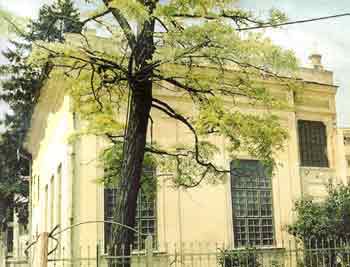 Great
Synagogue, Suceava,
Great
Synagogue, Suceava,
Built 1870 |
The Zionist leadership
negotiated with Antonescu on organizing the
emigration of Romanian Jews. The minister
of finance proposed that the emigration be
funded by Romanian assets; which had been
frozen in the United States because Romania
had joined the Axis. The transaction had
to be accomplished through the American Jewish
Joint Distribution Committee (JDC), whose
representative in Romania was also the president
of the Union. In every city the Jewish community
had to register those who wanted to emigrate
and were able to pay the amount demanded
by the government. The Union's board utilized
this agreement as a leverage for achieving
certain concessions, especially after Romania
joined Germany in the war against the Soviet
Union (June 1941). For example, when the
evacuation of Jews from villages and towns
began, the Union secured the government's
agreement not to send these Jews to concentration
camps (as had previously been ordered),
but rather to lodge them in the big cities,
where they were to be cared for by the local
Jewish communities. Another achievement (on
August 14, 1941) was the liberation of the rabbis,
leaders of communities, and teachers employed
in Jewish schools, who had been arrested
after the outbreak of war with the U.S.S.R.,
from the Targu-Jiu concentration camp. The
Union raised the argument that the plans
concerning the release of the Romanian properties
in the United States were dependent upon
those local leaders. On August 2, 1941, the
board achieved the cancellation of the order
that Jews wear the yellow
badge and other measures, including the
creation of ghettos in the cities and mobilizing
women to join men in forced labor.
Richter insisted on the reintroduction of
repressive measures, and on September 3 the
order to wear the yellow
badge was reendorsed. This time, in addition
to intervention by the Union's leaders, Chief
Rabbi Alexander Safran went into action.
He appealed to the head of the Christian
Orthodox Church, Patriarch Nicodem and, on
September 8, Antonescu annulled the order.
Nevertheless, the yellow badge was maintained
in a number of Moldavian cities, as well
as in Chernovtsy (Cernauti), the capital
of Bukovina, where the German influence was
strong.
During this period, when Romania suffered
great losses on the front and Germany called
for an increase in Romanian participation,
the Union's board employed the argument that
Romania, being an ally of the Third Reich,
and thus a sovereign state, did not have
to accept anti-Jewish laws that were applied
only to German satellite countries. Hungary and Italy,
allies that did not apply such measures at
that time, were presented as examples.
After Jews began to be deported from Bessarabia
and Bukovina to Transnistria, the board delegated
Chief Rabbi Safran to intervene with the
queen mother, Patriarch Nicodem, and the
archbishop of Bukovina and induce them to
intercede with Antonescu to halt the deportations
and permit aid to those who had already been
transported over the Dniester. Until a decision
could be achieved through their intervention,
and against the opposition of von Killinger,
the 17,000 Jews who remained in Chernovtsy
were not deported. However, the steps taken,
with permission to provide assistance to
those who had already been deported to Transnistria,
were sabotaged by difficulties raised by
lower authorities. The Union also endeavored
to gain the support of the U.S. ambassador,
who interceded with the Romanian government.
Nevertheless, when the ambassadors of Brazil,
Switzerland, and Portugal proposed to the
U.S. ambassador the initiation of an international
protest against the Romanian anti-Jewish
excesses, the latter reported to Washington
that he did not possess enough exact information.
Later on, however, in another report (November
4, 1941), he described in detail the massacres
committed in Bessarabia and in Bukovina and
the cruelties that were committed during
the deportations to Transnistria. The description
was based on the information received from
the Union. (It was only at the end of 1941
that Romania broke off relations with the
United States, under German pressure.) The anti-Semitic press—financed
and inspired by the German embassy—including
the German-language Bukarester Tageblatt,
then intensified the incitement againt the
Jewish leaders and their constant interventions
against anti-Jewish measures.
The Underground Jewish Council
At the end of 1941, the Union of the Communities
was dissolved under pressure from Richter,
and the Centrala evreilor (Central
Board of the Jews) was set up at his suggestion
in January 1942. Its leaders were appointed
by Radu Lecca, who was responsible for Jewish
affairs in the Romanian government, but they
were actually subordinate to Richter. Nearly
all of the new leaders were unknown to the
Jewish public, with the exception of A. Willman,
who shortly before his appointment had published
a number of pamphlets proposing a kind of
neo-territorialist plan to be accomplished
with the aid of Nazi Germany. From the outset,
the Jewish population expressed its distrust
of the new organ. The former leaders of the
Jewish institutions formed a clandestine
Jewish Council with Chief Rabbi Alexander
Safran as its president. The Council leaders
handed memoranda personally to, or interceded
individually with, Antonescu or his ministers,
who went on to deal with them because the
government did not trust the Central Board
either.
In the spring of 1942, changes were made
in the framework of the Central Board. Willman
and some of his followers were removed and
replaced by others appointed from among the
leadership of the Zionist movement
and the Union of the Romanian Jews (U.E.R.).
Thus the Central Board was prevented from
taking any harmful initiatives against the
Jewish population. In the summer, the Zionist
Organization was dissolved at the request
of the Germans, and this was a sign that
the Germans disagreed with the Romanian policy,
which aided Jewish emigration.
On July 22, when Richter obtained Mihai
Antonescu's assent to the deportation of
the Jews to the extermination camps in Poland,
the clandestine Jewish Council immediately
learned of the details of the deportation
program and used personal contacts to achieve
the repeal of the agreement. Safran invited
the archbishop of Transylvania, Nicholas
Balan, to Bucharest, since the transports
were to be initiated from there. The queen
mother was also convinced by Safran to intercede
and, together with the archbishop and Ion
Antonescu, she did so. Others were also asked
to intercede on behalf of the Jews. The papal
nuncio, Andreas Cassulo; the Swiss ambassador,
Rene de Weck; and even Antonescu's personal
physician helped repeal the decision.
Eichmann persevered
in demanding the deportation of Romanian
Jews. In October 1942 the deportation was
issued again, this time from Transylvania.
The Council immediately went into action:
the most important figure to intercede was
Safran with the papal nuncio, who applied
to the Romanian minister of foreign affairs
to cancel the deportation order. The nuncio's
efforts were supported by the Swedish and
Turkish ambassadors, and by the delegates
of the International Red Cross. At the same
time, the Jewish Council achieved the annulment
of the order to deport to Transnistria 12,000
Jews accused of having committed crimes or
breaches of discipline.
The Struggle to Repatriate Deported Jews
After overcoming the danger of deportation
to the extermination camps in Poland, the
Jewish Council began to request the return
of those who had survived the deportations
to Transnistria. The dealings with the Romanian
government began in November 1942 over the
question of a ransom to be paid by Zionist groups
outside Romania. Eichmann's unceasing interventions
prevented a clear-cut decision until, on
April 23, Antonescu—under German pressure—issued
the order that not a single deportee should
return. The Jewish leaders then initiated
the struggle for a "step by step" resolution
to the problem, asserting that a series of
categories had been deported arbitrarily,
without previous investigation. The Romanian
government ordered a detailed registration
of categories. At the beginning of 1943,
an official commission was appointed to classify
the deportees. In July Antonescu authorized
the return of certain cases (aged persons,
widows, World War I invalids, and former
officers of the Romanian army). Implementation
of the order, however, encountered difficulties.
The governor of Transnistria was under the
heavy influence of German advisers. Only
at the beginning of December did the deportees
begin to return. It was, however, a struggle
against time, as the front had reached Transnistria.
The Jewish Council took advantage of the
opportunity offered by the conflicts between
the Romanians and the Germans, which became
more and more stressed, especially after
the Nazis discovered the peace feelers sent
out by the Romanians to the Allies. The Romanian
government now felt that alleviating the
condition of the Jews and protecting them
from the Germans would create more favorable
conditions for Romania upon the conclusion
of the peace treaty. From the beginning of
1944 the clandestine Zionist Executive dealt
separately with Antonescu on the question
of emigration. Its efforts had an influence
on the general situation, as the Romanian
authorities made the return of the deportees
conditional upon their immediate emigration.
The Committee of Assistance
Much of Romanian Jewry fell into poverty
because of anti-Jewish economic measures.
The former committee of the JDC was able
to continue its activity under the control
of the Union of the Jewish Communities and
the Jewish Council. In October 1943, it was
officially recognized within the framework
of the "Jewish Central Board" as
the Autonomous Committee of Assistance. Assistance
was thus provided to the Jews evacuated from
towns and villages who could not be maintained
by the local communities. The most important
accomplishment, however, was the aid in the
form of money, medicines, utensils for craftsmen,
coal, oil heaters, window glass, clothing,
etc. transmitted to Transnistria. In order
to cover the budget, money and clothing were
collected in the regions not affected by
deportations. These means, however, were
far from adequate. Because of donationis
from the JDC, the Jewish Agency, and other
world Jewish organizations was the Autonomous
Committee of Assistance able to continue
its activity.
In addition to all the official difficulties
raised by the Romanian central authorities
(the compulsory transfer of money through
the National Bank at an unfavorable exchange
rate, and the obligation of paying customs
for the objects sent), the transports were
frequently plundered on the way or confiscated
by the local authorities in Transnistria.
The assistance, however, was in itself an
element of resistance. The mere fact that
the deportees knew that they had not been
abandoned, at least by their fellow Jews,
contributed to the maintenance of their morale.
The aid in its various forms saved thousands
of lives. Through clandestine correspondence,
carried by non-Jewish messengers, reports
were received concerning the situation of
the refugees. This means of providing information,
however, was insufficient, according to the
Autonomous Committee of Assistance.
As early as January 1942 authorization was
obtained from the Ministry of the Interior
for a delegation to go to Transnistria. Due
to the opposition of the governor of Transnistria,
however, the representatives could not get
there until Dec. 31, 1942. The governor received
them in audience at Odessa but threatened
them, saying they would be unable to return
to Romania. He gave them permission to visit
only three of the camps in which deported
Jews were concentrated. The delegates of
the committee responded by requesting a regional
conference with representatives of all the
camps. During the railway journey to Mogilev,
the delegates visited the Zhmerinka camp
and received information about the surrounding
camps. Upon their arrival at Mogilev (Jan.
8–9, 1943), a regional conference took
place with the participation of about 70
delegates. Before the conference opened,
the prefect and the commander of the gendarmes
warned the delegates not to complain about
their situation, adding the threat that complaints
might endanger the further receipt of aid.
However, the delegates clandestinely submitted
a written report concerning the real situation
to the representatives of the committee.
From Mogilev, the delegation left for Balta,
where it did not receive a license for a
regional conference, but each delegate from
the ghettos or camps of the area was authorized
to report individually about the situation.
Back in Bucharest, after this two-week tour
in Transnistria, the delegates presented
their report, which was also sent to Jewish
organizations abroad.
In December 1943, representatives of the
Autonomous Committee of Assistance again
left for Transnistria to organize the return
of the deportees, taking with them wagons
of clothing. One group of representatives
left for the north, to Mogilev and its surroundings;
another for the south, to Tiraspol. The central
administration of Transnistria did not display
any goodwill, but the local authorities provided
wagons for the transport. On February 15,
1944, two delegations started out to aid
the return of the orphans. On March 17, 1944,
another two delegations set out for Transnistria,
but they could not reach their destination
as the area had already become a front area,
the northern part occupied by the Red Army.
The delegates installed themselves in Tighina
(Bessarabia), whence they made contact with
Tiraspol on the eastern bank of the Dniester
River and succeeded in saving almost all
those concentrated there. The Germans still
had the time to organize a last massacre,
murdering 1,000 Jews who were in detention
in the Tiraspol jail. When Transnistria and
Bessarabia were reconquered by the Soviets,
the deportees who followed the armies were
the last to succeed in returning to Romania,
for afterward, at the end of June 1944, the
Soviets closed the frontier. It was reopened
only in May 1945 for a last group of 7,000
deportees, after prolonged negotiations in
Bucharest between the Jewish leaders and
General Vinogradov, the head of the Soviet
armistice commission.
Contemporary Period Through the 1960's
By the time that Romania broke with Nazi Germany and
entered the war on the side of the Allies
(August 23, 1944), Romanian Jewry had been
considerably decreased. Emigration from the
country would decrease the population even
further. The struggle for Jewish independence
in Palestine influenced Romanian Jews, and
the goal of aliyah, which had been
deep-seated in the community in the past,
became a powerful force. After World War
II, the political regime in Romania exercised
its authority over the community life of
Romanian Jewry. The government was able to
place restrictions on Jewish activities.
Government control was prevalent during the
first period—from August 23, 1944 until
the abolition of the monarchy (December 30,
1947)—and even more so in succeeding
periods, through all the internal changes
that altered the regime in Romania.
For a few years after the abolition of the
monarchy, Romania closely followed the line
dictated from Moscow. This situation continued
until the end of the 1950s, when the first
signs of an independent Romanian policy began
to appear. Until 1965, the pattern of this
policy gradually solidified and Romania was
able to have an independent policy. All the
changes in government and policy also left
their mark on Jewish community life.
The situation of Romanian Jewry always had
a special character. Even in the days of
complete dependence on Moscow, when the tools
and institutions of national Jewish identity
were destroyed and expression of Jewish aspirations
was repressed, Romanian Jewry was not compelled
to be as alienated from its national and
religious identity as were the Jews of the
Soviet Union. At the end of the 1960s, the
Jewish community in Romania found itself
in an intermediate position. Its activities
displayed indications of free community life
as well as the limitations imposed by the
government. Variations in the government's
policy also reflected the confusion between
the status of Romanian Jewry and Israel.
Most questionable was the central issue of
the right to leave the country and settle
in Israel.
Population
The Romanian Jewish community was characterized
by its decreasing size during this period.
The only source on the size of the Romanian
Jewish community at the end of World War
II is a registration (the results of which
were published in 1947) that was carried
out on the initiative of the World Jewish
Congress. According to the registration,
there were 428,312 Jews in Romania at the
time. This number was the balance after the
losses caused by the Holocaust,
the annexation of Bessarabia and North Bukovina
by the U.S.S.R., and the migration to Palestine
during the war. The professional composition
of the community at that time (1945) was
as follows: 49,000 artisans, 35,000 employees,
34,000 merchants and industrialists, and
9,500 in the free professions. Ten years
later the Jewish population had been reduced
to about a third. According to the census
taken on February 21, 1956, there were 144,236
Jews in Romania, of whom 34,263 spoke Yiddish.
The drastic reduction in the size of the
Romanian Jewish community was largely a result
of mass emigration, especially during the
years 1944–47. The means of emigration
were dictated by the conditions of the war
and its aftermath. At the end of the war
thousands of Jews, terrified by the Holocaust,
fled Romania through its western border,
which was still open, and reached the West.
In addition to this spontaneous migration,
14 refugee boats left Romanian ports carrying
24,000 "illegal" immigrants to
Palestine. A portion of Romanian Jewry, including
thousands who left Romania of their own volition
immediately after the war, was also among
those who boarded refugee boats to Palestine
in other European ports. From the establishment
of the State
of Israel (1948) until the end of the
1960s, more than 200,000 Romanian Jews settled
in the new state. In addition, it should
be noted that not all the Jews who emigrated
from Romania went to Israel; about 80,000
others were scattered throughout other countries.
At the end of the 1960s the Romanian Jewish
community numbered no more than 100,000.
The Liquidation
of Jewish Organizations
On August 23, 1944, when Romania joined
the Allies, the Zionist movement
came up from its underground operation. The
same was true of the Jewish Party, which
was reorganized as the representative body
of Romanian Jewry and headed by the Zionist
leader A. L. Zissu. In 1945, an extension
of the Communist Party was established among
the Jewish population under the name the
Jewish Democratic Committee (Comitetul
Democrat Evreesc). For about four years
the Zionist movement maintained regular activities
in the fields of organization, education,
training farms, and Zionist funds. In 1948
there were 100,000 members in the movement
and 4,000 in He-Halutz, with 95 branches
and 12 training farms. The Zionist Organization
in Romania participated in the World
Zionist Congress in Basle in 1946. A
general representation of Romanian Jewry
(including delegates from the Jewish Democratic
Committee) was present at the Montreux conference
(1948) of the World Jewish Congress. These
were the last regular contacts of Romanian
Jewry with Jewish organizations abroad; afterward
the ties were severed for an extended period.
The more the Communist Party strengthened
its power, the more Zionist activity
in Romania turned from "permitted" to "tolerated," until
it was finally outlawed completely. The instrument
of this process was the Jewish Democratic
Committee, which never succeeded in striking
roots among the Jewish population, in spite
of the support it received from the authorities.
The cue to abolish Zionist activities was
given in the decision of the central committee
of the Communist Party on June 10–11,
1948, in the midst of Israel's War
of Independence. The decision stated
that "the party must take a stand on
every question concerning the Jews of Romania
and fight vigorously against reactionary
nationalist Jewish currents."
As early as the summer of 1948, the liquidation
of Zionist training farms was begun, and
the process was completed in the spring of
1949. In November 1948 the activities of
the Zionist funds were forbidden. On November
29, 1948, a violent attack on the branch
of the Zionist Organization in Bucharest
was organized by the Jewish Communists. On
December 12, 1948, the party decision was
again publicized, including a clear denunciation
of Zionism, "which,
in all its manifestations, is a reactionary
nationalist movement of the Jewish bourgeoisie,
supported by American imperialism, that attempts
to isolate the masses of Jewish workers from
the people among whom they live." This
statement was published in the wake of a
bitter press campaign against Zionism during
November and December 1948.
The persecution of the Zionist movement
was also expressed by the imprisonment of shelihim from Erez
Israel. On December 23, 1948, a general
consultation of Zionists was held and resulted
in the decision to dissolve "voluntarily" the
Zionist organizations. Following this decision,
the Zionist parties halted their activities,
with the exception of Mapam, the youth movements,
and He-Halutz. The World Jewish Congress
also ceased to operate in Romania. Those
organizations that did not close down at
the time continued to operate formally until
the spring of the following year. On March
3, 1949, however, the Ministry of Interior
issued an order to liquidate all remnants
of the Zionist movement, including youth
movements and training farms. With this order
the Jewish community in Romania was given
over completely to the dominance of the government
alone—at first by means of the Jewish
Democratic Committee, until it too was gradually
dissolved. In April 1949 the youth movement
of the Jewish Democratic Committee was disbanded
just as the Communist Party Youth (UTM) was
organized, and the committee itself was disbanded
in March 1953, together with all other national
minorities' organizations in Romania. In
1949–50 the activity of the American
Jewish Joint Distribution Committee in Romania
was discontinued by order of the government.
The hostile attitude toward the Zionist movement
was also expressed in Romania's attitude
toward Israel,
which gradually hardened and led to the frequent
imprisonment of previously active Zionists.
The situation did not begin to improve until
1967.
Community Life
With the liquidation of the Zionist movement
and the dissolution of the Jewish Democratic
Committee, the religious communities (kehillot)
were the only organized bodies left in Romanian
Jewry. The legal foundations for their activities
were laid down even before other Jewish frameworks
were destroyed. In 1945, the "Regulations
on Nationalities" were passed and declared
the formal equality of members of all national
minority groups before the law. Regulations
of the activities of the recognized religions,
including Judaism,
were set down in the August 4, 1948 order
of the presidium of the Grand National Assembly
(which also served as the presidency of the
state). The regulations of the Federation
of Communities of the Mosaic Religion, which
were approved by the Assembly's presidium
on June 1, 1949, were based upon this order.
The Federation's scope of activity was limited
to the area of religious worship alone. In
the first years of the Communist regime,
Jewish Communists infiltrated into the Federation,
but afterward their participation in Jewish
religious bodies decreased, although it did
not cease altogether. The Federation of Communities
was responsible for maintaining synagogues
and cemeteries and supplying religious objects,
unleavened bread for Passover, kosher food,
and the like. It was not authorized to deal
in matters of Jewish education, however,
although it did have the right (according
to a decision of the department of religions
on Nov. 13, 1948) to set up seminaries for
training rabbis,
and for a few years it maintained a yeshivah
in Arad (Transylvania). According to the
registration of 1960, there were 153 communities
throughout Romania that maintained 841 synagogues and battei
midrash (56 of which were no longer in
use), 67 ritual baths, 86 slaughterhouses,
and one factory for unleavened bread (in
Cluj). From 1956 the Federation also published
a Romanian, Yiddish, and Hebrew newspaper
entitled Revista Cultului Mozaic Din R.P.R. ("Journal
of (Romanian) Religious Jewry"). Since
1964, the chief rabbi officiated as the chairman
of the Federation and was also a member of
the National Assembly. Thus the Federation
became the general Jewish representative
in the country.
Education
With the renewal of Jewish life after the
war, Jewish education also became more popular.
In 1946, the total number of Jewish schools
was 190 with 41,000 students. In 1948, five
yeshivot, 50 talmud torah schools, 10 Bet
Jacob schools, one elementary school of Tarbut,
five dormitories for students, 14 dormitories
for apprentices, the agricultural training
institute (Cultura Agricola), three
vocational schools in Bucharest, and three
vocational schools in provincial cities (Husi,
Sibiu, Radauti) were supported by the American
Jewish Joint Distribution Committee. A substantial
number of educational institutions were maintained
by the various Jewish communities without
outside support. The network of Jewish education
was destroyed in the autumn of 1948, when
all schools in Romania were nationalized.
At that time a small number of schools in
which the language of instruction was Yiddish were
established (in Bucharest and in Jassy) and
remained open until the 1960/61 school year.
After the nationalization, Jewish education
remained in the hands of melammedim, whose
activities were tolerated by the authorities.
In 1960 there were 54 talmud torah schools,
in addition to the yeshivah that was established
in Arad in 1956. By the end of the 1960s
the number of educational institutions had
decreased considerably.
Culture
During the first years after World War II
the most important newspaper was Mantuirea,
which began to reappear after Romania joined
the Allies, and continued to be published
until the Zionist movement
ceased to exist. In 1945 the press of the
Jewish Democratic Committee began to appear,
and its major newspaper was Unirea,
in Bucharest, which lasted until 1953. As
long as Zionist activity was permitted, the
Zionist publishing house Bikkurim and the
He-Halutz publishing house continued to operate.
In Jewish contributions to Romanian literature,
art, and music, the influence of the memories
of the Jewish milieu was sometimes felt.
The writers and poets A. Toma, Maria Banus,
Veronica Porumbacu, Barbu Lazareanu, and
others belonged to this group. Among the
writers who wrote in Yiddish were
Jacob Groper, Alfred Margul Sperber, and
Ludovic Brukstein. The most outstanding Jewish
artists were Josif Iser, M. H. Maxy, and
Jules Perachim. Well-known Jewish musicians
were Matei Socor, Alfred Mendelsohn, and
Max Eisikovits. The only Jewish cultural
institution was the Jewish theater in Bucharest.
It was established as a state institution
in 1948. The Jewish theater in Jassy, which
was established at the same time, closed
down in 1968. During the 20 years of its
existence, the theater produced 107 plays
including works by Abraham Goldfaden, Shalom
Aleichem, Moliere, and Gogol. In 1968,
the Bucharest Jewish theater performed on
tour in Israel.
Israel-Romania Relations to the End of
the 1960s
In September 1948, the first Israel representative
to Romania, the artist Reuven Rubin, arrived
in Bucharest, but neither he nor his successors
succeeded in substantially developing relations
between the two countries. Until 1965, the
relations between them were cold; especially
because of the attitude of the Soviet Union
toward Israel, which was strictly followed
by Romanian foreign policy. Cultural ties
were not developed during the period, and
trade also remained static at a modest level
(the mutual trade balance between Israel
and Romania reached $4.5 million).
Relations improved considerably, however,
as Romania grew more independent of the U.S.S.R.
in international affairs. From February 1966,
a Romanian minister again headed the Romanian
mission in Israel. In March 1967, a high-level
Romanian economic delegation visited Israel
for the first time, and afterward an Israel
economic delegation, headed by the finance
minister, went to Bucharest; full trade agreements
were signed. In 1968 the trade balance between
the two countries reached $20,000,000, and
subsequently trade increased. Cultural relations
also expanded (Israel musicians, choirs,
etc. visited Romania and the countries exchanged
art exhibitions), as did tourism.
The Six-Day
War (1967) served as a decisive test
in the relations between Israel and Romania.
On June 10, 1967, a consultation of all East
European nations, including Yugoslavia,
was held in Moscow and resulted in a denunciation
of Israel’s "aggression." The
participating states also decided to sever
diplomatic relations with the State
of Israel. Romania, however, refused
to sign the denunciation and also refused
to carry out the conference's decisions.
She did not sever diplomatic relations
with Israel and refrained from taking part
in the anti-Israel Soviet propaganda campaign.
Romania repeatedly expressed her stand
that the Arab-Israel dispute must be settled
by political means, taking into consideration
the just rights of both sides. In August
1969, Romania and Israel elevated their
diplomatic missions to the rank of embassies.
1970 - 1981
 A 1928 picture of Timisoara's
Orthodox synagogue.
A 1928 picture of Timisoara's
Orthodox synagogue. |
The official census published in June 1977
gave the Jewish population as only 25,600.
According to the statistics given by the
Federation of Jewish Communities, which based
itself on a registry of those in need of
the community's services, the number was
approximately 45,000, and its files did not
include those Jews who have no connection
with the communities. If these Jews were
included, it would bring the total Jewish
population to approximately 70,000. The Jewish
community of Romania is an aging one; 25.51%
of all Jews in Romania belong to the age
category 41–60 and 46.2% to the age
category 60–80. The majority of the
Jews of Romania are professionals.
In an earthquake that struck Bucharest on
March 4, 1977, the Choral and Malbim synagogues
were damaged. During his official visit to
Romania on August 1, 1977, Prime Minister
Menahem Begin participated in the Sabbath services
in the Choral Synagogue and addressed the
large congregation.
Religion and Culture
Synagogues throughout
the country (about 150) continued to function.
In addition to the Chief Rabbi, there were
two other rabbis, Rabbi Yitzhak Meir Marilus
in Bucharest and Dr. Ernest Neumann in Timisoara. Kosher meat
was provided by ritual slaughterers who visit
the various communities weekly.
In the latter part of December 1977, the
Museum for the History of the Jews in Romania
was opened in Bucharest. In August 1977,
the centenary of the founding of the Jewish
theater in Romania was celebrated by a gala
performance at which Tevye der Milchiger by
Shalom Aleichem, The Dybbuk by An-ski,
and Lessing's Nathan the Wise were
presented.
In September 1981 Romania was the site of
the convention of the European Rabbinical
Conference, marking the first time a major
Jewish gathering has been held in an East
European country since World War II.
The chief rabbis of England, France, Italy,
and Holland were
among the participants.
The 25th anniversary of the publication
of Revista Cultului Mozaic was celebrated
in September 1981. The state publishing house
has published a bibliographical work on the
Jewish press in Romania, Yiddishe Presse
in Roomenie by Wolf Tambor.
Relations With Israel
Political relations between Israel and Romania
were strengthened with statesmen exchanging
visits, and particularly visits by Israelis.
Romania has consistently campaigned for a
political settlement of the Near East conflict
and for a solution that will guarantee the
territorial integrity and independence of
all states in the region and lead to the
withdrawal of Israeli forces from territories
occupied after the Six-Day War. Romania has
also underscored the need to solve the problem
of the Palestinian
Arabs in conformity with their national
interests. The fact that the Romanian government
adopted a policy quite different from that
of the U.S.S.R. and the other East
European governments and did not brand Israel as
an "aggressor" has permitted Romania
and Israel to maintain normal relations.
In August 1977, Prime Minister Begin paid
an official visit to Romania. He held wide-ranging
talks with his counterpart Manea Manescu, with
Foreign Minister Macovescu, and held two lengthy
political talks with the President of Romania,
Nicolae Caeausescu. The Begin-Caeausescu meeting
played an important role in the decision of
the president
of Egypt to visit Jerusalem in
November 1977, and Romania was the only East
European country which expressed open support
for the Israeli-Egyptian
peace initiative.
1982 - 1992
General
In the decade 1983–1992, the central
development in Romanian life, and especially
in the life of the ever-dwindling Jewish
community was the overthrow of the Communist
regime and the attempts at introducing democracy
into the country along Western lines. The
change of rule did not bring in its wake
any real changes in the life of the few Jews
left in the country.
Over the past decade Jewish life throughout
Romania continued to revolve around the synagogues and
the kosher restaurants,
operated by the Federation of Romanian Jewish
Communities and funded by the Joint Distribution
Committee. The dominating figure in Jewish
life continued to be Chief Rabbi Moses Rosen.
Demography and Aliyah
Since the establishment of the State
of Israel, some 300,000 Romanian Jews
have immigrated there. The more the number
of Jews in Romania shrinks, the more difficult
it is to obtain reliable current Jewish
population figures. The Federation of Communities,
whose numbers are used by the Joint, estimate
that there is a total of 15,000 Jews, 8,000
of whom are in Bucharest, the capital.
Timisoara (in Transylvania) and Jassy each
has a community of some 900 people; all
the others are scattered among a Romanian
populace of 22 million people. The official
1992 government yearbook, citing statistical
data from a kind of census, states that
there were 9,000 Jews. It may be that not
all Jews were counted or admitted to being
Jewish, particularly those in mixed marriages.
After the death in 1986 of Rabbi I. M. Marilus,
the dayyan of Bucharest, only two
rabbis remained in Romania: Chief Rabbi Dr.
Rosen, who is also the president of the Federation
of Communities, and Dr. Ernest Neuman of
Timisoara. The aging of the leadership as
well as the migration of a few of the leaders
to Israel has thinned out their ranks, and
Rabbi Rosen had to fill some positions with
people who in the past were active in the
communist regime and even in the Ministry
of Religion, whose function was to oppress
religions rather than encourage them.
Anti-Semitism and Zionism
The remnants of the Romanian Jewish community
welcomed the overthrow of Ceasescu and the
community journal published a special issue
expressing joy at the change. In the new
spirit of freedom Rabbi Rosen was the object
of personal attacks by anti-Semitic groups,
which accused him of close cooperation with
the communist regime. Two anti-Semitic newspapers
waged this campaign, which the chief rabbi
saw as an attack on the entire community. Romania
Mare ("Great Romania") and Europa,
are weeklies publishing virulent anti-Semitic
material, aiming their barbs personally at
Rabbi Rosen. In 1992 Paul Everac, director
of public television, published a book which
also contained anti-Semitic material.
He claimed, among other things, that the
Jews of Romania control everything and that
they number more than 30,000 (more than double
the real figure). Complaints lodged by Rabbi
Rosen were rejected on the grounds that they
were not of public interest. Rabbi Rosen
managed to secure the dismissal of the anti-Semitic
attorney general, Cherecheanu.
Some observers have felt that the chief
rabbi has exaggerated his cries against anti-Semitism;
there have been no physical attacks on Jews,
aside from an attempted break-in and robbery
at the Ploiesti synagogue in June 1992 in
which windows were broken and a parokhet
torn (police in the district claimed that
churches in the area had been similarly broken
into), and incitement against Jews has not
gone beyond the bounds accepted under Ceausescu.
They claim that the outcry by Rabbi Rosen
has itself fanned the flame of anti-Semitism.
There is no Zionism in
Romania in the commonly accepted meaning.
In the early 1990 attempts were made to organize
a branch of the Maccabi sport organization
and after the overthrow of Ceausescu, a Romania-Israel
Friendship League was established, led by
the writer Victor Barladeanu. The Jewish
Agency emissary in Romania, Tova Ben-Nun,
deals with arrangements for aliyah; there
are no Zionist youth organizations and Romania
is the only country in Eastern Europe—at
least in the past few years—which sends
no representative to participate in the International
Bible Contest for Jewish Youth, held on Independence
Day in Jerusalem.
However, all this is about to change in the
mid-90’s, as youth work is encouraged
by the Joint.
The President in the Great Synagogue
To quash the harsh complaints about active anti-Semitism,
President Iliescu has invested effort, internally
and externally, to placate Chief Rabbi Rosen.
In 1993, he took the rabbi with him to the
opening of the Holocaust Museum in Washington,
D.C., and before that participated in a memorial
service for Holocaust victims held in the
Bucharest Choral Synagogue, where Iliescu
spoke and condemned anti-Semitism.
The Joint's Rearguard Action
Upon the emigration to Israel of Rabbi Wasserman
of Dorohoi, the home for the aged and the kosher restaurant
there were closed. Otherwise, all the institutions,
restaurants, and homes for the aged are still
in operation—10 restaurants and 4 homes
(2 in Bucharest, and 2 smaller ones in Arad
and Timisoara). Needy Jews receive packages
of food and clothing. All this activity is
financed by the JDC, fighting a rearguard
action to maintain the few remaining Romanian
Jews. The situation of the elderly has worsened
considerably as their pension's value has
eroded to nothing because of inflation, and
without the Joint's help they would be starving.
The biweekly paper Revista, edited
by Chaim Riemer, still appears in four languages.
A selection of sermons by Rabbi Rosen has
appeared and work is progressing on a book
of testimonies which will document the Holocaust
of Romanian Jewry.
In an attempt to bring a fresh spirit to
the leadership of the communities, Osy Lazar
was appointed head of the Bucharest community,
while elderly Theodore (Tuvia) Blumenfeld
continues to serve as the general secretary
of the Federation of Communities. The Federation
is actually directed by Rabbi Rosen's adviser
and confidant, Iulian Sorin. Sorin was previously
a senior official in the communist Ministry
of Religions.
Since Ceasescu's overthrow, a few communities
in the provinces—and especially in
Transylvania—have tried "to declare
independence." to establish links with
other countries and mainly with emigres from
those communities now living in Israel, and
even to sell property, without the Federation's
approval, an act that was unthinkable during
the centralized communist regime. This has
created tension between the communities and
the chief rabbi, with repercussions even
reaching Israel.
Jewish education is almost non-existent.
A third of the Jews, whose very number is
indeterminate, are involved in mixed marriages,
and the majority of the community consists
of elderly people whose children and grandchildren
live in Israel. Choirs and talmudei Torah outside
of Bucharest are dwindling along with the
Jewish population. Bucharest has been able
to maintain its successful choir and a Talmud
Torah, which dozens of children attend on
Sundays.
Romania lost its special status regarding
relations with Israel, since it is no longer
the only Eastern bloc country to have diplomatic
relations with the Jewish state. Relations
continued to be normal and friendly, with
efforts to increase bilateral trade. Israeli
tourism to Romania dropped off.
1990's - Present
The death of Rabbi Moses Rosen in May 1994
significantly affected the remaining Jews
of Romania. The passing at age 83 of the
man who for over 40 years had served as chief
rabbi and head of the federation of Romanian
Jewish communities signified the end of an
era.
New Chief Rabbi
The feeling of stagnation that followed
the death of the Rabbi Rosen prompted the
representatives in Romania of the AJDC, which
essentially administers to Jewish life there,
to find a new chief rabbi quickly. Among
the five candidates, all from Israel, they
chose in May 1995 the Romanian-born professor
Yehezkel Mark, a lecturer in literature at
Bar-Ilan University who had never served
in the rabbinate. Rabbi Dr. Mark energetically
assumed the role of chief rabbi and, as the
High Holidays approached in his first year
in office visited the Jewish communities
of Moldova and Transylvania. Rabbi Mark also
turned to the Israel Ministry of Religious
Affairs asking for individuals to assist
with Jewish education, and also to train
adults to function as gabbaim, to conduct prayer services,
chant the weekly Torah portion,
and so on.
Community Life
Rabbi Rosen’s death also put an end
to the concentrated centrality of the Federation
of communities and allowed for greater freedom
to the individual communities. The Federation
was no longer headed by the rabbi but by
Prof. Nicolae Cajal; Theodor Blumenfeld was
the secretary general, and Iulian Sorin,
the vice secretary general and prime mover
who, together with the Joint representative,
Dr. Zvi Feine, are trying to fill the gap
left by the rabbi’s demise. The head
of the Bucharest community, the largest in
Romania, was Osy Lazar, and Israeli Alex
Sivan was in charge of economic affairs (estates)
for the Federation.
One of the most difficult issues is the
number of Jews remaining in Romania. In 1995,
it became known in Israel that the Jewish
Agency had been asked—and refused—to
bring 3,000 elderly Romanian Jews, those
living in Jewish old age homes, to Israel.
At the same time it was noted that besides
those older people, there were still some
4,000 Jews in the country. A census taken
after the fall of Ceausescu indicated that
9,000 remained, while the Federation and
Joint speak of 14,000. It seems that 7,000–9,000
Jews live in Bucharest and that the countrywide
total is about 12,000, most of them members
of mixed marriages. A few dozen requests
for conversion are
received every year, but Rabbi Mark's reply
has been that he “does not do conversions
as yet.” Even though the total number
of Jews is small, immigration to Israel continues.
Anti-Semitism and the Jewish Community
Despite the declining number of Jews the
communities run smoothly and without assistance
from the Federation, whose central place
has been taken under the prevailing circumstances
by the Joint. In addition to the Bucharest
community, there are organized communities
in the Transylvania region in Cluj, Oradea,
Arad, Timisoara and in eastern Romania in
Piatra-Neamt, Botosani, Jassy, Braila, Galati,
Constanta, Ploiesti, Brasov, Sighet, Satu-Mare,
and a number of small communities. Ten kosher canteens
are still operated by the communities and kosher meat
is provided by three ritual slaughterers.
The community biweekly was recently revamped
and changed its name to Jewish Reality
(Realitatea Evreiasca). Yiddish is
no longer used, and the paper now appears
in Romanian, English, and one page in Hebrew,
for a total of 12 pages presenting information
on the Jewish world with emphasis on Jewish
culture and many quotations from Israeli
newspapers translated into Romanian. The
editor is Dorel Dorian, while the veteran
editor, Chaim Riemer, who immigrated to Israel
some years ago and then returned to Romania
as an emissary of the Joint, was appointed “Honorary
Director” and writes the Hebrew page.
In recent years anti-Semitism in
Romania has been on a back burner, mainly
in intellectual circles and is not accompanied
by violent acts. Its most prominent spokesman
is Vadim Tudor, editor of the daily newspaper Romania
Mare. The newspaper and the political
party of the same name incite against the
Jews, against Israel,
and also against the democratic forces in
post-Ceausescu Romania. Iliescu tries to
block any rising anti-Semitism, especially
when considering America’s decision
regarding the granting of economic concessions
as a most favored nation. The Jewish community’s
attitude, as expressed by Cajal, differs
from that held in the past by Rabbi Rosen.
Cajal does not declare a general, vocal war
on anti-Semitism, but focuses on providing
information to convince the Romanians of
the great contribution the Jews made to the
Romanian people and to the country. It may
be that by the time the efficacy of this
approach will be proven, there will be no
Jews left in Romania.
On October 12, 2004, Romania celebrated
its first Holocaust Remembrance Day. President
Ion Iliescu told a joint session of Parliament, “We
must never forget or minimize the darkest
chapter of Romania's recent history, when
Jews were the victims of the Holocaust.” Romania
established the Memorial Day after a government
statement denying that the Holocaust took
place on Romanian territory provoked an uproar.
Romanian President Klaus Iohannis signed legislation into law on July 22, 2015, that punishes Holocaust denial with up to three years in prison. The law also bans the promotion of fascist movements and symbols.
Israel-Romania Relations
Israel-Romania relations over the past few
years have proceeded on a fairly even keel.
Many Romanian laborers work in Israel,
while Israeli students, particularly of medicine,
study in Romania. Some 400 Romanians immigrate
annually to Israel, the majority of them
partners in mixed marriages. In 2014, Israel and Romania signed a Joint Declaration for Intergovernmental Consultations, which included statements reaffirming their shared values of democracy, freedom, and rule of law.
During a visit to Romania in July 2015, officials from the Israeli and Romanian Chambers of Commerce announced that they had signed an agreement for business cooperation, to promote economic relations between the two countries. The Chambers of Commerce of Israel and Romania agreed to work together to encourage foreign investment in each other's countries, and continue to develop increasing trade between them. According to Matan Safran, Israel's Foreign Trade Administration representative who was present at the signing of the agreement, “ there is a fruitful system of trade and investments between the two countries. The volume of trade stood at $400 million in 2014 and is on the rise.”
Romanian Foreign Minister Lazar Comanescu paid an official visit to Israel in November 2016, during which he met with Israeli Prime Minister Netanyahu and the two discussed areas to expand cooperation between their countries.
The Revival of the Jewish Youth
The Joint representatives continued to struggle
for the continuity of the Jewish community
in Romania and, together with the leaders
of the community, launched a Jewish Education
program aimed at revigorating the youth activity.
The Joint recruited Jewish Service Corps
(JSC) volunteers to develop informal programming
for Jewish youth in Romania. Young active
Jews from the United States would travel
to Romania for a year, live and work closely
with the emerging youth, educating them and
supporting local initiative in Jewish education.
FEDROM (the Federation of Jewish Communities
of Romania) has prioritized Jewish outreach,
community development and education and hired
local staff to work with the JSC volunteers
on the following programs:
- Revitalization of Romania’s Talmud
Torah network, a countrywide
Jewish educational program that
reaches over 200 Jewish youth.
- An annual two-week, jam-packed Summer
Education Seminar, which attracts
Jewish youth from around the country. For
many, this seminar is their first
opportunity to explore Jewish issues
in depth.
- Regional and national Seminars on Jewish
Identity, Religious Practices, Leadership
Development, and more, which are providing
more advanced learning for young activists
and important follow-up for many Summer
Seminar participants.
- Fun-filled Jewish programming at
Jewish Camps for children and pre-teens
aged 5-13.
- The Jewish
Education Network and Jewish Education
through the Mail (JEM), which reach over
400 families around the country.
- OTER – the Organization for
Young Jews in Romania, which already
has over 10 branches countrywide.
The JDC is also supporting the participation
of Romanian Jewish youth in international
programs such as the Machol Hungaria annual
Israel dance festival in Hungary, the March
of the Living, the International Bible Contest,
and the Ronald S. Lauder Foundation/JDC International
Jewish Summer Camp in Szarvas, Hungary.
The Jewish Agency sets up the “Tnuat
Aliyah” youth club, where young Jews
who are entitled to make aliyah have a chance
to study basic Hebrew, learn about Israel
and make new friends. The youth club also
has an Israeli dancing group called “Hora”.
The group has been touring Romania and Israel
and is also performing at various local Jewish
and social events.
The Pedagogical Center was created in Bucharest
as a response to the increasing demand for
Jewish activities and education. The staff
is made of young people trained at various
leadership and education programs organized
by the EUJS (the European Union of Jewish
Students) and by the WUJS (the World Union
of Jewish Students).
The Pedagogical Center has organized numerous
programs and seminars: the annual Judaism
Seminar in the summer, regional seminars,
journalism and web-design seminars, family
programs, the children’s camps, Jewish
identity programs, women’s seminars,
training seminars for Jewish educators and Talmud
Torah teachers and many more. Young and
middle-aged Jews attend these programs in
increasingly great numbers and there is growing
interest in becoming involved in the community
life.
The FEDROM has edited and published a Siddur
Kabbalat Shabbat created for those who are
not familiar with the services. The publication
includes the Hebrew text with Romanian transliteration
and translation. Later on, the FEDROM also
published a Birkon Shabbat, a collection
of blessings and songs that accompany the
Shabbat traditions, from the time when the
family returns after services until Havdalah.
Both publications have been distributed to
all the Jewish communities around the country
and people use them either in their congregations
or at home, with their families.
Cemetary fire
On September 30th 2014 a fire broke out at one of Romania's oldest Jewish cemetaries, damaging much of the land and multiple headstones. There are over 80,000 individuals buried at the Iasi cemetary, a historic Jewish cemetary that has been serving Romania's Jewish community since the 18th century. Officials believe that the fire was a brush-clearing fire set by local individuals that simply got out of hand. The fire easily spread through the Iasi cemetary due to the overgrowth of dry vegitation from lack of maintenence. Jews in Romania were massacred during World War 2 in 1941, and the cemetary is home to a monument for those individuals. A previous fire in 2012 damaged several headstones in the nearby Romanian Jewish cemetary of Pacurari.
Sources: Heritage
Films;
JDC;
Anda Dumitru;
Postcard Photo Credits: Judaica
Philatelic Resources Other Synagogue Photos: "Synagogues
in Romania.";
JTA. “Fire rips through 18th century Romanian Jewish Cemetary,” Forward, (October 2, 2014);
IMRA. “Israel and Romania Sign Business Cooperation Agreement,” IMRA, (June 29, 2015);
IMRA. “PM Netanyahu Meets with the Foreign Ministers of Romania and New Zealand,” IMRA, (November 17, 2016);
|
