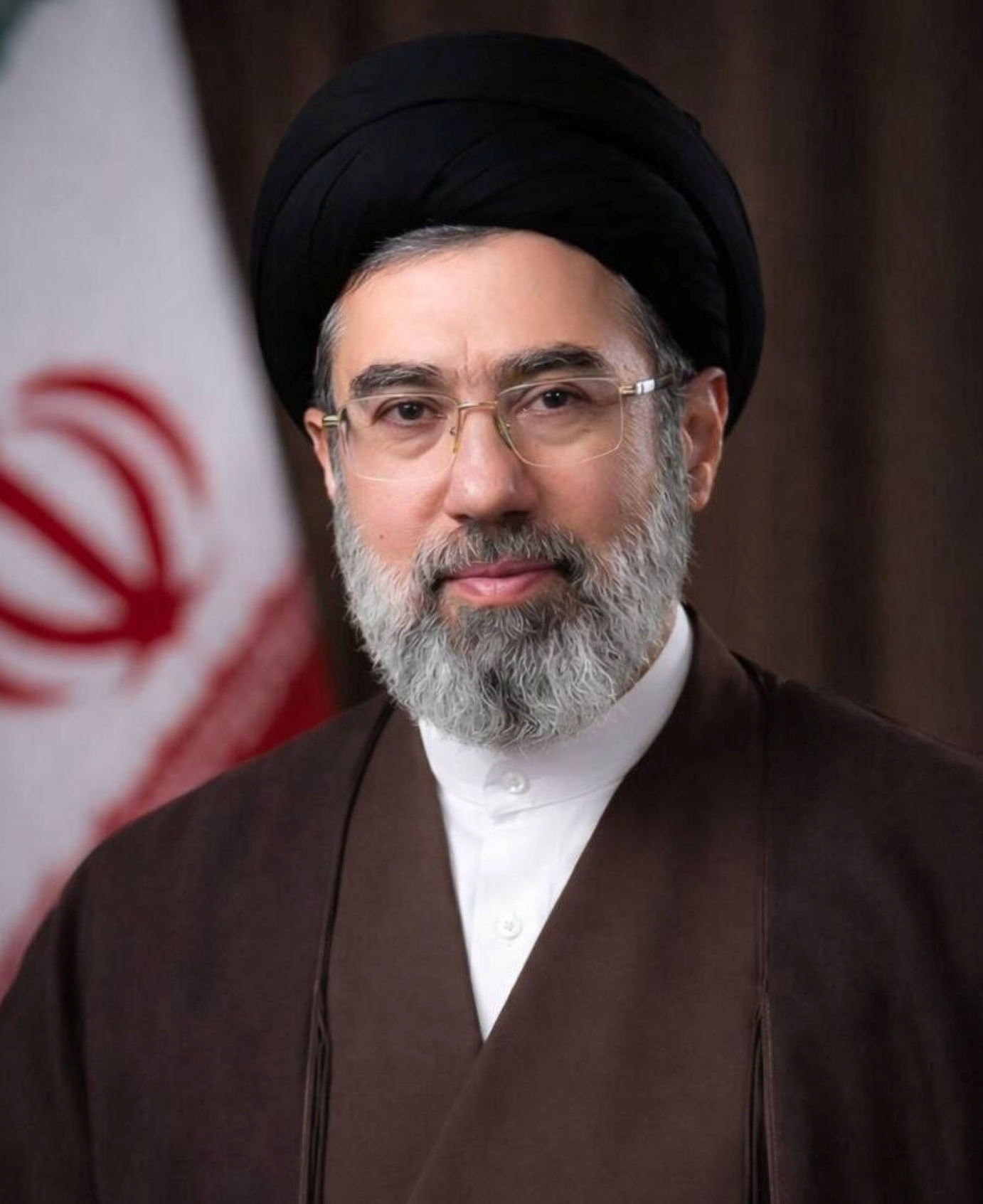
Mojtaba Khamenei is the third Supreme Leader of the Islamic Republic of Iran. He assumed the position in 2026 following the death of his father, Ayatollah Ali Khamenei, during the opening phase of the US-Israel-Iran war. His appointment marked the first hereditary transfer of power in the Islamic Republic since the 1979 Iranian Revolution. It was widely interpreted as a signal of ideological continuity within Iran’s ruling establishment.
Mojtaba Khamenei was born in Mashhad, one of Iran’s most important religious centers and the site of the shrine of the eighth Shi’ite imam, Ali al-Rida. He is the second son of Ali Khamenei, a revolutionary cleric who rose to prominence during the movement that overthrew Shah Mohammad Reza Pahlavi in 1979 and later served as Iran’s president before becoming Supreme Leader in 1989.
Growing up during the Iranian Revolution and the early consolidation of the Islamic Republic, Mojtaba was raised in an environment closely connected to the country’s clerical and political elite. After completing his secondary education in the late 1980s, he joined forces associated with the Islamic Revolutionary Guard Corps (IRGC) and served during the final stages of the Iran-Iraq War (1980-1988).
In the late 1990s, Mojtaba Khamenei began pursuing advanced religious studies in the Shi’ite seminaries of Qom, Iran’s principal center of theological scholarship. There, he studied under prominent conservative clerics and eventually taught courses himself, although he was generally regarded as a mid-ranking cleric rather than a leading religious authority.
At the same time, he developed strong connections within the Islamic Revolutionary Guard Corps and the Office of the Supreme Leader, where he gradually became a key intermediary between his father and powerful political and military institutions. Over time, he built a reputation as a behind-the-scenes figure who helped coordinate relationships among clerical authorities, security agencies, and political actors.
Although Mojtaba Khamenei never held an elected or formal government position, analysts and diplomats widely regarded him as one of the most influential individuals within the Iranian system during his father’s rule. His role within the Supreme Leader’s office allowed him to cultivate ties across the country’s security apparatus and political elite.
His name first drew widespread public attention during Iran’s 2005 presidential election, when reformist candidate Mehdi Karroubi accused him of influencing the outcome in favor of conservative candidate Mahmoud Ahmadinejad. Similar accusations resurfaced after the disputed 2009 presidential election, which triggered large demonstrations known as the Green Movement. Opposition figures alleged that Mojtaba played a role in coordinating the crackdown that followed the protests.
During the 2022 protests sparked by the death of Jina Mahsa Amini, demonstrators again directed criticism toward Mojtaba Khamenei, reflecting his perceived influence within the regime’s security structure.
For years, Mojtaba Khamenei was viewed by some observers as a potential successor to his father, though speculation about a hereditary succession remained controversial within Iran. After Ali Khamenei was killed in the opening phase of the 2026 war involving Iran, Israel, and the United States, Iran’s Assembly of Experts selected Mojtaba as the country’s new Supreme Leader.
His appointment was supported by powerful factions within Iran’s security establishment, particularly the Islamic Revolutionary Guard Corps. Many analysts interpreted it as a decision aimed at maintaining continuity and stability during wartime.
Mojtaba Khamenei rarely spoke publicly before assuming leadership, and his personal views on international issues were not widely documented. However, analysts generally expect him to continue his father’s hard-line policies. His close ties to the IRGC and the broader security establishment suggest a confrontational posture toward Western powers, particularly the United States, and continued hostility toward Israel.
Observers have noted that his leadership is likely to emphasize ideological continuity, domestic control, and resistance to Western pressure, reflecting the priorities of the institutions that supported his rise to power.
U.S. intelligence suggests that Khamenei may be gay, a claim reportedly considered credible within the intelligence community. The intelligence indicates he may have had a long-term relationship with a male childhood tutor or a former family associate, and sources also alleged that while recovering from injuries sustained in the strike that killed his father, he made sexual advances toward male caregivers. U.S. officials reportedly lack photographic proof but say the information comes from a highly protected source. The report also notes that rumors about Mojtaba’s sexuality had circulated previously within Iranian circles and that his father allegedly worried about the political implications of those suspicions.
Mojtaba Khamenei’s elevation to the position of Supreme Leader marked a significant moment in the history of the Islamic Republic. The transfer of power from father to son represented an unprecedented development in a system founded in opposition to hereditary rule. At the same time, his selection underscored the enduring influence of Iran’s clerical and security establishments and their commitment to preserving the political structure created after the 1979 revolution.
“Mojtaba Khamenei,” Encyclopedia Britannica.
Farnaz Fassihi, “Iran’s New Leader, Ayatollah Khamenei’s Son, Is a Mysterious Figure,” New York Times, (March 8, 2026).
James Powel, “Who is Mojtaba Khamenei? What we know about Iran’s new supreme leader,” USA Today, (March 8, 2026).
Benoit Faucon, Sune Engel Rasmussen, “Iran Signals a Fight to the End With Appointment of Khamenei’s Son,” WSJ, (March 8, 2026).
Yoni Ben Menachem, “Mojtaba Khamenei Appointed Iran’s Supreme Leader in Defiance of America and Israel,” JCFA, (March 9, 2026).
“Trump briefed that Iran’s new Supreme Leader Mojtaba Khamenei is probably gay — and president has priceless reaction,” New York Post, (March 16, 2026).
Photo: Bahasa Indonesia, CC0 1.0 Universal Public Domain via Wikimedia Commons.