
Axios reported that the accelerated timetable for launching the war left the White House without the time it had planned to build a public case for military action, forcing the administration to justify the strikes only after the bombs had already fallen.
On September 29, Trump rejected an Axios report that he had offered Iran sanctions relief and frozen funds, saying: “This is untrue. I offered them NOTHING!’
The Road to War
Failed Negotiations
The Iranian Uprising
The Internal Debate
“Help Is on Its Way”
The State of the Union Warning
The Case for War
Israel’s Reasoning
Epic Fury and Roaring Lion
Missile Hunting
Expanding the Targets
The Covert Operation to Sink Iran’s Navy
The Kurdish Invasion That Never Happened
The Failed Ahmedinijad Plot
Russian Support for Iran
China’s Role
An Uncertain Path
Trump Announces Negotiations
Fighting Continues
Iran Strikes the Gulf and its Neighbors
Internationalizing the Conflict
Hezbollah Joins the Fight
Militias Drag U.S. Back to Iraq
The Houthis Attack Israel
Trump Finally Addresses the Nation
Pakistan Mediates Peace Talks
Trump Extends Deadline
Misreading Iranian Intentions
Economic Impact
Casualties
Regime Resilience
Domestic Politics
American Public Opinion
American Jewish Opinion
Palestinian Opinion
Israeli Opinion
Tortuous Negotiations to End the War
Congress Intervenes
Iran Escalates While Trump Restrains
Trump Loses Patience
Iran and U.S. Agree to MOU
Trump’s Desperation
The Nefarious Qataris
Iran and the U.S. Contradict Each Other
The Pickaxe Mountain Challenge
Netanyahu at the White House Again
The Ceasefire Breaks
Damage to U.S. Bases
The Analysts’ Verdict
How Iran Used the Pause
Trump Declares Economic War
Endnotes
The Road to War
The path to war began not with a single decision but with a cascading series of crises stretching back more than a year.
On June 13, 2025, Israel launched a massive preemptive strike – Operation Rising Lion – against Iranian nuclear and military facilities, amid ongoing U.S.-Iran nuclear negotiations that Trump had initiated two months earlier with a personal letter to Supreme Leader Ali Khamenei.[1] Iran retaliated within hours, firing waves of ballistic missiles at Israeli cities.[2]
Over the next twelve days, the two countries exchanged sustained aerial bombardments in the most intense direct military confrontation in their history. Israel’s strikes killed top Iranian military commanders and nuclear scientists, destroyed missile depots and launch centers, and severely damaged facilities at Natanz, Fordow, Isfahan, and the Arak heavy water reactor.[3] Iran’s response, though more modest, was not insignificant — its missiles shut down the Haifa oil refinery, paralyzed Ben Gurion Airport, and killed 31 people in Israel.[4]
On June 21, the United States entered the fight directly with Operation Midnight Hammer, striking three Iranian nuclear sites — Fordow, Natanz, and Isfahan — using B-2 bombers armed with GBU-57 Massive Ordnance Penetrator bunker-buster bombs.[5] Trump claimed the strikes “obliterated” Iran’s nuclear program. A leaked Defense Intelligence Agency assessment was less definitive, suggesting Iran had moved much of its enriched uranium stockpile before the strikes and that the setback amounted to months, not years. CIA Director John Ratcliffe countered that new intelligence showed far more severe damage.[6]
Iran retaliated against the U.S. by firing 14 missiles at Al Udeid Air Base in Qatar, which houses American forces. The attack caused no casualties — Iran had reportedly warned both Qatar and the United States in advance, suggesting the strike was largely symbolic.[7]
On June 24, Trump brokered a ceasefire, ending what became known as the “Twelve-Day War.” Both sides claimed victory. The ceasefire was an oral understanding, not a written treaty, and it left every underlying issue — Iran’s nuclear program, its missile arsenal, its regional proxy networks — unresolved.[3]
Failed Negotiations
What followed was months of fitful diplomacy. In August, Iran agreed to resume nuclear talks with Britain, France, and Germany, even as its parliament fast-tracked legislation to suspend cooperation with the International Atomic Energy Agency. The European nations responded by triggering a mechanism to reinstate United Nations sanctions on Iran for the first time in a decade.[2]
By November, Trump said Iran had requested that Washington lift its crippling sanctions, and he expressed willingness to talk. But the contours of a deal remained elusive. The Trump administration demanded the complete dismantling of Iran’s nuclear and missile programs — terms Tehran refused.[1] Indirect talks mediated by Oman continued into early 2026, but Trump envoy Steve Witkoff and senior advisor Jared Kushner reportedly told the president it would be “difficult, if not impossible,” to reach an agreement.[1]
Meanwhile, Iran was quietly rebuilding. By the time of the second round of hostilities, Iran had reportedly stockpiled more missiles than it possessed before the June war.[4]
According to Amit Segal, an operation was planned as a joint Israeli-U.S. campaign against Iran’s ballistic missile capabilities around June, but the timeline shifted after the United States expressed interest in joining a broader effort targeting the Iranian regime, discussed during a December 29 meeting between Prime Minister Benjamin Netanyahu and Donald Trump at Mar-a-Lago.[100]
The Iranian Uprising
On December 28, 2025, the crisis took a dramatic turn — not from outside Iran, but from within. Shopkeepers in Tehran’s Grand Bazaar went on strike after the Iranian rial collapsed to a record low of 1.42 million to one U.S. dollar.[9] The protests, initially sparked by economic desperation — soaring food prices, chronic inflation, state mismanagement — spread with stunning speed to all 31 provinces.[10]
Within days, the demonstrations evolved from economic grievances into explicit calls for regime change. Crowds chanted “Down with Khamenei!” and “Down with the dictator!” — slogans that went far beyond anything the regime could dismiss as a reaction to rising prices.[11]
On January 3, 2026, Khamenei declared that “rioters should be put in their place.”[12] The IRGC and judiciary took this as authorization for a pitiless crackdown. On January 5, Iran’s chief judiciary ordered prosecutors to show “no leniency.”[12] Then, on January 8, the regime shut down the internet entirely, severing 85 million people from the outside world.[13]
What followed was among the deadliest episodes of state violence in modern history. On January 8 and 9, IRGC and Basij forces — acting under what multiple investigations later confirmed were direct orders from Khamenei to suppress the protests “by any means necessary” — opened fire on demonstrators with rifles, shotguns, mounted machine guns, and drones.[14][15] Internal estimates from Iran’s own Ministry of Health indicated at least 30,000 people were killed in just the first 48 hours.[10] The UN Special Rapporteur on Iran estimated the toll could surpass 20,000; other organizations placed it higher still — Time magazine reported a figure of over 30,000 deaths registered in civilian hospitals for January 8 and 9 alone, while Iran International estimated approximately 36,500 total deaths.[15] Some observers described the crackdown as the deadliest incident of gunfire against civilians since the Nazi massacre at Babi Yar in 1941.[10]
By January 21, the regime declared the protests crushed. More than 42,000 people had been arrested.[16]
“Help Is on Its Way”
Trump responded with escalating rhetoric. On January 13, 2026, he posted on Truth Social: “Iranian Patriots, KEEP PROTESTING — TAKE OVER YOUR INSTITUTIONS!!! HELP IS ON ITS WAY.” When reporters asked what he meant, he replied, “You’re going to have to figure that one out.”[13]
On Jan. 14, Netanyahu called Trump and asked him to delay any military strike until later in the month, when Israel’s defense preparations were complete. Trump agreed to wait.[1]
Trump called off scheduled meetings with Iranian representatives and announced on January 23 that a U.S. “armada” was heading to the Middle East, including the aircraft carrier USS Abraham Lincoln and guided-missile destroyers.[17] By late January, Khamenei had reportedly taken shelter in a bunker beneath Tehran.[17] Defense Minister Israel Katz said any leader appointed by the Iranian regime to replace Ali Khamenei would be an “unequivocal target for elimination.”[61]
On February 3, a U.S. Navy fighter jet shot down an Iranian drone approaching the Lincoln in the Arabian Sea, and Iranian fast-attack boats attempted to intercept a U.S.-flagged ship in the Strait of Hormuz.[9] Iran threatened to retaliate against energy infrastructure in the Gulf countries if the U.S. attacked the oil-related infrastructure on the island. Iran also said it was closing the Strait to U.S. and Israeli shipping. However, it did not take any action to close the strait.
Indirect nuclear talks resumed in Oman on February 6, then moved to Geneva on February 17 — the same day Iran announced it had temporarily closed the Strait of Hormuz, through which roughly a fifth of all globally traded oil passes.[9] It was not closed, but commercial traffic began to avoid the area.
The Internal Debate
The New York Times reported that the road to war began on February 11 in the White House Situation Room, where Netanyahu arrived for a classified hour-long briefing with Trump and a select group of advisers. The unusual venue — foreign leaders rarely meet in the Situation Room — set the stage. Mossad director David Barnea and Israeli military officials appeared onscreen behind the prime minister, giving the impression of a commander flanked by his team.[241]
Netanyahu argued Iran was near collapse and that a joint American-Israeli military campaign could finally topple the Islamic Republic. He had pressed Trump for months, and the February meeting was the culmination of that effort. At the meeting, his message to the president was direct: “We’ve come this far, Donald. We have to finish what we started.” He maintained that Iran, already struck, would now see nuclear weapons as its only protection. As one Israeli official told Time magazine, “After they got hit the last time, they thought they had nothing to lose.”[99]
Netanyahu outlined four objectives, each framed as achievable: dismantle Iran’s ballistic missile infrastructure within weeks; keep the Strait of Hormuz open; minimize risks to American interests; and use Israeli intelligence to spark a domestic uprising for regime change. To dramatize a post-theocratic Iran, his team played a video featuring possible future leaders, including Reza Pahlavi, the exiled son of the last Shah, now in Washington. Netanyahu also proposed that Kurdish fighters cross from Iraq, stretching Iran’s military and hastening its collapse.
The president’s response gave the prime minister what he was looking for, as Trump indicated that the plan sounded promising. As a result, most people in the room took his reaction as a clear green light.
American analysts worked through the night to evaluate what Netanyahu had presented. Their findings, delivered the following day in a meeting from which the Israelis were excluded, were pointed. The first two elements of Netanyahu’s pitch — eliminating Iran’s top leadership and degrading its capacity to project power — were judged to be realistic military objectives. The final two — a mass popular uprising and the installation of a secular successor government — were deemed wishful thinking, disconnected from Iranian political reality. CIA Director John Ratcliffe summarized the regime-change scenario with a single word: “farcical.” Secretary of State Marco Rubio offered a plainer translation: “In other words, it’s bullshit.”
This interpretation of events has been challenged as being based on the use of selective sources to support the anti-war, anti-Netanyahu, and anti-Trump narrative of the New York Times and Washington Post. A U.S. official told Israel Hayom’s Danny Zaken, “They were fed by sources in certain departments at the State Department and the War Department who dislike what they see as the overly close ties between Jerusalem and Washington, certainly when it comes to Middle East policy.”[277]
According to Zaken, the information presented by Mossad Director David Barnea, Military Secretary Roman Gofman, and another senior Israeli intelligence officer reflected a more cautious assessment that toppling the regime was a complex and long-term mission. Barnea also publicly disputed reports that he had suggested the regime could be quickly overthrown. “We didn’t think this mission would be completed immediately after the fighting subsided,” Barnea told the New York Times. “Rather, we planned — and prepared — for our campaign to continue and to be reflected also in the period following the strikes on Tehran.”[278]
The CIA had, in fact, prepared several scenarios after Supreme Leader Khamenei’s death. There were so many variables that the agency could not confidently predict the most likely outcome. One scenario saw a hardline cleric replacing Khamenei, possibly even more determined to acquire nuclear weapons. Another predicted a popular uprising, though many intelligence officials doubted this, given Iran’s weak and fragmented opposition. A third scenario, favored by several senior Trump administration officials, held that a pragmatic faction within the Islamic Revolutionary Guard Corps might take power, even if a cleric remained in charge. CIA analysis suggested that if the U.S. left this faction’s economic interests, especially oil industry influence, intact, these officers might prove conciliatory toward Washington. They might surrender Iran’s nuclear program or restrain proxy forces long targeting American interests. It would be a dramatic shift for an officer corps strongly anti-American for four decades, but the possibility was not dismissed outright.
General Dan Caine, chairman of the Joint Chiefs, voiced skepticism about the Israeli plan. He told the president that Israel typically oversells its cases to Washington, explaining, “They know they need us,” and adding, “That’s why they’re hard-selling.”
Trump listened, acknowledged the critique, and set it aside. He declared that regime change would be “their problem” — whether he meant the Israelis or the Iranians was left unclear — and his interest in destroying Iran’s military and eliminating its leadership remained entirely intact.
Trump’s advisers differed on war, but none were willing to challenge his instincts.
Trump grew increasingly receptive to military action following the successful January 2026 operation that captured Venezuelan President Nicolás Maduro from his compound without a single American casualty. The operation had deepened his faith in the reach and precision of American military power, and it set a template in his mind for how the Iranian campaign might unfold.
Defense Secretary Pete Hegseth was the war’s strongest advocate in the cabinet. At the February 26 deliberation, he said that confronting Iran was inevitable; the timing was just a strategic matter. Secretary of State Rubio was more cautious. He preferred ongoing economic and diplomatic pressure to military action, but did not push back. Once the decision was made, he defended it publicly with conviction. At the final meeting, he noted one reservation: if regime change and popular uprising were objectives, the operation was not worth attempting. Destroying Iran’s missile program was an achievable goal.
Chief of Staff Susie Wiles was concerned about the political consequences of rising energy prices ahead of the midterm elections. However, she considered military decisions outside her purview when the president was present and ultimately supported the operation.
General Caine persistently raised logistical and regional risk warnings, noting that such a campaign would further deplete U.S. weapons stockpiles and missile interceptors, with slow replacement rates. He cautioned about U.S. casualties, regional instability, retaliatory risks in the Strait of Hormuz, and unpredictable regime reactions. Yet Caine avoided taking a personal stance, presenting only the consequences; this made his warnings seem diffuse. Trump focused on Caine’s assurance of overwhelming air power and later publicly oversimplified Caine’s assessment as “something easily won.”
Among Trump’s immediate circle, Vice President JD Vance alone made a real case against war. His opposition stemmed not from politics or temperament, but conviction. He had spent years opposing such military ventures and believed full-scale war with Iran would be a historic mistake.
Vance argued before the president and team that the conflict risked regional chaos and unpredictable casualties, broke Trump’s pledge of no new wars, and could fracture his political coalition. He emphasized that intelligence could not reliably forecast Iranian behavior if the regime’s survival was at risk, and repeatedly mentioned the danger of the Strait of Hormuz—closure could devastate U.S. energy prices and have dire economic and political effects.
Privately, Vance preferred no military action. Seeing this as unlikely, he urged Trump to limit strikes. When this failed, he shifted: if Trump insisted on a large operation, it should be with overwhelming force to end the conflict rapidly—”big and fast.”[29]
Gen. Dan Caine also warned Trump that an American strike could trigger an Iranian attempt to shut down the Strait of Hormuz. In a series of briefings, Caine reportedly explained that U.S. intelligence had long assessed that Tehran would likely use mines, drones, and missiles to disrupt traffic through the Strait.
Trump acknowledged the danger, but nevertheless chose to proceed with what became the most consequential foreign-policy decision of his presidency. He reportedly concluded that Iran would likely back down before taking the drastic step of closing the strait—and that even if Tehran tried, the U.S. military possessed the capability to reopen it by force.[294]
Tucker Carlson, a leading skeptic of intervention on the American right, visited the Oval Office several times to make similar arguments. In a conversation shortly before the war began, Trump reassured him. “I know you’re worried about it,” the president said, “but it’s going to be OK.”
At the final Situation Room meeting on February 26, Vance addressed the president directly: “You know I think this is a bad idea, but if you want to do it, I’ll support you.”
The president’s confidence that the war would be short and decisive was not something his advisers’ warnings could easily penetrate. Iran’s restrained response to American bombing of its nuclear facilities the previous June had suggested to Trump that the regime would back down rather than escalate. The Maduro operation had further deepened his certainty. When advisers raised the possibility that Iran could shut down the Strait of Hormuz, he dismissed it, assuming the regime would capitulate before resorting to such a step.
But the deeper explanation the reporting offers is structural. Trump’s second-term inner circle was fundamentally different from the one that surrounded him in his first term. Figures like General Mark Milley viewed their role partly as preventing the president from taking actions they judged dangerous and were willing to argue with him directly and forcefully. The second-term team had been shaped by a different experience: by watching Trump survive indictments, assassination attempts, and a political exile that would have finished most careers, and then win an improbable return to the White House; by the clean success of the Maduro operation; and by a series of bold calls that had repeatedly paid off. The result was something close to institutional faith in the president’s instincts — a belief that Trump possessed a quality of judgment that conventional analysis could not fully capture. Almost no one, in that environment, was willing to plant themselves firmly in the way.
The State of the Union Warning
Behind the scenes, the military was already positioning. Trump was furious when the New York Times published details of the military operation’s planning on February 17, according to Time. “The President then told reporters he would decide on strikes within ‘10, 15 days,’ although he knew the U.S. was planning to attack much sooner. ‘He was intentionally engaged in public misdirection to protect the mission,’” a White House official told Time.[99]
CBS News reported on February 19 that the White House had issued a warning that Tehran should make a deal, and that Trump had sent warships, tankers, and submarines to the Middle East, with strikes possible as early as February 21. Sources cautioned, however, that Trump had privately argued both for and against military action, polling advisers and allies on the best course.[17]
On February 24, Trump delivered his State of the Union address and used it to lay the public groundwork for military action. He accused Iran of reviving efforts to build nuclear weapons, describing its ambitions as “sinister.” He warned that Iran had developed increasingly advanced missile capabilities “that can threaten Europe and our bases overseas, and they’re working to build missiles that will soon reach the United States of America.” He said he preferred diplomacy but would not allow Iran to acquire nuclear weapons.[17]
Previously, during their December meeting at Mar-a-Lago, Trump told Netanyahu that the United States would support Israeli strikes on Iran’s ballistic missile program if a deal could not be reached. Internal discussions among senior U.S. military and intelligence officials had begun focusing not on whether Israel could act, but on how the United States might assist — including aerial refueling and securing overflight permissions from countries along the route.[18]
In an unprecedented move, the U.S. sent F-22 Raptor fighter jets and refueling aircraft to Israel. This represented a dramatic break with the long-dominant foreign-policy doctrine promoted by Washington’s “Arabists who had convinced presidents for eight decades that such close strategic cooperation with Israel would undermine America’s standing in the Arab world. Trump, however, recognized when planning operations against Iran, only Israel was prepared to stand with the United States. Gulf states hosting American bases — nations that had received decades of arms sales and security guarantees — refused their use against Tehran.
The irreconcilable gap between the parties became clear on February 21, when Witkoff explained that Trump was perplexed by Iran’s refusal to accept zero enrichment—the complete dismantlement of its nuclear fuel production. Trump, Witkoff said, was “curious as to why they haven’t — I don’t want to use the word ‘capitulated,’ but why they haven’t capitulated” under mounting U.S. pressure and military deployments. “It’s sort of hard to get them to that place,” he added.
On February 26, another round of talks was held in Geneva. Iran presented U.S. negotiators with a seven-page proposal outlining future nuclear enrichment levels that alarmed American officials. The United States insisted that Iran commit to zero enrichment and offered to supply free nuclear fuel for civilian use, but Tehran refused. After the talks, Witkoff and Kushner advised President Trump that a nuclear agreement was unlikely.[29]
On February 27, Oman’s foreign minister announced that Iran had agreed to degrade its nuclear stockpiles to “the lowest level possible.” Iran refused to give up enrichment or discuss non-nuclear issues. American negotiators concluded that the Iranians were stalling.
Witkoff later told Fox News that negotiations with Iran collapsed after Iranian officials openly declared their intent to enrich uranium at weapons-grade levels. “The Iranians made it clear from the start that they believe they have an undeniable right to enrich all the uranium they possess,” Witkoff said.
Iran rejected a U.S. proposal for a ten-year enrichment freeze, even with Washington offering to supply nuclear fuel at its own expense. “That was the moment we understood they had no intention of doing anything other than enriching uranium for nuclear weapons,” Witkoff said. He revealed that two Iranian negotiators openly acknowledged possessing roughly 460 kilograms of uranium enriched to 60% — enough, they admitted, for as many as 11 nuclear bombs. “They weren’t hiding it. They were proud,” Witkoff said.
“President Trump sent us to see if Iran was serious,” Witkoff stated. “But by the second meeting, it was clear a deal was impossible. We came to the third meeting in good faith, and they wanted us to project optimism. There was nothing optimistic about it.”[42]
Trump acknowledged that his confidence in diplomacy had evaporated. “Toward the end of the negotiation, I realized that these guys weren’t going to get there,” he told the New York Times on March 1. “I said, ‘Let’s just do it.’”
Around the same time, intelligence surfaced that Supreme Leader Khamenei would be meeting above ground with senior regime officials — a rare and fleeting window for a decapitation strike. The CIA had prepared multiple scenarios for what might follow if Khamenei were killed. The variables were so numerous that the agency could not confidently predict which outcome was most likely.[30]
The Case for War
On February 26, Trump convened the final Situation Room meeting. He went around the table, heard from each adviser, and then delivered his conclusion: “I think we need to do it.” He said the United States had to ensure that Iran could not acquire a nuclear weapon and could not continue firing missiles at Israel and across the wider region.
At 3:38 p.m. on February 27, Central Command received the final go-ahead from President Trump via the defense secretary. “Operation Epic Fury is approved. No aborts. Good luck!” the president’s message said.[38]
By his own telling, President Trump was asked to choose the name for the military operation against Iran but found the options uninspiring. “They gave me, like, 20 names, and I’m like, falling asleep,” he said. “I didn’t like any of them.”
Then one option caught his attention: Operation Epic Fury. “I like that name,” he told supporters at a rally in Kentucky. And with that, the name was set.[270]
Israel launched coordinated strikes on Iranian targets, including sites in and around Tehran, on February 28. The U.S. began operations at 1:15 a.m. Hours later, in an eight-minute video posted to Truth Social at roughly 2:30 a.m., Trump announced that the United States had begun “major combat operations in Iran.”[19]
While critics insisted Iran posed no direct threat to the United States and that Trump did not explain to the American people why military action against Iran was necessary, the president’s video laid out the case in detail, noting that Iran’s hostility dated to 1979, when revolutionaries seized sovereign American territory—the U.S. Embassy in Tehran—and held more than 50 Americans hostage for 444 days. Since then, Iran has waged a sustained shadow war against the United States through proxies and terrorism. Iranian-backed Hezbollah has killed more Americans than any terrorist organization except al-Qaeda on September 11, 2001. Iranian-supplied roadside bombs (IEDs) killed thousands of people, including Americans, in Iraq. Iranian-supported Hamas murdered and kidnapped Americans on October 7. Iranian operatives have plotted assassinations of dissidents and even former U.S. officials on American soil. “Death to America” was a ritualized slogan of the state.
He further justified the action by accusing Iran of having “rejected every opportunity to renounce their nuclear ambitions,” claiming that after the June 2025 strikes, Tehran “attempted to rebuild their nuclear program and to continue developing long range missiles that can now threaten our very good friends and allies in Europe, our troops stationed overseas and could soon reach the American homeland.”[19] Fact-checkers noted that a 2025 Defense Intelligence Agency assessment said Iran was years — possibly a decade — away from developing an intercontinental ballistic missile.[19]
Trump had previously opposed the idea of using military force to promote regime change in Iran, but reversed his position. He now told the people of Iran: “that the hour of your freedom is at hand” and called on them to take over the government. “It will be yours to take. This will be probably your only chance for generations,” he said.
Unspoken was another threat manufactured by China, which was helping Iran accelerate production of missiles. During the twelve-day war in 2025, the United States expended roughly 150 THAAD interceptors—high-end munitions that take years to replace and are also critical for deterrence in the Pacific. With only limited replenishment and Iran rebuilding faster than U.S. stockpiles could recover, policymakers faced a stark choice: tolerate a potential Iranian nuclear breakout protected by an increasingly dense missile shield, or divert resources from Asia and risk a broader war. Operation Epic Fury was a preemptive effort to eliminate that dilemma by destroying Iran’s missile capabilities and negating years of Chinese-backed military buildups.
As Zineb Riboua observed, when Rubio stated, “The objectives of this operation are to destroy their ballistic missile capability and make sure they can’t rebuild, and make sure that they can’t hide behind that to have a nuclear program,” he collapsed a distinction originally drawn by President Barack Obama and effectively closed the loophole it created. In doing so, “one sentence fused what the JCPOA had deliberately kept apart—the nuclear file and the missile file—and redefined what an acceptable Iran looks like.”[185]
Critics, including most of America’s European allies, opposed war and advocated further negotiations, ignoring that they had already failed, and Iran made clear it would not accept Trump’s terms.
The prospect that U.S. military force could produce regime change was widely met with skepticism. Analysts observed that even if the ruling clerical establishment were removed, the Iranian Revolutionary Guard Corps (IRGC) remained deeply entrenched across the country’s political, military, and economic institutions. President Trump called on the Guards to lay down their arms, but few believed they would willingly relinquish power; more likely, many argued, the IRGC would replace the mullahs rather than surrender authority.
Although many Iranians—particularly in Tehran’s urban centers—expressed pro-American sentiments and aspirations for democratic reform, significant segments of the population continued to support some form of Islamic republican system. No unified or organized opposition movement existed, and regime opponents lacked both the leadership structure and armed capacity necessary to challenge the IRGC. Reza Pahlavi, the son of Iran’s last shah, promoted himself from exile in the United States as a potential national leader, yet memories of the Shah’s authoritarian rule—one of the catalysts of the 1979 revolution—limited his appeal. No broad internal movement coalesced around him, nor did the Trump administration signal support for restoring a monarchy or installing an exile-led government.
Prior to launching the war, reports also suggested that Pentagon officials were worried about having the resources to conduct a long operation. Munitions and missile defense interceptors were said to be in short supply.
The decision to go to war was also controversial because Trump did not seek congressional authorization. Democrats and a handful of Republicans, including Senator Rand Paul and Representative Thomas Massie, pushed for war powers resolutions. Democratic Senator John Fetterman broke with his party to support the strikes.[22]
The decision, the Times reporting made clear, was not the product of a strategic consensus or a favorable intelligence assessment. It was the product of instinct — and of a governing environment in which, unlike in his first term, almost nothing stood between that instinct and its consequences.
Pushing back against reports like the Times suggesting that Israel had drawn him into the conflict, Trump took to social media on April 20 to insist that his decision was driven by his own long-held views and the events of October 7—not by Israeli influence. “Israel never talked me into the war with Iran, the results of Oct. 7th, added to my lifelong opinion that IRAN CAN NEVER HAVE A NUCLEAR WEAPON, did.”[240]
The following day, the State Department provided a legal analysis to quiet the furor. It said “the United States is acting well within the recognized contours of international law relating to the use of force and self-defense. This legal assessment is grounded in facts demonstrating Iran’s malign aggression over decades, particularly in Iran’s escalatory attacks against the United States, Israel, and others in the region for years.”
The rationale also said “the United States is engaged in this conflict at the request of and in the collective self-defense of its Israeli ally, as well as in the exercise of the United States’ own inherent right of self-defense,” which was more likely to fuel the claims that Netanyahu had convinced Trump to start the war.
Israel’s Reasoning
Israeli Defense Minister Katz said Netanyahu set the goal of assassinating Iran’s Supreme Leader Ali Khamenei as early as November, with plans later accelerated due to widespread anti-regime protests that created an opportunity for a joint U.S.-Israeli operation.[137]
Netanyahu justified the timing of Operation Epic Fury by arguing that Iran had begun rebuilding the very capabilities destroyed in the June 2025 strikes. ‘After we hit their nuclear sites and their ballistic missiles program, you’d think they learned a lesson, but they didn’t because they’re unreformable.’ He said Iran was constructing new underground bunkers that would have made its missile and nuclear programs impervious to attack ‘within months.’ ‘If no action was taken now, no action could be taken in the future. And then they could target America. They could blackmail America.’
In addition, Israeli defense planners warned that Chinese components, technology, and expertise were rapidly accelerating Iran’s missile production, projecting an arsenal of 5,000 missiles by 2027 and up to 10,000 by decade’s end.[185]
Netanyahu pushed back against fears of a prolonged conflict, insisting the joint U.S.-Israeli operation against Iran would be swift and transformative. ‘You’re not going to have an endless war,’ he said. ‘This terror regime in Iran is at the weakest point that it’s been since it hijacked Iran from the brave Iranian people 47 years ago. So this is going to be a quick and decisive action.’
The prime minister framed the military campaign as a precondition for regional peace rather than an obstacle to it. ‘This is not an endless war. This is, in fact, something that will usher in an era of peace that we haven’t even dreamed of.’ He predicted the regime’s fall would lead to ‘many peace treaties’ with Muslim countries, singling out Saudi Arabia as a nation with ‘a lot to gain’ and saying peace between Riyadh and Jerusalem would be ‘very close’ as a result.[41]
Netanyahu said on March 12 that he hopes Israeli and U.S. military actions will help create conditions for regime change in Iran, but acknowledged the outcome is uncertain, remarking: “You can lead someone to water; you cannot make him drink.” He said Israel is striking Iran’s security forces to give citizens “the space needed to take to the streets,” but admitted, “I cannot say for certain that the Iranian people will bring down the regime,” emphasizing that “ultimately, a regime is ousted from within.”
Netanyahu argued the war was necessary because Iran had accelerated its nuclear and missile programs after earlier warnings, saying that without action, Iran’s weapons infrastructure would soon have become “immune to any strike.” He added that the U.S.-Israel campaign had already weakened the Islamic Republic: “It’s simply a different Iran — it no longer threatens as it did before.”[118]
Epic Fury and Roaring Lion
The joint operation — dubbed “Operation Epic Fury” by the Pentagon and “Roaring Lion” by Israel — was far more expansive than the June 2025 strikes.[20] Trump declared its aims: to eliminate Iran’s nuclear threat, destroy its ballistic missile arsenal, degrade its proxy terror networks, annihilate its navy, and — for the first time explicitly — change its leadership.[21]
“We are going to destroy their missiles and raze their missile industry to the ground. It will be totally, again, obliterated,” Trump said, adding, “We’re going to annihilate their navy.”[20] He appealed directly to the Iranian people: the country “will be yours to take. This will be probably your only chance for generations.”[21]

Originally set for late March or early April to build public support, Operation Epic Fury’s timetable was ultimately accelerated after months of intensive coordination between Trump and Netanyahu. According to Axios, the two leaders met twice and spoke by phone 15 times.[84]
Trump wanted to strike in January, but Netanyahu requested a delay to ensure missile defenses were prepared. The U.S. and Israel considered a strike a week earlier but postponed it due to intelligence, operational issues, and bad weather.
On February 23, Netanyahu called Trump with critical intelligence: Khamenei would be at his central Tehran compound with top Iranian officials on February 28. Netanyahu said a strike could kill them all. By February 26, the CIA confirmed the gathering. A source told Axios, “These people would all be together, and we needed to take advantage.”
Officials said Trump made a “deliberate decision” not to focus excessively on Iran in his State of the Union speech so as not to spook the ayatollah and drive him underground before the strike could be executed. The original plan for a nighttime operation was scrapped in favor of a daylight decapitation strike after the intelligence confirmed Khamenei’s schedule.
Israel’s Operation “Roaring Lion” began on the 28th with an elaborate deception plan designed to conceal the imminent strike. Senior Israeli military officers deliberately returned home for Friday night dinner so observers would assume no attack was imminent, while key commanders secretly traveled to the command bunker using inconspicuous vehicles.[100] Israel then bombed Khamenei’s compound. Later that day, Trump confirmed the supreme leader’s death. Iranian state media acknowledged his passing and declared 40 days of mourning.
Referring to two alleged Iranian-backed Trump assassination attempts, Trump said: “I got him before he got me. They tried twice. Well, I got him first.”[80]
The reaction inside Iran was deeply divided. Many Iranians — still raw from the January massacres in which the regime had slaughtered tens of thousands of protesters — took to the streets in celebration, seeing Khamenei’s death as the end of a figure who had ruled with an iron fist since 1989 and had ordered security forces to crush every uprising from the 2009 Green Movement to the Woman, Life, Freedom protests to the 2026 revolution. Others, particularly in regime-loyal communities, gathered in mourning, and pro-government rallies took place in Tehran and other cities. The Iranian diaspora in America was similarly stirred — though the overwhelming sentiment among Iranian Americans was jubilation, with crowds gathering in cities across the country to mark the fall of the man many held responsible for decades of repression, executions, and exile.
Netanyahu declared at a press conference: “This morning, with a surprising hit, a blow, we hit out at the tyrant Khamenei. For three decades, he has been sending terror with proxies and has made his people miserable and continue talking about the extermination of the state of Israel. This plan and program no longer exists. This tyrant no longer exists.”[22]
The Israeli operation was more devastating than the elimination of Khamenei. Israel said it killed 40 senior Iranian commanders in the first minute of Roaring Lion in multiple strikes on locations where they were meeting. The dead included:[85]
- Maj.-Gen. Abdolrahim Mousavi, who served as chief of staff of Iran’s armed forces.
- Ali Shamkhani, the secretary of Iran’s Defense Council and a close adviser to Khamenei.
- Aziz Nasirzadeh, Iran’s minister of defense.
- Mohammad Pakpour, commander-in-chief of the IRGC.
- Sayed Yahya Hamidi, Deputy Intelligence Minister.
- Jalal Pour Hossein, head of espionage.
Later, assassinations included:
- Ali Larijani, secretary of the Supreme National Security Council.
- Esmail Khatib, Iran’s intelligence minister.
- Gholamreza Soleimani, commander of the IRGC’s Basij paramilitary force.
- Mohammad Shirazi, Head of the military bureau.
- Seyed Majid Khademi, Head of IRGC intelligence.
- Esmaeil Khatib, intelligence minister.
- Salah Asadi, intelligence chief.
- Hassan Jabal Amelian, head of the advanced weapons program.
- Sardar Bagheri, head of the Quds Force’s clandestine Unit 840
Several of the leaders killed were replacements for their former bosses.
Trump said that a diplomatic solution was now “easily” possible. “Much easier now than it was a day ago, obviously, because they are getting beat up badly.” He said he knew who was running Iran but would not be specific, adding that “there are some good candidates.”[22]
Iran’s top security official, Ali Larijani, announced a temporary leadership council would be established and warned that any “secessionist groups” attempting to exploit the chaos would face a harsh response.[23]
Khamenei was just one target. Israel’s military said more than 40 top Iranian security officials were also among the dead, including the defense minister and the commander of the Revolutionary Guards.[20] The U.S. and Israel hoped that decapitating the Iranian leadership would make it more difficult for the military to respond, weaken the regime, and create conditions for the regime’s overthrow.
On March 2, Defense Secretary Pete Hegseth said, “This operation is a clear, devastating, decisive mission. Destroy the missile threat. Destroy the Navy. No nukes.”
He added, “Israel has clear missions as well for which we are grateful. Capable partners are good partners, unlike so many of our traditional allies who wring their hands and clutch their pearls, hemming and hawing about the use of force.”[36]
The following day, Hegseth rejected the idea of an “endless” war with Iran. But Trump insisted there was no fixed timeline.[37]
Gen. Dan Caine, chairman of the U.S. Joint Chiefs of Staff, outlined the initial operations:
- “Across every domain – land, air, sea, cyber – the U.S. Joint Force delivered synchronized and layered effects designed to disrupt, degrade, deny and destroy Iran’s ability to conduct and sustain combat operations.”
- The first moves involved U.S. cyber capabilities, which can include jamming, spoofing, signal interruption, digital network manipulation, satellite interference, and more. Their focus was “disrupting and degrading and blinding Iran’s ability to see, communicate, and respond.”
- Then, more than 200 aircraft, including fighter jets, tankers, early-warning and control planes, electronic-warfare planes, bombers, and uncrewed aerial systems, were launched from land and sea, from within the region and from the U.S., forming a single wave for a daylight strike.
- Air Force B-2 bombers, flying from the U.S., dropped “precision penetrating munitions on Iranian underground facilities.” Israel separately executed hundreds of aircraft missions against hundreds of targets across Iran. U.S. Navy warships launched Tomahawk cruise missiles at Iranian targets.
- “This was a massive, overwhelming attack across all domains of warfare, striking more than 1,000 targets in the first 24 hours.” The aim was to “daze and confuse them.”[38]

CENTCOM said the first 24 hours of operations were nearly double the scale of the “shock and awe” campaign in Iraq in 2003. Less than 100 hours into the campaign, coalition forces had struck nearly 2,000 targets using more than 2,000 munitions.
CENTCOM said the campaign has included first-time combat use of several systems, including the U.S. Army’s long-range Precision Strike Missile (PrSM). The update also cited large-scale operations by CENTCOM’s “Task Force Scorpion Strike” drone unit, which deployed numerous one-way attack drones against Iranian targets.
More than 50,000 troops were engaged in the operation, and CENTCOM said more resources were on the way.
In the first three days, the U.S. Navy destroyed more than 20 Iranian ships, including a submarine. The Iranians claimed it had sunk a U.S. aircraft carrier, but it was the U.S. that destroyed an Iranian drone carrier.
CENTCOM said Iran has launched more than 500 ballistic missiles and over 2,000 drones in the first three days of fighting. The IDF and American forces were actively hunting Iranian launchers and targeting them. Though Iran was thought to have a large stockpile of missiles, the number of launchers was thought to number only around 450. Without the launchers, the missiles would be useless; hence, the focus on destroying the platforms.
On March 1, three U.S. F-15E Strike Eagles were mistakenly shot down by Kuwaiti air defenses. All six aircrew ejected safely.[43]
At a press briefing four days into Operation Epic Fury, Defense Secretary Pete Hegseth said the campaign was still in its “early” days and would intensify. “As President Trump said, more and larger waves are coming,” he said. “We are just getting started. We are accelerating, not decelerating.”
Joint Chiefs Chairman Gen. Dan Caine said that after establishing air superiority, U.S. forces “will now begin to expand inland,” striking “progressively deeper into Iranian territory” to create additional freedom of maneuver. He reported that Iran’s capacity to fight back had been sharply degraded: theater ballistic missile launches were down 86% from the first day of fighting, with a further 23% decrease in the last 24 hours alone, and drone attacks down 73%.
Hegseth also announced that a U.S. submarine had sunk an Iranian warship with a torpedo in international waters — the first enemy vessel sunk by torpedo since World War II. “An American submarine sunk an Iranian warship that thought it was safe in international waters,” he said. “Instead, it was sunk by a torpedo.”[65]
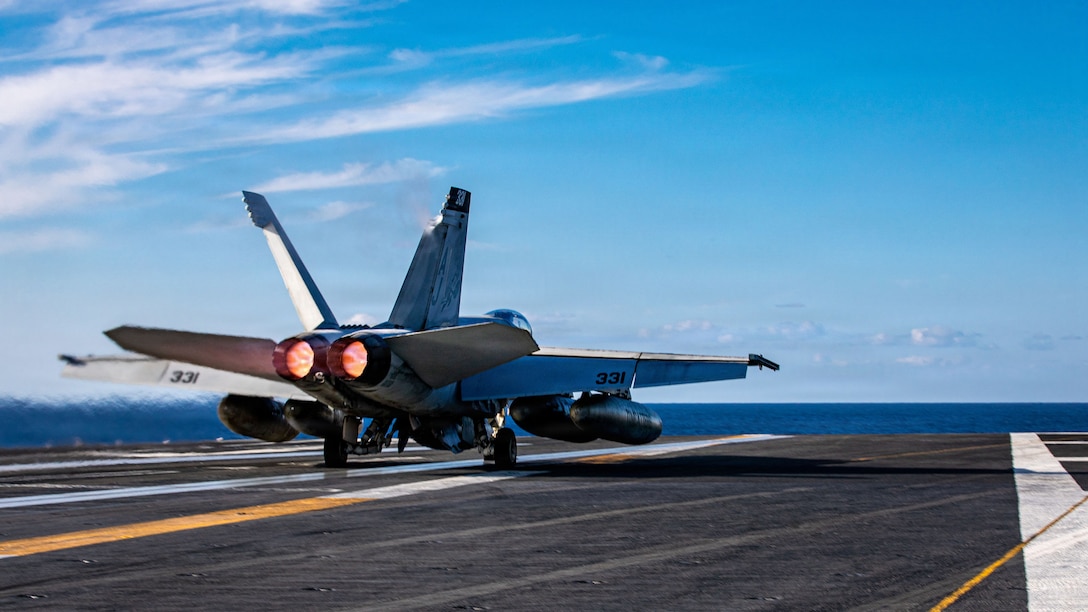 An F/A-18E Super Hornet aircraft, launches from the world’s largest aircraft carrier, USS Gerald R. Ford, Feb. 28, 2026. (U.S. Navy photo)
Meanwhile, Israel carried out strikes throughout Iran, concentrating on regime targets in Tehran. On March 3, the IDF struck a building in Qom where senior clerics had gathered to elect Iran’s new supreme leader. The strike reportedly occurred during the vote count. The Assembly of Experts has 88 members, but none were apparently in the building as Iran confirmed only the death of one clerk.
The same day, the IDF announced that it had struck a secret underground nuclear complex in Tehran known as the “Minzadehei” compound, where Iran’s nuclear weapons group had been operating under the country’s Defense Ministry. IDF spokesperson Brig. Gen. Effie Defrin said that after Israel inflicted heavy damage on Iran’s nuclear weapons program during Operation Rising Lion in June 2025, the regime relocated parts of its infrastructure to fortified underground bunkers to conceal continued development. “Despite the severe damage to the nuclear weapons group, the Iranian regime did not stop its military nuclear activity,” Defrin said. “It continued to develop the capabilities required for a nuclear weapon while relocating infrastructure to an underground, airstrike-resistant site.” He said a group of nuclear scientists had been secretly working inside the compound on a central component of a nuclear weapons system. Military Intelligence tracked the scientists’ movements and identified their new location, enabling what the IDF described as a precise strike that “removes a core component of the Iranian capability to develop a nuclear weapon.”[70]
The IDF said “joint coordination cells” in Israel and the United States are synchronizing intelligence, targets, and defense. The military said more than 1,000 American troops are stationed in Israel.
The military said on March 4 that the IDF had dropped 5,000 bombs on Iran since the start of the war, more than it deployed during the 12-days of Operation Rising Lion.[83]
On March 4, an Israeli Air Force F-35I “Adir” shot down an Iranian Air Force Yak-130 over Tehran. The incident marked the first time an F-35 had destroyed a crewed aircraft in air-to-air combat and the first Israeli shootdown of an enemy aircraft in more than four decades.[67]
The Israeli Navy said it has been participating in aerial defense during Operation Roaring Lion by identifying and intercepting UAVs launched toward Israel, and released footage from the interception.
The New York Times reported that the U.S. and Israel have expanded their targeting beyond conventional military sites to include police stations, detention centers, and intelligence offices — an apparent effort to dismantle the security apparatus that has enforced the regime’s grip on the Iranian population. IDF spokesman Lt. Col. Nadav Shoshani confirmed that Israel was “targeting the Iranian security establishment, which also includes elements relevant to suppressing the Iranian people,” including the Basij — the roughly one-million-strong plainclothes militia that played a central role in crushing the January protests that killed thousands.
Analysts say the strikes on detention centers and police stations where tens of thousands of protesters and dissidents were held carry powerful symbolic weight for ordinary Iranians. But the strategy also carries significant risks. Much of Iran’s security infrastructure is embedded in urban areas, raising the likelihood of civilian deaths. Rights activists have warned that strikes on detention facilities could endanger people held inside.
Some analysts question whether destroying the physical infrastructure will be enough. Farzin Nadimi of the Washington Institute cautioned that the people who run the security services remain intact. “Destroying buildings alone is not enough,” he said. “Many of those Basij, IRGC — they are just changing to plain clothes and mingling with people and just trying to survive until the day comes to take up arms.”[69]
Israel’s strikes on 30 Iranian fuel depots on March 7 went beyond what the United States expected when Israel gave advance notice, creating the first significant disagreement between the allies since the war began. U.S. officials worry that attacking infrastructure used by ordinary Iranians could strengthen domestic support for the regime and unsettle oil markets, as images of burning depots might drive energy prices higher. A Trump adviser told Axios: “The president doesn’t like the attack. He wants to save the oil. He doesn’t want to burn it. And it reminds people of higher gas prices.”[96]
U.S. Central Command issued a safety warning to Iranian civilians on March 8, accusing Tehran’s regime of deliberately conducting military operations from heavily populated areas — including launching drones and ballistic missiles from crowded neighborhoods in Dezful, Isfahan, and Shiraz. CENTCOM warned that under international law, locations used for military purposes lose their protected status and could become legitimate targets. The statement urged Iranian civilians to stay home, and accused Iranian forces of endangering lives not only within Iran but across the Middle East by "deliberately and indiscriminately targeting civilian airports, hotels, and residential neighborhoods.”[91]
The Trump administration invoked emergency authority to bypass congressional review and approve the sale of more than 20,000 bombs to Israel valued at about $650 million. Secretary of State Rubio said on March 6 that an emergency justified the immediate transfer amid the ongoing U.S.–Israeli air campaign against Iran. The package includes 12,000 BLU-110A/B 1,000-pound bomb bodies requested by Israel and additional BLU-111 500-pound bombs as part of an amended weapons sale. In addition, Israel will purchase another $298 million in critical munitions through direct commercial sales.[97]
Missile Hunting
The scale of Iran’s underground missile infrastructure — long dismissed by many Iranians as propaganda —became evident early in the war. The country maintained at least ten major “missile cities” and some 20 additional missile bases, believed to house between 2,500 and 6,000 ballistic missiles, along with an unknown number of cruise, anti-ship, and shorter-range systems.
These underground facilities demonstrated remarkable engineering and strategic foresight, but their true significance lay in their roles as secure launch sites and logistical hubs, complicating adversaries’ detection and attack plans. The complex southwest of Yazd, embedded in a granite mountain and reaching depths of up to 1,500 feet, featured rail tunnels for moving missiles to and from hidden launch points. Another major facility between Tehran and Karaj had a satellite footprint comparable to Karaj, a city of nearly two million. Many sites were clustered in western Iran to shorten missile flight times to Israel, and along the Persian Gulf to extend operational reach in the south.
The extraordinary financial commitment to this infrastructure highlighted Iran’s determination to prioritize its underground missile program over other potential domestic needs. According to European Commission estimates, tunneling through hard rock costs up to $40 million per kilometer, rising to $80 million with military hardening. For example, a single Iranian missile city with thirty miles of tunnels could have cost at least $4 billion. The cost for its known underground facilities likely exceeded $100 billion, before the development and production of thousands of missiles are considered.
Once the infrastructure was in place, the financial advantage turned to the Iranians. As Rubio noted, “They can build 100 ballistic missiles a month. We build 6 or 7 interceptors a month.” Each interceptor costs between $1 million and $15 million, while each Iranian missile costs between $200,000 and $500,000.[185]
Analysts had long assumed Iran observed a range ceiling of roughly 1,500 miles — sufficient to reach Israel — shaping international threat perceptions. However, missile launches toward Diego Garcia, over 2,600 miles away, demonstrated the capacity for longer-range strikes, fundamentally altering assessments of Iran’s ability to threaten targets as far as Europe and requiring reassessment of regional defense postures.[179]
Israeli and American forces conducted a layered air campaign against four categories of Iranian missile targets. They exploited the force multiplier of joint operations across Iran’s vast territory.[74]
The first targeted category was storage and launch sites. These are concentrated in caves throughout the Zagros Mountains in northern and western Iran. After last year’s war, Iran dispersed its missile systems across these facilities. Many have multiple concealed entrances. Israeli attack drones operated against exposed missiles in real time. They attempt to strike them before launch—a high-risk mission that costs some drones. Sealing or destroying the caves themselves required fighter jets.
In addition to these sites, the second category was Iran’s fortified underground “missile cities”—subterranean complexes with concealed launch facilities. These required American GBU-57 bunker-buster bombs, delivered by B-2 stealth bombers. The bombers flew mainly from the United States at night with F-22 escorts and electronic warfare aircraft. Precision was critical—even a meter or two off from a tunnel entrance can negate the bomb’s effect.
The third category was mobile launcher trucks, which Iran disguised as standard shipping containers. These containers open at pre-prepared sites, erect the missile, and fire. During daylight, the trucks traveled on highways indistinguishable from ordinary traffic. Israeli and American satellites could track movements down to the license-plate level, and artificial intelligence could analyze travel patterns. The trucks were primarily targeted by drones, and the fact that nighttime highway travel would appear suspicious partly explains why Iranian launches were after dark.
The fourth category included missile production facilities. These were dispersed across Kermanshah, Tabriz, Karaj, and Qom. They manufactured everything from solid rocket propellant to electronic guidance systems. Many production systems were dismantled and hidden in the weeks before the war. This created intelligence gaps. The stated objective was to make Iran’s missile industry impossible to revive, even if sanctions are eventually lifted.
To accomplish their mission, IAF jets flew in concentrated waves for nearly 1,000 miles (1,500 kms) each way to minimize aerial refueling. Upon arrival, formations split and struck multiple target sets simultaneously. Officials noted Iran’s post-June dispersal strategy had made the campaign more complex than in June 2025. Real-time intelligence coordination between Israeli and American assets—described as a “game changer”—became essential to counter Iran’s concealment efforts.
The Washington Post reported on March 29 that four of Iran’s most critical missile manufacturing sites — Khojir, Parchin, Hakimiyeh, and Shahroud — had been severely damaged, with experts saying the destruction exceeded what had been inflicted during either the 12-day war with Israel in June 2025 or Israel’s October 2024 strikes. The attacks targeted the facilities that produced solid and liquid propellants, the fuel that made ballistic missiles function. As one nonproliferation expert put it simply: "If you don’t have propulsion, the missiles aren’t going anywhere." Analysts reviewing satellite imagery concluded the damage had most likely halted Iran’s ability to produce short- and medium-range ballistic missiles until the facilities could be rebuilt.
On the launch side, at least 29 of an estimated 30 known ballistic missile launch bases had beeendn hit. U.S. and Israeli strikes had focused on tunnel entrances leading to underground missile storage, blocking access to existing stockpiles and forcing Iran to rely more heavily on mobile launchers — whose numbers remained unknown. The destruction of base infrastructure also meant it took Iran longer to set up launchers, giving U.S. and Israeli forces more time to locate and destroy them before they fired.
Experts cautioned, however, that the missile program was unlikely to be permanently eliminated. Iran had a track record of rebuilding after prior attacks and retained access to foreign supply chains that could replace destroyed manufacturing equipment.[167]
Moreover, Reuters reported that after the first month, the U.S.was certain of having destroyed only about a third of Iran’s missile arsenal.[169]
Expanding the Targets
On March 9, Trump told reporters in Florida: “It’s going to be ended soon, and if it starts up again they’ll be hit even harder.” He called the campaign a “short-term excursion” and said, “We’ve already won in many ways, but we haven’t won enough.” He threatened an attack of “incalculable” size if Tehran blocked oil supplies. His comments helped reverse stock market slumps, with oil prices dropping as much as 5% after benchmark crude had rocketed past $100 a barrel.[121]
On March 10, Iran’s Foreign Minister Abbas Araghchi rejected Trump’s timeline, telling PBS News: “The firing continues, and we are prepared. We are well prepared to continue attacking them with our missiles as long as needed and as long as it takes.” He effectively ruled out negotiations: “I don’t think talking with Americans anymore would be on our agenda.” He claimed the U.S. and Israel had “failed” to achieve regime change and were now “aimless.” Security chief Ali Larijani also dismissed Trump’s “empty” threats: “Even those greater than you could not eliminate the Iranian nation. Watch out for yourself—lest you be eliminated.”[121]
Iranian parliament speaker Mohammad Baqer Qalibaf posted on X: “We are absolutely not looking for a ceasefire; we believe that the aggressor should be punched in the mouth so that he learns a lesson.” Israeli Knesset Speaker Amir Ohana responded in Persian: “The only thing proposed to you was unconditional surrender.”[121]
Israeli and American forces continued an intensive air campaign against Iran’s military infrastructure. The Israeli Air Force struck the IRGC’s Quds Force Command Centre in Tehran, a missile production and storage site in Isfahan, and nuclear laboratories in Tehran. Airstrikes disabled at least six Iranian airfields and destroyed the IRGC’s headquarters for unmanned aerial vehicles.
Among the most significant strikes were attacks on major weapons production sites in Parchin and Shahroud. The IDF described Shahroud, approximately 2,000 kilometers from Israel, as a major site for producing ballistic missile components, including explosive materials for warheads, raw materials for motors, engine manufacturing, and missile research and development. At Isfahan airport, the IAF struck the Iranian regime’s F-14 fighter jets. This followed the destruction two days earlier of 16 Quds Force aircraft at Mehrabad airport in Tehran—aircraft used to transport weapons and funding to Hezbollah.
The combined force also struck the IRGC Space Force headquarters, which served as a reception, transmission, and research center for the Iranian Space Agency, including a command-and-control structure for the Khayyam satellite—used by the IRGC to monitor Israel. Additional targets included approximately 50 ammunition bunkers inside an internal security base, a Basij base, an internal security command center, and an IRGC Ground Forces compound.
In a notable expansion of the target set, the combined force struck the Sahab Pardaz Company in Tehran, which the United States sanctioned in October 2022 for providing “censorship, surveillance, and espionage tools” to the Iranian regime. Dozens of internal security institutions across central and western Iran have been struck since February 28.
The IAF also eliminated Abu al-Qassem Baba’iyan in Tehran, the newly appointed Head of the Military Office of the Supreme Leader and Chief of Staff of the regime’s emergency command headquarters.
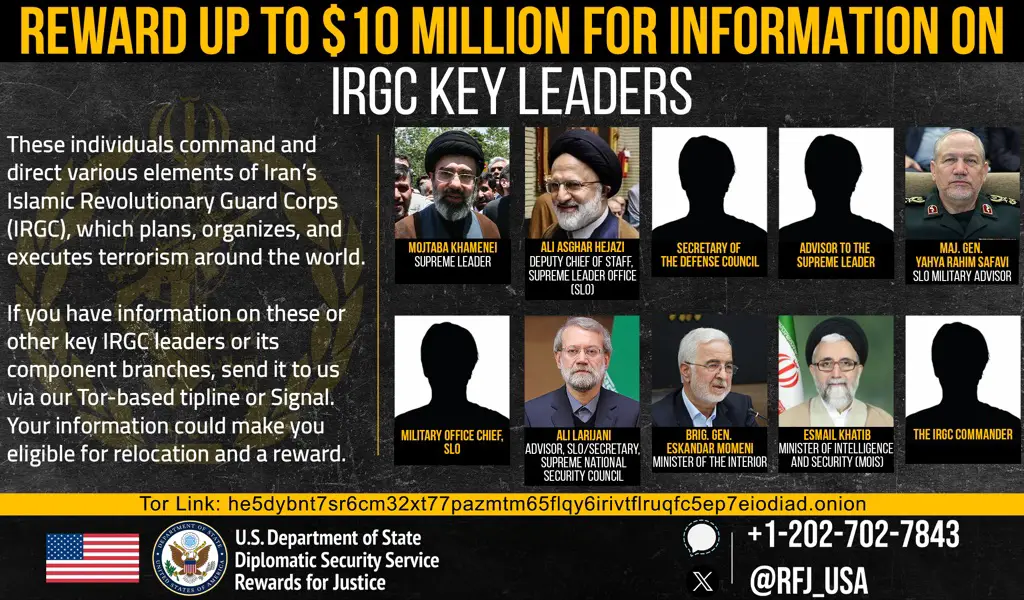
The U.S. Department of State put a bounty on the heads of the regime’s leaders:
On March 11, the UN Security Council voted to condemn Iranian aggression by 13-0. Russia and China, Iran’s allies, abstained.
On March 13, Axios reported that President Donald Trump rejected an offer from Russian President Vladimir Putin to transfer Iran’s highly enriched uranium to Russia as part of a deal to end the war. A week later, the U.S. dismissed a separate Russian proposal to halt intelligence-sharing with Iran in exchange for ending U.S. support to Ukraine.[127]
The United States struck Iranian military infrastructure on Kharg Island on March 13, in part to degrade Iran’s ability to threaten shipping in the Strait of Hormuz. CENTCOM stated that U.S. forces conducted large-scale precision strikes targeting Kharg Island, destroying naval mine storage facilities, missile storage facilities, and other military sites.
Trump announced that American forces “totally obliterated every MILITARY target in Iran’s crown jewel, Kharg Island.” He said he had chosen not to destroy the island’s oil infrastructure “for reasons of decency,” but warned he would “immediately reconsider this decision” if Iran interfered with the Strait of Hormuz. “Iran has NO ability to defend anything that we want to attack—There is nothing they can do about it!” he wrote on Truth Social.
Meanwhile, Iran began systematically targeting the radar systems that serve as the eyes of U.S. and allied air defenses across the Middle East, hitting several in recent days and degrading the ability to track incoming missiles, the Wall Street Journal reported. Iranian strikes hit radar, communications, and air defense systems in Qatar, the UAE, Jordan, Bahrain, Kuwait, and Saudi Arabia. The attacks were often carried out by low-cost one-way attack drones like the Shahed, a fraction of the cost of the missiles that sophisticated U.S. systems were designed to intercept. Ravi Chaudhary, a former assistant secretary of the Air Force, acknowledged: “Overall, our defenses are doing quite well. That said, it is clear that the Iranians have a sense of what type of targets they want to continue to press against, and that includes command and control and our ability to detect inbound missiles and drones.”[120]
Ali Larijani, Iran’s top security official and de facto wartime leader, made a defiant public appearance on March 13, strolling through a regime rally in Tehran. He later posted on X: “Brave people. Brave officials. Brave leaders. This combination cannot be defeated.” Four days later, Israeli intelligence located him at a hideout on Tehran’s outskirts and killed him with a missile strike. The IDF confirmed his death overnight on March 16–17.
That same night, ordinary Iranians tipped off Israel that Basij militia leader Gholamreza Soleimani was sheltering with his deputies in a tent in a wooded area of Tehran—the kind of payoff Israel had been seeking after two weeks of destroying Basij facilities and forcing members into the open. Soleimani was killed along with at least ten senior Basij commanders, including his deputy Rasem Qureishi.[124]
Israeli Defense Minister Israel Katz confirmed on March 18 that Iran’s intelligence minister, Esmaeil Khatib, was also eliminated. “He was responsible for the regime’s internal repression apparatus and for advancing external threats,” Katz said.[125]
The Iranian regime tightened internet restrictions. The BBC reported on March 15 that the regime had begun targeting individuals with Starlink access and reduced VPN availability. ISW noted this will “almost certainly limit” the ability to observe strikes inside Iran.[129]
The combined force targeted a likely Iranian drone facility in South Khorasan Province—one of the easternmost strikes since the war began, indicating that U.S. and Israeli aircraft could operate deep inside Iranian territory. The IDF confirmed on March 16 that it struck the IRGC Navy headquarters in Tehran, from which commanders directed naval operations against Israel and regional countries.[129] On the 17th, Israel struck a naval outpost in the Caspian Sea in what marked its first-ever operation on the world’s largest inland sea, targeting a key supply route that Russia and Iran had used to transfer ammunition, drones, and other weaponry between their ports, which sat roughly 600 miles apart.
The attack on the Caspian port of Bandar Anzali hit dozens of targets, the Israeli military said, including warships, a port facility, a command center, and a shipyard used to repair and maintain vessels. Photos showed damage to Iran’s naval headquarters at the port and destroyed naval vessels, though the full extent of the damage to the port itself was not immediately clear.
The Caspian route had grown increasingly critical for moving Shahed drones — now manufactured in both countries — which Russia had used to bombard Ukrainian cities, and Iran had deployed to strike airports, energy facilities, and U.S. military bases across the Persian Gulf. Beyond weapons, the sea route also facilitated trade in goods such as wheat and oil, and sat well beyond the reach of the U.S. Navy.
Former Israeli Navy commander Eliezer Marum said the strike had served a dual purpose: “The most important goal of this strike was to limit Russian smuggling and show the Iranians that they don’t have sea defenses in the Caspian.”[178]
The following day, Israel struck Iranian naval vessels in the Caspian Sea and a vital Iranian gas field for the first time.[130]
Trump backed Israel’s strike on Iran’s South Pars gas field as a warning over threats to the Strait of Hormuz, but later opposed further attacks on energy infrastructure. Iran condemned the strike and warned of “uncontrollable consequences,” while the IRGC threatened Gulf energy sites. Fearing escalation, facilities in Qatar, Saudi Arabia, and the UAE were evacuated. Iran then struck Qatar’s Ras Laffan liquefied natural gas facility, sparking a fire that caused “extensive” damage before it was extinguished, and prompting Doha to expel Iranian military officials and warn against further violations.[131]
Trump later said he would block further Israeli strikes on Iran’s South Pars gas field, claiming Israel “violently lashed out” and that the U.S. “knew nothing about this particular attack,” despite reports of coordination. He warned that “NO MORE ATTACKS WILL BE MADE” unless Iran targets Qatar again, after Tehran “unjustifiably and unfairly attacked” Ras Laffan. Trump added that if Iran strikes Qatar, the U.S. would “massively blow up the entirety of the South Pars gas field,” though he said he does not want to authorize “this level of violence and destruction.”[136]
U.S. and Israeli strikes effectively destroyed Iran’s ballistic missile production capabilities in the first three weeks of fighting, leaving Tehran unable to manufacture new missiles and forcing it to rely on a dwindling stockpile. While Iran had been rapidly producing missiles before the conflict, it was “burning through” a finite arsenal—estimated at 500 to 1,000—reducing its long-term threat, though production could resume after the war.
Jonathan Schanzer, executive director of the Foundation for Defense of Democracies, told Jewish Insider that stopping Iran’s ballistic missile production “is a major achievement for both Israel and the United States. It’s a both a sign of tremendous intelligence collection and the ability to act on that intelligence.”[134]
On March 19, shrapnel from an intercepted Iranian missile landed in Jerusalem’s Old City, narrowly missing the Church of the Holy Sepulcher but damaging a nearby Greek Patriarchate building. Another fragment fell inside the Al Aqsa Mosque compound, highlighting the risk to major religious sites as Iran continues to fire missiles indiscriminately at civilian areas.
On March 20, Iran attempted to strike the joint UK-U.S. base at Diego Garcia, about 2,500 miles (4,000 km) from Iran, with two ballistic missiles but failed, with one missile malfunctioning and the other likely intercepted. The strike revealed that Iran likely possesses longer-range missile capabilities than previously acknowledged—potentially putting much of Europe within reach.[157]
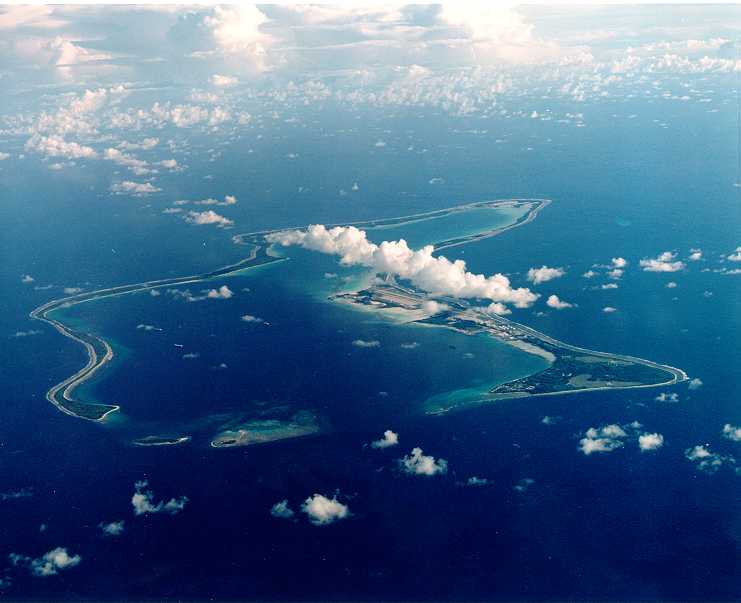 Diego Garcia (Public Domain)
After the first 18 days of fighting, the IDF said it had dropped over 12,000 bombs in over 8,500 separate strikes on Iranian regime targets. The assaults severely degraded Iran’s air defenses and missile capabilities, destroying about 92% of advanced air defenses, 80% of older systems and radars, and 75% of supporting networks. It has also disabled or destroyed roughly 60% of Iran’s estimated 470 ballistic missile launchers. While Iran still had hundreds of missiles, launch rates slowed significantly as Israel targeted the remaining launchers.[138]
The Covert Operation to Sink Iran’s Navy
The United States and Israel conducted a covert operation over the course of a month that resulted in the sinking or destruction of five Iranian warships that had been disguised as commercial container vessels. Senior U.S. and Israeli commanders, who briefed neighboring Gulf countries on the mission’s scope, said the operation had thwarted Iranian plans to devastate commercial shipping routes not only in the Strait of Hormuz and the Caspian Sea but at a greater range as well.
Three of the five ships belonged to the naval unit of the IRGC, including Iran’s first drone carrier, the Shahid Bagheri — described by U.S. Central Command as “roughly the size of a World War Two aircraft carrier” — which was struck and set on fire. The other two ships, the Makran and the Tabukan, belonged to Iran’s conventional navy. According to one commander, all five vessels were sunk “like sitting ducks in the water,” with most having been stationed in the Bay of Oman and the Strait of Hormuz.
The ships had been secretly converted at a shipyard west of Bandar Abbas into what an intelligence summary described as “floating naval bases,” with hundreds of millions of dollars reported to have been spent on the transformations. The vessels could launch one-way attack drones, cruise missiles, anti-ship missiles, and ground-to-air missiles, and could carry commando forces intended to destroy commercial shipping.
The operation also targeted the shipyard itself. Under a division of military responsibility, U.S. warplanes struck the ships while Israel handled the assassination of Iranian naval commanders. Among those killed was Alireza Tangsiri, the IRGC commander said to oversee blocking the Strait of Hormuz, who was killed on March 26 in an airstrike as he sheltered in a converted apartment used as an IRGC base in Bandar Abbas.[174]
The Kurdish Invasion That Never Happened
The United States and Israel developed a plan for tens of thousands of armed Kurdish fighters to invade Iran from Iraqi Kurdistan in the early days of the war. They would be backed by massive U.S. and Israeli air cover. The goal was to spark a rebellion that would topple the Islamic Republic, reflecting both countries’ desire to destabilize Iran’s regime from within. The Mossad had reportedly been developing the plan for years. It became a key factor in Netanyahu’s push to convince Trump to proceed with joint strikes on February 28.
The plan unraveled quickly. On March 4, a Fox News report leaked that an offensive was imminent. This eliminated the element of surprise and undermined U.S. and Israeli hopes for swift regime destabilization. Iran reinforced its defenses in the northwestern region to prevent unrest and preserve its regime. Tehran increased military pressure on Kurds in northern Iraq to discourage their participation. It also pressed Baghdad diplomatically to block the operation and protect Iranian sovereignty. President Erdogan, concerned about Kurdish autonomy, warned Trump that Ankara would not tolerate Kurdish independence anywhere in the region. Gulf Arab states, aiming to avoid chaos, cautioned that an ethnic partition of Iran could destabilize the Middle East. The Kurds grew hesitant, demanding political guarantees instead of just weapons. Their mistrust stemmed from previous experience in Syria, where the U.S. relied on Kurdish fighters against ISIS, only to later back a government offensive that dismantled Kurdish-held territory.
With surprise lost and allies pushing back, Trump concluded the operation was too dangerous and called it off. A second opportunity to revive the invasion was also scrapped, and the idea was taken off the table entirely.
The plan’s collapse strained the relationship between Netanyahu and Trump. IDF intelligence had viewed the plan as unlikely to succeed, describing it as “imaginary” and “full of holes." Netanyahu was disappointed by the outcome.[170]
On April 6, Trump revealed that the U.S. had covertly sent a large quantity of weapons to anti-regime protesters inside Iran, intending to help them fight back against government crackdowns. The operation failed, Trump said, because the intended recipients never received the arms — someone kept them instead. Without initially naming names, he warned that those responsible would “pay a big price.”
A day earlier, Trump had told Fox News directly: “I think the Kurds took the guns.” The accusation fit a broader pattern of U.S. frustration with Kurdish involvement in the Iran strategy. Trump’s comments reinforced his growing skepticism of Kurdish participation, saying he would “rather have them stay away” because “they bring death... to themselves.”[206]After Trump decided on a diplomatic approach to ending the war, members of Netanyahu’s inner circle blamed the president for missing what Israeli security officials viewed as a genuine opportunity to destabilize or even topple the Iranian regime by supporting Kurdish insurgents. Israeli sources reportedly believed Turkish President Recep Tayyip Erdoğan persuaded Trump to abandon the plan. The decision allegedly left Iraqi Kurdish groups deeply disappointed and fearful of Iranian retaliation after details of the operation became public.[295]
Despite having no diplomatic relations, Israel reportedly established two clandestine outposts in Iraq’s western desert, with U.S. knowledge, to support Operations Rising Lion against Iran in June 2025 and Roaring Lion in February 2026. The installations housed special forces, served as logistics hubs for the Israeli air force, and provided air support, refueling, medical treatment, and search-and-rescue capabilities in the event Israeli pilots were downed.
The outposts were intended to shorten the distance Israeli aircraft had to fly to reach Iran and were established as temporary facilities to support military operations during the campaign. Early in the war, Israel reportedly launched airstrikes against Iraqi troops who came close to discovering one of the sites.[382]
The Failed Ahmedinijad Plot
Israel spent years cultivating former Iranian president Mahmoud Ahmadinejad as an intelligence asset and potential replacement for Iran’s leadership, according to New York Times reports published July 13–14, 2026. Despite his history of Holocaust denial and threats against Israel, Israeli intelligence reportedly saw an opening in his estrangement from Iran’s ruling establishment. Mossad allegedly financed housing and travel and arranged secret meetings abroad, including a 2024 meeting with director David Barnea at a Budapest climate conference organized as cover.
On February 28, 2026, an Israeli strike targeted Ahmadinejad’s bodyguards and armored vehicle, after which Mossad operatives reportedly drove him to a safe house in Iran. He became disillusioned with the plan to restore him to power and eventually left under unclear circumstances. The broader regime-change effort, which also envisioned an incursion by Iranian Kurdish opposition forces, failed to materialize.
Iranian officials said Ahmadinejad was subsequently placed under Revolutionary Guards house arrest. His office denied both the Israeli connection and his detention, dismissing the reporting as “Hollywood-style claims” and “psychological warfare.” The Times stood by its investigation; Israeli officials offered no public comment.[445]
Russian Support for Iran
The Washington Post reported on March 6 that Russia has been providing Iran with targeting information on U.S. military assets in the Middle East—including the locations of warships and aircraft—since the war began.[98]
Later, European allies told U.S. diplomats that Russia was more deeply involved in supporting Iran’s war effort than Washington had publicly acknowledged. A U.K. official said Russian-Iranian defense ties had “ballooned in recent years,” with cooperation on drone technology helping Iran improve its capabilities, though no recent Russian weapons transfers were confirmed.
French Foreign Minister Jean-Noël Barrot described the relationship as “two-way cooperation,” adding, “There are reasons to believe that Russia is now supporting Iran’s military efforts.” Ukraine’s President Volodymyr Zelenskyy said there was “irrefutable evidence” Russia was providing intelligence to Tehran, including satellite surveillance of U.S. and allied bases, “in the interests of Iran.”
EU foreign policy chief Kaja Kallas said, “We see that Russia is helping Iran with intelligence to target Americans,” while U.K. Defense Secretary John Healey pointed to “the hidden hand of Putin.”
U.S. officials struck a more cautious tone. Secretary of State Marco Rubio said, “There is nothing Russia is doing for Iran that is in any way impeding” U.S. operations, while Defense Secretary Pete Hegseth said any concerning activity “is being confronted and confronted strongly.” U.S. intelligence has acknowledged “selective cooperation” among Russia, Iran, China, and North Korea, but not a fully unified alliance.[172]
China’s Role
The 2015 nuclear agreement (JCPOA) contained a fatal omission: it placed extensive restrictions on Iran’s uranium enrichment but imposed no limits whatsoever on its ballistic missile program — the only delivery system that could actually carry a nuclear warhead to its target. The omission was deliberate. China and Russia had categorically refused to include missile restrictions in the negotiations, and Iran had declared its missile program a non-negotiable sovereign right. The Obama administration, determined to secure a landmark diplomatic achievement, separated the nuclear and missile files entirely — treating them as two distinct problems when they formed two halves of the same threat. The enforcement language of earlier UN resolutions was weakened to get the deal done, with missiles to be addressed “later.” Iran tested ballistic missiles within weeks of the agreement entering into force. Nothing in the deal prohibited it.
Over the decade that followed, Iran transformed its missile program from a crude deterrent into a sophisticated, mass-produced arsenal. It perfected guidance systems, extended ranges across the Middle East and into parts of Europe. China was the principal architect of that buildup. Beijing supplied chemical precursors for solid rocket fuel, satellite guidance through its BeiDou-3 navigation network, and machine tools that accelerated Iranian production lines. Intelligence revealed Iranian cargo ships unloading sodium perchlorate at Bandar Abbas in quantities sufficient to produce propellant for approximately 800 missiles in a single delivery.
“The Chinese government was industrializing Iran’s capacity to hold the Middle East at gunpoint,” observed Zineb Riboua.
The strategic consequences operated on three levels, Riboua noted. First, every American interceptor fired over the Middle East was one fewer available for the Western Pacific, imposing a war of attrition on U.S. munitions without China having to deploy a single soldier. Secretary of State Rubio captured the asymmetry starkly: “They can build 100 ballistic missiles a month. We build 6 or 7 interceptors a month.” Second, each Iranian salvo provided Chinese military intelligence with a live laboratory to study American radar signatures, electronic warfare capabilities, and interceptor performance under real combat conditions. Third, if the United States proved unable to shield its Arab partners from sustained bombardment, every ally from Tokyo to Taipei would draw the same conclusion about the limits of Washington’s guarantees.[185]
The Institute for the Study of War reported on April 15 that Iran had used an advanced reconnaissance satellite purchased from China in 2024 to target U.S. military assets across the Middle East during the war.[226]
U.S. intelligence indicated China may have sent—or considered sending—shoulder-fired missiles (MANPADS) to Iran, though the evidence was not conclusive and there was no indication the weapons were used. Such a transfer would signal a shift in Chinese policy, with China taking a more active, if indirect, role in the conflict by allowing companies to supply Iran with dual-use materials such as chemicals and fuel. While Beijing traditionally avoided sending finished weapons, internal debate over doing so suggested that some Chinese officials were willing to escalate support, potentially aiming to weaken the United States in the broader regional conflict.[234]
China was a discreet yet influential force in the U.S.-Iran standoff, maneuvering behind the scenes to shape the outcome without taking on a public role. Regional diplomatic sources report that Beijing engaged in covert backchannel discussions, urging commanders of Iran’s Islamic Revolutionary Guard Corps to adopt a more flexible stance in talks.
Meanwhile, China reinforced its quiet diplomatic engagement by delivering a blunt warning: if Iran continued to disrupt the Strait of Hormuz, Beijing would protect its own interests first—by diversifying its energy supplies and potentially suspending its long-term cooperation agreement with Tehran.
China’s involvement was not aligned with Washington. While nudging Iran toward compromise, it also cautioned Tehran against any agreement that could open its oil sector to American companies—a move that would give the U.S. a strategic foothold in one of the region’s most critical industries, something Beijing is keen to prevent.
Ultimately, this strategy demanded a delicate balancing act. China advocated de-escalation to stabilize global energy markets, while also seeking to curb U.S. influence in Iran, aiming to subtly steer the conflict’s strategic outcome.[254]
An Uncertain Path
Trump told Axios he had several “off ramps” for the campaign.[22] The Council on Foreign Relations assessed that the operation’s goal of regime change is “a risky strategy given the enormous challenges of trying to engineer regime change from thousands of miles away,” noting that Gulf states had refused to participate in the attack but were likely providing technical assistance. Gulf governments’ greatest fear, the council assessed, was likely “the survival of the Iranian regime” — not its collapse, but a weakened, vengeful neighbor.[21]
The critics Trump dismissed long ago have resurfaced with force. CNN noted the deep contradiction between the president who once mocked Obama for threatening Iran and the one now waging open war against it. Social media users circulated Trump’s 2013 posts: “Remember what I previously said — Obama will someday attack Iran in order to show how tough he is.” And from 2011: “Our president will start a war with Iran because he has absolutely no ability to negotiate.”[25]
Supporters counter that four decades of diplomacy failed, that Iran was weeks from bomb-grade material, and that the January massacres revealed a regime willing to slaughter tens of thousands of its own people. While the New York Times editorial board labeled the attack on Iran “reckless,”[26] the Wall Street Journal’s board called it “a necessary act of deterrence against a regime that is the world’s foremost promoter of terrorism.” Senator Lindsey Graham declared, “The mothership of terrorism is sinking. The captain is dead.” Senator Ted Cruz called it “the single most important decision of his presidency.”[27]
What comes next — for Iran’s people, for the region, and for American forces now engaged in a conflict with no declared endpoint — remains deeply uncertain. Whether it leads to the liberation Trump promises or the quagmire his critics predict may not be clear for years.
In a March 5 interview with Axios, Trump responded to reports that Khamenei’s son, Mojtaba Khamenei, would become Iran’s new leader. “They are wasting their time. Khamenei’s son is a lightweight. I have to be involved in the appointment, like with Delcy [Rodriguez] in Venezuela.” He added, “Khamenei’s son is unacceptable to me. We want someone that will bring harmony and peace to Iran.” Someone who continued Khamenei’s policies, he said, would force the U.S. back to war “in five years.”[79]
Mojtaba did not appear in public and was reportedly wounded and possibly disfigured. Iranian state TV read a statement attributed to him vowing Iran “will not neglect avenging the blood of [the] martyrs” and demanding that “the popular demand is to continue our effective defense and make the enemy regret.” ISW assessed that his inner circle is dominated by long-standing hardline IRGC commanders whose influence “will almost certainly drive Iran toward more hardline, anti-Western policies.” Netanyahu dismissed him as “a puppet of the Revolutionary Guards” who “cannot show his face in public.”[128]
Before the attacks, the administration had identified possible leaders of a post-Khamenei Iran, but the Israeli strike killing 40 senior officials changed that. “The attack was so successful it knocked out most of the candidates,” Trump said. “It’s not going to be anybody that we were thinking of because they are all dead. Second or third place is dead.”[80]
On March 8, Trump hinted to the Times of Israel that a decision on when to end the war with Iran will be made together with Netanyahu. “I think it’s mutual… a little bit. We’ve been talking. I’ll make a decision at the right time, but everything’s going to be taken into account.”
Trump also claimed that “Iran was going to destroy Israel and everything else around it… We’ve worked together. We’ve destroyed a country that wanted to destroy Israel.”[86]
On March 9, President Trump presented contradictory timelines for the war. In a call with CBS News, he declared the conflict nearly over: “The war is very complete, pretty much. They’ve got no navy, no communications; they’ve got no air force. Their missiles are down to a scatter. Their drones are being blown up all over the place, including the manufacturing of drones… There’s nothing left in a military sense.” He added: “We’re very far ahead of schedule.”
That same day, the Department of Defense posted on X that “we have only just begun to fight,” alongside a graphic of a missile interceptor and the text: “No Mercy.”[108]
Later in the day, Trump said in a speech to House Republicans in Florida, “We’ve already won in many ways, but we haven’t won enough....We go forward more determined than ever to achieve ultimate victory that will end this long-running danger once and for all.”
Asked to reconcile his statements with Hegseth’s suggestion that the war was just beginning, Trump responded: “I think you could say both. It’s the beginning of building a new country. We could call it a tremendous success right now, or we could go further.” He added: “And we’re going to go further.”[110]
In the same CBS interview, he suggested Iran had no means to fight anymore. Iran has “no navy, no communications, they’ve got no air force,” Trump said. He added, “They’ve shot everything they have to shoot....If you look, they have nothing left. There’s nothing left in a military sense.”
In his news conference, he also said, “They have no radar, they have no telecommunications. … It’s all gone.” But elsewhere at that event, he cast the same capacities as greatly diminished rather than gone.
While he previously said that Iran had “no navy,” he instead said, “Most of Iran’s naval power has been sunk.”[109]
Trump also said repeatedly that Iran was going to “take over the Middle East” and would have obtained a nuclear weapon “within weeks” had he not ordered the operation. He later indicated he was ready to wind down: “It’s going to be ended soon, and if it starts up again they’ll be hit even harder.” His comments caused an immediate fall in oil prices, though the pace of attacks on both sides did not materially change.[111]
Trump’s advisers were pressuring him to find a way out of the war due to rising oil prices and growing political risks. A senior U.S. official told the Wall Street Journal that it will be very difficult for Trump to exit the war as long as Iran continues attacking Gulf countries and Israel continues striking Iran.[112]
The Washington Post assessed Trump’s strategic posture: “Trump shows no concern about chaos. He is giving the Iranians a chance to take control away from the ayatollahs. Trump sees that as a gift—he doesn’t think the U.S. owes Iranians an on-the-ground effort to prevent chaos or to make their country stable, let alone democratic and prosperous. The president’s goal is to deprive Iran of the power to hurt the U.S. and its interests. If dangers develop down the road, he expects to be able to deal with them far more easily than if he had left in place the Islamic regime that was pursuing nuclear weapons and developing ever-longer-range missiles.”[113]
Netanyahu made comments suggesting Israel does not intend to continue fighting until the Iranian regime completely collapses. He said: “Our aspiration is to bring the Iranian people to throw off the yoke of tyranny. Ultimately it depends on them. But there is no doubt that through the actions taken so far we are breaking their bones—and our arm is still outstretched.” He added, “If we succeed together with the Iranian people, we will bring a permanent end.”[114]
In his almost-daily comments, Trump made confusing remarks about the length of the operation. On March 11, Trump said, “We don’t want to leave early, do we?...We got to finish the job. We don’t want to go back every two years.” The next day, commenting on the rise in gas prices, he argued the short-term increase was worth eliminating the Iranian threat to the region.[119]
Trump Announces Negotiations
On March 21, Trump threatened to bomb Iranian power plants in 48 hours unless Tehran agreed to fully reopen the Strait of Hormuz. Iran responded with its own threat to hit Israeli and Gulf power plants. Then, as the deadline was expiring, he announced on March 23 a five-day moratorium on U.S. attacks on Iranian energy sites and that negotiations were underway for a “total resolution of our hostilities in the Middle East.”[156]
According to Israel Hayom, Trump reversed course because of a surge in global energy prices and a message from the shah’s son urging Trump to reconsider because targeting Iran’s electrical infrastructure would not weaken the regime so much as deepen the suffering of an already burdened Iranian population.[154]
Trump said Kushner and Witkoff were leading the talks, but did not specify who the Iranian interlocutors were. “We have had very, very strong talks,” Trump said. “We’ll see where they lead. We have major points of agreement.”
Regarding the Strait of Hormuz, Trump said, “That’ll be open very soon, if this works,” adding the flow of oil would be jointly controlled by "me and the Ayatollah, whoever the Ayatollah is."[145]
Sources told the New York Times Witkoff had spoken to Iran’s foreign minister, Abbas Araghchi, but the Iranians denied they were engaged in any negotiations. The speaker of the Iranian Parliament, Mohammad Bagher Ghalibaf, said claims of negotiations were being used to “manipulate the financial and oil markets and escape the quagmire in which the U.S. and Israel are trapped.”[146]
Other sources indicated, however, that Iran had said it would hold talks only with Vice President JD Vance, who was considered an opponent of the war, though he publicly expressed support for the president. A Gulf source told The Guardian, “They don’t want to work with Jared and Witkoff because they stabbed them in the back.”[153]
The White House responded that President Trump decides who negotiates on behalf of the U.S. But Trump had said earlier that Vance was one of “several people” taking part in negotiations, along with Kushner, Witkoff, and Rubio.[151]
The U.S. sent Iran a 15-point plan to end the war through Pakistan. The reported terms called for a month-long ceasefire during which the parties would negotiate a peace agreement. Iran would be required to dismantle its existing nuclear capabilities, permanently abandon efforts to acquire nuclear weapons, and transfer all enriched uranium out of the country. Tehran would also have to accept limits on the range and capability of its missile program, reopen the Strait of Hormuz as a free maritime corridor, and cease financing and arming proxy forces across the region. In return, international sanctions on Iran would be lifted.
Trump told reporters on March 24, “We’re actually talking to the right people, and they want to make a deal so badly, you have no idea how badly they want to make a deal.” He added, “There won’t be any nuclear weapons. Iran has agreed to that. We’re in a good bargaining position. We’re way ahead of schedule, and they have no navy, air force, or missile protection. Most of their launches we’ve killed.”[155]
Netanyahu said that Trump told him it was possible to “leverage” the allies’ military gains to “realize the objectives of the war in an agreement.” The prime minister added that Israel was continuing its campaign of targeted killings in Iran and had eliminated two more nuclear scientists.”[147]
The Iranians publicly rejected the U.S. plan and issued their own demands, knowing they would be unacceptable to the United States. According to the Wall Street Journal, Iran’s terms were:[152]
- The closure of all U.S. bases in the Gulf.
- Reparations for damage caused by attacks on Iran.
- Guarantees that the war wouldn’t restart and an end to Israel’s strikes on the Iran-aligned Lebanese militia Hezbollah.
- Lifting all sanctions on Iran.
- Permitting Iran to keep its missile program with no negotiations to limit it.
Not mentioned in the report was the previous Iranian insistence on the right to enrich uranium. This remains a serious issue. The head of the IAEA, Rafael Grossi, said that while U.S. and Israeli strikes have significantly damaged Iran’s nuclear program, they have not eliminated it, noting that “a lot has survived.” He acknowledged the attacks were “quite effective” and had “rolled back the program considerably,” but cautioned that “we will still inherit a number of major issues” once fighting ends. Grossi emphasized that Iran retains critical capabilities, including enriched uranium stockpiles, warning that “they have the capabilities, they have the knowledge, they have the industrial ability” to rebuild, and that fully removing nuclear materials would be “a very challenging operation.”[159]
Despite diplomatic signals, fighting continued, and U.S. forces were building up in the region. An expeditionary force of 2,200 Marines was about to arrive in the region, and Trump ordered an additional 2,500 Marines aboard three warships to head to the Middle East.
On March 25, the Israeli Air Force struck Iran’s naval development infrastructure in Isfahan, targeting a key underwater research center responsible for designing submarines and unmanned naval vessels. The attack significantly degraded Iran’s ability to produce advanced submarines and upgrade its naval capabilities.
Trump said on March 29 that the strikes against the top leadership of the Islamic Republic effectively amount to regime change. “The one regime was decimated, destroyed, they’re all dead. The next regime is mostly dead, and the third regime — we’re dealing with different people than anybody’s dealt with before… and frankly, they’ve been very reasonable,” he told reporters.
The president continued to project optimism about peace talks in Pakistan involving foreign ministers from Turkey, Saudi Arabia, and Egypt. “We’re doing extremely well in that negotiation. But you never know with Iran, because we negotiate with them and then we always have to blow them up,” he said.
“I think we’ll make a deal with them, but it’s possible that we won’t,” Trump continued. “I do see a deal in Iran. It could be soon.”
Trump claimed that Iran has agreed to most of the U.S. demands despite Iran’s public messaging to the contrary.
“They’re going to give up nuclear weapons. They’re going to give us the nuclear dust,” Trump said. “They’re going to do everything that we want to do, [and] they’re going to go on and maybe have a great country again. But if they don’t do that, they’re not going to have a country,” Trump warned.
In an interview with the Financial Times, Trump said, “To be honest with you, my favorite thing is to take the oil in Iran but some stupid people back in the US say: ‘Why are you doing that?’ But they’re stupid people.”
“Maybe we take Kharg Island, maybe we don’t. We have a lot of options,” Trump told the Financial Times. “It would also mean we had to be there for a while.” He added, “I don’t think they have any defense. We could take it very easily.”
As evidence of the progress in negotiations, Trump said, Iran had agreed to allow some ships to pass through the Strait of Hormuz in a goodwill gesture.
“They gave us 10” Pakistani-flagged tankers. Now they’re giving 20.”
The president said Parliament Speaker Mohammad Bagher Ghalibaf, who approved the ships’ movement, revealed that someone considered a hardliner closely associated with the IRGC, which he had commanded, was the interlocutor.
“He’s the one who authorized the ships to me,” Trump acknowledged. “Remember I said they’re giving me a present? And everyone said: ‘What’s the present?’ … When they heard about that they kept their mouth shut and the negotiations are going very well.”[161]
Trump surprisingly signaled he might end the U.S. military campaign against Iran even if the Strait of Hormuz remains largely closed, prioritizing a shorter conflict timeline over reopening the key waterway. Officials said the administration aims to weaken Iran’s navy and missile capabilities, then shift to diplomacy, potentially leaving allies to handle reopening the strait later.
Trump also urged other countries to take action themselves, writing on March 31: “Build up some delayed courage, go to the Strait, and just TAKE IT… the U.S.A. won’t be there to help you anymore.”[171]
Iranian officials revived a proposal to allow American companies into Iran’s oil and gas sector as an economic incentive, but tied it to broader demands—especially an immediate ceasefire—which Washington rejected.
U.S. officials believed Iran’s worsening situation could force it to accept American terms within weeks. However, negotiations were hindered by opposition from the IRGC, creating a major internal obstacle.
Meanwhile, Trump threatened strikes on Iran’s energy infrastructure if talks failed, while the Treasury coordinated with Gulf states to freeze Iranian assets. Additional sanctions targeting major IRGC-controlled conglomerates were aimed at hitting the financial interests of key power brokers resisting an agreement.[173]
As Trump vacillated between ending the war quickly and escalating, the Gulf states—led by Saudi Arabia and the United Arab Emirates—argued that the operation had not sufficiently weakened Tehran. As fighting reached the 30-day mark, they insisted that the U.S. must not squander the “historic opportunity” to deal a decisive blow to Iran’s clerical regime. This marked a shift from their initial frustration at not having advance notice of the U.S.-Israeli strikes and their earlier warnings about possible regional destabilization. In private, officials from Saudi Arabia, the UAE, Kuwait, and Bahrain urged Washington to continue military operations until there were major changes in Iran’s leadership or a dramatic shift in its regional behavior. They warned that stopping prematurely would allow Iran to recover.[181]
Trump made clear that he would not allow Israel to continue fighting after the U.S. ends its campaign. “They’ll do what I tell them,” Trump told Time. “They’ve been a good team player. They’ll stop when I stop. They’ll stop unless they’re provoked, in which case, they’ll have no choice, but they’ll stop when I stop.”[99]
Fighting Continues
Israel and Iran began trading attacks on energy sources.
On March 27, Israel bombed a yellowcake production plant near the central Iranian city of Yazd that the military said was “the only one of its kind in Iran, where raw materials mined from the ground undergo mechanical and chemical processing so that they can later be used as precursor materials for uranium enrichment.” The IDF added that it is a “highly important process for the nuclear weapons program advanced by the regime.”
Iran’s heavy-water production plant at Khondab was also hit. The facility was built to serve the adjacent Arak reactor and was the “key infrastructure for producing plutonium for nuclear weapons,” according to the IDF. The plant was also a “significant economic asset for the terror regime and served as a source of income for the Iranian Atomic Energy Organization, generating tens of millions of dollars for the regime each year.” The IAEA reported the strike disabled the plant.
Israel also bombed two of Iran’s largest steel factories, Khuzestan Steel near Ahvaz and Mobarakeh Steel in Isfahan, causing billions of dollars in damage to the Iranian economy and paralyzing Iran’s steel industry.
In retaliation, Iran published a list of steel manufacturing facilities in Israel and the Gulf that it said would be targeted.[168]
On March 29, an Israeli attack on power infrastructure temporarily knocked out the power in parts of Tehran. The same day, a fragment from an Iranian ballistic missile struck a chemical plant near Beersheva on March 29. A simultaneous missile attack by Iran and Hezbollah the following day caused a blaze at the main Haifa oil refinery. It had been previously damaged by fragments from an interception on March 19. Energy Minister Eli Cohen said there was no damage to production facilities and that fuel supply would not be affected. The Bazan Group Oil Refineries Ltd. site spans 526 acres, approximately 1.2 miles from Haifa Bay, and has long been a target of Israel’s enemies. During the June 2025 war against Iran, Bazan was also hit twice, and three workers died when a massive blaze broke out from one of the missile attacks.[160]
The IDF also targeted sites where long-range anti-aircraft missiles were assembled; a manufacturing facility for components for anti-tank and anti-aircraft missiles; and a complex for the production, research, and development of ballistic missile engines. The IAF also destroyed an IRGC research and development center for advanced weapons based at an Iranian university, along with air defense systems near the Caspian Sea—almost 1,000 miles from Israel.
Spokesman Brig. Gen. Effie Defrin said on March 28 that “within a few days” the IDF would complete strikes on Iran’s key military production sites, having already destroyed most ballistic missile launchers and air defense systems. Israeli officials describe the campaign as entering a “completion phase,” claiming it has largely achieved its goals of weakening Iran’s military capabilities and setting back its weapons production by years.
With most military targets already struck, Israel is now shifting its focus to economic targets, including gas infrastructure and major steel plants, aiming to inflict significant financial damage on the regime.[165]
Meanwhile, Iran made increasingly bellicose threats to target tourist sites, hotels where it claimed U.S. soldiers were staying, and private residences of U.S. and Israeli officials.[176]
In another example of Spain’s opposition to the war, the Defense Minister announced on March 30 that it had closed its airspace to U.S. military aircraft. This followed an earlier refusal by Spain to allow the U.S. to use the Rota naval base and Moron air base, and heightened tensions between the U.S. and NATO countries. The week before, Trump had lambasted NATO for failing to help secure the Strait of Hormuz.
“So easy for them to do, with so little risk. COWARDS, and we will REMEMBER!” Trump posted on Truth Social, accusing NATO of failing to join the “fight to stop a Nuclear Powered Iran.”
“Without the USA, NATO IS A PAPER TIGER!”[162]
Spain was not the only ally making the war effort more difficult. Switzerland and Austria denied American permission to fly over their territory. Italy denied the United States permission to land bombers at the Sigonella air base in Sicily. Defense Minister Guido Crosetto rejected the request but said the U.S. could use Italian bases for routine operations and logistics under existing bilateral agreements; any expanded military use would require prior authorization from parliament.[186]
Trump, however, singled out France and Britain for their lack of support.
“France wouldn’t let planes headed to Israel, loaded up with military supplies, fly over French territory,” Trump said on March 31. “France has been VERY UNHELPFUL with respect to the ‘Butcher of Iran,’ who has been successfully eliminated! The U.S.A. will REMEMBER!!!,” he posted.
Trump also lashed out at Britain, as he had several times previously. “All of those countries that can’t get jet fuel because of the Strait of Hormuz, like the United Kingdom, which refused to get involved in the decapitation of Iran, I have a suggestion for you,” Trump wrote. “Number 1, buy from the U.S., we have plenty, and Number 2, build up some delayed courage, go to the Strait, and just TAKE IT.”
“You’ll have to start learning how to fight for yourself, the U.S.A. won’t be there to help you anymore, just like you weren’t there for us. Iran has been, essentially, decimated. The hard part is done. Go get your own oil!” he added.[175]
For its part, Israel halted defense trade with France, with sources citing the country’s hostile posture over the previous two years.[180]
In the first 30 days, CENTCOM said the U.S. had struck more than 11,000 targets and damaged or destroyed 150 Iranian vessels.[164]
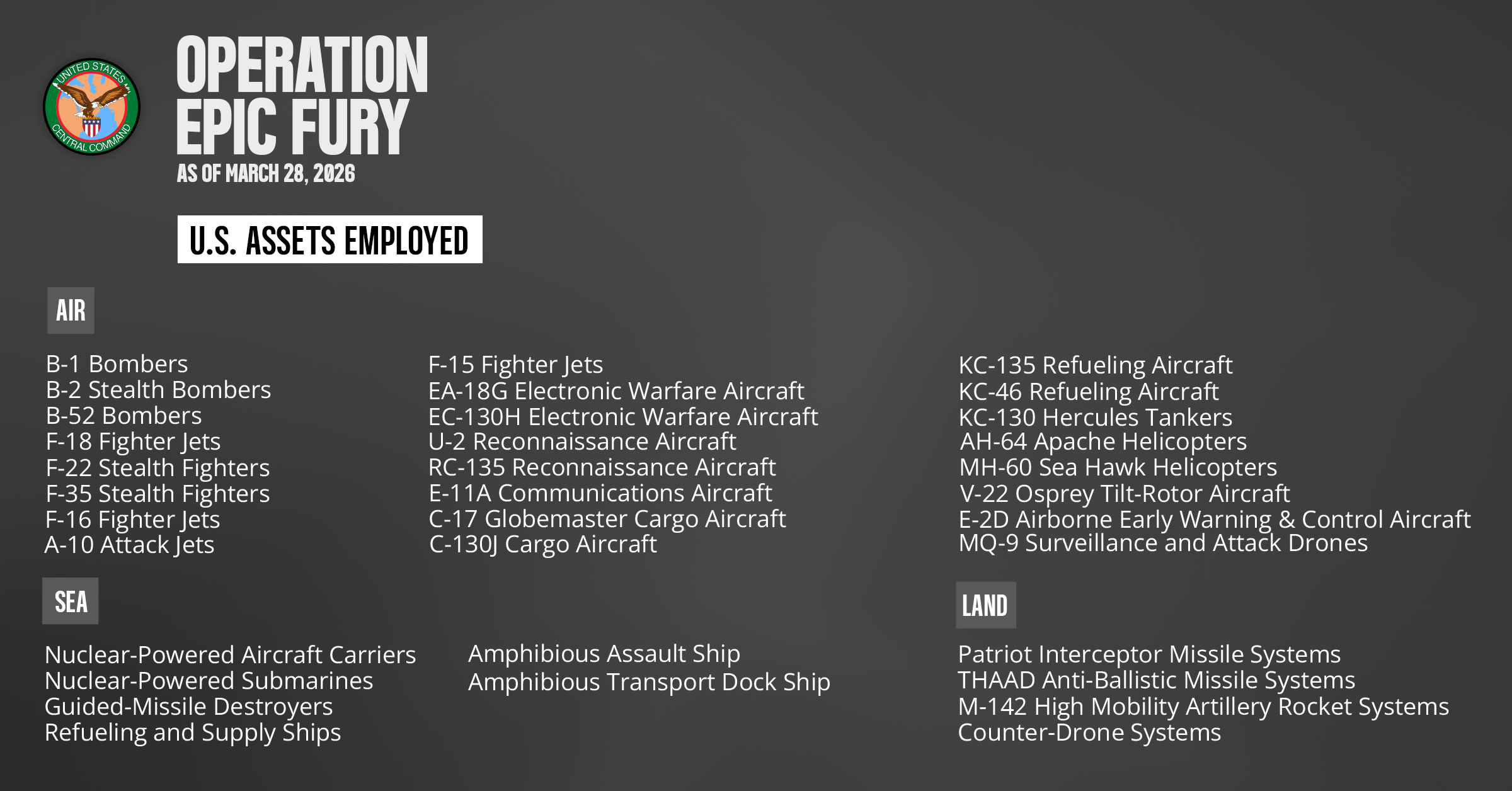
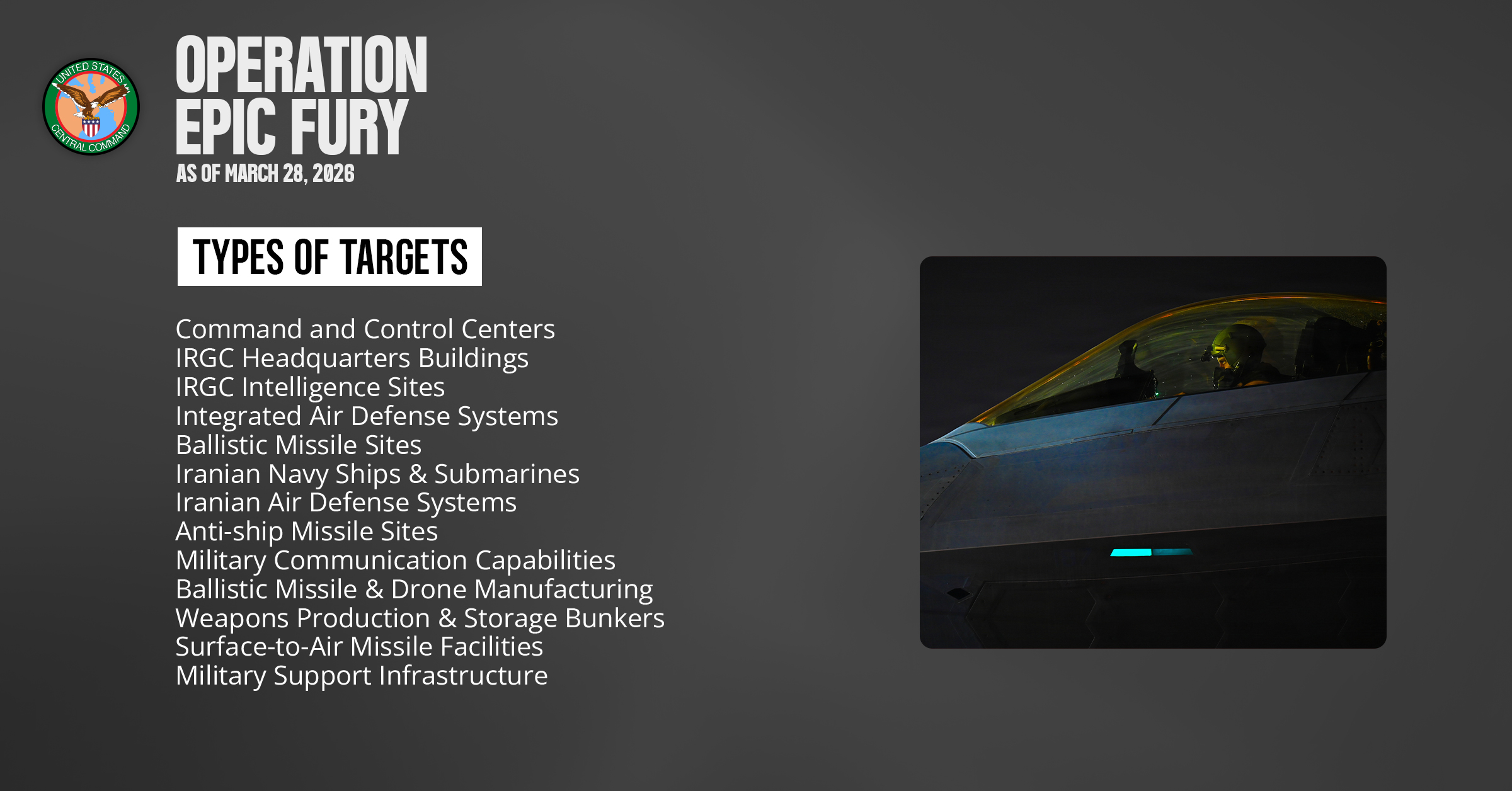
Iran Strikes the Gulf and its Neighbors
Iran’s retaliation was immediate and broad. Tehran launched missiles and air strikes not only against Israel but across the region — Bahrain, Jordan, Saudi Arabia, Qatar, the United Arab Emirates, and Iraq.[2] In Dubai, fire and smoke rose from the Fairmont Hotel on Palm Street after an Iranian drone strike. The UAE ordered nationwide school closures and told residents to seek shelter. Abu Dhabi residents received emergency alerts warning of “potential missile threats.”[23]
The United States issued a joint statement with those Arab countries strongly condemning the regime’s “indiscriminate and reckless missile and drone attacks against sovereign territories across the region.” It further stated, “The Islamic Republic’s actions represent a dangerous escalation that violates the sovereignty of multiple states and threatens regional stability. The targeting of civilians and of countries not engaged in hostilities is reckless and destabilizing behavior.”
According to Time, Iran’s reaction caught the administration by surprise. “Key Trump officials, including Defense Secretary Pete Hegseth, were surprised by the barrage of retaliatory attacks Tehran launched against U.S. and Israeli targets across the region, including in countries long assumed to be off-limits: Kuwait, Bahrain, Saudi Arabia, the United Arab Emirates, and Qatar, a state that had both harbored Iran’s terrorist proxies and served as a conduit for backchannel diplomacy between the U.S. and Hamas. The response shattered the assumption that Tehran would confine itself to performative retaliation. In internal deliberations before the war’s launch, Hegseth had pointed to Iran’s muted reaction to Trump’s past attacks as evidence that calibrated force could impose costs on Tehran without triggering a broader war.”[99]
Iran continued to lash out in all directions:
- The U.S. Embassy in Riyadh was hit by two drones on March 2, causing a fire and minor material damage to the building. A drone also struck the U.S. Embassy in Kuwait.
- The UAE reported it had successfully destroyed 814 of the 871 drones, ballistic missiles, and cruise missiles.
- Iranian drones struck an Australian military facility in the UAE.
- Qatar’s Defense Ministry reported shooting down two Iranian Soviet-made Su-24 bombers and more than 120 missiles and drones.
- Iranian drones that were intercepted still sparked a fire at the Ras Tanura oil refinery in Saudi Arabia. Operations at the facility were halted to prevent damage and fires.
- Iranian drones targeted a power plant and an energy facility in Qatar.
- Debris from an intercepted Iranian missile hit an oil tanker at a Bahrain port, causing a fire.
- Amazon’s cloud computing business said two of its facilities in the UAE were struck by drones.
On March 1, the foreign ministers of the Gulf states condemned Iran’s attacks while affirming their right to respond. In a joint statement, they urged a return to diplomacy as “the sole path to overcome the current crisis” and cautioned that further escalation could “drag the region toward dangerous trajectories with catastrophic consequences.”[39]
The United Arab Emirates holds billions of dollars belonging to Iranian entities and individuals. According to Israel Hayom, after Iran’s initial attacks on the Emirates, a substantial portion of those assets was frozen. Iranian Foreign Minister Abbas Araghchi subsequently called his Emirati counterpart, Sheikh Abdullah bin Zayed, to apologize for the strikes—saying they were intended only to target U.S. bases—and urged him to release the funds.[94]
Sima Shine, a former senior Iran analyst at Mossad, argued that Tehran’s decision to strike Arab Gulf states — including hotels in the Emirates and oil facilities in Saudi Arabia, despite claiming to target only U.S. bases — represents a deliberate strategic gamble. The faction that prevailed in internal regime debates believes widening the war and potentially closing the Strait of Hormuz will spike oil prices and pressure the international community into demanding a ceasefire. “They believe that if oil prices rise, it will put pressure on President Trump,” Shine said.
She also warned that Iran maintains sleeper networks in Europe capable of conducting attacks if ordered, and according to information obtained by Euractiv, German security services are already on heightened alert over potential Iranian operative activity.
Iranian Targets
| Country | Missile | UAV | Total After Ceasefire |
| United Arab Emirates | 563 | 2,256 | 2 |
| Kuwait | 369 | 852 | 235 |
| Bahrain | 194 | 523 | 70 |
| Qatar | 228 | 111 | 7 |
| Jordan | 60 | 59 | 113 |
| Saudi Arabia | 104 | 916 | 2o |
| Oman | 3 | 60 | 4 |
| Cyprus | 2 | 5 | 0 |
| Turkey | 4 | 0 |
Source: INSS (As of July 28, 2026)
The war expanded into a dangerous new domain on March 8 when civilian infrastructure across the Persian Gulf, with desalination plants — the region’s most critical and vulnerable resource — came under attack.
An Iranian drone struck a desalination plant in Bahrain, a country almost entirely dependent on such facilities for drinking water for its 1.6 million people. Iran’s foreign minister justified the attack by claiming the U.S. had first struck an Iranian desalination plant on the Gulf island of Qeshm — a claim CENTCOM denied.
Hussein Ibish of the Arab Gulf States Institute called the targeting of water infrastructure “really going for the jugular,” noting that desalination plants, even more than energy infrastructure, are the Gulf monarchies’ “Achilles’ heel.”
The broader pattern of infrastructure attacks was escalating rapidly across the region as a drone exploded near Dubai’s airport, forcing a temporary flight suspension, and projectile fragments hit a residential building in the Dubai Marina neighborhood. Saudi Aramco’s Berri oil field was targeted by a drone, and the kingdom intercepted ballistic missiles aimed at a military base and drone waves headed for the Shaybah oil field. Two fuel tanks at Kuwait’s main airport were hit. Iran targeted Saudi Arabia’s Ras Tanura oil complex at least twice. An Iranian missile set fire to Bahrain’s state-run Bapco refinery, and a drone attack ignited an oil tank in the UAE city of Fujairah.[92]
According to Israel Hayom, three Gulf state leaders told the United States that the war must result in the elimination of Iran’s threat to their countries. A Gulf diplomat told the paper that Iran miscalculated in assuming that Gulf countries would pressure the U.S. to end the conflict. “Why would the GCC states (the Gulf Cooperation Council) want the war to end before defeating a regime that, at its first opportunity, fired hundreds of missiles at them indiscriminately?” he asked rhetorically. “Why should we leave that risk hanging over us and over our most important economic interests, when it is clear that the missiles and drones will be directed at us in the next confrontation as well?”[94]
The attacks on Gulf nations were evidence of Iran’s aspiration to dominate the region. Abdulrahman al-Rashed, Chairman of Al Arabiya’s Editorial Board, noted that “Tehran’s strategy of developing destructive capacities capable of paralyzing or even toppling neighboring states was never a secret. The question was always when ‘zero hour’ would arrive, perhaps after the regime achieved nuclear deterrence, which would have granted Tehran protection from international military intervention.”
Al-Rashed added, “Stripping the regime of its military claws would represent a historic achievement of enormous significance…Regardless of whether the current regime survives or a successor emerges from within it, Iran’s ability to threaten the region will have been largely eliminated by the end of the war, and its regional tools of influence will likely disappear.”[89]
Qatari Prime Minister Mohammad bin Abdulrahman al-Thani stated on March 9 that Iran “betrayed” the Gulf with its “miscalculation” in attacking Gulf countries, and said Iran had destroyed its relationship with Gulf states.[107]
Dr. Anwar Gargash, an adviser to the Emirati president, said Iran miscalculated by attacking the UAE and other Persian Gulf states, driving them closer to Israel and the U.S., while demonstrating why the region can’t accept Iranian nuclear and missile programs.
“We’re not seeing 2,000 Israeli missiles and drones targeting us,” Gargash said. “We’re seeing 2,000 Iranian missiles and drones targeting us. So, for countries that have relations with Israel, this relationship will be strengthened. For countries that don’t have relations, I expect that more channels will be opened.”
Similarly, he said, “We are seeing how important the American connection is” and that Iran’s attack is “strengthening it.”[135]
Although Gulf states initially warned against war with Iran, many—especially the UAE, Saudi Arabia, Bahrain, and Qatar—later supported U.S.-Israeli strikes to significantly degrade Iran’s military capabilities after experiencing Iranian attacks firsthand. While they doubted regime change was likely, they wanted Iran weakened enough to no longer threaten the region, with some even considering joining the campaign. However, divisions remained, with countries like Oman favoring a quick end to the war, while others are concerned about a prolonged conflict and diminishing returns.[158]
Gulf states subsequently responded to the Iran conflict with a broad, coordinated crackdown on Iranian-linked networks, operatives, and influence—both internally and across the region.
In the United Arab Emirates, authorities dismantled espionage and terror cells tied to Iran and Hezbollah, arrested operatives operating under commercial fronts, and were considering freezing billions in Iranian assets and targeting shadow financial networks linked to the IRGC.
In Kuwait, security forces have foiled plots linked to Hezbollah, arrested suspects tied to Iranian proxies, and imposed strict internal security controls, including arrests for activities seen as undermining national stability.
In Bahrain, authorities have arrested suspected Iranian spies and dismantled militant cells, while detaining dozens accused of aiding Iran amid ongoing attacks on its territory.
Across the region—including Qatar and Saudi Arabia—governments detained Iranian-linked cells, tightened surveillance, and coordinated politically to counter Tehran’s proxy networks, warning of sleeper cells and external militia threats.[253]
Israel provided the United Arab Emirates with advanced defensive systems during heavy Iranian missile and drone attacks, marking a significant expansion of post–Abraham Accords security cooperation. The deployment included an advanced laser system, drone-detection surveillance technology, air defense platforms such as Iron Dome, and Israeli personnel and real-time intelligence support.
These systems helped the UAE intercept the vast majority of more than 500 missiles and 2,000 drones launched by Iran. In some cases, Israel even supplied prototype or not-yet-integrated technologies to meet urgent battlefield needs, underscoring both the intensity of the conflict and the deepening strategic partnership between the two countries.[276]
Prime Minister Benjamin Netanyahu ordered the deployment following a phone call with Emirati President Mohammed bin Zayed Al Nahyan.[265]
Jordan, despite seeking to stay out of the conflict, was also drawn into the war as Iranian missiles and drones struck its territory, injuring civilians and damaging key military assets, including a U.S. radar system. The attacks exposed the limits of Jordan’s neutrality, forcing it to rely more heavily on U.S. and allied defense support while fueling domestic tensions over its alignment with the West amid strong public focus on Gaza. The kingdom faced mounting security, economic, and political pressures, balancing external threats, internal dissent, and the risk of deeper regional escalation.[143]
Iran escalated rhetorically and militarily against the UAE in May 2026, attempting to portray it as a hostile state supporting U.S. and Israeli operations. On May 17, likely Iranian or Iranian-backed forces launched three drones targeting the Barakah Nuclear Power Plant in Abu Dhabi, with radiation levels remaining normal. IRGC-affiliated media used the attack to attempt to drive a wedge between the UAE and other Gulf states by falsely blaming Saudi Arabia. ISW assessed that Iran sought to demonstrate that continued U.S. military actions against Iran would generate direct security and economic costs for Gulf states cooperating with the United States.
Separately, Kuwaiti authorities reported on May 12 that six IRGC officers attempted to infiltrate Bubiyan Island on May 1. ISW assessed that the island offered opportunities to stage operations, conduct intelligence gathering, or sabotage nearby facilities. Iranian military drills at Mahshahr Port, approximately 100 kilometers away, were assessed as potentially preparing for new operations or dispersing vessels ahead of resumed strikes.[290]
Saudi Arabia and the United Arab Emirates separately conducted direct military strikes against Iran in retaliation for Iranian attacks early in the war. Neither government acknowledged the operations or disclosed their targets.
The strikes reflected a shift in Gulf security policy after Iran launched thousands of missile and drone attacks against Gulf states hosting U.S. forces, causing widespread damage to infrastructure and killing at least 19 civilians. U.S. officials said the Saudi and Emirati responses were intended to restore deterrence and demonstrate a greater willingness to defend their own territory rather than rely solely on American protection.
It remains unclear whether the strikes were coordinated with the United States. Analysts said Riyadh and Abu Dhabi likely sought to calibrate their responses to avoid a broader escalation while signaling that they would no longer tolerate repeated Iranian attacks. President Trump had previously suggested that Saudi Arabia, the UAE, and other Gulf states were “fighting with us,” though none had publicly acknowledged participating in offensive operations. Iranian Foreign Minister Abbas Araghchi later accused the UAE of being “directly involved” in attacks against Iran.[397]
Internationalizing the Conflict
The British participated in the interceptions of missiles and UAVs launched toward Israel and Cyprus, while they passed over Jordanian soil, initially refusing to allow the U.S. use of its bases in the region. Prime Minister Keir Starmer quickly reversed this position, framing the decision as self-defense.[23] A British air base in Cyprus was subsequently struck by an Iranian drone believed to have been fired by Hezbollah.[35]
Germany, France, and the UK said on March 1 that they would take “proportionate defensive action to destroy Iran’s capability to fire missiles and drones at their source.” Iran warned that if European countries join the U.S.-Israeli offensive, it would treat their involvement as an act of war.[34] As Iranian attacks intensified, aircraft from Britain and France stationed in the area were deployed to defend their Gulf allies. France deployed fighters to the UAE and anti-missile and anti-drone systems to Cyprus. Britain sent a warship to protect Cyprus. Greece dispatched four F-16 fighter jets to the island. Two frigates, one equipped with an anti-drone jamming system, were also sailing to Cyprus.[57]
On March 3, French President Emmanuel Macron ordered France’s nuclear-powered aircraft carrier to move to the Mediterranean to help protect allied assets. Macron also said that France has defense agreements with Qatar, Kuwait, and the UAE, as well as commitments to Jordan and Iraq.[68]
Meanwhile, Spain refused to authorize logistical support operations for the United States. President Trump responded by announcing the U.S. would stop all trade with Spain. [55]
On March 2, the U.S. Department of State called on Americans to immediately depart more than a dozen countries in the Middle East, including Israel, as fighting escalated.
In a potentially significant escalation, Iran fired a drone toward Turkey on March 4, which was shot down by a U.S. Navy destroyer, marking the first attack on a NATO country other than the United States.[63] NATO deployed a Patriot missile defense system to Malatya, Turkey, as part of enhanced air and missile defense measures.
Azerbaijan announced on March 5 that Iran launched four attack drones at it, injuring four people. President Ilham Aliyev said, “We will not tolerate this unprovoked act of terror and aggression against Azerbaijan. Our Armed Forces have been instructed to prepare and implement appropriate retaliatory measures.” Azerbaijan has also temporarily closed its airspace near Iran.
Haaretz noted that Azerbaijan, along with the UAE and Cyprus, is equipped with Barak and SPYDER air defense systems, produced by Israel Aerospace Industries (IAI) and Rafael, respectively.[95]
Iranian Deputy Foreign Minister Kazem Gharibabadi denied that Tehran had targeted Nakhchivan.[76]
Israel carried out a covert extraction of non-essential embassy staff from the UAE after two Iranian terror plots targeting the diplomatic team were foiled, according to an Israeli official cited by the Times of Israel. A senior Israeli official told Channel 12 that the two attacks were part of “a specific effort to hunt the Israeli diplomats.”[62]
Hezbollah Joins the Fight
On March 1, Hezbollah entered the war in what it said was retaliation for the killing of Khamenei by launching rockets and drones into Israel, and the others fell into open areas. Israel had been biding its time, hoping for an excuse to finish the job of destroying Hezbollah, which had been preempted by Trump forcing it to accept a ceasefire. In response to the new attacks, Israel began a campaign targeting dozens of Hezbollah sites across Beirut and southern Lebanon. Hezbollah leaders were also eliminated, including Hussein Makled, the head of Hezbollah’s intelligence.[17]
Israel said on March 2 that the head of Hezbollah’s intelligence arm, Hussein Makled, was killed in an overnight strike in Beirut. A senior commander in Palestinian Islamic Jihad was also eliminated.
The military also struck branches of the Al-Qard al-Hasan association, which the IDF said is used by Hezbollah to store money, manage salaries for its operatives, transfer funds from Iran, and purchase weapons.
In an effort to prevent further escalation, Prime Minister Nawaf Salam said Lebanon rejected any military actions launched from its territory “outside the framework of its legitimate institutions and affirmed that the decision of war and peace is exclusively in its hands.”
This “necessitates the immediate prohibition of all Hezbollah’s security and military activities as being outside the law, and obliging it to hand over its weapons to the Lebanese state,” he said.
Salam ordered the military and security agencies to take “immediate measures” to implement the cabinet decision and prevent “any military operation or the launching of missiles or drones from Lebanese territory.”
The orders were unlikely to affect events as Hezbollah remained determined to conduct operations against Israel, and IDF Chief of Staff Lt. Gen. Eyal Zamir said Hezbollah must be disarmed, and Israel would not end its offensive until “the threat is removed.”[44]
The IDF estimated that about 300,000 Lebanese civilians evacuated their villages after they were ordered to leave, as Israel apparently was preparing a new ground operation.
Syria closed all border crossings into Lebanon following an alleged notification from Israel that the IDF would target them due to Hezbollah smuggling weapons through them.
On March 4, Iran and Hezbollah carried out their first coordinated attacks on Israel. The IDF said one missile was launched from Iran, while six projectiles were launched from Hezbollah in Lebanon. A second joint attack was launched later. No injuries were reported.[64]
Hezbollah redeployed elite Radwan Force fighters to southern Lebanon to confront Israeli troops, according to Lebanese sources, marking a deeper involvement in the expanding regional conflict. The fighters were sent to areas near the Israeli border to block Israeli tank advances. Their return reverses a withdrawal made under a November 2024 U.S.-brokered ceasefire, which had moved Hezbollah forces north of the Litani River.[77]
Israel warned Iranian regime representatives in Lebanon to leave the country within 24 hours or face being targeted by Israeli forces. Lebanon’s cabinet subsequently announced it would prevent Iranian Revolutionary Guard activity on Lebanese territory, detain any involved personnel, and deport them. Information Minister Paul Morcos also said Iranians will now require visas to enter Lebanon.[78]
The IDF ordered all civilians to evacuate southern Lebanon below the Litani River and Beirut’s Dahiya district. This order displaced more than half a million people. The Israeli Air Force began destroying multistory apartment blocks in Dahiya while ground forces moved armor and infantry into border areas to prevent Hezbollah raids.
Hezbollah responded with rocket and drone strikes on northern Israel and once on Tel Aviv. A drone also appeared to unsuccessfully target Netanyahu’s private home in Caesarea. Hezbollah issued its own evacuation order for Israeli border settlements, including Kiryat Shmona, but observers considered it an empty gesture.
Amid these escalating military moves, the more significant development is political. The Lebanese government, for the first time, declared all Hezbollah military activity illegal and arrested 26 armed Hezbollah operatives at army roadblocks. Following Israel’s directive for IRGC officers training and arming Hezbollah to leave Lebanon, Beirut subsequently ordered the Iranians out and announced that all Iranians will henceforth require visas to enter the country, barring Iranian personnel and funds for Hezbollah. Israeli jets also struck a downtown Beirut hotel suite reportedly housing IRGC Quds Force operatives. Iran stated that if Israel bombs the Iranian Embassy in Beirut — which has long served as an IRGC base of operations — it would target Israeli embassies and the Dimona nuclear facility.
Perhaps most remarkably, Lebanon’s Christian and Sunni populations have been outspoken in condemning Hezbollah for dragging the country into a destructive war against its interests. Many Lebanese Shi’ites have joined the chorus, including Nabih Berri, the powerful speaker of parliament and leader of the Amal Party, who formally dissociated his movement from Hezbollah — a historic break after years of routinely supporting the Islamist organization.[90]
Hezbollah launched a barrage of rockets on central Israel, with one missile striking the city center of Ramleh and injuring 16 people. Senior Israeli officials told Israeli media on March 9 that they expect Hezbollah to increase the volume of its attacks in “the coming days” as part of an effort to “draw Israeli attention away” from Iran.
Following Israel’s threat that Iranian regime officials in Lebanon who did not immediately leave would become targets, the IDF struck a room in the Ramada Hotel in Beirut’s upscale Raouché district, killing five senior IRGC members involved in financing and directing terrorist operations among Iran’s Lebanese and Palestinian proxies. Ten other people were injured. At least 150 Iranian nationals have left Lebanon since the threat was issued.
Lebanese President Joseph Aoun publicly lashed out at Hezbollah, telling European officials: “Whoever launched those missiles wanted to bring about the collapse of the Lebanese state, plunging it into aggression and chaos… all for the sake of the Iranian regime’s calculation.” He proposed a four-point plan that would include “establishing a full truce” with Israel and direct negotiations.[106]
A massive, coordinated barrage of rocket and missile fire on northern Israel was carried out by Hezbollah and Iran on March 11, marking a significant escalation in the Lebanese front of the war, which opened on March 2 with a much smaller Hezbollah attack on northern Israel. Some 200 Hezbollah rockets were fired on northern Israel, with a smaller barrage from Iran also hitting Israel’s north at the exact same time. Most of the projectiles were intercepted or landed in open fields. The IDF launched a wave of airstrikes on Lebanon, focusing on Hezbollah strongholds such as the Dahiya quarter of Beirut. The IDF reported destroying ten different Hezbollah command posts and dozens of rocket launchers.
On March 11, Trump said, “We’ve got to get rid of Hezbollah. It’s been a disaster for many years.” [117]
Israel Hayom reported on March 12 that President Trump approved Israel’s limited ground incursion into Lebanon and agreed that the operation could be expanded significantly if necessary. Publicly, he said, “We love Lebanon, we love the Lebanese people,” adding, “We have to get rid of Hezbollah. It has brought disaster for many years.”[116]
Click here for further updates on the conflict with Hezbollah.
Militias Drag U.S. Back to Iraq
The war in Iran is spilling into Iraq, drawing American forces back into a country they spent years trying to leave. Iraqi militias have launched dozens of small-scale drone and rocket attacks since the conflict began, targeting a U.S. military base and consulate in northern Iraq, a State Department facility at Baghdad International Airport, and the U.S. Embassy in Baghdad — which Iraqi Prime Minister Mohammed Shia al-Sudani condemned as a “terrorist act” by “rogue groups.”
The U.S. acknowledged Sunday that it has been striking back. “We have conducted operations in Iraq as part of Operation Epic Fury, but it’s in defense of U.S. troops as they’ve come under attack by Iran-aligned militia groups,” said Capt. Tim Hawkins, a CENTCOM spokesman. The Pentagon has carried out multiple airstrikes on militia strongholds, including bases near Jurf al-Sakhar south of Baghdad and al-Qaim along the Iraqi-Syrian border — both long used as depots for Iranian-supplied weapons. A March 4 strike in Babil killed Abu Hassan al-Fariji, a commander of the U.S.-designated terror group Kataib Hezbollah who had served the organization for more than two decades.
The shift is significant. The Pentagon had mostly avoided targeting Iraqi militias in recent years, seeking to disengage from the country’s painful legacy. Tamer Badawi of the Royal United Services Institute said there have been at least two dozen reported attacks on Iraqi militias since the war began, most likely by U.S. forces or allies. “They are working to decapitate the Iranian-backed infrastructure in Iraq,” he said. Analysts say the Pentagon is not only opening a second front against Iran but also settling years-old scores with the militia networks.[93]
The Trump administration intensified pressure on Iraq to curb Iranian-backed militias by taking significant financial and military steps. In April, the U.S. blocked nearly $500 million in dollar shipments from Iraq’s oil revenues, the second scheduled shipment to be delayed, and suspended certain security and training programs with the Iraqi military.
These actions followed repeated militia attacks on U.S. targets and signaled Washington’s demand that Baghdad dismantle the militias and distance itself from Iran. The measures underscored a broader effort to push Iraq to align more closely with the United States amid the ongoing war with Iran.[258]
The Houthis Attack Israel
After weeks of signaling, the Houthis entered the Iran war on March 28 by launching missiles at southern Israel, though none hit their targets. They framed the move as a response to escalating U.S. and Israeli actions against Iran and warned that attacks would continue until “aggression” against the broader “axis of resistance” stops.
The group outlined clear triggers for further escalation, including expanded U.S.-aligned involvement (especially by Gulf states) and hostile operations in the Red Sea. Their most potent leverage is the Bab al-Mandab Strait, a critical chokepoint for global trade, where past Houthi attacks have disrupted shipping and raised costs. Analysts warn that renewed disruption could spike oil prices and further strain global supply chains.
Houthi actions remained calibrated—targeting Israel as a lower-risk step while avoiding immediate confrontation with the U.S. and preserving potential arrangements with Saudi Arabia. However, their entry into the conflict raised the likelihood of broader escalation, including threats to regional infrastructure and shipping, despite the risks of reigniting Yemen’s civil war.[183]
The Houthis’ involvement ultimately was brief, and they observed the ceasefire agreed to by Iran, Israel, and the United States.
After Iran attacked Israel on June 7, the Houthis launched two ballistic missiles at central Israel the next day. One was intercepted, the second didn’t reach Israeli territory. On June 9, Israel intercepted a Houthi drone over Eilat. The group announced a “complete and total ban on Israeli maritime navigation in the Red Sea,” declaring what it called “all enemy movements” to be legitimate military targets.
Trump Finally Addresses the Nation
More than a month into the war with Iran, Trump delivered a prime-time address on April 1 defending the conflict while escalating his rhetoric, warning the United States would bring Iran “back to the Stone Ages where they belong.” He claimed Iran’s missile and drone capabilities had been sharply degraded, its weapons infrastructure heavily damaged, and the leadership of the Islamic Revolutionary Guard Corps was “being decimated,” asserting that “we are on track to complete all of America’s military objectives shortly,” though he offered no clear timeline for ending the war.
Trump described the campaign as a major success and predicted it could conclude within weeks, while urging Americans to keep the conflict “in perspective” despite rising economic concerns and declining domestic support. At the same time, he sent mixed signals—referencing ongoing discussions while also threatening intensified military action—without outlining a clear exit strategy.
He downplayed concerns about Iran’s nuclear program, suggesting key sites had been sufficiently damaged and ruling out an immediate operation to seize enriched uranium, leaving uncertainty about long-term outcomes. Trump also dismissed worries about disruptions to the Strait of Hormuz, claiming it would reopen “automatically” once the U.S. withdrew and urging oil-dependent countries to “take the lead” in securing it, even as global supply risks continued to affect prices.
Shortly after the speech, Iran reportedly launched missiles at Israel, underscoring the ongoing intensity of the conflict. Meanwhile, Trump pointed to past operations, such as Venezuela, as models of swift success, though the Iran war has proven far more complex, with continued hostilities, U.S. casualties, and unresolved strategic questions.
CNN reported on April 2 that U.S. intelligence assessed that despite weeks of U.S. and Israeli strikes, about half of Iran’s ballistic missile launchers remained intact, though some were buried or inaccessible. Israeli estimates differed, claiming roughly 60% have been destroyed or disabled, with discrepancies tied to how damaged or blocked launchers are classified.
Iran also retained thousands of attack drones, a large share of its coastal defense cruise missiles—key to threatening Strait of Hormuz shipping—and significant IRGC naval capabilities, including hundreds or thousands of small boats and unmanned vessels, even as its conventional navy had been largely destroyed.
White House spokesperson Anna Kelly disputed the report, saying, “Here are the facts: Iranian ballistic missile and drone attacks are down 90%, their navy is wiped out, two-thirds of their production facilities are damaged or destroyed, and the United States and Israel have overwhelming air dominance over Iran.”[187]
On April 3, a search-and-rescue operation was underway for the crew of a U.S. F-15E fighter jet that was shot down over Iran by a shoulder-fired missile, the first known loss of a jet inside the country. One of the two airmen, the pilot, was rescued quickly, though the rescue helicopter was reportedly hit by small arms fire, wounding some crew members.[195] A local television station affiliated with Iran’s state broadcaster, IRIB, aired a message offering a reward to civilians who could locate or capture the weapons officer who had also ejected, and hand them over to authorities.[188] The second airman survived more than 24 hours in mountainous terrain before being rescued in a daring night rescue by special forces on April 4. Israel contributed intelligence and an air strike to prevent Iranian forces from reaching the area.[199] Both men were taken to a military hospital in Germany.
An A-10 Thunderbolt crashed near the Strait of Hormuz around the same time the F-15E was shot down. Before ejecting, the pilot brought the aircraft into Kuwaiti airspace and was rescued.[196]
Commentators were quick to lampoon Trump’s earlier and subsequent claims of air superiority over Iran; however, the Institute for the Study of War noted that “Friendly forces can maintain air superiority even if the enemy is attempting to shoot down friendly aircraft, so long as the enemy air defenses do not seriously impede friendly operations. Iranian attempts to challenge US and Israeli air superiority have not seriously impeded the combined force’s ability to conduct operations over Iran, as demonstrated by the persistent strikes nationwide.”[197]
The U.S.-Israeli campaign also expanded beyond strictly military targets to include infrastructure tied to Iran’s weapons programs and economy, striking facilities such as pharmaceutical and research institutes linked to biological and chemical activities, a petrochemical complex, and steel factories critical to military production. The U.S. also targeted key logistics, including a bridge used to transport missiles, aiming to disrupt Iran’s ability to reposition launch capabilities as its western launch sites are degraded. Trump posted, “The biggest bridge in Iran comes tumbling down, never to be used again — Much more to follow! IT IS TIME FOR IRAN TO MAKE A DEAL BEFORE IT IS TOO LATE, AND THERE IS NOTHING LEFT OF WHAT STILL COULD BECOME A GREAT COUNTRY!”[189]
As reports indicated negotiations were at an impasse, Trump issued more threats. On April 4, he said, “Remember when I gave Iran ten days to MAKE A DEAL or OPEN UP THE HORMUZ STRAIT. Time is running out - 48 hours before all Hell will reign down on them. Glory be to GOD!”[190]
The following day, his frustration seemed to boil over as he posted, “Tuesday will be Power Plant Day, and Bridge Day, all wrapped up in one, in Iran. There will be nothing like it!!! Open the Fuckin’ Strait, you crazy bastards, or you’ll be living in Hell - JUST WATCH! Praise be to Allah.”[191]
The same day (April 5), Pakistan proposed a 45-day ceasefire as part of a mediated effort to halt the war and reopen the Strait of Hormuz. Netanyahu reportedly lobbied Washington against accepting the plan, but the concern proved unnecessary: the proposal gained no traction. The United States tied any pause to Iran reopening the strait, while Iran rejected a temporary truce outright, insisting instead on a permanent end to the war. Still, Trump told Netanyahu that a ceasefire could be possible if Iran accepted U.S. terms, but emphasized he would not back down from his core demands that Tehran surrender its enriched uranium and commit to ending enrichment permanently.[207]
Iran’s response to U.S. ceasefire proposals, delivered through Pakistani mediators after two weeks of internal deliberation, went well beyond a simple pause in fighting. Tehran’s demands made clear it was seeking a comprehensive settlement, not a temporary arrangement, and the gap between what Iran wanted and what the U.S. was prepared to offer represented the central obstacle to any deal.
Iran’s core demand was a permanent end to the war, not the 45-day ceasefire the U.S. was proposing as a first step toward negotiations. This was the critical sticking point, with mediators scrambling to find language that could bridge the two positions. Beyond that, Iran insisted that any agreement cover not just its own territory but all active hostilities in the region — explicitly including Lebanon, where Israel was conducting an ongoing ground operation. Tehran was effectively demanding that a deal with the U.S. bind Israel’s hand on a separate front, a condition Israel would almost certainly resist. Iran also demanded a formal protocol guaranteeing safe passage through the Strait of Hormuz, financial compensation for reconstruction, and the lifting of all U.S. and international sanctions.
Trump described the Iranian response as “significant” but insufficient, and made clear his own non-negotiable demands remained in place. Nevertheless, he offered a one-day extension of his prior deadline. He now said the Strait must be opened by 8:00 PM on April 7. The Iranians responded that the Strait would remain closed to most ships and threatened to retaliate in kind if the United States or Israel attacked infrastructure. “If attacks on civilian targets are repeated, the subsequent phases of our offensive and retaliatory operations will be carried out much more crushingly and extensively,” Ebrahim Zolfaghari, an Iranian military spokesman, said on April 6.[198] Iran also rejected an offer to reopen the Strait of Hormuz in exchange for a ceasefire, and has declined to meet with U.S. officials.
On April 6, Trump reiterated: “We have a plan, because of the power of our military, where every bridge in Iran will be decimated by 12 o’clock tomorrow night, where every power plant in Iran will be out of business, burning, exploding and never to be used again.” If the attacks take place, he added, “It will take them 100 years to rebuild.”[201]
He told Fox News, “You will see bridges and power plants collapsing across Iran. If Iran does not quickly reach a deal with us, I am considering the option of destroying everything and seizing the oil.”
He further stated: “The reconstruction of Iran will take 20 years if they are lucky — and if they still have a country left at all.”
Trump added: “If the Iranians don’t want to sign an agreement, their entire country will be destroyed.”
He also said, “I do not rule out sending ground forces to Iran if an agreement is not reached.”
In another statement, he added: “I think I will be able to get a deal by tomorrow.”
If not, he said it is “highly unlikely” that he will extend his deadline for the Iranian regime to reopen the Strait of Hormuz. “They’ve had plenty of time,” Trump said. “They asked for an extension of seven days... they have until tomorrow... and after that, they’re going to have no bridges, they’re going to have no powerplants.”
A White House official told Bloomberg that Iran will not be allowed to establish a permanent system to control access to the Strait of Hormuz.
Iran reportedly produced a 10-point peace proposal that was unacceptable to the United States.[201]
Iran’s Revolutionary Guard naval command said that the Strait of Hormuz will not return to normal conditions—especially for the U.S. and Israel—and said it is preparing to implement an approved plan to establish a new order in the Gulf.[200]
Israeli Defense Minister Katz said on April 6, after killing Iranian intelligence chief, Major General Seyed Majid Khademi, that Israel would continue to “hunt them down, one by one.” Khademi had only been in office since June 2025 after replacing his predecessor and his deputy, who were killed in an airstrike during Operation Rising Lion.[193]
Airstrikes struck Sharif University of Technology, Iran’s premier science and engineering institution, triggering widespread outrage among Iranians, including regime critics. The university has been sanctioned by Western governments due to documented cooperation with Iranian military and defense entities involved in weapons development programs.[201]
On the morning of his deadline, Trump posted:
A whole civilization will die tonight, never to be brought back again. I don’t want that to happen, but it probably will. However, now that we have Complete and Total Regime Change, where different, smarter, and less radicalized minds prevail, maybe something revolutionarily wonderful can happen, WHO KNOWS? We will find out tonight, one of the most important moments in the long and complex history of the World. 47 years of extortion, corruption, and death will finally end. God Bless the Great People of Iran![202]
Later in the day, Trump said he was studying a new Pakistani proposal for a two-week ceasefire “to allow diplomacy to run its course.” Pakistani Prime Minister Shehbaz Sharif said he had asked Iran to open the Strait of Hormuz for two weeks “as a goodwill gesture.”[208]
An effort to stop the fighting at the UN also failed when Russia and China vetoed a UN Security Council resolution aimed at protecting commercial shipping in the Strait of Hormuz from Iranian interference, citing bias against Iran. The proposal had received support from 11 members and warned that Iran’s actions threatened international peace and security, while demanding an immediate end to disruptions of maritime navigation. The vetoes came even after the resolution was weakened to remove any authorization of force to open the strait.[210]
It was unclear who was conducting negotiations on Iran’s behalf and who was running the country. American and Israeli intelligence sources report that Iran’s Supreme Leader, Mojtaba Khamenei, has been incapacitated and is unable to govern. According to a memo obtained by The Times of London, Khamenei, who was wounded in the strike that killed his father, is in critical condition and receiving treatment in Qom, leaving him unable to participate in any regime decision-making.[209]
Meanwhile, Iranian officials urged “all young people, athletes, artists, students and university students and their professors” to form human chains around power plants. President Masoud Pezeshkian claimed that more than 14 million Iranians had vowed to “sacrifice their lives” in defense of the country.[204]
Israel and the U.S. continued airstrikes in advance of the deadline, with the U.S. hitting military targets on Kharg Island and Israel bombing railways and a petrochemical plant in Shiraz, which had been responsible for producing critical components used in explosives and ballistic missiles.
Even as it fought the war, Iran continued its repression of the population, accelerating executions tied to January’s nationwide protests, hanging young men—some teenagers—accused of involvement in unrest or opposition groups. Human rights organizations said executions were a near-daily occurrence and warned that hundreds more detainees could be at risk.
Those executed were convicted in fast-track trials widely criticized as unfair, with allegations of torture and lack of legal counsel. Iranian authorities portrayed the protesters as foreign-backed “terrorists,” while rights groups argued the executions were a deliberate campaign to suppress dissent and intimidate the population following a crackdown that reportedly killed thousands.[205]
Less than two hours before his deadline, Trump announced the U.S. would suspend bombing for two weeks on the condition that Iran agree to reopen the Strait of Hormuz.
Based on conversations with Prime Minister Shehbaz Sharif and Field Marshal Asim Munir, of Pakistan, and wherein they requested that I hold off the destructive force being sent tonight to Iran, and subject to the Islamic Republic of Iran agreeing to the COMPLETE, IMMEDIATE, and SAFE OPENING of the Strait of Hormuz, I agree to suspend the bombing and attack of Iran for a period of two weeks. This will be a double sided CEASEFIRE! The reason for doing so is that we have already met and exceeded all Military objectives, and are very far along with a definitive Agreement concerning Longterm PEACE with Iran, and PEACE in the Middle East. We received a 10 point proposal from Iran, and believe it is a workable basis on which to negotiate. Almost all of the various points of past contention have been agreed to between the United States and Iran, but a two week period will allow the Agreement to be finalized and consummated. On behalf of the United States of America, as President, and also representing the Countries of the Middle East, it is an Honor to have this Longterm problem close to resolution.[211]
A White House official said Israel had also agreed to the ceasefire.[212]
During the 40 days of fighting, the IAF dropped over 18,000 bombs across more than 1,000 strike waves. According to the IDF, this included over 10,800 individual strikes on more than 4,000 targets, ranging from air defense systems and ballistic missile launchers to weapons production sites, nuclear facilities, headquarters, and senior military leaders. In total, Israeli fighter jets flew approximately 8,500 sorties.
Israel claimed it destroyed or disabled about 60% of Iran’s estimated 470 ballistic missile launchers—roughly 200 destroyed outright and another 80 rendered inoperable by strikes on underground storage facilities. At the outset of the war, Iran was believed to possess 2,500 ballistic missiles; about 1,000 remained capable of reaching Israel.
The IDF also assessed that its operations eliminated approximately 85% of Iran’s air defense and detection systems, striking more than 300 related targets, including radars and missile batteries.
The most consequential impact, according to Israel, was on Iran’s military-industrial base. Thousands of production-related targets were destroyed, including all key sites involved in developing weapons threatening Israel, leaving Iran currently unable to manufacture new missiles.
Pakistan Mediates Peace Talks
Iran submitted a “new” and “modified” peace proposal on April 8 that the U.S. Government said would serve as the basis for negotiations. Trump described it as “a workable basis on which to negotiate,” and unspecified mediators told the Wall Street Journal that Iran had softened several demands, including those related to nuclear enrichment, the withdrawal of U.S. forces from the Middle East, and war reparations.
Despite the initial optimism, talks in Islamabad on April 11 and 12 ended without an agreement. Trump said on April 12 that Iran’s delegation had not made compromises on its nuclear program but that he believed Iran would return to the table. Three core disputes drove the breakdown: Iran’s stockpile of highly enriched uranium, control of the Strait of Hormuz, and access to $27 billion in frozen funds. The Iranians also wanted a commitment that it would not be attacked in the future by either Israel or the United States. The U.S. demanded Iran reopen the strait immediately and “hand over or sell” its enriched uranium stockpile. Iran insisted maritime access would come only after a final deal and refused to yield on enrichment. Washington also rejected Iran’s demand for the release of frozen oil revenues as reparations. ISW also noted that internal divisions within Iran’s delegation — between hardline IRGC figures and more pragmatic officials — further undermined the talks.[214]
On April 13, CENTCOM announced a blockade on vessels entering or departing Iranian ports and coastal areas, including in the Persian Gulf and Gulf of Oman, while stating that it would not impede freedom of navigation for vessels transiting the Strait of Hormuz to non-Iranian ports. Trump said he expected unspecified countries to assist with enforcement. The United Kingdom and France said they would not participate, though Trump claimed they were aiding mine-clearing efforts. The U.S. decision not to renew a 30-day sanctions waiver on Iranian oil exports, set to expire April 19, added further economic pressure.[215]
Joint Chiefs Chairman General Dan Caine said on April 16 that 12 vessels had been turned around since the blockade began without any boardings, and that the blockade had prevented Iran’s shadow fleet from delivering oil in violation of U.S. sanctions. In addition, the Treasury Department’s Office of Foreign Assets Control sanctioned more than 25 individuals, companies, and vessels linked to oil shipping magnate Mohammad Hossein Shamkhani’s network.[218]
CENTCOM Commander Adm. Brad Cooper praised Israel for its role in the war against Iran, saying, “There’s been no better teammate than Israel...Twice in the past two weeks, I’ve met with the Israeli Chief of Defense [Zamir] to ensure that we remain closely aligned, and we do.”[219]
Pakistani mediators traveled to Tehran to help preserve a fragile U.S.-Iran ceasefire ahead of its expiration. Trump signaled optimism on April 16, praising Pakistani Prime Minister Shehbaz Sharif and army chief Asim Munir as great mediators and saying Iran was “willing to do things today that they weren’t willing to do two months ago.” He even floated attending a deal-signing in Islamabad: “If the deal is signed in Islamabad, I might go… They want me.” He claimed the war “is going swimmingly” and dismissed economic concerns, calling predictions of soaring oil prices “fake inflation.” Trump also claimed Iran had agreed to surrender its highly enriched uranium stockpile, saying, “They’ve agreed to give us back the nuclear dust.” Iranian sources linked to the IRGC repeatedly denied reports of progress or concessions.[220]
Significant gaps remained on the nuclear question. The U.S. proposed a 20-year pause on enrichment; Iran offered three to five years. The U.S. wanted all highly enriched uranium removed from Iran entirely; Iran proposed down-blending part of its stockpile or transferring only a portion abroad. Experts noted that retaining even a fraction of the stockpile, combined with a short pause, could allow Iran to improve its centrifuge capacity and rebuild relatively quickly.[221]
On April 17, Trump said the U.S. would work with Iran to recover its enriched uranium and bring it back to the United States. “We’re going to get it together. We’re going to go in with Iran, at a nice leisurely pace, and go down and start excavating with big machinery...We’ll bring it back to the United States,” Trump said.[222]
Earlier, the Institute for Science and International Security reported that Iran appeared to be restricting access to a tunnel complex at the Esfahan Nuclear Technology Center, likely to delay or complicate any ground operation to seize its enriched uranium stockpile. ISW also assessed that Iran was exploiting the ceasefire to reorganize its ballistic missile forces and reopen tunnel entrances at missile bases.[223]
The United States reportedly conditioned any new round of talks on two requirements: Iran must fully reopen the Strait of Hormuz, and its negotiating team must have “full authority” to finalize an agreement. The demands underscored Washington’s conclusion that it was dealing with a fragmented Iranian leadership split between hardliners and more pragmatic officials.[224]
On April 17, Iran declared the Strait of Tiran completely open for the remainder of the ceasefire. Trump said, “Thank you!” but added that the blockade of Iranian ports would continue until a peace agreement was finalized. He also posted, “THIS PROCESS SHOULD GO VERY QUICKLY IN THAT MOST OF THE POINTS ARE ALREADY NEGOTIATED.”[225]
A day later, however, Iran declared the Strait closed and fired on ships entering the area. Trump subsequently claimed that it was the U.S. that had closed the Strait and warned: “We’re offering a very fair and reasonable DEAL, and I hope they take it because, if they don’t, the United States is going to knock out every single Power Plant, and every single Bridge, in Iran. NO MORE MR. NICE GUY!”[227]
Even as Trump was talking tough in public, his administration was reportedly considering unfreezing $20 billion in Iranian assets as part of a peace deal. The report surprised many who remember that Trump had excoriated President Obama for a $400 million cash delivery to Iran the same day the country released four American prisoners and implemented the JCPOA nuclear deal.[228]
Trump claimed he had good news about the negotiations and posted on the 17th that “Iran has agreed to never close the Strait of Hormuz again.” This appeared true when a convoy of ships transited the Strait.[230] However, the Institute for the Study of War reported on April 18 that IRGC Commander Major General Ahmad Vahidi and his inner circle likely seized at least temporary control over both Iran’s military response and its negotiating posture. That assessment was reinforced when the IRGC Navy attacked multiple commercial vessels and abruptly declared that no vessel of “any type or nationality” could pass through the Strait—directly contradicting Foreign Minister Abbas Araghchi’s statement just one day earlier that the waterway was “completely open” to commercial traffic.
ISW concluded that the IRGC’s consolidation of power effectively stripped civilian negotiators of real authority, indicating that the officials engaging with Washington cannot independently set Iran’s negotiating positions. Instead, more pragmatic figures appear to have been sidelined as the IRGC tightens its grip over decision-making.[229] ISW also reported that Ghalibaf publicly supported diplomacy—arguing it should complement military power—while clashing with hardliners, particularly Vahidi and his allies, who oppose talks. Ghalibaf’s push for diplomacy, ISW suggested, may be driven in part by efforts to preserve his political standing, as hardliners consolidate control and sideline more pragmatic figures. Meanwhile, U.S. officials said negotiators in Islamabad were later overruled by the IRGC.[244]
The U.S. Navy’s blockade of Iranian ports remained in place as CENTCOM said it had forced 23 ships to turn back since the United States began the blockade. On April 19, U.S. forces seized a previously sanctioned Iranian-flagged container ship for the first time after it attempted to pass the blockade line.
Vance, Witkoff, and Kushner were expected to travel to Islamabad to engage in another round of negotiations on April 21. Iran’s Supreme National Security Council said Pakistan’s army chief had presented a new American proposal; however, IRGC-affiliated media signaled a hardening stance, announcing that Iran would not participate in another round of talks with the United States because of “excessive” U.S. demands.[232]
Israel Hayom reported on April 19 that Iran agreed to transfer all of its enriched uranium, though it remained unclear who would ultimately take custody. Potential recipients include Russia—which signaled its willingness—the International Atomic Energy Agency, which would need to identify a secure site for storage and processing, or the United States. However, Washington was insisting on participating directly in locating and securing the material, but Iran said it would permit only IAEA personnel to carry out that role.[237]
The ceasefire was due to end on April 22 if there was no agreement, and all sides were reportedly preparing for a resumption of fighting. According to the New York Times, U.S. intelligence officials believed Iran retained roughly 40% of its pre-war drone arsenal and access to about 50% of its missile launchers. Since the ceasefire, it recovered roughly 100 additional systems from caves and bunkers, restoring launcher capacity to approximately 60% of prewar levels. Iran was also working to recover missiles buried in damaged depots. Once that effort is complete, U.S. estimates suggested Iran could regain up to 70% of its prewar missile arsenal.[233]
President Trump said on April 21, “I do not want to extend the ceasefire. I think we are going to end up with a great deal. They have no choice.” He added, “We are totally loaded up; we are much more powerful than we were before the ceasefire. We used the ceasefire to restock, and they have probably done a little restocking. We totally control the Strait of Hormuz.”[245]
Trump told PBS, “We’re not negotiating anything other than the fact that they will not have a nuclear weapon and that if the ceasefire expires without a deal, then “lots of bombs start going off.”[246] If Iran didn’t negotiate, he warned in another interview, “they’re going to see problems like they’ve never seen before.” [247]
Trump also said, "We caught a ship yesterday that had some things on it that werent very nice. A gift from China, perhaps — I don’t know. I am surprised. I thought I had an understanding with President Xi.”[245]
As Vance and the negotiating team were preparing to leave for Islamabad, the Iranians indicated they would not be sending negotiators. Nevertheless, Trump announced an extension of the ceasefire. He posted on April 21:
Based on the fact that the Government of Iran is seriously fractured, not unexpectedly so and, upon the request of Field Marshal Asim Munir, and Prime Minister Shehbaz Sharif, of Pakistan, we have been asked to hold our Attack on the Country of Iran until such time as their leaders and representatives can come up with a unified proposal. I have therefore directed our Military to continue the Blockade and, in all other respects, remain ready and able, and will therefore extend the Ceasefire until such time as their proposal is submitted, and discussions are concluded, one way or the other.
Later, he posted: “Iran is collapsing financially! They want the Strait of Hormuz opened immediately- Starving for cash! Losing 500 Million Dollars a day. Military and Police complaining that they are not getting paid. SOS!!!”[250]
Meanwhile, Iran’s Parliament Speaker Mohammad Bagher Qalibaf said: “We do not accept negotiations under the shadow of threat, and that over the past two weeks, preparations have been made to reveal new cards on the battlefield.”[251]
Trump Extends Deadline
The United States reportedly informed Israel on April 22 that the ceasefire would end on April 26. Katz said Israel was “awaiting a green light from the United States, first and foremost to complete the elimination of the Khamenei dynasty, the initiator of the extermination plan against Israel, and the successors of the successors of the leadership of the Iranian terror regime, and in addition to return Iran to the age of darkness and stone by blowing up central energy and electricity facilities and crushing national economic infrastructure.”[260]
A source told Israel Hayom the U.S. and Israel would then launch a much larger strike than before, expected to last several days.[255] Toward that end, the USS George H.W. Bush and other assets were being moved to the region. Only a major Iranian nuclear concession could prevent this operation, though Trump said the Iranians had made a positive gesture in responding to his request to cancel the planned execution of eight female protestors.[256]
Meanwhile, Iran’s public stance grew more defiant. Iranian state media broadcast videos ridiculing Trump’s outreach, asserting that Iran never negotiated with him.
A Western diplomat said Trump avoided striking Iran’s energy targets due to concerns about oil prices. Still, U.S. and Israeli officials argued that dismantling Iran’s military required destroying its supporting infrastructure, making strikes on energy and national assets inevitable.[255]
Multiple U.S. officials and Trump associates said Trump had effectively decided he wanted out of the Iran war. He believed the U.S. had achieved what it could militarily and would not resume strikes unless he had exhausted all other options first. His negotiators believed a deal covering what remained of Iran’s nuclear program was still reachable, but faced a significant obstacle: it was unclear whether anyone in Tehran was actually empowered to say yes. Supreme Leader Khamenei was barely communicating, and the IRGC generals who effectively controlled the country were openly at odds with Iran’s civilian negotiators over strategy. As one U.S. official described it: “There is an absolute fracture inside Iran between the negotiators and the military — with neither side having access to the supreme leader, who is not responsive.”
The immediate focus was on whether Pakistani mediators could bring Iran back to the table within Trump’s timeframe. U.S. officials and the mediators were watching for Khamenei to break his silence and give Iranian negotiators a clear directive to return to talks.
Trump had extended the ceasefire at some cost to his leverage, but believed the naval blockade he kept in place compensated for it, claiming Iran was “starving for cash” and could not pay its own military and police.[257]
On April 26, Iran proposed a two-step deal to end the war: first reopen the Strait of Hormuz and lift the U.S. blockade, with nuclear negotiations postponed. The proposal reflects divisions within Iran’s leadership over nuclear concessions and seeks a quicker path to a ceasefire.
The idea emerged during talks in Islamabad, where Iranian Foreign Minister Abbas Araghchi met with Pakistani, Turkish, Egyptian, and Qatari mediators but made little progress. Planned meetings with Witkoff and Kushner were canceled after Iran signaled it was not ready to engage directly, underscoring the stalemate.
“I see no point of sending them on an 18-hour flight in the current situation. It’s too long. We can do it just as well by telephone. The Iranians can call us if they want. We are not gonna travel just to sit there,” Trump said.
The U.S. remained cautious, since ending the blockade would reduce Trump’s leverage to force limits on Iran’s uranium enrichment—one of his main war aims. Trump indicated he preferred to maintain pressure while weighing next steps.[263]
Trump told advisers he was not satisfied with Iran’s latest proposal, and Secretary of State Rubio rejected it because “What they mean by opening the straits is, ‘yes, the straits are open, as long as you coordinate with Iran, get our permission, or we’ll blow you up and you pay us.’“
“That’s not opening the straits. Those are international waterways. They cannot normalize, nor can we tolerate them trying to normalize, a system in which the Iranians decide who gets to use them,” Rubio added.[266]
Ultra-hardliners are reinforcing Vahidi’s position, while pragmatists and reformists have been sidelined or silenced. Ghalibaf has largely retreated into a stance of public deference to the Supreme Leader, signaling his acceptance of the hardline status quo. Reformist voices, including Masoud Pezeshkian and former president Hassan Rouhani, have essentially vanished from the active policy debate. With no faction able to challenge the prevailing line—and dissent further suppressed by measures like an internet shutdown—the regime now presents a unified but rigid negotiating posture.[267]
On April 28, Trump posted, “Iran has just informed us that they are in a “State of Collapse.” They want us to “Open the Hormuz Strait,” as soon as possible, as they try to figure out their leadership situation (Which I believe they will be able to do!).”[268]
All indications were that Trump was unwilling to resume military operations and hoped to simply declare victory. That was impossible, however, so long as Iran kept the Strait of Tiran closed. By continuing to squeeze Iran’s economy and oil exports by preventing shipping to and from its ports, Trump hoped to force the regime to capitulate. Trump told aides that Iran’s three-step offer to reopen the Strait of Hormuz and save nuclear talks for the final phase proved Tehran wasn’t negotiating in good faith. The New York Times noted, however, that “continuing the blockade also prolongs a conflict that has driven up gas prices, hurt Trump’s poll numbers and further darkened Republicans’ prospects in the midterm elections.”[271]
Meanwhile, cargo ships and planes from the U.S. carrying 6,500 tons of military equipment arrived in Israel at the end of April to replenish stockpiles. The shipments contained “thousands of air munitions, ground munitions, military trucks, JLTV combat mobility vehicles, and additional equipment,” the Israeli Defense Ministry said, with the ministry’s director general adding that the shipments “will continue and intensify in the coming weeks.”
Since the conflict with Iran began on February 28, more than 115,600 tons of military equipment have arrived in Israel on 403 flights and 10 ships.
Israeli Defense Minister Israel Katz said the goal is “to ensure that the IDF receives all the necessary means so that it can return to operating at full strength against our enemies at any time and in any place required.”[272]Mojtaba Khamenei declared on April 30 that Iran would not relinquish control of shipping through the Strait of Hormuz or compromise on its nuclear and missile programs—underscoring Tehran’s refusal to yield on core strategic assets.
At the same time, Iran was pursuing a dual-track strategy. Regionally, it was working to drive a wedge between the Gulf states and the United States in a bid to pressure them to expel American forces. Militarily, it used the ceasefire to rebuild, recovering hidden or buried missile systems and drones in preparation for a potential renewal of hostilities.
Economically, the regime was attempting to shift blame for its deteriorating conditions onto U.S. pressure, even as structural mismanagement remains a central factor. To cope with the U.S. naval blockade, Iran began scaling back oil production as storage fills, a calculated move to avoid long-term damage to its fields.
Diplomatically, Tehran’s counterproposal outlined a three-phase plan: first, a rapid end to the war, guarantees against future joint strikes, and arrangements for the Strait of Hormuz; second, deferred negotiations over the nuclear program, including possible limits on enrichment and steps involving its highly enriched uranium stockpile. The sequencing reflected a clear effort to secure immediate relief while postponing any binding nuclear concessions. Previously, Tehran demanded concessions up front before talks.
“They want to make a deal, but I’m not satisfied with it,” President Trump said in response on May 1.[273]
On May 3, Trump announced that “Project Freedom” would begin on May 4. He said the U.S. Navy would begin to escort ships and their crews out of restricted waterways near the Strait of Hormuz, focusing on vessels from countries uninvolved in the current Middle East conflict whose crews indicated they would not return until the area was safe for navigation. While U.S. representatives were simultaneously engaged in discussions with Iran, Trump said the ship movements were intended as a humanitarian gesture to relieve innocent people, companies, and countries caught as victims of circumstance, particularly given that many vessels are running low on food and essential supplies needed to keep large crews healthy and sanitary. The initiative was framed as an act of goodwill on behalf of the United States, Middle Eastern nations, and especially Iran, meant to demonstrate positive intent after months of intense fighting, with a clear warning that any interference with this humanitarian process would be dealt with forcefully.[274]
Iranian state media published a map on May 4 showing the Revolutionary Guard’s area of control over the strait, which encompassed the U.A.E. port of Fujairah, the end of a pipeline that the Gulf country uses to circumvent the blockage in the strait. The IRGC warned it would stop unauthorized vessels by force and asserted continued control over the strait.
The Pentagon said May 4 that it successfully guided two U.S.-flagged commercial ships through the strait, but the captain of the Marshall Islands-flagged JV Innovation said it was at anchor, waiting to cross the strait, when it was hit by a drone. A second ship was also hit later in the day.
The UAE confirmed a drone hit sparked a fire at the oil hub of Fujairah, which the country used to pump petroleum and circumvent the Strait. The UAE also condemned an Iranian drone attack on a tanker used by the state-owned oil company of Abu Dhabi, Adnoc. Two drones targeted the ship while it was transiting the strait, causing no injuries.[275]
Trump announced on May 4 that he was pausing “Project Freedom” while keeping the naval blockade of Iranian ports in place, citing progress toward a deal and requests from international partners. The operation, aimed at opening the Strait by escorting ships, never got off the ground because of opposition from Saudi Arabia, which denied permission to use its airspace. The Saudis backed down after the administration threatened to withhold delivery of interceptors they needed to shoot down Iranian missiles and drones, but Trump decided to abandon the mission to focus on diplomacy.[381]
The White House believed it was close to a preliminary deal with Iran centered on a one-page memorandum of understanding (MOU) to end the war and launch broader nuclear negotiations—the closest the sides had come to agreement since the conflict began. The framework reportedly included a temporary halt to Iran’s uranium enrichment, gradual U.S. sanctions relief and release of frozen funds, and reciprocal steps to reopen transit through the Strait of Hormuz. However, many provisions were conditional on a final agreement, leaving open the risk of renewed conflict or a prolonged interim period without full resolution. The proposed 30-day process would aim to finalize terms on limiting Iran’s nuclear program, lifting sanctions, and restoring maritime access. Key sticking points remained, including the length of the enrichment moratorium, verification measures, and the potential removal of Iran’s highly enriched uranium stockpile, with U.S. officials still wary that internal divisions in Iran could derail an agreement.[279]
On May 5, Rubio shocked reporters by declaring that “Operation Epic Fury is concluded.”[281]
As Trump appeared willing to sign a peace deal with Iran to avoid additional unpopular military action and stem rising gas prices, Netanyahu was desperately trying to influence negotiations to ensure Israeli priorities were included. In a call with the president on May 6, Netanyahu emphasized Israel’s top demands: the complete removal of Iran’s enriched uranium and the dismantling of its enrichment capabilities. While both countries share these objectives, Israel believes additional military pressure may be necessary, whereas the Trump administration appears more focused on economic sanctions and diplomacy.
Israel was also concerned that the U.S. would narrow the scope of negotiations to the nuclear issue alone, potentially dropping demands related to Iran’s ballistic missile program and support for proxy groups. Despite doubts that Iran would accept the core demands, Israel was pushing to secure them in any agreement while preserving its freedom of action to act against future threats. At the same time, U.S.-Israel coordination produced at least one concrete outcome: expanded Israeli operational flexibility in Lebanon, allowing more targeted actions beyond the security zone it had established.[280]
Meanwhile, U.S. forces operating in the Gulf of Oman enforced blockade measures by disabling an Iranian oil tanker attempting to sail toward an Iranian port on May 6.[282]
A report by the Washington Post using satellite imagery contended that Iranian attacks caused greater damage to U.S. assets than acknowledged by the administration. It said Iranian airstrikes damaged or destroyed at least 228 structures or pieces of equipment at U.S. military sites across the Middle East, hitting hangars, barracks, fuel depots, aircraft, and key radar, communications, and air defense equipment.[283]
In a separate report, the Post said the CIA had concluded that Iran could survive the U.S. naval blockade for at least three to four months before facing more severe economic hardship. An official told the paper that Iran retained about 75% of its prewar inventories of mobile launchers and about 70% of its prewar stockpiles of missiles. In addition, Iran had reopened underground storage facilities, repaired damaged missiles, and assembled some new rockets.[284]
The U.S. was reportedly awaiting Iran’s response to a one-page memorandum of understanding outlining Washington’s core demands for any nuclear agreement. According to senior U.S. officials cited by the Wall Street Journal, the proposed deal would require Iran to halt uranium enrichment for 20 years, transfer all enriched uranium stockpiles out of the country, including 60% and 20% material, formally declare that it will not seek nuclear weapons, and dismantle the Fordow, Natanz, and Isfahan nuclear facilities. The terms would also ban underground nuclear activity and impose immediate, on-demand inspections of all facilities, with penalties for violations.[285]
On May 7, the U.S. military said it carried out retaliatory strikes against Iranian military facilities after what it described as unprovoked Iranian hostilities. CENTCOM said Iran had launched multiple missiles, drones, and small boats as three U.S. Navy destroyers, the USS Truxtun, USS Rafael Peralta, and USS Mason, transited the Strait of Hormuz toward the Gulf of Oman. CENTCOM said it “eliminated inbound threats” and struck Iranian missile and drone launch sites, command-and-control locations, and intelligence, surveillance, and reconnaissance nodes responsible for attacks on U.S. forces. No U.S. military assets were hit, and CENTCOM said it did not seek escalation but was ready to protect American forces.[287]
On May 23, 2026, CENTCOM announced that U.S. forces enforcing the maritime blockade on Iran had reached a milestone, redirecting 100 commercial vessels since the operation began on April 13. According to the statement, more than 15,000 U.S. service members have taken part in the mission, which has also included disabling four vessels and allowing 26 humanitarian aid ships to pass. CENTCOM commander Adm. Brad Cooper said the operation has been carried out “with precision and professionalism,” resulting in “zero trade into and out of Iranian ports” and increasing economic pressure on Tehran.[286]
Two days later, the U.S. military carried out what it described as self-defense strikes against Iranian targets near the Strait of Hormuz. The U.S. struck boats attempting to lay mines and missile launch sites that CENTCOM said posed a threat to American forces. The strikes also took out a surface-to-air missile site in Bandar Abbas, located at Iran’s primary naval station, which was reportedly targeting U.S. warplanes. Iran described the strikes as a violation of the fragile ceasefire, while U.S. officials framed them as defensive actions meant to protect troops and keep the strait open.[288]
U.S. forces again struck inside Iran two days later after Iranian drones threatened shipping around the Strait of Hormuz. The U.S. military shot down four Iranian one-way attack drones and struck an Iranian ground-control station in Bandar Abbas that a U.S. official said was about to launch a fifth drone. An Iranian drone-launching unit and four one-way drones that fired at an American commercial ship were reportedly struck. A U.S. official said the actions were “measured, purely defensive, and intended to maintain the ceasefire,” even as negotiations continued over reopening the waterway and broader issues, including Iran’s highly enriched uranium stockpiles.[289]
Misreading Iranian Intentions
Journalist Khaled Abu Toameh argued that American negotiations and ceasefires were seen by Tehran, Gaza, and Beirut as infidels trying to tell Muslims what to do. For them, this is unimaginable and unacceptable. A piece of paper signed with infidels at gunpoint is, in their eyes, just a Western fantasy. Iran’s leaders don’t care if Trump bombs the country’s bridges or power plants. Their only interest is survival, so they can keep waging jihad against their people, neighbors, and the West. Even if the regime can no longer fund, arm, or guide its proxies, all will remain committed to armed struggle until “victory.” For them, victory means the destruction of Israel (“the Little Satan”), taking over oil-rich neighbors, and eventually the destruction of Europe and the United States (“the Great Satan”).[236]
In a similar vein, Iranian-American Hamid Biglari argued that the United States misread Iran by believing in the existence of “moderates.” Figures like Mohammad Bagher Ghalibaf (former mayor of Tehran, chief of police, and commander of the IRGC Aerospace Force)—despite being presented as pragmatic negotiators—are deeply rooted in Iran’s security establishment and ultimately share the same goal as hardliners: preserving the Islamic Republic.[238]
According to this view, Iran’s system produces not true moderates but two types of hardliners—those who favor confrontation and those who use negotiation tactically. While the latter may appear flexible, their objectives remain unchanged. Moreover, the war strengthened Iran’s most extreme hardliners, leaving the regime more radical and less restrained. Power was concentrated around Mojtaba Khamenei and the IRGC, whose leaders—many with violent pasts—dominate both military and political decision-making. Rather than moderating, the regime intensified domestic repression, cracking down on dissent. Internal divisions persisted, but hardliners were ascendant, and negotiations were complicated by unclear authority and competing factions. Underlying this posture is a deeply ideological framework—rooted in hardline Islamist and even apocalyptic beliefs—that reinforces a willingness to sustain conflict rather than seek compromise.[252]
As a result, U.S. diplomacy is seen as misguided: it engages visible negotiators like Ghalibaf, while real authority lies with figures such as IRGC commander Ahmad Vahidi who reportedly is the only Iranian official with direct access to Supreme Leader Mojtaba Khamenei.
Similarly, former Mossad head Yossi Cohen said, “We must not deceive ourselves: the Iranians will continue to lie, and we must not trust them or rest on our laurels. No agreement or ceasefire will change their fundamental ambitions.”[242]
Economic Impact
Immediately after hostilities began, airlines canceled thousands of flights across the Middle East. At least 14,000 departures and arrivals were affected. Stock futures tumbled — the Dow dropped over 500 points in overnight trading — while gold surged 2% as investors fled to safety. Oil markets braced for a potential supply shock, given that roughly 13 million barrels per day of crude oil transit the Strait of Hormuz.[22][23]
Iran declared that it was closing the Strait of Hormuz and would attack any ship trying to pass. The U.S. insisted the Strait remained open, but ships began avoiding the area when hostilities began. The blockage had long been viewed as potentially catastrophic for the world’s economies because about 20% of the world’s daily oil consumption passes through the Strait.
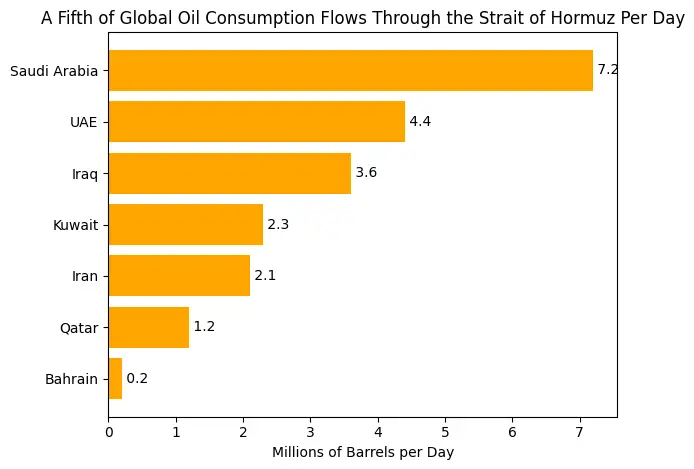
Source: Reuters, (March 2, 2026)
As Iranian attacks on the Gulf states escalated, they collectively decided on a dramatic reduction in the activity of all oil and gas facilities, including pumping, transmission, refining, and liquefaction.[40] QatarEnergy, one of the world’s largest exporters of liquefied natural gas, halted production after Iranian drones targeted a Qatari energy facility.[39]
By March 2, U.S. oil traded 7.6% higher at $72.12 per barrel, while international benchmark Brent was up 8.6% at $79.11 per barrel. Natural gas futures in Europe jumped more than 40%. Europe, which was ill-prepared for an energy shock, was hit hard immediately, with gas prices nearly twice as high as before the war.[33] On March 8, oil prices spiked near $120 per barrel before settling closer to $110.
Ilan Berman, Senior Vice President of the American Foreign Policy Council, argued the panic over energy prices and predictions of economic apocalypse are wildly overblown. Prices today are still below levels seen under President Biden. As Ariel Cohen of the Atlantic Council has noted, in 2008 the price of oil reached the equivalent of $223 per barrel in today’s dollars, roughly double the current price.[139]
Prices fell to under $100 per barrel on March 23 after Trump said he was postponing threatened strikes on Iranian power plants for five days after what he described as productive talks with Iran.[144]
Three commercial ships were hit by Iranian fire in the Persian Gulf on March 10. “Any vessel whose oil cargo or the vessel itself belongs to the United States, the Zionist regime, or their hostile allies will be considered legitimate targets,” the Iranian military said, in a statement carried by state TV.
“We won’t allow even one liter of oil to reach the US, Zionists and their partners,” Ebrahim Zolfaqari, the spokesperson for Tehran’s Khatam al-Anbiya military command headquarters. “Get ready for the oil barrel to be at $200 because the oil price depends on the regional security which you have destabilized,” he added.[104]
U.S. officials told CBS News on March 23 that Iran had laid at least a dozen underwater mines through the Strait. The following day, Iran declared that “non-hostile” ships would be allowed to pass through the Strait. It defined nonhostile vessels as those which “neither participate in nor support acts of aggression against Iran” or belong to the United States or Israel. Iran said, “the full restoration of security and sustainable stability in the strait is contingent upon the cessation of military aggression and threats.” Up to that point, 17 ships had been struck by Iran.[177]
Saudi Aramco CEO Amin Nasser warned that the global energy industry is headed for disaster if conflict with Iran continues and the Strait of Hormuz is shut down. “There would be catastrophic consequences for the world’s oil markets,” Nasser said. “The longer the disruption goes on,” he said, “the more drastic the consequences for the global economy.”
Saudi Arabia, meanwhile, said its oil exports fell by about 50% in March, dropping by roughly 3 million to 3.5 million barrels a day because of the blockade. To protect its oil tankers from Iranian attacks, Aramco stopped loading crude from Gulf terminals and began redirecting shipments through its East-West pipeline to the Red Sea port of Yanbu. It was pumping oil at its full capacity of 7 million barrels a day while tankers collecting oil at Yanbu were carrying 5 million barrels a day of oil products. Though it does not fully compensate for the 15 million barrels per day that would normally be shipped through the Strait of Hormuz, this supply has helped prevent oil prices from rising more precipitously. [115]
“U.S. forces eliminated multiple Iranian naval vessels, March 10, including 16 minelayers near the Strait of Hormuz,” the U.S. Central Command announced after Trump had said, “if for any reason mines were placed, and they are not removed forthwith, the military consequences to Iran will be at a level never seen before,” and that minelaying boats “will be dealt with quickly and violently.”[105]
The Times of Israel reported that a prolonged disruption of shipping through the Strait of Hormuz could drive oil prices significantly higher, particularly if energy infrastructure elsewhere in the Gulf were damaged. However, it noted that if the conflict remains brief and maritime disruptions are quickly reversed, the current spike in prices may prove temporary rather than sustained.[45]
The war is also driving up prices for key agricultural chemicals such as urea and ammonia, which are essential for fertilizer. Because the Middle East supplies about 45% of the world’s urea, disruptions—especially a potential closure of the Strait of Hormuz—could quickly tighten global supplies and raise costs. The pressure is compounded by Western sanctions on Russian fertilizers and Chinese export restrictions, further constraining the global market.[102]
“If Iran does anything that stops the flow of Oil within the Strait of Hormuz, they will be hit by the United States of America TWENTY TIMES HARDER than they have been hit thus far,” Trump warned on March 6.[121]
Aramco CEO Amin Nasser said tankers were being rerouted and the East-West pipeline would reach full capacity of 7 million barrels per day to the Red Sea port of Yanbu, warning: “If this takes a long time, that will have a serious impact on the global economy.”[121]
Though Iran claimed to close the Straight to U.S. and Israeli shipping, nothing was preventing any ships from transiting except fear of possible attacks, which caused war-risk insurance premiums to climb to record levels. The U.S. already significantly degraded Iran’s ability to threaten ships, which had been anticipated before the war. The U.S. has dealt with such a threat in the past, notably during the Iran–Iraq War, when Iran began attacking oil tankers in the Persian Gulf. In response, the United States launched Operation Earnest Will in July 1987, the largest U.S. naval convoy mission since World War II. As part of the operation, Kuwaiti tankers were reflagged as American vessels and escorted by the U.S. Navy through the Persian Gulf and the Strait of Hormuz to ensure the continued flow of oil shipments. After Iranian mines damaged several ships, the United States escalated its response with Operation Praying Mantis in April 1988, a major naval strike that destroyed Iranian oil platforms used for military purposes and severely damaged Iran’s naval forces.
Trump announced that American forces “totally obliterated every MILITARY target in Iran’s crown jewel, Kharg Island” on March 14. He said he had chosen not to destroy the island’s oil infrastructure “for reasons of decency,” but warned he would “immediately reconsider this decision” if Iran interfered with the Strait of Hormuz. “Iran has NO ability to defend anything that we want to attack—There is nothing they can do about it!”[126]
The president also expressed frustration that no allies accepted his call to join the United States in opening the Strait. “WE DON’T NEED THE HELP OF ANYONE!” he subsequently posted on social media.[132] Trump said on March 17 that NATO is making a "very foolish mistake" by not helping to escort tankers through the Strait of Hormuz. This was after France said it is ready to help escort ships through the Strait of Hormuz, but only once the situation has become “calmer.”[133]
Iran did not attack any vessels in the Strait between March 12 and March 17. On the latter date, U.S. forces employed multiple 5,000-pound deep penetrator munitions on hardened Iranian anti-ship missile sites along the coastline near the Strait.[122] This was viewed as a necessary prelude to making transit safe.
Meanwhile, administration sources told CBS News that Iran had deployed as many as a dozen mines in the strait. U.S. forces had destroyed 44 minelaying vessels and were continuing to target and destroy mine storage facilities and naval ammunition depots. Following the CBS report, Trump posted on Truth Social: “If Iran has put out any mines in the Hormuz Strait, and we have no reports of them doing so, we want them removed, IMMEDIATELY!”[145]
The foreign minister of Oman said his country was working to establish “safe passage arrangements for the Strait of Hormuz.” [146]
As negotiations reached an impasse, oil prices spiked, rising more than 11% following Trump’s April 1 address to the nation. At over $111 a barrel, prices were the highest in four years, exceeding $4 at the pump. This, despite the fact that America gets only about half a million of the 20 million barrels of crude it consumes each day from the strait.[192] Prices fluctuated with announcements by Trump. On April 17, the president declared the Strait open and prices fell to less than $84 a barrel.[231] A day later, Iran reiterated it remained closed.
France sought to lead a mission involving India and China, while excluding the United States, to escort ships in the Strait of Hormuz, but failed to reach an agreement. France’s effort was complicated by divisions among allies over how the mission should be carried out and the scope of military involvement.[203]
The Europeans made little progress toward agreeing on a solution to the problem. Meanwhile, Iran leveraged the uncertainty surrounding naval mines it deployed in the Strait to pressure commercial vessels into routing through its territorial waters, where they can be subjected to fees and controls. By creating a hazardous environment that deters normal transit, Tehran effectively compelled ships to seek “permission” and operate under Iranian oversight. In effect, this amounted to coercive interference with international shipping—functionally a protection racket—at odds with the principles of the United Nations Convention on the Law of the Sea and widely accepted customary international law.[213]
After CENTCOM announced on April 13 that it was blockading vessels from all nations that enter or depart Iranian ports and coastal areas, Iran’s Supreme Leader adviser Mohammad Mokhber warned that Tehran would “open new fronts” and “increase economic pressures” on U.S. allies in response to the blockade.[216]
According to the Institute for the Study of War, Iran’s parliament was moving to formalize its claim of control over the Strait of Hormuz by drafting legislation that would ban Israeli-linked vessels from transiting the waterway, require ships from “hostile countries” to obtain approval from Iran’s Supreme National Security Council, and prohibit states that have “caused damage” to Iran from passing through the strait until they pay reparations.[239]
Meanwhile, the Saudis urged Washington to lift the blockade of the Strait and return to negotiations, warning that the move could provoke Iran to retaliate by disrupting other critical shipping routes, including key Red Sea chokepoints vital to global energy flows. Arab officials told the Wall Street Journal that Iran was pressuring the Houthis to “close” the Bab al-Mandeb Strait. The Houthis, however, did not respond. [217]
The United States and Iran said the Strait was open on April 17, but the IRGC quickly said it was closed because the U.S. had not ended its blockade. The following day, Iran attacked a ship trying to pass. Some ships made it through, but traffic stopped after Iran attacked two cargo vessels on April 22. An average of around eight ships a day had been passing through the strait before these attacks, down from 130 a day before the war.[259]
The Washington Post reported that Pentagon officials told Congress that clearing Iranian naval mines from the Strait of Hormuz could take up to six months, and likely would not begin until the U.S. war with Iran ends—raising the prospect that economic disruptions could persist well beyond any ceasefire.
The estimate underscored concerns that oil and gasoline prices could remain elevated long after fighting ends, frustrating lawmakers from both parties ahead of midterm elections.[261]
U.S. forces boarded a vessel in the Indian Ocean that was transporting oil from Iran on April 23, and CENTCOM said its forces had “redirected 33 vessels since the start of the blockade against Iran.”
Trump had said he “ordered the United States Navy to shoot and kill any boat, small boats though they may be… that is putting mines in the waters of the Strait of Hormuz.”[262]
Iran warned that submarine internet cables in the Strait of Hormuz were a vulnerable pressure point, highlighting that the conflict could disrupt not just shipping but the global digital economy. These cables—carrying about 99% of global internet traffic—link Asia, the Gulf, and Europe, and are critical for cloud services, financial transactions, and communications, especially for tech-invested Gulf states like the UAE and Saudi Arabia. Repairing any disruption would be difficult and slow in a war zone, meaning even limited damage could have significant global economic and technological consequences.[269]
Meanwhile, the Middle East tourism sector was losing about $600 million a day due to flight cancellations, airspace closures, and traveler concerns following regional strikes, according to the Financial Times.[103] Major U.S. airlines’ suspensions of direct flights to Israel forced thousands of travelers to cancel plans to visit the country for Passover, when the country typically sees a surge in visitors.
Casualties
Shortly after the initial U.S. and Israeli strikes, Iran began to launch drones and missiles toward Israel. Most were intercepted or fell in empty areas. Still, every launch prompted alerts in Israel, forcing millions of people into shelters. Many injuries were attributed to people being hurt on the way to shelters and shock. A few missiles landed with devastating impact. On the first night, a Filipina caregiver was killed, and more than two dozen others were wounded when an Iranian rocket destroyed an apartment building in Tel Aviv.[75] The most serious incident in the first days of the war involved a missile that struck a synagogue, which collapsed on a bomb shelter in Beit Shemesh, killing 9 and wounding more than 40.[31]
Missile Barrages Fired by Iran at Israel
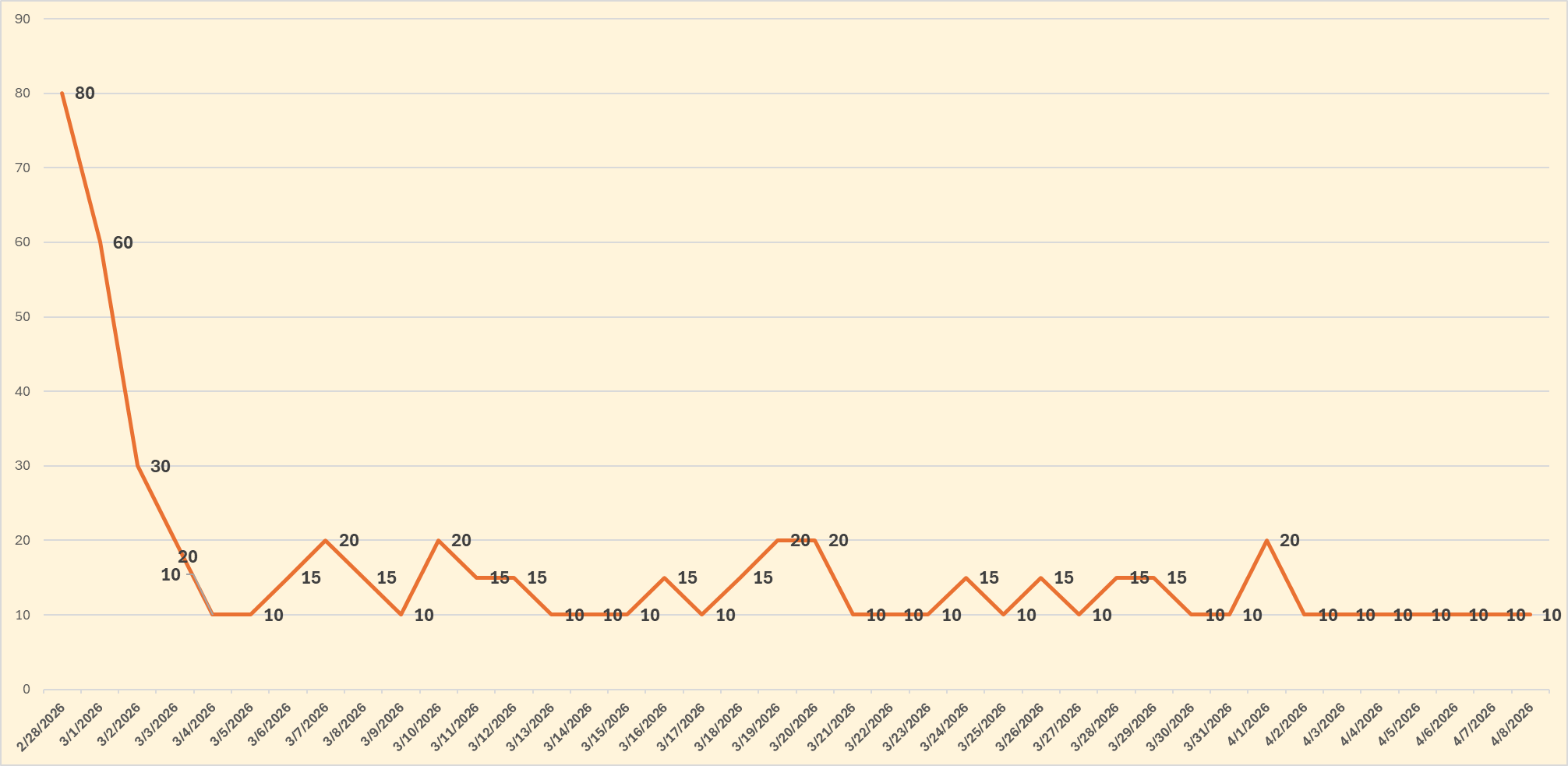
IDF data and estimates. The ceasefire began on April 8. Source: Times of Israel (April 10, 2026)
A missile strike on Tel Aviv injured at least 21 people.[22] Another hit a residential area in Beersheba and injured 19 people.[32] On March 3, submunitions from a cluster bomb warhead hit several locations in central Israel, wounding 12 people.[66]
An Iranian missile barrage on central Israel on March 9 killed one person and seriously wounded two others. Cluster munitions struck at least six locations, damaging electricity infrastructure in northern and central Israel and causing power outages in multiple areas.
On March 13, an Iranian missile struck the Bedouin town of Zarzir near Nazareth in northern Israel, injuring 58 residents and damaging 300 homes.
On March 18, a married couple in their 70s was killed when an Iranian missile with a cluster warhead struck Ramat Gan. They were found in a heavily damaged building only a few meters from their safe room. Damage was also reported at Tel Aviv’s Savidor Central railway station, and train service was temporarily suspended. Iran has repeatedly used internationally banned cluster munitions against Israel throughout the war.[123]
On April 5, four Israelis were killed when a missile slammed into a residence in Haifa.[194]
The Palestinian Red Crescent said at least four Palestinians were killed on March 18 in the West Bank town of Beit Awa, and at least six others were injured. It was not clear if the deaths were from a direct strike or debris from a missile interception.
When the ceasefire ended after 40 days of fighting, 20 Israeli civilians and foreign nationals, along with four Palestinians in the West Bank, had been killed, and more than 7,000 injured. Some 650 ballistic missiles were fired at Israel, with the IDF reporting an interception rate of 92%. At least 16 missiles carrying conventional warheads and 50 carrying cluster bomb warheads struck populated areas, causing extensive damage. All 24 fatalities from Iran’s missile attacks were civilians, and all but two were not inside bomb shelters. Cluster munitions killed 10, and conventional missiles killed 14.[235]
After the first three soldiers were killed on March 1, Trump acknowledged there could be more U.S. casualties.[24]
Six US soldiers were killed when a refueling plane crashed in Iraq due to an apparent accident. On March 27, 12 U.S. soldiers were injured when Iran launched a missile and drone attack on the Prince Sultan Air Base in Saudi Arabia. On April 6, 15 Americans were injured by an
Iranian drone strike on Ali Al Salem Air Base in Kuwait. Two U.S. soldiers were killed on July 17 when Iran attacked a U.S. base in Jordan. The controlled detonation of unexploded ordnance from a downed Iranian drone killed a U.S. service member in Iraqi Kurdistan.
As of July 20, 17 American troops had been killed and more than 400 wounded during Operation Epic Fury.[56]
Fatalities
| Israel | 20 |
| United States | 13 |
| UAE | 10 |
| Kuwait | 7 |
| Qatar | 7 |
| Oman | 7 |
| Syria | 5 |
| Palestinian Authority | 4 |
| Bahrain | 3 |
| Saudi Arabia | 2 |
| France | 1 |
| Kurdistan | 14 |
Source: INSS (as of March 30)
Israel estimated that 1,000-1,500 members of the Islamic Revolutionary Guard Corps (IRGC) and Iranian security forces were killed in the first three days of the war. As it has in the wars with Hamas and Hezbollah, Israel issued warnings for civilians to evacuate areas it planned to bomb. Nevertheless, as in any war, collateral damage produces casualties. The Iranian Red Crescent claimed over 1,900 people were killed as of March 30 without distinguishing between combatants and civilians. After the ceasefire, the IDF claimed around 5,000 Iranian soldiers killed and tens of thousands wounded, including members of internal security forces and the Basij.[235]
A serious incident occurred on the first day of the war when Iranian state media said some 170 people, including over 100 children, were killed when a girls’ elementary school in the town of Minab was hit. Iran did not allow foreign journalists to access the site to independently verify the toll, and neither the U.S. nor Israel has claimed responsibility. The U.S. military said it was “looking into” reports of civilian harm, and Secretary of State Rubio said American forces “would not deliberately target a school.” An Israeli military spokesperson said it was unaware of any Israeli strikes in the area. Some, including Israel’s UN Ambassador Danny Danon, suggested the strike may have been caused by an errant Iranian missile — though that theory is complicated by the fact that an adjacent IRGC naval base was also struck in the same wave of attacks. A New York Times analysis found the school is located next to the base, and that imagery dating to 2013 shows the school building was originally incorporated into the IRGC barracks compound — a detail that suggests a targeting error rather than a deliberate attack on a school.[58]
Regime Resilience
Despite a wave of Israeli decapitation strikes that eliminated much of Iran’s senior military and security leadership — including Khamenei himself — the regime’s institutional machinery held together in the first days of the war. That is by design, according to Shine. “The system does not depend on one person,” Shine told Euractiv. “It is structured so that key positions within the political and security apparatus can be replaced quickly.” Iranian leaders had long anticipated exactly this kind of wartime scenario.[28]
When IRGC commander Mohammad Pakpour was killed, his deputy Ahmad Vahidi — a veteran insider and former interior and defense minister who is wanted by Interpol over the 1994 bombing of a Jewish community center in Buenos Aires that killed 85 people — stepped in immediately. Even before the current escalation, Khamenei had entrusted Ali Larijani, secretary of the Supreme National Security Council, with overseeing military and political coordination, recognizing that President Pezeshkian was not up to the task. An interim leadership council has since been announced, comprising Pezeshkian, judiciary chief Gholam-Hossein Mohseni-Eje’i, and Guardian Council member Alireza Arafi.
Meanwhile, units of the Basij militia — typically deployed to crush domestic dissent — were quickly activated, signaling that the regime was bracing not only for external attack but for the possibility that its own people would try to seize the moment.
On March 8, Iran announced that Mojtaba Khamenei was named Iran’s new supreme leader, succeeding his father, Ayatollah Ali Khamenei. Israel immediately announced that it would consider him a target. Trump called the younger Khamenei an “unacceptable” choice and warned that any new supreme leader would struggle to remain in power without U.S. approval.
The Wall Street Journal noted, “The elevation of Mojtaba Khamenei, a conservative long close to Iran’s Islamic Revolutionary Guard Corps, shows that Trump’s efforts so far to cow the regime into surrender have failed. It also appears to have put hard-liners in firm control of the country, with moderate and reformist factions long marginalized.”[88]
The same day, Ahmad Vahidi was appointed head of the IRGC, a day after the unit’s previous leader was killed in the first wave of U.S.-Israeli strikes. Vahidi helmed the IRGC’s Quds Force paramilitary arm responsible for attacks abroad at the time of the 1994 AMIA bombing in Argentina.[87]
After nearly a month of fighting, analysts were sharply divided over whether the Islamic Republic was on the verge of collapse or settling into a prolonged war of attrition it believed it could outlast. Three assessments offered competing frameworks for understanding what was happening inside Iran.
Mehdi Parpanchi argued that what appeared to be Iranian resilience was actually the regime executing its collapse protocol. Iran’s continued missile fire, internal repression, and outward displays of normalcy did not signal strength but rather a system operating as designed after a decapitation strike. The regime’s decentralized “mosaic defense” structure allowed regional units to keep functioning even as central command fractured, creating an illusion of stability. While repression and basic services persisted, both were degraded, and the new supreme leader—unseen since his appointment—lacked visible authority. Economic strain, weakened proxies, and elite uncertainty all pointed to systemic breakdown. Parpanchi’s core insight was that Iran’s strategy was not to win but to endure long enough for the United States to lose the will to continue, masking terminal decline with controlled displays of continuity.[140]
Meir Javedanfar contended that targeted assassinations could significantly weaken the regime but would not, on their own, topple it. The killing of senior officials forced the elevation of less experienced and often more hardline successors—figures like Mojtaba Khamenei—who lacked the institutional knowledge and political dexterity of their predecessors. This degraded governance and deepened public dissatisfaction. The pervasive fear of being targeted also bred paranoia among surviving leaders, impairing decision-making and operational effectiveness. However, Javedanfar cautioned that while decapitation strikes could hollow out the regime’s competence, Iran’s institutional structures—the IRGC, the judiciary, the Guardian Council—were designed to survive the loss of individuals. Assassination weakened; it did not, by itself, deliver the killing blow.[141]
Raz Zimmt offered the most cautious assessment, arguing that Iran was far from collapse despite the enormous damage it had sustained. He found no clear evidence that the regime was near a breaking point. Instead, it was adapting—maintaining internal control, sustaining missile strikes, and seeking to leverage the war to reshape regional dynamics in its favor. Leadership losses and internal tensions may have weakened cohesion, but security forces remained functional, and repression continued. Public sentiment was fluid: while some Iranians had rallied against external attacks, unrest could reemerge. Most critically, Zimmt warned that Iran’s nuclear capabilities remained a serious concern, particularly if the leadership opted to accelerate weaponization as a survival strategy. Iran was also using energy disruption—its partial blockade of the Strait of Hormuz—as a strategic tool to raise global costs and prolong the conflict, betting that its adversaries would lose the will to continue before the regime collapsed.[142]
Taken together, the three analyses converged on one point: the regime’s fate hinged less on what had already been destroyed than on whether the United States and Israel sustained the pressure long enough to make the damage irreversible. Parpanchi believed the collapse was already underway but disguised. Javedanfar believed the regime was weakened but structurally intact. Zimmt believed it was adapting and could emerge from the war battered but surviving. All three implicitly agreed that the most dangerous outcome was a premature end to hostilities that left the Islamic Republic wounded, vengeful, and in possession of the knowledge and material to reconstitute its most dangerous programs.
Mossad Director David Barnea assessed before the war that regime change in Iran would likely take about a year and would not occur quickly, offering cautious, conditional predictions rather than guarantees. The failure to quickly overthrow the regime provoked criticism and leaks in the American press, blaming him for overly optimistic expectations that appeared politically motivated and misrepresented his nuanced position. Israeli intelligence broadly agreed that military action could at best create conditions for regime change—not achieve it rapidly—while ultimate decisions and expectations were shaped by political leaders, not the Mossad alone.[148]
Domestic Politics
“We didn’t make the case in advance as well as we could have because the opportunity came on us so fast,” an official told the outlet.[84]
Democrats largely condemned President Trump’s decision to strike Iran without congressional authorization, but the military action has exposed significant internal divisions within the party over national security, regime change, and the use of force in the Middle East.[54]
Many Democrats reacted with sharp opposition, accusing Trump of acting recklessly and illegally. Lawmakers such as Rep. Eric Swalwell and Sen. Chris Murphy denounced the strikes as unjustified and dangerous, warning of American casualties and a potential quagmire. Progressive figures, including Reps. Alexandria Ocasio-Cortez and Ro Khanna focused their criticism squarely on Trump, accusing him of choosing aggression over diplomacy and misleading the public. Some Democrats were viewed as opposing the war because they objected to everything Trump did, regardless of whether it was good for America.
Others adopted a more nuanced position. While criticizing the president for bypassing Congress and lacking a strategic plan, they reaffirmed the longstanding bipartisan view that Iran poses a serious threat and must not obtain a nuclear weapon. Senators like Mark Kelly and several Democratic governors condemned Trump’s process but not necessarily the objective of curbing Iran’s nuclear ambitions.
A small minority of Democrats, including Rep. Greg Landsman and some staunch supporters of Israel, openly backed the operation as serving U.S. national security interests, even at political risk within the party.
The debate reflected broader identity struggles within the Democratic Party following its 2024 electoral defeat. Longstanding fault lines—dating back to the Iraq War—have resurfaced, particularly among veterans of Iraq and Afghanistan who oppose another Middle East conflict. As casualties mounted and public opinion opposed the war, Democrats remained divided between fierce resistance to Trump’s actions and a cautious acknowledgment of the Iranian threat.
Senate Republicans blocked a War Powers resolution on March 4 that would have limited Trump’s authority to continue military operations against Iran without congressional approval, in a 53-to-47 vote that fell almost entirely along party lines. The vote represented Congress’s first clear test of resolve since Operation Epic Fury began four days earlier.
Senators Tim Kaine, a Virginia Democrat, and Rand Paul, a Kentucky Republican, invoked a provision of the 1973 War Powers Act to expedite consideration of the measure. Paul was the only Republican to support the resolution, with no other GOP senators joining him. On the Democratic side, Senator John Fetterman of Pennsylvania was the sole defector, voting against the resolution.[81]
The following day, the House of Representatives rejected a similar Democratic-led resolution by a 212-to–219 vote. Four Democrats joined Republicans, giving the GOP enough votes to defeat the measure.[82]
On March 24, the Senate rejected another Democratic effort to pass legislation to prevent the president from using military force in Iran without congressional approval. The 53-47 vote was identical to the earlier one, with Paul and Fetterman again the only senators to cross party lines.[150]
American Public Opinion
Early polling on Operation Epic Fury shows the American public is broadly opposed to the strikes, with no sign of the “rally around the flag" effect that accompanied previous U.S. military engagements.
A Reuters/Ipsos poll conducted February 28–March 1 found that just 27% of Americans approved of the strikes, while 43% disapproved and roughly 30% were unsure.[46] A Washington Post flash poll on March 1 found 52% opposed, with strong opposition outweighing strong support 39% to 22%.[47] A CNN poll conducted by SSRS found nearly 6 in 10 Americans disapproving, with most saying a long-term conflict was likely.[48] And a YouGov snap poll fielded on the day of the strikes found just 34% approval against 44% disapproval.[49] By a 56%–44% margin, Americans opposed U.S. military action in Iran in the NPR/PBS News/Marist poll, conducted March 2–4, 2026.[101]
A Fox News poll conducted February 28–March 2, 2026, found that 61% of Americans believe Iran poses a real national security threat to the United States. However, opinion on the U.S. military strikes against Iran was evenly divided, with 50% approving and 50% disapproving. A majority (51%) also believe President Trump’s handling of Iran has made the United States less safe, compared with 29% who think it has made the country safer.[59]
The partisan divide is stark but not absolute. About 8 in 10 Republicans supported the strikes in the Washington Post poll, while nearly 9 in 10 Democrats and about 6 in 10 independents opposed them.[50] Similarly, Fox News found that nearly 80% of Democrats and a majority of independents disapprove of the strikes and say Trump’s actions have reduced U.S. security. While 8 in 10 Republicans approved of the use of force in that poll, the Reuters/Ipsos poll found 55% approval, with 32% unsure and 13% opposed. Perhaps most significantly, about 42% of Republicans said they would be less likely to support the operation if it led to U.S. troops being killed or injured.[51]
The PBS poll found that 84% of Republicans supported the military action in Iran, while 86% of Democrats and 61% of independents opposed it. A majority of Americans (55%) view Iran as either a minor threat (40%) or no threat at all (15%) to U.S. national security. Only 44% consider Iran a major threat. The partisan gap is pronounced: 70% of Republicans see Iran as a major threat, while three-quarters of Democrats and six in ten independents view it as minor or nonexistent.[101]
The level of support is remarkably low by historical standards. A Gallup poll in November 2001 found 92% of Americans approved of military action in Afghanistan, and a Pew poll in late March 2003 found 71% supported the use of force in Iraq.[49] Operation Epic Fury’s 27–34% approval range is a fraction of those figures.
Several polls found deeper skepticism beneath the topline numbers. CNN found that 60% said Trump does not have a clear plan for handling the situation, 62% said he should seek congressional approval for further action, and only 27% felt the U.S. had made enough of an effort at diplomacy before resorting to force. A majority — 54% — said Iran would become more of a threat as a result of the strikes, with just 28% saying the action would make Iran less dangerous.[48] Additionally, 56% opposed the U.S. trying to overthrow the Iranian government, and 60% opposed sending ground troops into Iran.[50]
The PBS poll found that just 36% of Americans approve of how Trump is handling Iran, while 54% disapprove. Younger Americans are the most opposed. Approval of Trump’s handling of Iran stands at just 25% among those aged 18–29, 35% among those 30–44, and 41% among those 45 and older.[101]
A Morning Consult survey found that opposition to deploying ground forces cut across demographic lines: 46% of registered voters opposed such a deployment, compared with 39% in support, and even 30% of Republicans opposed a ground invasion.[52]
A University of Maryland Critical Issues Poll conducted February 5–9 — before the strikes — found only 21% of Americans favored initiating an attack on Iran, with 49% opposed and 30% unsure.[53] That pre-strike baseline suggests the actual operation produced only a modest bump in support, largely among Republicans.
The Economist/YouGov tracker showed support for military action against Iran barely moving from January through February — hovering between 27% and 33% — before ticking up to 34% after the strikes, suggesting little evidence that the operation itself shifted public opinion.[49]
The Ipsos poll also found that views could evolve: nearly half said they would be more likely to support continued action if it led to a friendly government in Iran or ended its nuclear program, but 54% said their support would decline if the strikes led to U.S. casualties[46] — a significant finding given that three American soldiers were killed within the first 48 hours.
A March 22 CBS News poll found that a majority (57%) of Americans believed the conflict was not going well, and more Americans disapproved of U.S. military action (60%) than supported it (40%). About one-third believed the administration had not clearly explained its goals and thought the war could last months or longer.
Most Americans said it was unacceptable to end the conflict with the current Iranian regime in power, but 92% said the most important goal was to end it as quickly as possible, reflecting a tension between opposition to the conflict and hostility toward Iran’s government.
Economic concerns dominated perceptions. Large majorities expected the war to raise gas prices and weaken the U.S. economy, reinforcing overall negative views of the conflict.
As in other polls, the partisan gap was huge, with Republicans approving the war by an 84% to 8% margin, compared with Democrats.[149]
A POLITICO/Public First poll taken March 13–18 found that 70% of Trump’s 2024 voters backed the strikes, while 56% of Kamala Harris voters opposed them, reflecting a sharp partisan divide. Overall, 44% of Americans supported the operation.
Within Trump’s coalition, support was broad but not uniform: 81% of self-identified MAGA voters favored the strikes, compared to 61% of Trump voters who did not identify as MAGA. Much of this backing was driven by security concerns—46% of supporters said the strikes were necessary to stop Iran’s nuclear program, a view shared by 54–56% of Trump voters. Trust in Trump himself was also decisive, with 53% of his supporters citing confidence in his judgment as a key reason for their support.
Perceptions of the conflict’s stakes and duration diverged sharply by political alignment. Roughly two-thirds of MAGA voters viewed Iran as an active national security threat, and 60% of Trump voters expected the war to be short, in line with Trump’s assurances. In contrast, 60% of Harris voters believed the conflict would become a prolonged “forever war.”
Trump’s base also showed flexibility regarding his campaign pledge to avoid new wars. A 35% plurality of his 2024 voters said the conflict broke that promise but was justified by changing circumstances, while 30% said it did not break the pledge at all, and 21% believed it did so unnecessarily. Meanwhile, 46% said the war was consistent with MAGA principles, underscoring how events were reshaping the definition of “America First.”
Still, signs of strain were emerging, particularly around casualties and strategy. A majority of MAGA voters (58%) said the U.S. should continue until its goals were achieved, even if it meant additional American lives lost. Non-MAGA Trump voters were far more divided: 44% prioritized achieving objectives, while 41% said avoiding further casualties should take precedence. Concerns about leadership also surfaced, with 50% of non-MAGA Trump voters believing the president lacked a clear plan, though some still expressed confidence in his ability to resolve the conflict.[182]
Pew released a survey taken March 16-22, which found that 59% of Americans said the decision to use military force against Iran was wrong, versus 38% who said it was right. Nearly two-thirds disapproved of Trump’s handling of the conflict, and by a nearly two-to-one margin, more Americans said the military action would make the U.S. less safe in the long run (40%) than safer (22%).
The partisan gulf was stark. Nine in ten Democrats (88%) called the decision to strike Iran wrong, and 90% disapproved of Trump’s handling of it. Republicans took the opposite view — 71% supported the initial decision and 69% approved of Trump’s management of the conflict, though even within the GOP there were meaningful cracks. Republican-leaning independents were essentially split: 52% approved of Trump’s handling; 45% did not. Younger Republicans were also notably cooler, with only 49% of those aged 18–29 approving, compared to 84% of Republicans 65 and older.
On duration, a majority (54%) expected the conflict to last at least six more months, with 29% expecting it to stretch beyond a year. Democrats were considerably more pessimistic about a quick resolution — 68% expected it to last six months or longer — while most Republicans (58%) anticipated it would end within six months.
The one area of relative bipartisan agreement was uncertainty: on global safety, Americans were nearly evenly split, with 33% saying the conflict would make the world less safe, 27% saying it would make the world safer, and nearly 40% unsure or expecting no change.[166]
An NBC News poll conducted from March 30 to April 13 found that 67% of Americans disapproved of Trump’s handling of the war with Iran, and 61% opposed the U.S. taking further military action.[243]
In a survey from Ipsos and Reuters conducted April 10-12, after the ceasefire and after President Trump threatened that “a whole civilization will die tonight,” just 24% of Americans believed the war was worth the costs, while 22% were unsure, leaving a clear majority either opposed or unconvinced. Approval of the military strikes themselves was similarly weak, holding steady at only 35%, with little change across party lines over the previous month.
Even within the president’s political base, cracks were evident. While a slim majority of Republicans—55%—said the war has been worth it, a significant share disagreed or remained uncertain: 20% said it was not worth the cost and 24% were unsure. The divisions run deeper beneath the surface: Republicans who do not identify as “MAGA” are markedly less supportive, and younger Republicans are far more skeptical than those over 45. The numbers suggest not just declining enthusiasm, but a fracturing consensus, with skepticism spreading beyond traditional partisan lines and into the core of the president’s own coalition.[249]
The May 2026 Harvard CAPS/Harris Poll paints a nuanced picture of American opinion on the Iran war. Most voters believe the United States is achieving its military objectives: 72% say the U.S. is winning the war, and 66% believe Washington has the upper hand in negotiations with Iran. There is also strong support for maintaining a tough stance in any peace talks, with 65% saying that dismantling Iran’s nuclear program must be a non-negotiable condition for peace and 75% insisting that freedom of navigation through the Strait of Hormuz should be guaranteed.
At the same time, Americans remain deeply skeptical of Iran’s intentions. Nearly seven in ten voters (68%) believe Iran is using negotiations primarily to buy time rather than negotiate sincerely, while 62% think Iran has violated past nuclear agreements and 69% believe it is rebuilding its nuclear capabilities. This skepticism helps explain why 57% view U.S. military strikes as justified and 59% say additional strikes would be warranted if Iran refuses to abandon its nuclear program.
Although voters generally support the war’s strategic goals, they are less satisfied with how the conflict is affecting daily life. The economic impact is widely felt: 88% report noticing higher gasoline prices and 85% higher grocery prices. More than half (58%) expect those price increases to persist, and 53% say the higher gas prices are not worth the cost, even if they advance U.S. national security objectives.
President Trump’s handling of the conflict reflects this tension. While 74% approve of his decision to pursue a ceasefire with Iran, a narrow majority (51%) disapprove of his overall management of the war. Politically, the issue appears to be slightly benefiting Democrats: 39% say Trump’s actions on Iran make them more likely to vote Democratic in the midterm elections, compared with 34% who say they are more likely to vote Republican.
Overall, the poll suggests that Americans largely support the war’s objectives and remain wary of Iran, but growing concern about economic costs and dissatisfaction with the administration’s management of the conflict are creating political headwinds despite perceptions of military success.[315]
Similarly, the Reuters/Ipsos May 2026 poll found that the Iran war had become a significant political liability for President Trump, with Americans expressing broad dissatisfaction with both his handling of the conflict and U.S. foreign policy more generally. While the war was not the country’s top concern—only 9% named war and foreign conflicts as the most important problem facing the United States, compared with 21% who cited the economy—it remained a major source of public unease.
When asked specifically about Trump’s handling of “the situation with Iran,” only 28% approved while 62% disapproved. The issue was sharply polarized: 62% of Republicans approved, but only 5% of Democrats and 19% of independents did. Among Democrats, an overwhelming 92% disapproved of Trump’s handling of Iran, while 70% of independents also disapproved.
The negative views on Iran were part of a broader skepticism toward the administration’s foreign policy. Just 30% approved of Trump’s handling of U.S. foreign policy overall, while 59% disapproved. Similarly, only 25% of Americans believed U.S. foreign policy was heading in the right direction, compared with 55% who said it was on the wrong track.
Economic concerns appear closely connected to these attitudes. Only 19% approved of Trump’s handling of inflation and rising prices, while 74% disapproved. Likewise, just 14% believed their own cost of living was heading in the right direction, compared with 74% who said it was on the wrong track.
The poll also suggested that the political advantage on national security and foreign conflicts was narrow rather than decisive. When asked which party had a better approach to “war, foreign conflicts, or terrorism,” 33% chose Republicans and 31% chose Democrats, with 26% unsure. This indicates that despite the traditional Republican advantage on security issues, the Iran conflict had not generated strong public confidence in either party’s approach.[316]
A Quinnipiac University poll (June 18-22) found that most voters remain skeptical that President Trump’s agreement with Iran will succeed, with 59% saying they are not confident it will work, compared with 37% who express confidence. At the same time, 61% believe Iran is likely to develop nuclear weapons. Nearly half of voters (45%) say the U.S. military action against Iran has left the United States in a weaker position internationally, while one-third believe it has strengthened the country’s standing. Views of Iran’s position are more divided: 39% say Iran is weaker because of the U.S. action, 31% say it is stronger, and 26% see no change. Compared with an April poll, fewer voters now believe Iran has been weakened, while more think it has emerged stronger.[364]
A CBS News/YouGov poll (July 22-24, 2026) found widespread dissatisfaction with the war with Iran and President Trump’s handling of it. Sixty-one percent of Americans disapproved of U.S. military action against Iran, while 39% approved, and 65% disapproved of Trump’s handling of Iran. Nearly two-thirds (63%) believed the war was going badly for the United States, while 40% still thought the United States had the advantage, 22% thought Iran did, and 38% thought neither side did.
The public strongly favored ending the conflict. Sixty-seven percent wanted the United States to end the war immediately rather than continue fighting until Iran made additional concessions. Opposition was especially pronounced among Americans under 30, 83% of whom favored ending the conflict.
Despite their opposition to the war, Americans broadly supported its principal objectives. Eighty-six percent considered reopening the Strait of Hormuz and restoring oil access important; 79% prioritized ensuring that Iranians were safe and free; 76% supported permanently ending Iran’s nuclear programs; and 72% considered preventing Iran from threatening other countries important. Regime change attracted substantially less support, with only 47% considering the installation of pro-American Iranian leaders important.
The poll also reflected doubts about the administration’s conduct and portrayal of the war. Seventy-six percent believed the conflict had proved more difficult than the Trump administration expected, and 60% thought Trump was depicting the war as going better than it actually was. Meanwhile, 69% said they were not receiving a clear day-to-day picture of developments in Iran and the Strait of Hormuz.
Public sentiment was overwhelmingly negative: 58% described themselves as uncertain about the conflict, 57% as frustrated, and 36% as pessimistic, while only 19% were optimistic, 16% confident, and 7% satisfied. Few anticipated a quick resolution. Just 9% expected the war to end within days or weeks, while 37% expected it to continue for months, 21% for years, and 33% were unsure.
Public patience with the war in Iran had run out by mid-summer, according to a Quinnipiac poll from July 23-27, 2026. Support slid to 34% while opposition climbed to 60% — the weakest position the war has held since Quinnipiac began tracking it in early March. The coalition behind it narrowed to Republicans, who backed the action 74 to 19; Democrats opposed it almost unanimously, 89 to 5, and independents, the group that usually decides where public opinion settles, moved decisively against it, 69 to 26.
Voters rejected escalation by an even wider margin. Nearly three-quarters — 74% — opposed sending American ground troops into Iran, with just 19% in favor.
In April, only about a third of voters expected the conflict to drag on for a year or more. In July, 55% do, including 35% who expect it to run longer than a year. Meanwhile, a majority (54%) say the United States is not winning, compared with 36% who think it is.
Weighing costs against benefits, 66% say the war has not been worth fighting, and only 31% say it has. The partisan split persists here too: Democrats say it wasn’t worth it, 93 to 5; independents, 73 to 24; and Republicans still say it was, 67 to 27.
Voters are also skeptical that the diplomatic path out is in capable hands. Only 39% expressed some or a lot of confidence in Jared Kushner and Steve Witkoff as negotiators, while 57% had little or no confidence — with the largest single group, 38%, having none whatsoever.
As Quinnipiac analyst Tim Malloy put it, “The pushback is evident. Six in 10 voters want no part of military action against Iran.”[399]
American Jewish Opinion
A mid-March poll conducted by the Mellman Group found that a majority of U.S. Jews opposed the U.S. war against Iran, with 55% expressing opposition and 32% supporting the military action, while about a quarter said they felt conflicted. As in polls of the general public, a clear partisan divide was evident, with Republicans more likely than Democrats to support the war.
The findings also showed that most respondents believed President Trump should have sought congressional approval before launching the operation, including nearly a third of those who support it. Around four in ten said they oppose the war because it lacks clear provocation and defined objectives. In addition, more than half expressed concern that coordinating the war effort with Israel could create long-term complications, particularly regarding perceptions of Israel’s influence on U.S. foreign policy.[163]
Palestinian Opinion
Immediately after the war began, several Palestinian factions condemned U.S.–Israeli strikes on Iran as a broader attack on the region, accusing Washington and Israel of seeking dominance. Hamas called the operation “a direct targeting of the entire region,” expressed solidarity with Iran, and warned it was part of a plan to redraw the Middle East for “Greater Israel.” Palestinian Islamic Jihad labeled the strikes “a dangerous escalation” aimed at “redrawing the maps of the region in favor of the Zionist entity” and “liquidating the Palestinian cause.” The Popular Front for the Liberation of Palestine described the operation as “colonial savagery” designed to impose U.S.–Israeli control over the region’s resources. They said Iran had the “natural and internationally guaranteed right…to respond.” Other groups, such as the Palestinian Resistance Committees and the Palestinian National Initiative Movement, also condemned the strikes, accusing the United States and Israel of threatening regional stability and seeking to restore “colonial control” over the Middle East.[60]
Israeli Public Opinion
Two major Israeli polls show overwhelming support for the war with Iran, though a stark divide exists between Jewish and Arab Israeli opinion.
Twelve days into the joint U.S.-Israeli operation against Iran, the Israel Democracy Institute found that 81% of Israelis continued to support it. Among Jewish Israelis, support remained virtually unchanged at 92.5%, down from 93% in the first week. However, the share who “strongly support” the operation declined from 74% to 68%.
Among Arab Israelis, opposition grew. A 66% majority opposed the operation, up from 60% in the previous survey. The increase came at the expense of those who had previously answered: “don’t know.”
Among Jewish Israelis, the sense of being protected from Iranian attacks increased since the first week of the operation, rising from 74% to 79%. Among Arab Israelis, the sense of protection remains low (15%) and unchanged.
Around 70% of Jewish Israelis believed Iran’s nuclear program and ballistic missile threat could be eliminated. A smaller but still substantial 61% believed the ayatollahs’ regime can be overthrown. Arab Israelis are far more pessimistic: only roughly a quarter to a third think any of these goals are achievable.
A strong majority of Jewish Israelis (82%) and just over half of Arab Israelis (52%) believed that Israeli and American interests are strongly aligned in the context of the joint operation.
Just over two-thirds of Jewish Israelis (68%) and a slightly smaller majority of Arab Israelis (59%) estimated the operation will end either within two weeks or within two weeks to a month.[71]
In a survey taken before Operation Roaring Lion, the Institute for National Security Studies (INSS) found that the most urgent issue, according to 36% of the public, was the nuclear project; 29%, the ballistic missile array; 18%, the Ayatollah regime; and 8%, the organizations supported by the regime. More than half of Israelis supported an Israeli attack if the U.S. reached an agreement with Iran.[72]
A March 3 survey by INSS found that 81% of Israelis supported the war, 92% among Jewish Israelis, and 38% among Israeli Arabs. Support is nearly unanimous among coalition voters (96%) and strong among opposition voters as well (77%). A large majority (77%) say the campaign’s purpose is clear to them, though a sharp gap exists between Jewish Israelis (86.5%) and Arab Israelis (39%). Nearly two-thirds (63%) believe the campaign should continue until Iran’s regime is overthrown, with 86% of coalition voters holding that view compared to 52% of opposition voters. Among Jewish Israelis, 74% support fighting until the regime falls; among Arab Israelis, only 17.5% agree, with 61% favoring an immediate ceasefire.
Expectations for military outcomes are optimistic. Nearly two-thirds (62.5%) expect significant damage to Iran’s nuclear program, 73% expect significant damage to its ballistic missile system, and 69% believe the regime itself will be significantly harmed, with 22% predicting its complete collapse.
Fear levels are notably lower than during the June 2025 war: 56.5% report being afraid of the campaign’s development, compared to 79% at the start of last year’s conflict. Most (82%) expect the operation to last a month or less.
On the war’s sustainability, 37% of INSS respondents said Israelis could endure the current situation for up to a month, while 29% said over a month — a notable decline from the start of last year’s war with Iran, when half said they could continue for over a month.
As in the IDI survey, the Jewish-Arab divide runs through nearly every finding. Jewish Israelis feel markedly safer (74% feel protected from Iranian attacks versus 15% of Arab Israelis), more optimistic about military outcomes, and far more supportive of regime change as a war aim. Arab Israelis are substantially more fearful (80% concerned about the campaign’s development versus 51% of Jewish Israelis), and only 6% report a high sense of personal security compared to 31% of Jewish Israelis.
Views of Trump are mixed and politically polarized. The largest bloc (45%) believes Trump supports Israel only when it serves his interests, while 35% see him as genuinely committed to Israel’s security, and 16% view him as unpredictable. Coalition voters are far more trusting (51% see him as committed) than opposition voters (21%).
Notably, concern about internal social tensions within Israel (82%) remains higher than concern about external security threats (71%) — a finding that has barely shifted since the operation began.[73]
Two post-ceasefire surveys in Israel — one by the INSS (April 9–10) and one by IDI’s Viterbi Center (April 9–12) — found a Jewish public deeply dissatisfied with the Iran campaign’s outcome, skeptical about the future, and divided from Arab Israelis on nearly every issue.[264]
The INSS survey found Israelis opposed the ceasefire by more than two to one — 61% against, 29% in favor. Reinforcing this sentiment, the IDI survey showed only 26% of Jewish Israelis felt any relief at the announcement, while 38% felt unhappy and 34% felt neutral. In contrast, among Arab Israelis, 70% felt relieved, and just 12% were unhappy.
The INSS survey documented a dramatic decline in public confidence in the campaign’s military results across all metrics. The belief that the Iranian regime had been significantly weakened fell from 69% at the outset to just 31% by the time the ceasefire was announced. Confidence that Iran’s nuclear program had been seriously damaged dropped from 62.5% to 30%. The belief that Iran’s ballistic missile capability had been substantially degraded fell from 73% to 42%. In every case, initial optimism was roughly halved or worse within weeks of the campaign’s end.
The two surveys produced somewhat different results on Israel’s strategic situation, likely reflecting differences in question wording and timing. The INSS survey found the Israeli public evenly and grimly split: 37% said Israel’s overall security situation had improved since the war began, and an identical 37% said it was unchanged. The IDI survey found a somewhat more positive reading among Jewish Israelis — 49% said the situation was slightly or much better, 23% said it was unchanged, and 23% said it was slightly or much worse — but the IDI results broke down sharply along political lines: on the Left, only 18% said better while 51% said worse; in the Center, 34% said better and 29% said worse; on the Right, 62% said better and only 15% said worse. Among Arab Israelis in the IDI survey, 15% said the situation had improved, 26% said it was unchanged, and 49% said it had worsened.
The INSS survey found that 73% of Israelis believed Israel would need to resume fighting Iran within the next year, and 76% believed the war’s objectives could not be achieved through the anticipated negotiations. The IDI survey confirmed the skepticism: 72% of Jewish Israelis said it was unlikely the U.S. and Iran would reach an agreement that adequately took Israel’s security into account, while only 21% believed such an agreement was likely. Arab Israelis were considerably less pessimistic on this question — 52% said an acceptable agreement was unlikely, and 38% said it was likely.
The IDI survey found a striking divergence in how Israelis graded the two institutions most responsible for the war. Over 90% of Jewish Israelis gave the IDF a positive performance rating. The government fared dramatically worse, with only 38% of Jewish Israelis awarding it a positive rating — a gap that widened further along political lines: only 6% on the Left and 17% in the Center gave the government high marks, compared to 54% on the Right. Among Arab Israelis, 35% gave the IDF a high rating, and just 10% gave the government a high rating.
The INSS survey found one significant long-term implication: only 35% of Israelis believed their country could act independently when disagreements arose with Washington, while nearly two-thirds felt Israel was effectively constrained by American preferences. This perception accompanied—and may have deepened—the broader sense that the ceasefire had been accepted on terms Israel did not choose.
According to the May 2026 INSS National Security Survey, Israelis had become markedly more skeptical about the results of the war with Iran after the fighting ended and a ceasefire took hold. While public support for the campaign had been strong during the conflict, confidence in its success declined significantly in the weeks that followed.
The survey found that Israelis were almost evenly divided over the campaign’s outcome. Only 41% believed that Israel had already won or was likely to win the confrontation with Iran, while roughly half believed that Israel had lost or would ultimately fail to achieve its objectives. Political affiliation strongly shaped these views: 70% of coalition voters believed Israel had won or would win, whereas 74% of opposition voters believed Israel had lost or would not win.
Public satisfaction with the campaign’s achievements also fell sharply. During the war, 60% of Israelis reported being satisfied with the military’s results. By May, that figure had dropped to 37%. Satisfaction with diplomatic achievements was even lower: only 22% expressed approval, while nearly half were dissatisfied.
The decline reflected growing doubts about the extent of the damage inflicted on Iran. In an April survey conducted shortly after the ceasefire, only about 30% of Israelis believed Iran’s nuclear program had been significantly damaged, compared with more than 60% who had expected major damage at the beginning of the campaign. Similarly, only 42% believed Iran’s ballistic missile capabilities had been significantly degraded, a substantial drop from the optimism recorded during the early stages of the war.
Many Israelis also doubted that the conflict had been truly resolved. In the April survey, 73% believed Israel would need to renew military action against Iran within a year, and 76% believed the war’s objectives would not be achieved through subsequent negotiations. These findings suggested that most Israelis viewed the ceasefire as a pause rather than a permanent settlement.[326]
A survey conducted by the Israel Democracy Institute between May 31 and June 5 found a significant decline in Israelis’ belief that U.S. President Donald Trump prioritizes Israel’s security.
Overall, only 44% of Israelis said Israel’s security was a central concern for Trump, down from 60% in March during the joint U.S.-Israeli campaign against Iran. The decline was especially pronounced among Jewish Israelis, where the figure fell from 64% to 41%.
Political affiliation strongly influenced perceptions. Among Jewish respondents, only 25.5% of those on the left, 32% of centrists, and 48% of those on the right believed Israel’s security was a key concern for Trump. All three groups showed substantial declines compared with March, with the sharpest drop occurring among centrists and right-wing voters.
In contrast, Arab Israelis became more likely to view Trump as concerned with Israel’s security, with support rising from 43% in March to 59% in the latest survey.[327]
Tortuous Negotiations to End the War
U.S. Central Command announced on May 7 that U.S. forces had “eliminated inbound threats” and struck Iranian military facilities responsible for attacks on U.S. forces after Iran targeted U.S. naval assets in and around the Strait of Hormuz. CENTCOM stated the United States “does not seek escalation.” President Trump subsequently canceled a planned May 19 strike against Iran at the request of Qatari, Emirati, and Saudi leaders, who asked him to suspend the strike “for two or three days” amid ongoing negotiations. Trump nonetheless instructed the U.S. military to remain prepared to launch a “full, large-scale assault” on short notice if talks failed, and stated on May 23 that he would decide by May 24 whether to resume strikes.
U.S.-Iran negotiations remained fundamentally deadlocked. Iran’s counterproposals consistently frontloaded its core demands — an end to the war “on all fronts,” withdrawal of U.S. forces from the region, lifting of the naval blockade, release of frozen assets, and formalized Iranian control over the Strait of Hormuz — while deferring nuclear discussions to a later stage. Iran demanded that the U.S. immediately release the first half of frozen Iranian assets upon signing any agreement and the second half within 60 days. Iranian Foreign Affairs Ministry Spokesperson Esmail Baghaei stated on May 9 that Iran was still reviewing the U.S. proposal and would “pay no attention to…deadlines.” Trump declared Iran’s counterproposal “totally unacceptable” on May 10, saying any deal must be “great and meaningful” and explicitly rejecting “anything like the Joint Comprehensive Plan of Action (JCPOA).”
Iran’s highly enriched uranium (HEU) stockpile and the Strait of Hormuz remained the two principal sticking points. A senior U.S. official told Axios on May 18 that Iran’s counterproposal contained no commitment “about suspending uranium enrichment or handing over its existing stockpile of highly enriched uranium (HEU).” Iranian officials said on May 25 that they were unwilling to discuss their nuclear program at all, and Iranian regime media insisted the United States recognize Iran’s “right” to enrich uranium on Iranian territory. As of May 26, the two sides had not bridged their differences on any major issue. ISW assessed that Iran’s proposed sequencing would require the United States to surrender key sources of leverage before nuclear negotiations even began, significantly weakening the U.S. position.
Mediators, including Qatar, the UAE, Saudi Arabia, Pakistan, Oman, Egypt, Turkey, and Jordan, worked to preserve momentum, but Iranian reporting suggested Iran had rejected efforts to defer its core demands. Conflicting U.S., Iranian, and regional reporting indicated that the contours of any memorandum of understanding remained unresolved. IRGC-affiliated outlets identified frozen assets, sanctions relief, the naval blockade, Lebanon, and the Strait of Hormuz as the main unresolved issues — effectively every issue in the first stage of any agreement.
Iran’s most consistent and unified demand was formalized control over the Strait of Hormuz. ISW assessed that Iran viewed control of the waterway as its most important remaining tool of deterrence after the degradation of its ballistic missile capabilities in the war. Iranian officials framed the strait as sovereign territorial waters under the administration of “coastal states,” excluding the UAE despite its bordering the waterway — a claim that contradicted the UN Convention on the Law of the Sea (UNCLOS).
Iran imposed a protection racket requiring vessels to obtain Iranian “permission” and pay fees disguised as “maritime insurance policies” to transit the strait — effectively insuring vessels against attacks by the very Iranian forces threatening them. The IRGC Navy claimed on May 22 that 35 vessels had transited the strait in the prior 24 hours after obtaining Iranian “permission” and “security.” Some regional states appeared to be complying. Iraq and Pakistan reached bilateral transit agreements with Iran, and commercially available maritime data appeared to show that other vessels were following Iranian transit procedures, thereby normalizing Iran’s claims. Iran also used force to maintain its illegitimate traffic separation scheme, attempting to deploy mines in the strait on May 25.
ISW warned that any arrangement requiring vessels to obtain Iranian approval to transit — with or without tolls — was unacceptable because it implied Iranian sovereignty over an international waterway and set a dangerous precedent for global freedom of navigation. The UAE announced on May 15 that it would accelerate efforts to double Fujairah's export capacity to bypass the strait, reflecting a broader Gulf strategy to reduce dependence on the chokepoint. Some NATO countries reportedly supported a plan to escort ships through the strait beginning in early July if Iran continued its blockade, though support was not unanimous.
Iran actively used the ceasefire period to reconstitute its military capabilities. Russia reportedly sent drone components to Iran via the Caspian Sea, and confidential Russian documents seen by The Economist revealed a Russian proposal to supply Iran with several thousand drones and training for drone operators, raising concerns about the proliferation of fiber-optic drone technology to Iran and its proxies. PRC companies were reportedly discussing arms sales routed through third-party countries with Iranian officials, and PRC officials reportedly sent missile components to Iran, though there was no evidence that the components had arrived. Russia and the PRC had also provided Iran with satellite imagery of U.S. and allied bases during the war itself.
Iran deployed 10,000 first-person view (FPV) drones to its Artesh Ground Forces since the 12-Day War in June 2025 and was likely providing Hezbollah and Iranian-backed Iraqi militias with FPV drone technology. Satellite imagery published by an Israeli open-source intelligence analyst showed reconstitution efforts at the Yazd Missile Base in Yazd Province since the April 2026 ceasefire. ISW noted that Iran’s drone program was far more difficult to degrade over time than its ballistic missile program, as drones relied on less complex and more easily produced systems. Iran was also attempting to circumvent the U.S. naval blockade by expanding overland and rail trade routes through China, Pakistan, and Iraq, though ISW assessed these were unlikely to replace maritime trade at scale.
Iran reportedly analyzed U.S. military aircraft flight patterns during the war to improve its ability to intercept and target U.S. and allied aircraft. A U.S. military official cited by the New York Times confirmed awareness of the risk of predictable flight patterns, suggesting the U.S. military was working to diagnose the issue.
Iranian regime media highlighted meetings between Supreme Leader Mojtaba Khamenei and President Masoud Pezeshkian, likely to project unity amid reports of internal divisions. Pezeshkian reportedly sought an emergency meeting with Mojtaba to ask him to stop IRGC attacks on the UAE, but the absence of any public disclosure of what was discussed suggested Pezeshkian had failed to alter regime policy. Iranian officials appeared divided over nuclear concessions, particularly whether to send the HEU stockpile abroad, though they had coalesced around demands to formalize control of the Strait of Hormuz. The Tehran Province IRGC conducted internal security exercises on May 12, reflecting the regime’s parallel focus on suppressing potential domestic unrest alongside external military preparations.
On May 26, Supreme Leader Mojtaba Khamenei released a statement reaffirming Iran’s commitment to the destruction of Israel, the expulsion of U.S. forces from the region, and the formation of a “new Islamic civilization” united against the United States, declaring “Death to America” remained the slogan of Iran and the Islamic world. Iranian media outlet Nour News published an op-ed emphasizing the need for Iran to convert its recent “military victory” into broader political success — reflecting a regime belief that it had emerged from the conflict in a position of strength and was entitled to remake the regional order on its own terms.[290]
Trump surprised everyone on May 27 when he suggested he may not sign a deal with Iran if neighboring Gulf countries do not normalize ties with Israel under the Abraham Accords. “I’m not sure we should make the deal if they don’t… join the Abraham Accords,” Trump said, insisting that they “owe it” to the U.S. for launching the war against Iran. He included Jordan and Egypt, both of which have peace treaties with Israel. The Saudis immediately rejected the idea, reiterating their insistence that Israel agree to establish a path to a Palestinian state.[291]
The United States struck a ground control station in the southern port area of Bandar Abbas, shot down four Iranian attack drones, and hit the station before a fifth could launch on May 28, after Iran fired drones at four ships trying to cross the Strait of Hormuz without coordination with Iranian security forces. Iran then fired missiles and drones at a U.S. base in Kuwait that were intercepted.
The altercation occurred a day after Trump said he was unsatisfied with the negotiations for a deal as Iran demanded the unconditional release of all Iranian assets blocked by the United States.
Even as Trump claimed that Iran had agreed to open the Strait, Iran announced the formation of a state agency to oversee the waterway, which many saw as a mechanism to collect tolls from ships, a practice Trump repeatedly said was unacceptable.
“The Iranian military’s latest attempt to extort global maritime trade is proof that Economic Fury has left the regime desperate for cash,” Treasury Secretary Scott Bessent said, referring to the U.S. blockade on Iranian maritime shipping. The Treasury Department imposed sanctions on the Persian Gulf Strait Authority and said that anyone cooperating with the authority could also be sanctioned.[292]
Western media reported on May 28 that U.S. and Iranian negotiators had reached a 60-day memorandum of understanding, but the proposed arrangement had not yet been approved by the two leaders whose consent ultimately matters most: Donald Trump and Mojtaba Khamenei. The substance of the reported agreement also remained murky, with leaks offering conflicting and incomplete details about what either side had actually conceded.
Moreover, even if Iranian negotiators signaled some flexibility, it remained unclear whether Tehran’s senior leadership—particularly Khamenei and Vahidi—was willing to make meaningful compromises. Public statements by Khamenei strongly suggested that Iran had no intention of relinquishing control over the Strait of Hormuz, underscoring the gap between diplomatic reporting and the regime’s publicly stated red lines.[293]
After reports that Iran had discussed partnering with Oman on a system for regulating or charging vessels passing through the strait, Trump threatened military action if such a deal were reached. Trump insisted the strategic waterway must remain open to all international shipping and declared that no country would be allowed to control it. “Oman will behave just like everybody else, or we’ll have to blow them up,” he said. “They understand that. They’ll be fine.”[296]
CENTCOM announced that American forces carried out “measured and deliberate” self-defense strikes on May 31 against Iranian radar installations and drone command-and-control sites in Goruk and on Qeshm Island in southern Iran. The operation followed aggressive Iranian actions, including the shootdown of a U.S. MQ-1 drone operating over international waters. American fighter aircraft destroyed Iranian air defense systems, a drone ground-control station, and two one-way attack drones assessed as threats to ships operating in regional waters.[297]
The IRGC announced that it targeted a U.S. base in Kuwait, which it claimed was used to launch the American strike against southern Iran. Kuwait’s military confirmed that the country came under missile and drone attack on June 1 and said Kuwaiti air defense systems were actively intercepting hostile targets.[298]
Meanwhile, the U.S. military was quietly coordinating the safe passage of approximately 70 commercial ships through the Strait of Hormuz over three weeks. Most vessels traveled with tracking systems turned off and followed routes farther from Iran’s coastline in an effort to reduce the risk of drone or missile attacks.[300]
President Trump stated on June 1, as he has repeatedly despite all evidence to the contrary: “Iran really wants to make a deal, and it will be a good one for the U.S.A. and those that are with us.” He blamed “Dumocrats, and various seemingly unpatriotic Republicans,” for making it more difficult for him to reach a deal. “Just sit back and relax,” he advised, “It will all work out well in the end - It always does!”[301]
Trump reportedly demanded revisions to a draft U.S.-Iran memorandum of understanding focusing on how and when the United States would take custody of Iran’s highly enriched uranium stockpile and on language concerning the Strait of Hormuz. Trump was also reportedly uneasy about provisions that would require the United States to unfreeze Iranian assets. Trump said on May 29 that “no money will be exchanged until further notice,” upsetting Iranian officials who repeatedly stated that the United States must unfreeze frozen Iranian assets for Iran to accept any potential agreement.[302]
Meanwhile, CNN reported on May 31 that satellite imagery showed that Iran rapidly restored access to many underground missile bases damaged by U.S. and Israeli strikes, highlighting the limits of bombing campaigns aimed at crippling Tehran’s missile arsenal. Iran reportedly reopened 50 of the 69 tunnel entrances targeted at 18 missile facilities and repaired damaged roads and infrastructure. Experts told CNN that Iran likely possessed around 1,000 missiles stored deep underground, largely protected from surface-level attacks.
Analysts quoted in the report argued that while U.S. and Israeli strikes achieved tactical successes by temporarily suppressing missile launches, they failed to eliminate Iran’s long-term missile capability. Iran has also reportedly resumed rebuilding missile production and drone manufacturing capacity faster than expected.
The report underscored concerns that Iran could quickly resume large-scale missile attacks if fighting restarts, while demonstrating the difficulty of permanently neutralizing hardened underground facilities with airpower alone.[303]
On June 1, Iran’s Tasnim news agency said that Tehran’s negotiating team stopped exchanging messages with the United States through mediators due to Israel’s attacks in Lebanon, a claim Trump later denied. The Tasnim report added that Iran and its allies would block the Strait of Hormuz and the Bab El Mandeb Strait to “punish” Israel and its supporters.[304]
In comments analysts did not take seriously, Trump told CNBC on June 1 that negotiations were starting “to get very boring.” He said, “I don’t care if they’re over, honestly. I really don’t care. I couldn’t care less. If they’re over, they’re over.”[305]
There was good reason to ignore the comments since he later called Netanyahu to lambaste him for escalating fighting in Lebanon, which his advisers said was threatening to unravel the deal they were negotiating with Iran. The Iranians had said they were suspending talks after Israel attacked a target in Beirut and was planning further strikes to respond to Hezbollah’s drone and missile attacks.
According to Axios, Trump called Netanyahu the same day and said, “You’re fucking crazy. You’d be in prison if it weren’t for me. I’m saving your ass. Everybody hates you now. Everybody hates Israel because of this.”[306]
Afterward, Trump posted, “I had a very productive call with Prime Minister Bibi Netanyahu of Israel, and there will be no Troops going to Beirut, and any Troops that are on their way have already been turned back. Likewise, through highly placed Representatives, I had a very good call with Hezbollah, and they agreed that all shooting will stop — That Israel will not attack them, and they will not attack Israel.”[307]
Some supporters of Netanyahu and journalists disputed the content of the call, but Trump confirmed the language he used in a subsequent interview. “I was a little bit perturbed at his constantly fighting with Lebanon,” he said, while noting, “I like Bibi a lot. And I work very well with him.”
Trump also used the interview to reiterate that Israel did not talk him into the war with Iran and that the Iranians had agreed not to pursue a nuclear weapon. “I’m the one that started it, because, again, I don’t want to bore anybody, but, I started because we can’t let them [Iran] have a nuclear weapon. That pertains to Israel because they probably would have been the first one to get hit. There would be no Israel. If there wasn’t me, there would be no Israel.”
“We can’t let them have a nuclear weapon. And they’ve already agreed they’re not gonna have a nuclear weapon,” Trump said.[309]
According to BICOM, the administration leaked details of the call between President Trump and Prime Minister Netanyahu amid growing concern over Israel’s intentions in Lebanon. Israel reportedly issued the evacuation order for Beirut’s Dahiya district based on an understanding between the two leaders that Jerusalem would threaten a strike on the Hezbollah stronghold without actually carrying it out, using the prospect of imminent military action to pressure Hezbollah into halting its attacks.
As the evacuation unfolded, however, the Trump administration reportedly came to believe that Israel intended to proceed with the strike rather than merely bluff, contrary to what Washington thought had been agreed upon. That apparent misunderstanding triggered the tense exchange between the President and the Prime Minister.[310]
Meanwhile, Iran appeared determined to save Hezbollah and found Trump willing to sacrifice Israeli security to keep negotiations to end the U.S. war with Iran alive.
The Wall Street Journal editorial board noted, “Anytime it wants, Iran could tell Hezbollah to stop shooting and end the war, which Israel has no desire to wage. Instead, it encouraged Hezbollah’s fire, so it could cut off U.S. talks when Israel inevitably responded in force. The regime has two interests here: Protecting its terror proxy while it attacks Israel and resisting the U.S. changes to the draft memorandum of understanding.”[308]
Iran was trying to shift negotiations from ending the war with Iran to ending the conflict in Lebanon on terms favorable to Tehran and Hezbollah, namely forcing Israel to halt operations and withdraw from Lebanon. At the same time, Iran and its allies were pressuring the United States through threats of wider regional escalation, including attacks on Israel and shipping routes such as the Bab el-Mandeb Strait, hoping Washington would pressure Israel to stop operations against Hezbollah.
Iran also used the diplomatic delay to pursue broader strategic goals, especially strengthening its de facto control over the Strait of Hormuz. The IRGC Navy highlighted its role in regulating maritime traffic through the strait, reinforcing Iran’s claim to authority there.[299]
On June 2, U.S. forces fired at a Botswana-flagged tanker that was heading toward Kharg Island in violation of the U.S.-imposed blockade of Iranian ports. The tanker’s engine was disabled in the attack.
Following that incident, Iran launched several drones at U.S. bases in Kuwait and Bahrain. According to American sources, the drones fired at Kuwait “fell short or broke apart,” and the ones fired at Bahrain were successfully intercepted.
The U.S. subsequently responded by striking an Iranian military facility on Qeshm Island.
On June 3, Kuwait was forced to suspend commercial flights after an Iranian drone attack heavily damaged the country’s airport, killing one person and causing several injuries.[311]
Even as its neighbors were under attack Qatar was in negotiations to release frozen Iranian funds and help Tehran evade U.S. sanctions. As a first step, Qatar approved a $6 billion line of credit for Iran, intended for the purchase of goods through Doha.[313]
Congress Intervenes
The U.S. House of Representatives voted 215–208 on June 3, 2026, to approve a war powers resolution to end U.S. military involvement in the conflict with Iran, marking the first time the House has passed such a measure during the three-month war. The vote was a significant rebuke of President Trump, with four Republicans joining Democrats in support.
The resolution was led by Rep. Gregory Meeks (D-NY), who argued that Americans are suffering economically from the war due to higher gas prices and the rising cost of living. House Speaker Mike Johnson (R-LA) had previously tried to block the vote but was unable to stop growing opposition.
Although the resolution reflected increasing congressional dissatisfaction with the war, its practical impact was uncertain. Trump was expected to ignore or veto any attempt to limit his authority as commander in chief, and the measure would not immediately end military operations.
The resolution moved to the Senate, where there were signs of bipartisan concern about the conflict. Meanwhile, Secretary of State Marco Rubio warned that passing such a measure could weaken the administration’s leverage by signaling to Iran that the United States’ military options are constrained.[312]
According to the Wall Street Journal, Trump has told aides privately that he would consider ending the ceasefire with Iran if Tehran kills American troops.[314]
Iran Escalates While Trump Restrains
On June 6, the U.S. shot down four Iranian attack drones that had been launched toward the Strait of Hormuz. The military said it also struck what it called surveillance and radar sites along Iran’s coast to diminish Tehran’s ability to launch further attacks. The IRGC said it opened fire to stop four oil tankers from transiting the waterway without its permission. After the U.S. attacked Iranian communications towers, Iran fired missiles at Kuwait and Bahrain that were shot down by the U.S.[317]
Ignoring warnings that attacks on northern Israel would trigger broader retaliation, Hezbollah fired a barrage of rockets toward northern Israel on June 7. Israel responded by conducting an airstrike against a Hezbollah headquarters in the southern suburbs of Beirut. Iran then launched two waves of ballistic missiles targeting the Ramat David Air Base in northern Israel in what it said was retaliation for Israel’s strike.
Trump told Netanyahu not to retaliate. “Each of them had their fun. Israel had its strike, and Iran had its strike. We don’t need another one," Trump told Axios.[318]
Netanyahu did not agree that Israel could accept such a brazen attack on its territory and ordered the Israeli Air Force to strike several targets at the petrochemical complex in Mahshahr on June 8. According to the IDF, the targeted facilities were used by the Iranian regime to manufacture and export raw materials for weapons production. The military says the infrastructure produced unique materials used as critical components in Iran’s ballistic missile program. Airstrikes also hit nine strategic defense systems in Western and central Iran that had been recently deployed to restore detection and defense capabilities degraded during Operation Roaring Lion.
Iran then fired another volley of missiles that were intercepted. The IDF said, “There is ‘full coordination’ with the U.S. Central Command,” and that the American military participated in the interceptions of missiles fired by Iran at Israel.[325]
“Israel and Iran must immediately stop ‘shooting,’” Trump posted.[319]
Later, he posted again, “Both sides, Israel and Iran, are looking to do an immediate CEASEFIRE! Final negotiations on ‘Peace’ are proceeding, subject to ignorance or stupidity getting in its way.”
Trump added: “The Blockade will remain in place, and in full force and effect, until a ‘Final Deal’ is reached. Things should move quickly.”[320]
“The cessation of armed forces operations is announced,” Khatam al-Anbiya, Iran’s emergency military command, said in a statement carried by Iranian media.
The statement added: “However, it is emphasized that if the aggression and acts of malice continue, including in southern Lebanon, much more severe and crushing measures than before will be forthcoming.”[321]
IDF Spokesperson Brig. Gen. Defrin said, “The [Iranian] regime is trying to create a new equation when it directly fires at our territory in response to IDF attacks on the Dahiya Quarter. We will not allow this. We attacked the Dahiya Quarter following Hezbollah’s endless fire on communities in northern Israel. The IDF will continue to operate throughout Lebanon and will intensify its strikes on the Hezbollah terrorist organization. We will not allow fire to continue at the citizens of the State of Israel.”[322]
Trump sent a message to Tehran in an interview with Fox News. “You’ve shot your missiles, that’s enough, get back to the table and make a deal.”[321]
Later, Israeli Air Force chief Maj. Gen. Omer Tischler confirmed that on June 8 “the entire Air Force was ready to take off for a broad strike sortie” that would have included attacks on “hundreds of targets in the heart of Iran.” An hour before the planes were scheduled to leave, the plan was canceled after Trump demanded that Netanyahu end Israeli operations.[430]
Meanwhile, Trump also made clear that Netanyahu would have no say in the U.S. negotiations with Iran and would have to accept whatever deal he negotiates. “He won’t have any choice,” Trump told the Financial Times, “I call the shots. I call all the shots. He [Netanyahu] doesn’t call the shots.”
Trump insisted the exchange of fire between Iran and Israel wouldn’t affect his plans. “It’s not going to have any impact on the deal,” he said. “We’ll see how it ends up. But they [the missile strikes on Israel] were attacks that did not kick at all. It’s one of those things that’s been going for 3,000 years, or 47 years, depending on how you count.”
“I think the deal is going on,” Trump added. “We’ll see what happens…. The deal may make it on its own merit, or not, but this will not have any effect on it.”
He reiterated his oft-repeated warning of military action if Iran does not make a deal. “Number one, it would mean that possibly we would go in and take care of the rest of the place that we didn’t take care of militarily. Or it would just mean that we would keep the blockade on Iran, because the blockade has been probably more powerful than any attack that was ever made on that country.”[323]
According to AP, “The U.S. told Iran there would be no more attacks by Israel if Iran halted its missile strikes, and that Israel has agreed to halt attacks for now.”[324]
Israeli analyst Amit Segal blamed Trump for the escalation:
Two months of projected American weakness and a blind obsession with securing a deal have brought us straight to this moment. The collapse started when Washington chose to look the other way during Iranian missile and drone launches in the Gulf. It accelerated every time the U.S. conceded ground just to keep Tehran from abandoning the talks, culminating in the immense pressure to hold Israel back from striking Beirut and the forcing of a hasty, fragile “ceasefire” in southern Lebanon. Tehran smells the desperation and knows exactly what the U.S. is terrified of losing.[321]
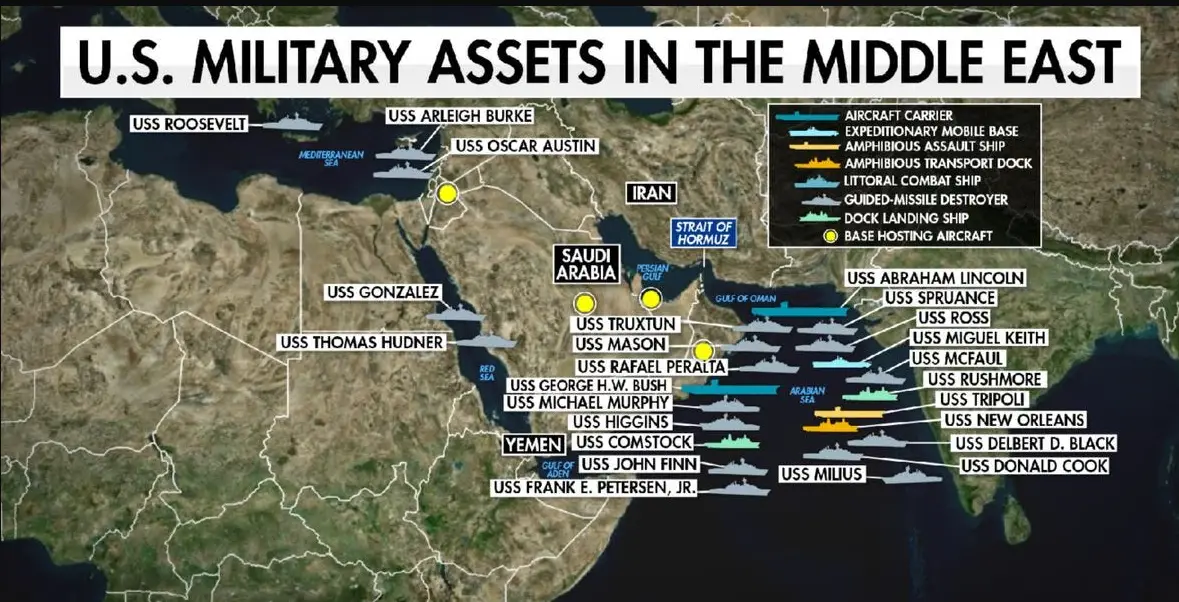
On June 8, a U.S. helicopter was brought down by an Iranian drone in what may have been an inadvertent confrontation. Nevertheless, Trump said the U.S. had to respond, and on June 9, U.S. forces targeted “air defense, ground control stations, and surveillance radar sites,” in what CENTCOM described as “a proportional response to unjustified Iranian aggression.”[328]
The Institute for the Study of War (ISW) said Iran appeared to be pursuing a strategy of carefully calibrated military pressure to extract concessions from the United States while avoiding a broader conflict. This approach likely reflects Tehran’s assessment that Washington is reluctant to become re-engaged in a major war.
As part of this strategy, Iran has targeted U.S. military assets near the Strait of Hormuz, apparently seeking to discourage American operations in the area and reinforce its influence over the strategic waterway. The helicopter incident suggested an effort by Tehran to assert control over the Strait of Hormuz while testing U.S. resolve without provoking a full-scale military response.[329]
Trump continued to vacillate between threats and promises that a deal was within reach. On June 10, he said Iran had “taken too long to negotiate a deal that would have been great for them. Now they will have to pay the price!”
He later suggested he might order strikes against Iranian bridges and power plants. “They had a chance to sign a deal and survive,” he said, adding, “We hit them hard yesterday and we’re going to hit them again hard today... And we’ll see what happens with the deal. We were really close to a deal — but they keep tapping us along.”[330]
Even after Iran shot down the U.S. helicopter and launched attacks on U.S. bases in Jordan, Kuwait, and Bahrain, Trump insisted, “They have been completely defeated. Iran is all talk and no action. The bully of the Middle East is DEAD!”[331]
He also vented against the media, which he said refused to report on what he called “the most successful Blockade in the history of Naval Warfare.” He said, “NOTHING GETS THROUGH unless we want it to. IT IS A STEEL WALL! Iran is doing ZERO business, not paying their military, or any of their bills, and quickly becoming a FAILED NATION!”[332]
Meanwhile, Israelis were furious with what many commentators viewed as Trump’s hypocrisy in telling Israel not to retaliate when Iran attacked but ordering U.S. forces to strike back after Iran downed the U.S. helicopter. He gave the order despite saying earlier that it “wasn’t a big deal,” since “the pilot is fine.”
Trump Loses Patience
The U.S. conducted its second consecutive night of strikes on Iran, with CENTCOM stating they began at 5:15 am ET on June 10 and concluded roughly four hours later. The operation was described as more intense and widespread than the previous night. Targets across southern Iran included air defense systems, radar installations, drone command-and-control units, and military surveillance and communications infrastructure. CENTCOM framed the strikes as a response to “Iran’s unwarranted and continued aggression.”
On June 11, the U.S. Navy fired missiles to disable a tanker attempting to transport Iranian oil — the ninth merchant vessel disabled since the blockade began. An Indian official separately confirmed that a U.S. strike on a different merchant ship earlier in the week killed three Indian sailors, raising the civilian cost of the operation.
Trump claimed U.S. forces covertly helped move more than 100 million barrels of oil through the Strait of Hormuz — aided by the destruction of Iranian radar equipment — though that figure was unconfirmed.
Iran responded to the latest American strikes by targeting the U.S. Navy’s 5th Fleet headquarters in Bahrain with drones. Jordan intercepted approximately 20 Iranian missiles fired toward an area hosting U.S. troops; no American casualties were reported. In Bahrain, an 11-year-old girl was injured, and homes and vehicles were damaged by debris from interceptions.
Iran’s Tasnim News Agency cited a military source promising “heavy responses,” and Iran’s president characterized Trump’s threats as a sign of “desperation” rather than strength. Iran also announced the Strait of Hormuz was closed, though CENTCOM disputed the claim. In practice, traffic through the strait had already been severely restricted since the conflict began.
On June 11, Trump posted on social media, threatening to hit Iran “VERY HARD TONIGHT” and announced U.S. intentions to assume “total control” of Iran’s oil and gas industries — including the strategically critical Kharg Island terminal — “in the not too distant future.” He drew a direct parallel to the U.S. seizure of Venezuela’s oil sector following Nicolás Maduro’s capture in January. Trump also accused Tehran of “playing us for suckers” in negotiations, and Defense Secretary Hegseth bluntly summarized the administration’s posture: “If we need to negotiate with bombs, we’ll negotiate with bombs.”[333]
After threatening a major military escalation, Trump abruptly announced later that day that the airstrikes had been canceled. The reversal came after negotiations with Iranian leaders appeared to make significant progress toward what Trump described as an emerging framework agreement, although Iranian officials subsequently stated that no final agreement had yet been reached.[334]
According to Politico, the leaders of Pakistan, the UAE, and Qatar urgently contacted him and said a preliminary agreement with Tehran was within reach.[335] The New York Times reported that President Trump spoke with Pakistani mediators shortly before calling off the strikes, who told the president they had reached a deal with Iran. Those assurances convinced Trump to cancel the planned attack and continue pursuing negotiations.[336]
Trump said discussions and final points had been approved “in both concept and great detail” by the United States, Israel, and other regional allies.[337]
He said the naval blockade would remain in effect until the “Transaction is finalized,” and that the agreement could be completed within the next few days.
When asked if Iran’s Supreme Leader had approved the deal, Trump replied: “I understand the answer is yes.”[338]
Asked if there was a deadline, the president said, “I don’t want to say a deadline because then you’ll say I didn’t meet the deadline. It is not going to matter much because it is going to get signed.”
The president said the signing would happen on June 14. Since he was celebrating his 80th birthday in Washington, Trump said Vance would sign it in at a location in Europe, likely Geneva. Iranian state media said this claim was false.[339]
Trump added that when the deal is signed, the U.S. would immediately lift the blockade.
Also, despite all evidence to the contrary, Trump maintained that the Strait of Hormuz “has been open for a number of months already, but you just didn’t know about it.”
Trump later stated: “We ended the war with Iran today.” He added, “They will not have a nuclear weapon, they’ve agreed to that. They will not only not have, they will not purchase, develop in any way, any shape, in any way, shape or form a nuclear weapon.”[340]
CNN noted that Trump had claimed a deal with Iran was close 39 times since the war began.[341]
Israel’s Prime Minister’s Office said President Trump spoke with Prime Minister Netanyahu about the emerging memorandum of understanding with Iran to enter negotiations.
According to the statement, Israel is not a party to the memorandum of understanding. Netanyahu expressed appreciation for President Trump’s commitment that any final agreement would include the removal of enriched material, the dismantling of enrichment infrastructure, limitations on missile production, and an end to Iranian support for regional terrorist proxies. [334]
On June 11, President Trump called Israeli Prime Minister Benjamin Netanyahu with news he did not want to hear: he expected to sign a deal with Iran within days.
“This is the deal. It’s a great deal, and it’s time to end this war,” Trump told Netanyahu, according to a senior U.S. official.
Four months before an election, Netanyahu’s rivals accused him of making Israel a “vassal state” by simply accepting Trump’s terms for peace. Earlier that week, as exchanges with Iran ratcheted up, Netanyahu had planned massive strikes against energy and infrastructure facilities before Trump stopped him at the last moment. After that, Netanyahu found himself largely out of the loop.
On June 14, Trump’s post claiming a deal had been reached caught Netanyahu by surprise, according to a source with knowledge of the matter. About an hour later, when Trump called, Netanyahu did not push back hard or argue much. The Israeli leader told Trump he trusted him to ensure the final agreement addressed their shared concerns around Iran’s nuclear program. “Bibi probably understood that a deal was about to happen and that he could not stop it,” a U.S. official said.[342]
On June 15, the Israeli military announced it had struck a Hezbollah target on the outskirts of Beirut. The attack threatened to imperil U.S. peace talks with Iran and drew the ire of President Trump.
Hours after the attack, Trump wrote on Truth Social: “This morning’s attack on Beirut should not have happened, particularly on a special day when we are so close to a Peace Deal with Iran.” He acknowledged that “Israel has the right to defend itself against threats, but the attack it was responding to was very small and meaningless, nobody was hurt, injured, or killed, and should not disrupt this important process.”
This statement was particularly galling to Israelis because Trump had ordered a retaliatory attack on Iran after its downing of a helicopter, which had caused no injuries.
An angry Trump said Netanyahu had shown “no judgment” in ordering the strikes and called on all sides to “stand down.” “He’s a very difficult guy,” Trump said of the Israeli prime minister, “and to be honest with you, he should be very thankful to us for doing this. Because if Iran had a nuclear weapon, Israel wouldn’t be around for two hours.”
Axios reported that Trump had another angry phone call with Netanyahu after learning about the Israeli attack on Beirut. “It is so bad — I couldn’t believe it. An hour before we are supposed to sign the deal,” Trump said. “Why did Bibi have to do a fucking attack? I was so pissed off. I let him know. He has no fucking judgement. I let him know that,” Trump said.
Iran’s lead negotiator, Mohammad Bagher Ghalibaf, condemned Israel’s strike on Dahiya and suggested the attack had undermined the credibility of the United States. “If you neither have the will nor the ability to execute your commitments, talking about the continuation of the path is not possible,” Ghalibaf wrote on X.[343]
A last-minute flurry of negotiations, led by Qatar, eased tensions, and the final agreement appeared to come together late that night in Tehran. Fars News Agency, affiliated with Iran’s Revolutionary Guards, reported that Iran had decided not to attack Israel after Trump proposed an Israeli withdrawal from southern Lebanon and the immediate removal of the naval blockade. Iran held off agreeing until the early hours of Monday, allowing it to claim it had not signed on Trump’s birthday on Sunday, as he had wanted, according to two Iranian officials who spoke on condition of anonymity.
Trump told the New York Times that the agreement he had reached with Iran would ultimately ensure that the Strait of Hormuz was “permanently toll-free,” and asserted that, despite Netanyahu’s objections, he had saved Israel from nuclear obliteration. He also said that if Iran failed to reach a final nuclear accord with the United States—a process his aides said they expected would begin Friday in Switzerland—he would restart military attacks on Tehran or make the United States “the guardian of the Middle East” in return for 20% of the region’s revenues.[344]
Iran and U.S. Agree to MOU
Pakistan announced that a Memorandum of Understanding between the United States and Iran had been reached and would be signed in Switzerland on Friday, June 19. Pakistan stated: “Both sides have declared an immediate and permanent cessation of military operations on all fronts — including in Lebanon. The official signing ceremony will take place on Friday in Switzerland.”
“The Deal with the Islamic Republic of Iran is now complete,” Trump said in a post on social media. Iran’s Supreme National Security Council said in a statement that the country had finalized a memorandum of understanding with the United States after “months of long and difficult negotiations.” Trump said the deal would reopen the Strait of Hormuz and announced he had authorized “the immediate removal of the United States Naval blockade” on Iranian ports.[345]
The deal was widely understood to stipulate a sixty-day period for the United States and Iran to reach an agreement on Iran’s nuclear program. At the start of that period, the Strait of Hormuz would be reopened to shipping, and the U.S. blockade of Iranian ports would be lifted. The issues addressed upfront included an Iranian commitment not to develop nuclear weapons and to abide by the Treaty on the Non-Proliferation of Nuclear Weapons, the immediate opening of the Strait of Hormuz to commercial shipping, the end of the U.S. blockade of Iranian ports, and a cessation of armed hostilities for the duration of the negotiation period.
Among the issues to be addressed during the sixty-day negotiation period were Iran’s nuclear facilities, limitations on Iranian enrichment capacities—earlier U.S. demands had called for a twenty-year moratorium on all enrichment followed by a permanent cap no higher than 3.67%—and the fate of Iran’s stockpile of enriched uranium. Trump hinted he might be willing to accept a fifteen-year moratorium but would still insist on the permanent cap. “They can only enrich for nonmilitary purposes. Forever,” he said, while declining to specify the precise enrichment level. Critics warned that if Iran could enrich uranium to 3%, it could eventually enrich to 90%, with the only question being how long it would take and how Iran would again conceal its activity.[346]
After initially considering sending troops to remove the uranium, Trump later said the United States would join with Iran in “down-blending” the enriched nuclear material over time, though he offered no deadline and sounded vague about the timing. Meanwhile, Iran was reported to have mined the entrance to the Isfahan nuclear complex to prevent the U.S. from sending troops to seize the material.[347]
According to reports, the memorandum included a roughly $300 billion reconstruction plan for Iran to be presented by the United States and mediating parties. The United States committed not to interfere in Iran’s internal affairs, to lift the naval blockade within thirty days, and to withdraw its forces from areas surrounding Iran. It also committed not to deploy additional forces to the region or to impose new sanctions on Iran during negotiations and agreed to suspend sanctions on Iranian oil exports. Iran’s ballistic missile program, its support for regional proxies, and its internal repression were not addressed in the interim agreement.[348]
Trump also posted: “This Great Deal will bring Peace and Security to the whole Region. Many presidents have tried to make Peace with Iran, and all have failed before me. The Leaders of the Region have, for the first time, found a President who can help them achieve real Peace.” He added: “With the opening of the Strait upon the signing of the Deal on Friday, for purposes of mine removal, oil will flow on both ends again for the Region, and the World!”
He later wrote: “The Deal with the Islamic Republic of Iran is now complete. Congratulations to all! I hereby fully authorize the toll free opening of the Strait of Hormuz, and, simultaneously herewith, authorize the immediate removal of the United States Naval blockade.”
The memorandum of understanding suspended tolls in the strait for only sixty days and promised a regional dialogue about the future, though Iran had never charged tolls before the war. That meant Trump was essentially celebrating a return to the prewar status quo.
On June 15, Trump posted that ships were beginning to move. “Ships are starting to move, many loaded up with Oil, out of the Strait of Hormuz,” he wrote.
While an in-person signing ceremony was set for June 19 in Switzerland, Vice President Vance said the MOU had been signed “digitally” on June 14. Trump repeatedly denied that any money would be unfrozen by the United States but did not say others would not make payments—a distinction he used to differentiate his deal from the one he had criticized Obama for making. Media reports claimed the UAE had already delivered more than $3 billion to Iran and agreed to release as much as $20 billion, payments meant to halt Iranian attacks on the UAE after the U.S. had failed to retaliate. The U.S. denied it, but Iran had claimed weeks earlier that Iranian assets held in Qatar had already been unfrozen.[349]
Despite Iranian claims that the MOU required an end to fighting in Lebanon, Netanyahu and Katz insisted that “Israel will not tolerate firing at its territory,” and Netanyahu reportedly informed Trump that Israel would not pull IDF forces from Lebanon and did not consider itself bound by the Lebanon clause in the U.S.-Iran agreement.
Trump declared that should negotiations fail, the United States would return to war, a threat he had made repeatedly in the run-up to the agreement—one that Iranians had come to see as increasingly empty.
Iranian Deputy Foreign Minister Kazem Gharibabadi declared victory over Israel, citing concessions Trump had made. “The military strength Iran demonstrated, along with the threats of retaliation that were made, helped finalize the text of the agreement and advance several of the remaining issues that still needed to be resolved,” he said. He added that “Trump also took positions critical of the Israeli government, while Hezbollah delivered a firm and decisive response to the Israeli regime’s terrorist attack.”[350]
The Trump administration refused to release the MOU it “digitally” signed with Iran to the consternation of Israel and members of Congress. The official signing involving Witkoff, Kushner, Vance, Araghchi, and Ghalibaf was scheduled for June 19 at the Burgenstock mountaintop resort in central Switzerland.
Media outlets published the terms of the MOU in advance, though Trump claimed they were not final. On June 17, the administration finally published an official version.
The United States of America and the Islamic Republic of Iran have jointly agreed in good faith on [ __ date] on the following:
1 — The United States of America and the Islamic Republic of Iran and their allies in the current war are signing this MOU to declare the immediate and permanent termination of military operations on all fronts, including in Lebanon, and undertake from now on not to initiate any war or any military operation against each other, and to refrain from the threat or use of force against each other, and ensuring the territorial integrity and sovereignty of Lebanon. The final deal will confirm the permanent termination of the war on all fronts, including in Lebanon and other provisions of this paragraph.
2 — The United States of America and the Islamic Republic of Iran undertake to respect each other’s sovereignty and territorial integrity and to refrain from interfering in each other’s internal affairs.
3 — The United States of America and the Islamic Republic of Iran commit to negotiating and achieving the final deal in maximum 60 days, extendable with mutual consent.
4 — Immediately upon the signing of this MOU, the United States of America will begin the removal of its naval blockade and any disturbances or impediments against the Islamic Republic of Iran, and will fully end the naval blockade within 30 days. During this period, the traffic of vessels will be in proportion to the numbers of pre-war traffic being restored by the Islamic Republic of Iran. The United States of America further undertakes to remove its forces from the proximity of the Islamic Republic of Iran within 30 days after the final deal.
5 — Upon the signing of this MOU, the Islamic Republic of Iran will make arrangements using its best efforts for the safe passage of commercial vessels with no charge, for 60 days only, from the Persian Gulf to the Sea of Oman and vice versa. The traffic of commercial vessels will immediately start, and considering the need for removing the technical and military obstacles, and demining by the Islamic Republic of Iran will be instated within 30 days. The Islamic Republic of Iran will conduct dialog with the Sultanate of Oman to define the future administration and maritime services in the Strait of Hormuz in discussion with other Persian Gulf littoral states in line with the applicable international law and the sovereign rights of coastal states of the Strait of Hormuz.
6 — The United States of America undertakes with regional partners to develop a definitive, mutually agreed plan with at least USD 300 billion for the reconstruction and economic development of the Islamic Republic of Iran. The mechanism for the implementation of this plan will be finalized as part of a final deal within 60 days. All required licenses, waivers and permissions needed for the relevant financial transactions will be granted by the United States of America.
7 — The United States of America undertakes to terminate all types of sanctions against the Islamic Republic of Iran, including the United Nations Security Council resolutions, IAEA Board of Governors resolutions, and all unilateral US sanctions, primary and secondary, in an agreed upon schedule as part of the final deal. The Islamic Republic of Iran and the United States of America acknowledge the critical importance of the sanctions termination issue above mentioned, and expressed their intentions to immediately address these issues in the negotiations in order to achieve mutual agreement on them.
8 — The Islamic Republic of Iran reaffirms that it shall not procure or develop nuclear weapons. The United States of America and the Islamic Republic of Iran have agreed to resolve the disposition of stockpiled enriched material pursuant to a mechanism that will be mutually agreed upon in accordance with the schedule mentioned in paragraph seven, with the minimum methodology to be down blended on site under the supervision of the IAEA. The two parties also agreed to discuss the issue of enrichment and other mutually agreed matters related to the Islamic Republic of Iran’s nuclear needs, based on a satisfactory framework being agreed upon in the final deal. The final deal will confirm the provisions of this paragraph. The United States of America and the Islamic Republic of Iran acknowledge the critical importance of the nuclear issues above mentioned. They express their intention to immediately address these issues in the negotiations in order to achieve mutual agreement on them.
9 — Pending the final deal, the United States of America and the Islamic Republic of Iran agree to maintain the status quo. The Islamic Republic of Iran will maintain the current status quo of its nuclear program, and the United States of America will not impose any new sanctions and will not deploy additional forces in the region.
10 — The United States of America undertakes that immediately upon the signing of this MOU and until the termination of sanctions, US Department of Treasury will issue waivers for the export of Iranian crude oil, petroleum products and derivatives, and all associated services, including banking transactions, insurances, transportation, etc.
11 — The United States of America undertakes to make fully available for use the frozen or restricted funds and assets of the Islamic Republic of Iran upon the implementation of this MOU. The United States of America and the Islamic Republic of Iran will mutually agree on the procedures related to the release of these funds during negotiations. Such funds, whether retained in the original account or transferred, shall be made fully usable for payment to any ultimate beneficiary designated by the Central Bank of the Islamic Republic of Iran. The United States of America undertakes to issue all necessary licenses and authorizations accordingly.
12 — The United States of America and the Islamic Republic of Iran agree that an executive mechanism will be established to monitor the successful implementation of this MOU and the future compliance of the final deal.
13 — After signing this MOU, and subject to the beginning of the implementation of paragraphs 1, 4, 5, 10 and 11 of this MOU, and the continuing implementation of these measures, the United States of America and the Islamic Republic of Iran will start negotiations regarding the final deal exclusively on the other paragraphs.
14 — The final deal will be endorsed by a binding UNSC resolution.[351]
The Institute for the Study of War’s (ISW) analysis was that the MoU granted Iran significant economic relief, which Iran would likely use to try to reconstitute its missile, drone, and nuclear programs, as well as the “Axis of Resistance.” The MoU stated that Iran could receive further economic relief by fulfilling its commitments and reaching a final agreement that addressed key nuclear issues. ISW-CTP (Critical Threats Project), however, had not observed any indication that Iranian decision-makers were willing to make concessions on the nuclear issues to be included in a final agreement.
Iran, it said, would likely try to exploit the agreement’s seemingly ambiguous language about the Strait of Hormuz to enforce its control over shipping through the strait. The reported text of the agreement did not explicitly bar Iran from “managing” the strait, and Iran could therefore continue to insist on vessels using its illegal traffic separation scheme in Iranian territorial waters and paying “fees” to the IRGC Navy.
The Iranian regime interpreted the clause in the agreement concerning a ceasefire “on all fronts” as requiring Israel to cease operations against Hezbollah and withdraw from Lebanon. This interpretation formed part of a broader Iranian effort to preserve Hezbollah by seeking Israel’s capitulation in Lebanon. According to Asharq Al-Awsat, Iran promised Hezbollah that after the initial agreement was signed, Israel would have to gradually withdraw from Lebanon within the 60-day framework, and that it would not sign a nuclear agreement unless the Israeli withdrawal from Lebanon is completed.
On June 18, Trump posted, “The United States is committed to PEACE, and we encourage everyone in the Middle East Region to maintain their commitment to allowing our negotiations to beautifully unfold. The Markets are loving what is happening with Oil Prices way down, and Stocks way up. We expect a complete Ceasefire on all fronts, including Lebanon, Hezbollah, and Israel.”[356]
The reported MOU terms indicated that Iran had structured the agreement to limit the United States’ ability to impose renewed pressure on Iran during the sixty-day negotiation period, thereby making it more difficult for the United States to extract concessions from Iran.
Iranian officials and media largely framed the U.S.-Iran MOU as an Iranian victory that codified Iran’s military achievements. The Iranian regime’s English-language media outlet, Press TV, argued on June 16 that the MoU was not simply a ceasefire, but rather represented the “political codification of a battlefield reality.”[352]
By agreeing to “refrain from interfering in each other’s internal affairs,” Trump signed away U.S. support for the Iranian people and gave up the original goal of regime change.
Like Obama’s agreement, the MOU was silent on several key issues, including Iran’s development of ballistic missiles, its sponsorship of terrorism, and its support for proxy groups. In the case of the “Axis of Resistance,” Trump had already taken several steps that critics argued helped preserve it. He forced Israel into a ceasefire with Hamas, which had refused to disarm as required under his peace plan. He agreed to a ceasefire with the Houthis without eliminating their missile capabilities, which they subsequently used to attack Israel. He also prevented Israel from striking Hezbollah strongholds in Beirut, allowing Iran to assist the group’s reconstruction efforts. Separately, he compelled Israel to stand down before completing its military operations in Iran.
At the G7 Summit, Trump insisted the MOU was a “very strong deal,” but threatened to resume bombing if “if they don’t behave.”
When asked about excluding Iran’s ballistic missile program from the MOU, Trump said, “I mean, they have to have some, because other people have some. You got to have some,” Trump said. He continued by imitating critics. “‘Sir, you shouldn’t let them have any missile’” and Trump’s response was, “‘Well, what am I going to do? Am I going to let Saudi Arabia have missiles, but they can’t have them?’” He continued, “It doesn’t work that way,” adding incredulously, “Missiles aren’t the problem. Missiles, they hurt a little location, but they don’t blow up the planet.”[355]
Stung by criticism that the deal is like the one Obama negotiated that he tore up and castigated, Trump defended it by saying, “Nobody knows what it is, but it’s very strong,” and based his judgment of its wider approval on investor sentiment. “Who’s really happy is the market,” he said.
While insisting he had not agreed to unfreeze billions in assets as Obama had done, Vance had earlier said Iran could be given access to a $300 billion reconstruction fund. Trump appeared to believe people would be fooled if the money came from Gulf states rather than from the United States. “What am I going to do, say no one is ever allowed to invest? We’re not investing, we’re not putting up 10 cents, and people can decide to do it. That’s up to them.”
Administration officials have said, however, that the U.S. would release frozen funds as Iran meets its obligations.
Trump continued to insist that it is “a wall to a nuclear weapon” even though the MOU only marks the beginning of a 60-day period during which the details of the dismantling of Iran’s nuclear program are to be negotiated. Rubio and Hegseth reportedly opposed the agreement because they did not believe Iran would give up its nuclear weapons program, which was also the view of the intelligence community, according to CIA director John Ratcliff. A senior U.S. official told Axios that the U.S. will know in two to three weeks if Iran is serious about nuclear concessions. If not, the process would stop.[353]
In the meantime, the U.S. had already lost leverage after Trump ended the blockade of Iranian ports and issued waivers for sanctions on exports of Iranian oil, as well as banking, transportation, and insurance needed to facilitate the sales.[354]
Trump’s Desperation
Iran’s supreme leader, Mojtaba Khamenei, said Trump had made the deal “out of desperation” and warned that Iran would not submit to “excessive demands” from the United States in the second round of talks. Trump responded, “We didn’t meet out of desperation, Iran did. They are FINISHED! We’ll play out the 60 days. They get no money, not ten cents!”[357]
Earlier, however, Trump admitted to feeling desperate due to economic realities. The Wall Street Journal noted that Trump’s decision to sign the MOU was driven by fear of high oil prices and a falling stock market going into the midterm elections, as evident from his comments at a press conference on June 17, where he insisted “the alternative would be a worldwide depression.” After previously saying he wasn’t concerned about the rising oil prices, he said that if the war continued, the market “would go down at levels that nobody ever saw before, maybe except for 1929,” adding, “The one President I did not want to be was the late, great Herbert Hoover.”
The next day, he posted, “These fools who think I haven’t been tough enough on Iran, when the Stock Market Just Hit A RECORD HIGH, and Oil prices are ‘tumbling’ down, are either jealous, bad people, or stupid.”[358]
Vice President Vance became the principal defender of the MOU, and Trump made clear he would be the scapegoat if the deal failed. “If it works out, I’m going to take the credit. If it doesn’t work out, I’m blaming JD.”[359]
Although Trump said it jokingly, no one would be surprised if that was his reaction.
Many observers noticed that Secretary of State Rubio was not the point person for the negotiations or their defense. That role fell to Vance, who held a press conference on June 18 that the New York Times described as relying on “vague and misleading claims.”
As Trump did in his own press conference, Vance revealed Trump’s main motivation for striking a deal that failed to secure the total surrender he had originally called for: falling gas prices.
In response to criticism about the sanctions relief that Iran is set to receive, Mr. Vance said Iran would have to “change their behavior” first — even though the deal lays out several benefits, including some sanctions waivers that begin “upon the implementation of this M.O.U.”
Those terms include the United States unfreezing assets and releasing restricted funds, and both sides committing to reopening the Strait of Hormuz, a critical waterway whose closure roiled global supply chains and prices. Iran also immediately receives waivers from the Treasury Department on sanctions for the export of oil and other petroleum products that have long been restricted.
Other elements of the agreement, such as broader sanctions relief, would take place on “an agreed-upon schedule as part of the final deal.”
Vance claimed that lifting oil sanctions on Iran was “not a new benefit”s for the country, even though severe economic restrictions in place before the war meant that Iran had to sell its oil at a steep discount. Lifting sanctions will allow it to fetch higher prices, sell to a wider array of buyers, and receive payment in more currencies.
When asked about Iran’s ballistic missiles, Vance echoed comments made earlier by Trump, suggesting that it was impossible to tell any country that they’re not allowed to maintain a self-defense capacity.
Sounding much like President Obama, whom Trump has repeatedly attacked for his deal with Iran, and echoing suggestions that the regime might change to be less antagonistic toward the United States, Vance said it was “worth trying” to see whether the Iranians might change their behavior.
At the end of his press conference, Vance launched a blistering attack on Israel after public criticism of the MOU by some members of the Israeli cabinet. He said, “Donald J. Trump is the only head of state in the entire world who is sympathetic to the nation of Israel at this moment in time.” He claimed that two-thirds of the weapons “that have protected your homeland” were American-made and paid for by Americans’ tax dollars, and added, “If I was in the cabinet of the Israeli government, I might not be attacking the only powerful ally that I have anywhere left in the entire world.”
He was likely referring to Israeli national security minister Itamar Ben Gvir and finance minister Bezalel Smotrich, who both criticized the deal and insisted that Israel should continue its operations in Lebanon and pursue the campaign against Iran in “creative ways.” Netanyahu diplomatically remained silent, but the reaction in Israel from his supporters, and even his opponents, left no doubt about the anger and disappointment over what many saw as a betrayal. As a result, the agreement accomplished none of Israel’s objectives: regime change, destruction of Iran’s nuclear capability, eradication of its ballistic missile threat, or cessation of support for terror and its proxies.[360]
Yediot Ahronot columnist Ben-Dror Yemini wrote, “Trump reneged on every promise, turned Iran into a superpower, strengthened Hezbollah, and for dessert gave Israel a kick and humiliation.”[361]
Meanwhile, commercial transit out of the Strait of Hormuz picked up, even as Iran was threatening to reclose the Strait because of Israel’s continued attacks in Lebanon.
After Trump digitally signed the agreement on June 13, Vance was scheduled to sign it in person on June 19 in Switzerland. Instead, Trump signed the document again on June 17 in France, where he was attending the G7 summit. Iranian President Masoud Pezeshkian signed it separately. Vance was still supposed to go to Switzerland to start talks on implementing a final deal, but his trip was canceled.
Senator Roger Wicker (R-MS), the chairman of the Armed Services Committee, was one of a number of Republicans who were critical of the deal, saying he was “concerned that the memorandum of understanding negotiates away the victories of Operation Epic Fury in ways that are completely out of step with the president’s goals.”[360] He also said, “The Iranian regime has not renounced its ultimate goal—‘Death to America, Death to Israel.’ The regime will invest every penny it receives to further that aim.”[358]
Wicker asserted that the $300 billion fund for the reconstruction and economic development of Iran included in the memorandum, “though not funded by U.S. taxpayers, would make Iran’s payoff under President Obama’s 2015 deal look like a pittance by comparison.”
Talks between U.S. and Iranian officials began in Switzerland on June 21, but conflicting reports immediately circulated. Iran said it was reclosing the Strait of Hormuz because of Israeli attacks in Lebanon. Trump then threatened to renew military action, and the Iranians said they were leaving the talks. The U.S. said they never did, and mediators from Pakistan and Qatar said early on June 22 that “encouraging progress” had been made toward a peace agreement.
The United States was reportedly working with Qatar on a proposal to give Iran access to an initial $6 billion in frozen assets for humanitarian purchases such as food and medicine, using funds held in Qatar. The mechanism, which still requires Iran’s approval, could serve as a model for the release of additional frozen Iranian assets worldwide.[374]
Iranian officials said they expected the release of some of the $24 billion in frozen assets, while Vance insisted that any unfrozen Iranian assets would have to be spent on U.S. goods, such as soy and wheat, and would be prohibited from funding terrorism. “If Iranian assets are ever unfrozen, they’re going to go to make American farmers richer and to feed the Iranian people,” Vance said.
The Treasury Department issued a 60-day license on June 21 permitting the production, sale, and export of Iranian oil. The waiver could provide Iran with a substantial economic windfall and mark a significant shift in U.S. policy. Most notably, it opens the door for Iran to sell its oil at prevailing market prices after years of relying on discounted sales to attract buyers willing to risk violating U.S. sanctions.
Vance left Switzerland after indirect negotiations with the Iranian delegation led by Ghalibaf. Vance said the two sides had agreed to a structure for the technical negotiations, with U.S. and Iranian negotiators remaining in Switzerland. Vance said Iran had already agreed to allow nuclear inspectors from the International Atomic Energy Agency to return to the country, but did not specify what they would be allowed to inspect. No agreement was reached on what to do about Iran’s stockpile of enriched uranium, and Pezeshkian once again ruled out giving up the right to enrich uranium.
The vice president also said that an agreement had been reached to coordinate the demining of the Strait of Hormuz and to oversee the ceasefire in Lebanon. The latter excluded Israeli participation.[362]
Iran declared victory over the United States. “The Islamabad understanding was not the result of pressure and coercion, but rather the result of the resistance and authority of the brave Iranian nation,” Ghalibaf asserted. “That is why the Islamabad memorandum of understanding became a declaration of America’s defeat.”[363]
The Nefarious Qataris
Qatar has been the principal mediator in talks between the U.S. and Iran, but the Qataris are not impartial. A foreign intelligence document obtained by Israel’s Kan News outlines how Qatar has emerged as a primary mechanism through which Iran circumvents international sanctions, a relationship that intensified following the U.S. exit from the nuclear agreement in 2018 and accelerated after the October 7 attacks.
On the trade front, Qatar deliberately broadened its maritime commercial ties with Iran after 2018, with bilateral trade volumes climbing by tens of percent over subsequent years. Energy cooperation expanded alongside commerce, with the two countries reaching agreements, including one on Iranian electricity exports to Qatar.
Financially, Qatar became a critical actor in the release of frozen Iranian assets. Six billion dollars in Iranian funds held in Qatar are identified in the document as the first tranche expected to be transferred to Tehran under current U.S.-Iran negotiations. Banking authorities from both countries reportedly worked out the mechanics of the transfer as early as October 2024, though Washington intervened to halt it. The intelligence assessment characterizes those funds as destined for terrorist financing rather than any civilian purpose.
The document also describes a pattern of Qatari material transfers to Iran with clear weapons applications, citing figures drawn from Qatar’s own National Planning Council. Among the items transferred were mineral oils with applications in rocket propellant, hydrogen in volumes inconsistent with civilian demand, aluminum components used in drone airframes, and internal combustion engines suited for incorporation into unmanned aerial vehicles. The assessment concludes these transfers serve Iranian military programs, not civilian needs.
The document’s overall finding is that Qatar is directly damaging the security interests of the United States, Israel, and regional Arab states, and recommends tangible action in response.[365]
Iran and the U.S. Contradict Each Other
On June 21, Vance said in advance of his meetings to discuss the MoU, “If they are willing to give up nuclear weapons ambitions for the long term, then the United States is willing to fundamentally transform our relationship with that country,” he went on. “That is certainly our goal.”[366]
Trump said the United States will soon use unfrozen Iranian assets to purchase American agricultural products.
“We have a new market coming up, and that’s called The Lovely Country of Iran. It’s a beautiful place. Would anybody like to go there? They’re having a hard time with food and we’re going to be taking some of their money and we’ll spend it and we’re going to be buying wheat, soybeans, and corn, a lot of it, and that process is going to be starting soon. It’s going to be big.”[367]
Iranian Foreign Ministry spokesman Esmaeil Baqaei rejected the remarks, arguing Washington should first address U.S. food insecurity.[368]
In another contradiction, Iran said it had not agreed to allow inspectors to access its nuclear facilities. Trump, however, insisted they had and said if that were not true, “there would be no further negotiations!” Vance also said they agreed to IAEA access to nuclear sites, but Foreign Ministry spokesman Esmaeil Baqaei said the next day that there was no plan for IAEA inspections of its nuclear facilities damaged by the war.[375] Ghalibaf later said, “IAEA inspectors do not have the right to inspect nuclear sites bombed by the U.S.,” referring to Fordow, Natanz and Isfahan. “Currently, inspectors only have access to two locations: Bushehr power plant and Tehran reactor,” he reportedly said.[380]
Trump said 19 million barrels of oil had passed through the Strait. “That’s the most in the history of the Strait. And the oil prices are dropping like a rock.”[369]
This was after Iran had attacked another ship transiting the area on June 25, when Oman approved the shipping route without coordinating with the IRGC. Iran maintained that Oman cannot guarantee maritime security without Iranian approval and that no outside party will interfere with its control of the strait.
Revolutionary Guard forces halted three other foreign oil tankers attempting unauthorized passage, forcing them to turn back into the Persian Gulf. Deputy Foreign Minister Gharibabadi warned: “Safe passage through the Strait of Hormuz… cannot be guaranteed.”[370]
Despite the clear violation of the ceasefire, the U.S. took no action. Trump simply reiterated that Iran would not be allowed to charge any shipping fees.[371]
The attack came the same day that the United States and Gulf Cooperation Council foreign ministers issued a joint statement that emphasized the importance of “free, unconditional, and unrestricted navigation” and rejected “any tolls, fees, or attempts to assert control over the strait.
Iran’s Foreign Ministry condemned the joint statement as “interventionist, irresponsible, and provocative.”[372]
Meanwhile, Vance said he negotiated a channel for conflict resolution. “They were like, ‘OK, fine, we’ll send somebody from the IRGC to go hang out in Doha with somebody from CENTCOM,’ and that’s how we’re going to settle a lot of these disputes.”[373]
The U.S. and Iran traded strikes on June 28-29. The U.S. accused Iran of violating the ceasefire after it launched drone attacks on a Singapore-flagged oil tanker in the Strait of Hormuz on June 25. In a “powerful response” to Iran’s “unwarranted aggression,” CENTCOM said the U.S. struck Iranian missile and drone storage locations and coastal radar sites on June 26. On the 28th, Iran launched another drone at a Panama-flagged oil tanker and followed that up with drone and ballistic missile attacks targeting the U.S. Fifth Fleet Naval Base in Bahrain and the Ali Al Salem Airbase in Kuwait on June 28. In retaliation, the U.S. targeted Iranian military surveillance infrastructure, communication systems, air-defense sites, drone storage facilities and minelayer capabilities, CENTCOM said.
Iran has continued targeting U.S. forces in the region in an apparent effort to deter Washington from interfering with its attempts to assert control over the Strait of Hormuz. The attacks may also be intended to discourage Gulf states from opposing Iran’s efforts to dominate the strategic waterway.
Vance said that if Iran had “disagreements about how the MOU is being applied, they can pick up the phone. But violence will be met with violence.”[376]
The Iranians skipped technical talks slated for June 29, saying the U.S. had not met the condition in the MOU for the release of billions in frozen funds. The same day, the two sides agreed to cease their strikes and meet in Doha on June 30 to discuss the status of the Strait of Hormuz.[377]
Going into the talks, Iran insisted it retained full authority over the Strait of Hormuz, while the Trump administration warned it would respond forcefully to any interference with international shipping, maintaining that the ceasefire guaranteed safe passage through the waterway. Another point of contention centered on the release of $6 billion in frozen Iranian assets held in Qatar. Tehran argued the funds should be released immediately for its own use, while Washington insisted they would remain under U.S. oversight and be used to purchase American agricultural goods. Meanwhile, analysts said the agreement could generate $10 billion for the regime in oil sales alone over the following two months.[378]
The U.S. and Iran held indirect technical talks in Doha on June 30-31; however, Iran continued to reject direct talks with the U.S. delegation and any discussion of its nuclear program. Iran was reportedly determined to win international recognition of its control over the Strait of Hormuz and the ability to levy fees on ships entering or leaving the Gulf.
At the same time, differences emerged between Iran and Oman over the proposed management of the Strait of Hormuz. Oman proposed a system of voluntary service fees for commercial shipping, while Iran insisted the fees would be mandatory. Any arrangement that recognizes Iranian authority over the strait would raise significant concerns for the United States, the Gulf states, and global trade.[379]
On July 6, Trump said that the U.S. would either reach an agreement with Tehran or “finish the job.” His comments came shortly before Iran struck three ships in the Strait of Hormuz, the most in a single day since late April.[383]
CENTCOM announced that the U.S. military struck more than 80 targets in response. The operation targeted air defense systems, command-and-control networks, coastal radar sites, anti-ship missile capabilities, and more than 60 Islamic Revolutionary Guard Corps small boats operating in and near the strait. In addition, the U.S. Treasury Department announced it was revoking the general license that authorized the sale of Iranian oil.[384]
The IRGC claimed it launched a coordinated missile and drone attack against 85 U.S. military targets the following evening, including the U.S. Fifth Fleet, Ali Al Salem Air Base in Kuwait, and Salman Port.
According to The Wall Street Journal, Bahrain and Kuwait secretly sent fighter jets to strike military targets inside Iran in early July, marking their first direct attacks on the country. The strikes targeted Iranian drone- and missile-storage facilities and other military sites. The UAE reportedly supported the operation by providing targeting intelligence and defensive air cover, suggesting growing military cooperation among Gulf Arab states against Iran.
Kuwait subsequently denied participating in the strikes, calling the report inaccurate and unfounded.[424]
Iran’s Khatam al-Anbiya Central Headquarters warned: “Any location from which attacks are launched against us, or support is provided to the American army, will be a legitimate target for our forces.”
Trump said: “I think the MoU is over. I don’t wanna deal with them anymore. They’re scum. They’re liars. We make a deal. Everyone’s agreed. No nuclear weapon. We make a deal. They go outside, talk to the press, they say we never even talked about it. There’s something wrong with them. They’re cuckoo. As far as I’m concerned, it’s over. I don’t like these people.”
He added: “I will talk to Witkoff and Kushner if they want to negotiate with Iran, but for me, this is a waste of time.”[385]
He also reiterated previous threats to attack critical civilian infrastructure such as electrical and desalination plants. He said Kharg Island was hit, but he had ordered the military not to touch the oil “because maybe we’ll take over Kharg Island.” Trump further warned he might reimpose the naval blockade on Iran.[386]
Trump said on July 11 that he had ordered the U.S. military to prepare devastating retaliation if Iran attempted to assassinate him, declaring that “1000 Missiles are Locked and Loaded and aimed at the Islamic Republic of Iran” and that “Orders have already been given” to “completely decimate and destroy all areas of Iran” if such an attack occurred. His comments followed a report that Israel had shared intelligence with Washington about Iranian discussions of assassinating Trump, although he denied Israel had provided any new information. Trump added that he had “left instructions” that if anything happened to him, the United States should “literally bomb them at levels that they’ve never seen before.”[387]
The vague language of the MOU allowed Iran to claim control over the Strait of Hormuz. After another attack on a ship transiting the strait, the U.S. launched another round of strikes on Iranian targets aimed at degrading Iran’s ability to attack commercial shipping. Iran, however, retained the capability to disrupt maritime traffic. Iran also launched missile and drone attacks against U.S. facilities in Bahrain, Kuwait, Jordan, Qatar, and Oman on July 12 to discourage Gulf states from supporting U.S.- or Gulf-led efforts to challenge its control of the strait. The United States then reimposed the blockade on Iranian ports, but only after Trump had allowed Iran to resume oil exports for 22 days, enabling Tehran to earn nearly $5 billion in additional revenue.[390]
The Iranian military said it had struck two U.A.E.-registered tankers on June 13. One of those attacks killed an Indian sailor and injured dozens more, prompting a protest from the Indian government. Shipping traffic in the Strait subsequently slowed to a near halt, and oil prices increased.
Trump continued to insist the Strait was open and announced the U.S. would take control of the passageway and begin charging a 20% fee for providing security to transiting ships. The idea contradicted his administration’s position that such fees violated international law, and Trump backtracked the next day. He also floated the idea of Gulf allies reimbursing the United States for its protection, then seemed to withdraw it.
Trump also said of the Iranians, “These people are crazy. We had a deal where we won everything and they basically break the deals. You know, they make deals and, to them, deals are made to be broken. They are extremely unreliable people. And, frankly, if they ever had a nuclear weapon, they’d use it within one day.”[389]
CENTCOM launched additional strikes to degrade Iran’s ability to attack shipping, while Iranian sources said sites in Bushehr, where its only nuclear plant is located, the port of Bandar Abbas, and the oil-producing province of Khuzestan were also targeted. Trump also threatened to strike Pickaxe Mountain, where Iran is believed to have built an underground nuclear facility that is invulnerable to America’s most powerful bunker-busting bombs.
Iran’s parliament declared the ceasefire with the United States over and renewed attacks on what it said were U.S. bases in Kuwait, Jordan, and Bahrain.[388]
Trump maintained that the United States would not unfreeze any funds unless Iran fulfilled the terms of the MOU. He also insisted he would not make the type of payments that Obama did when he signed the JCPOA. His decision to allow Iran to resume oil shipments, however, enabled Iran to net nearly $5 billion in the 22 days following the signing of the MOU, according to the Jewish Institute for National Security of America.
In a July 14 Fox News interview, Trump said that the strikes on Iran would continue “until I say it’s enough.” He said Iran was like a “great boxer,” refusing to give up. “You think you have them beat, and then all of the sudden he comes back and he gives you a shot,” Trump said. “They have some fight left, but they don’t have much.” He added, “Next week, it gets really bad for them, because next week comes the power plants, next week comes the bridges.” Trump said the strikes would not end until Iranian officials came back to negotiations.[391]
The United States expanded its campaign by striking bridges, rail lines, and other targets in southern Iran to disrupt supply routes to Bandar Abbas, a key IRGC naval hub, while continuing efforts to degrade Iran’s ability to threaten commercial shipping in the Strait of Hormuz.
Iran adapted its missile campaign by using high-speed, maneuverable ballistic missiles against U.S. bases, underscoring the growing threat posed by its advancing missile program. U.S. officials also expressed concern that China and Russia were assisting Iran’s targeting efforts after an Iranian strike on a base in Jordan killed two U.S. service members on July 18. Iran also targeted U.S. facilities in Saudi Arabia, Bahrain, Jordan, Qatar, Oman, and a former U.S. base in Syria as part of a broader effort to impose costs on U.S. allies and deter support for efforts to challenge Iranian control of the Strait of Hormuz.
Iran also struck a Kuwaiti power and desalination plant—possibly in retaliation for U.S. attacks on Iranian infrastructure. The Qatari foreign ministry denounced the Iranian bombardment of Kuwait, Bahrain, and Jordan, adding the attack on Kuwait’s power and water facilities “crosses all red lines.”
The IRGC also targeted a Thai-flagged vessel transiting the Strait of Hormuz. Tehran also threatened to escalate attacks on international shipping in the Bab el-Mandeb through the Houthis to deter expanded U.S. military action.
The commander of Iran’s military headquarters released what he called a “final official warning” to countries on the Persian Gulf. “The United States and Western countries will not only fail to bring you security, but when the need arises, they will sacrifice you to serve their own interests.”
The killing of U.S. troops enraged Trump, who ordered an eighth consecutive night of strikes on Iran on July 18. CENTCOM said that it struck IRGC forces responsible for the missile attack at Muwaffaq Salti Airbase.
The Jordanian Military announced on July 19 that Iran launched four ballistic missiles at Aqaba, southern Jordan, three of which Jordanian air defense systems intercepted, and the other of which fell in an open area. The same day, CENTCOM announced that the controlled detonation of unexploded ordnance from a downed Iranian one-way attack drone killed a U.S. service member in Iraqi Kurdistan.
CENTCOM said on July 20 that it had completed a tenth round of strikes on Iranian military command centers, missile and drone launch sites, and air defense systems.
The Pickaxe Mountain Challenge
According to David Albright of the Institute for Science and International Security (ISIS), the joint U.S.-Israeli attacks destroyed much of Iran’s enrichment infrastructure, including most of its 22,000 centrifuges, damaged or eliminated roughly ten nuclear weapons-related sites, and killed numerous scientists and engineers. He said Iran’s enrichment program “no longer exists” in its previous form and that any effort to rebuild it would take at least a year and face significant technical uncertainty, compared with an estimated breakout timeline of months before the war.
Albright said the strikes on Fordow, Natanz, and Isfahan, along with previously undisclosed weapons-related sites, significantly reduced Iran’s nuclear capabilities, although he noted that the underground Pickaxe Mountain facility (known in Iran as Mount Kolang) was not attacked because U.S. intelligence assessed it was still under construction.[398]
Israel shared intelligence with Washington indicating that Iran quietly moved thousands of uranium-enrichment centrifuges to Pickaxe after the 12-day war in June 2025. The complex is believed to run more than 100 meters beneath solid rock — deep enough that its lowest chambers may sit beyond the reliable reach of the U.S. GBU-57 Massive Ordnance Penetrator, the bunker-buster designed for exactly this kind of target.
The U.S. and Israel have watched Pickaxe for years. Located near one of Iran’s main nuclear installations, it was built as an underground replacement for a centrifuge-assembly plant destroyed in a 2020 explosion suspected to have been sabotage. ISIS says construction has continued steadily for roughly 15 months, with truck traffic, tunnel reinforcement, and a growing security perimeter, alongside separate work on an older tunnel network dating to 2007 that Iran has since sealed. Experts estimate the complex descends 300 to 450 feet into solid rock, with room for multiple nuclear-related facilities.
Pickaxe wasn’t a priority target during last year’s Israel-Iran war and hasn’t been struck in the renewed fighting with the U.S. that began Feb. 28. Officials and analysts have long worried Iran could use the tunnels to stockpile or build enrichment equipment. The presence of centrifuges there doesn’t necessarily mean Iran is building an active enrichment line — Tehran may have simply moved surviving equipment there after the 2025 strikes to protect it from further attacks. It’s unclear where the relocated centrifuges originated, though spares may have come from Iran’s main nuclear sites. The IAEA says Iran has granted no access to Pickaxe and shared no details of its plans there; Director General Rafael Grossi noted that Iran announced an “intention to have nuclear activity” at the site back in 2021.
President Trump called Pickaxe “a possible target for a nice big fat shot” in a July 13 interview with Hugh Hewitt — his first explicit mention of the site by name, though he’d previously referenced an Iranian facility buried in granite. He told reporters he was aware of the centrifuge reports and that the U.S. would be “hitting that area pretty soon and very heavily,” adding: “We follow the material. That’s where the action is.”
Military planners face a hard problem: repeated conventional strikes could collapse entrances, ventilation shafts and access routes, potentially disabling the facility without destroying every chamber. Some analysts argue only a nuclear earth-penetrating weapon could reach the deepest sections — an option that would carry severe radiological, military and geopolitical costs with no guarantee of success. Other options floated include sustained bunker-buster strikes, sabotage or a ground operation.
Iran’s Khatam al-Anbiya Central Headquarters has warned that if the U.S. strikes its nuclear facilities, American interests and allies “will become targets” in response.
Based on satellite imagery from late June 2026, ISIS reported continued vehicle activity and tunnel construction at Pickaxe, which it says violates the status quo requirement in the memorandum of understanding Iran reached with the Trump administration. ISIS senior fellow Spencer Faragasso said the site — under construction since at least 2020 — is likely large enough to house a uranium enrichment plant and appears to be a hedge in case negotiations collapse.[392]
On July 24, President Trump said the United States was “locked and loaded” for possible military action against Iran but emphasized that diplomacy was still ongoing. “We’re ready to go, but we’re talking to them, so maybe there will be, maybe there won’t be a tipping point,” he told reporters. In an interview with Axios the previous day, Trump said he was considering “a massive attack. Bigger than ever before. I am close to making a decision. We are all set for it.”
As the administration weighed its options, the Pentagon rushed additional forces, weapons, and supplies to the Middle East and considered expanding strikes against Iranian infrastructure, including railway bridges used to move military supplies, energy facilities, and nuclear sites such as Pickaxe Mountain.
Despite the military buildup, fighting subsided on July 25 for the first time in two weeks, with neither the United States nor Iran reporting direct strikes. The Trump administration also put plans for a major escalation on hold, at least temporarily, amid concerns that intensifying the conflict would further deplete U.S. stocks of Patriot interceptors and other air defense munitions. The decision came after an Iranian ballistic missile penetrated U.S. air defenses in Jordan the previous week, killing three American soldiers.
Meanwhile, U.S. forces continued to enforce the naval blockade of Iran. According to U.S. Central Command, American forces redirected 12 commercial vessels, disabled two, and boarded two others after the blockade was reinforced on July 14.
The Institute for the Study of War’s current assessment was that U.S. strikes failed to alter Iran’s strategic objectives. Iran continued pursuing long-term control of the Strait of Hormuz, maintaining its illegal claim over the waterway and using the threat of naval mines to deter commercial shipping from using routes not approved by Tehran. The continued coercion of maritime traffic suggested that U.S. military operations have not significantly weakened Iran’s determination to dominate the strait.[393]
Elsewhere, Ukrainian President Volodymyr Zelensky announced on July 25 that Ukraine had struck a cargo vessel transporting military supplies between Iran and Russia in the Caspian Sea. Iran’s Foreign Ministry said the attack killed one crew member and wounded another, condemned it as a violation of the UN Charter, and warned that it risked widening the war between Russia and Ukraine.[394]
Netanyahu at the White House Again
Netanyahu met Trump at the White House on July 28, in what was their eighth Oval Office meeting since Trump returned to office. The private session lasted 90 minutes and came after weeks of reported tension over the Iran war and U.S. policy toward the region. Both governments nevertheless described the meeting as “productive” and emphasized that they remained closely coordinated on their shared objective of preventing Iran from acquiring nuclear weapons.[403]
Iran dominated the discussions. A senior Israeli official cited by Reuters said that Trump and Netanyahu had reviewed every option for preventing Iran from developing a nuclear weapon, including diplomacy, economic pressure, and possible military action. According to the official, Netanyahu did not urge Trump to launch strikes but instead proposed additional ideas to increase pressure on Tehran. The two also discussed intelligence concerning Iran’s nuclear program, including the underground “Pickaxe Mountain” facility, and reaffirmed the intelligence cooperation between the two countries.
Afterward, Netanyahu described the conversation as “one of the best” he had ever had with Trump and said the two shared “a mutual understanding that the goal is to prevent Iran from getting a nuclear weapon.”[404]
The Ceasefire Breaks
Even as the press continued to emphasize disagreements between the two leaders, Defense Minister Katz pointed to the military cooperation underlying them, noting that U.S. fighter jets and bombers had used Israeli air bases to strike Iran. “The Iranians know” that the jets had taken off from Israel, Katz said, suggesting that for all their bluster, the Iranians were reluctant to attack Israel and hand it a pretext to reenter the war.[405]
Katz also made Israel’s frustration at being sidelined explicit, telling Channel 14 on July 28 that Jerusalem “very much want[s] to strike Iran’s energy targets” but that Washington “is not approving it at the moment because of the concern that Iran would attack neighboring countries, causing a global oil crisis.”
The same day, the IRGC broke the ceasefire, launching multiple ballistic missiles from Iran in an attempted surprise attack on U.S. forces in the Middle East. All of the Iranian missiles were intercepted, and Israel intercepted three drones near the Jordanian border. In an interview the following day, Trump warned that he was “going to beat the f---ing s--- out of” Iran — and CENTCOM followed through the same day with a heavy wave of strikes, hitting dozens of IRGC targets including military command centers, missile and drone facilities, coastal surveillance and defense sites, and maritime capabilities.[406]
Iran continued attacks on Gulf states and shipping. On July 31, Iran launched drone attacks targeting the Ahmad al-Jaber Air Base in Kuwait. No U.S. assets were damaged as the drones were intercepted.
Iran’s military said the attacks were a response to U.S. strikes the day before that targeted military command centers and missile and drone facilities. The U.S. attack was in response to Iran’s launching of ballistic missiles at American forces in the Middle East a day earlier.[400]
Trump told reporters that at the last moment he had canceled a “massive attack” on Iran at the request of Saudi Arabia, the United Arab Emirates, Qatar, and Iran itself. Saudi Arabia’s official news agency confirmed that Crown Prince Mohammed bin Salman had appealed directly to Trump to stand down.[407]
The Crown Prince stressed the need to prioritize dialogue to reduce escalation and the importance of making every possible effort to achieve calm that paves the way for diplomatic solutions, preserves the region’s security and stability, and prevents a wider conflict whose repercussions would affect regional and international security and stability.
Speaking to reporters on August 2, Trump described the decision as a close call. “It would have been a massive attack,” he said. “We were all set to go, but when the allies asked to call it off, you got to, sort of say, ‘well, let’s see.’” He acknowledged the division around him: “There is a group of people that would like me to just do it, and there is another group of people that does not want me to do it.” And he added, “Would I rather make a deal? I am not looking to kill people.”[408]
The public posture was less restrained. “The U.S.A. is locked and loaded and ready to go against the Islamic Republic of Iran, at levels of Military Terror, Strength, and Power not seen since World War II,” Trump posted. “Despite this, we have just been asked by Iran, and other Middle Eastern Countries, to hold off any attack in that the perimeters of a deal has been agreed to.” That deal, he said, would include “the Immediate, Complete, and Total OPENING OF THE HORMUZ STRAIT, and an end to Iran’s nuclear threat.”[408]
The region had braced for exactly the opposite outcome. After nearly a month in which Israel had been absent from the fighting, a joint Israeli-American attack was widely expected; the United States warned its citizens to evacuate the Middle East, and CBS News reported that Washington and Jerusalem were set to strike Iran’s energy infrastructure.[408]
Tehran denied that any of it was happening. Foreign ministry spokesman Esmaeil Baghaei told reporters that Iran was discussing ways to make passage through the Strait of Hormuz more secure but was neither sending envoys to talks nor planning to host any. “We do not currently have negotiations with America,” he said.[409]
Trump, for his part, said the Saudis believed a deal on the Strait of Hormuz was imminent and would be followed by one on Iran’s denuclearization, though he set no concrete deadline for either. Talks between Washington and Tehran were to begin on August 4.[410]
The president’s decision appeared to catch Israel off guard, and it undercut Netanyahu’s claim, made days earlier, that he and Trump were in lockstep on Iran.[411]
Damage to U.S. Bases
The Trump administration emphasized the impact of the military operation on Iranian capabilities while minimizing the impact of Iranian strikes on U.S. assets.
On March 27, an Iranian missile and drone strike on Prince Sultan Air Base in Saudi Arabia injured 12 U.S. troops, including two seriously, marking one of the most significant breaches of U.S. air defenses during the war. The attack also damaged refueling and surveillance aircraft.
Across the region, Iranian strikes have caused widespread damage to U.S. bases. Six service members were killed in Kuwait, and multiple installations—including Ali Al Salem Air Base, Camp Buehring, Al Udeid in Qatar, and the U.S. Fifth Fleet headquarters in Bahrain—sustained hits to infrastructure, aircraft, and communications systems, leaving several bases severely degraded or largely uninhabitable.
According to the New York Times, much of the land-based military is, in effect, waging the war remotely, with the notable exception of fighter pilots and ground crews who operate, maintain, and deploy aircraft for strike missions.[184]
A Wall Street Journal investigation found that Iranian missile and drone attacks caused far greater damage to U.S. military facilities in the Middle East than previously disclosed, particularly at the U.S. Navy’s Naval Support Activity Bahrain. Satellite imagery showed extensive damage to the headquarters, communications facilities, satellite terminals, and other infrastructure, although the Pentagon said no personnel were killed there, and operations continued after most staff were evacuated.[395]
A New York Times investigation concluded that Iranian missile and drone attacks on nine U.S. military sites across the Middle East since the collapse of the ceasefire demonstrated that Iran retained the ability to conduct accurate, damaging strikes despite U.S. claims that its military capabilities had been severely degraded.
The attacks damaged living quarters, command facilities, aircraft hangars, drone shelters, radar systems, warehouses, and other infrastructure. The deadliest strike, on Muwaffaq Salti Air Base in Jordan, killed three U.S. soldiers and wounded others. Nearly a dozen additional troops injured in attacks across the region were evacuated to a U.S. military hospital in Germany.
Four of the bases had already been attacked earlier in the war, indicating Iran’s continued ability to repeatedly target key U.S. installations. Other strikes damaged Tower 22 in Jordan, radar systems at Ahmad al-Jaber Air Base in Kuwait, a warehouse at the U.S. naval facility in Bahrain, facilities at Ali Al Salem Air Base in Kuwait, and a military site at Erbil International Airport in Iraq.[396]
The Analysts’ Verdict
Amos Harel read the episode as evidence of a broader shift in how the region calculated. Trump’s problem, he argued, was that everyone had noticed:[411]
Trump’s problem is that every player in the region has grasped this by now and is acting accordingly. Saudi Arabia and other Gulf states, which would once have welcomed decisive U.S. and Israeli action against Iran, no longer believe such an outcome is possible and are pressing him to reach a compromise. The Gulf’s major oil producers fear that strikes on Iranian sites would be met with attacks on their own refineries and oil and gas fields.
The Iranians, meanwhile, sense American weakness and intensify their provocations with each round, assuming Trump is afraid to confront them. … The regime projects deep confidence in two beliefs: first, that it has so far prevailed against the failed American-Israeli effort to topple it; and second, based on that conclusion, that it can absorb heavier blows than the United States, Israel or Iran’s Gulf neighbors can withstand.
The New York Times reached a similar conclusion about Tehran’s reading of its own position. “Iran’s leadership believes it has found the world’s Achilles’ heel,” the paper reported. “With the help of regional militia allies, Tehran spent the past week underscoring its ability to threaten several of the world’s most critical energy facilities and waterways.”[412]
That capability had been assembled deliberately. The IRGC had used the U.S.-Iran ceasefire of April 2026 to coordinate with the Houthis, Hezbollah, and Iraqi militias in order to expand the conflict and raise the costs of U.S. military operations. Two senior IRGC officers told the Times on August 1 that Quds Force officers had held calls with Hezbollah, Houthi, and Iraqi militia commanders during the ceasefire for precisely that purpose. Their decision to speak publicly was itself likely part of an Iranian information effort intended to deter U.S. and Israeli strikes on Iranian critical infrastructure.[413]
ISW assessed that the faction led by Ahmad Vahidi, which appeared to be dominating regime decision-making, would likely reject any arrangement that meaningfully reduced Iranian control over the waterway. Some officials, ISW noted, “may be seeking to appease ultra-hardliners by emphasizing that the regime is exploiting pauses in U.S. military operations and periods of diplomacy to reconstitute military capabilities and import new equipment.”[414]
Supporting evidence accumulated quickly. Supreme Leader military adviser Major General Mohsen Rezaei, whom ISW assessed to be part of the controlling IRGC faction, stated on August 3 that Iran would not allow the use of a second corridor in the strait “under any circumstances.” The IRGC continued to use force to assert control over the waterway: United Kingdom Maritime Trade Operations reported that on August 2, an explosion had occurred near a civilian vessel off the coast of Oman. Meanwhile, President Masoud Pezeshkian and other pro-negotiation officials continued to advocate diplomacy and to prioritize Iran’s economic problems, under mounting pressure from factions that opposed compromise — an intra-regime divide that would likely impede any concrete arrangement over the strait.
“The Strait’s Gonna Be Open”
Trump returned to the theme days later, telling Fox News on August 5 that an agreement was near following “very good discussions.” “The Strait’s gonna be open very soon, or they’re gonna get hit very hard, and then the Strait’s gonna be open,” he said. He described the sequence as he understood it: “We were going to do a tremendous attack, the biggest since World War II, and they called me and said very politely, please can we talk,” adding, “I said yes, we can talk, let’s get it done.”[415]
He paired the optimism with a threat. If the Iranians “back out again, they’re going to get hit really hard. They know that; they understand that. I have no choice. They can’t have a nuclear weapon. It’s very simple.” He credited the pressure campaign with producing the contacts in the first place: “they wouldn’t be talking if we weren’t doing what we’re doing. We hit them very very hard.” The two sides were having “very good discussions; they don’t want to admit that,” he said, anticipating the denial — “They’ll say, ‘We didn’t talk about nuclear,’ well, what did we talk about? We’re sitting there twiddling our thumbs?” And if no deal came, “it’s going to be too bad.”[415]
Iran again declined to confirm any of it, denying that it was negotiating with the United States and saying it was in talks only with Oman. A senior source told the Saudi channel Al-Hadath, however, that an announcement on reopening the Strait of Hormuz was expected soon and that talks on the issue were continuing.[415]
Iran’s allies kept the pressure on beyond the strait. Houthi military spokesman Yahya Sarea claimed that a Houthi drone had struck a “sensitive target” at Najran Regional Airport in southern Saudi Arabia on August 4; an informed regional source told Agence France-Presse that the strike had hit the airport’s main radar installation and affected operations.
The Houthis also appeared to have sunk an Indian-flagged cargo vessel with a one-way naval attack drone near the Bab al-Mandeb Strait. Indian Minister of Ports, Shipping, and Waterways Sarbananda Sonowal announced on August 4 that an unspecified projectile had struck and sunk the MSV Faize Noore Oliya “near Yemeni waters.”[416]
By August 9, Trump indicated that he would continue to rely on economic pressure rather than renewed military action, despite Tehran’s continued defiance and delays in finalizing an agreement to reopen the Strait of Hormuz. The United States was “low-keying it” and “semi-negotiating,” he said, while watching Iran’s worsening economic crisis — which he attributed in part to the U.S. naval blockade. Iran, he argued, was in “very bad shape” and lacked the resources to pay its troops, while lower oil prices had reduced the war’s impact on American consumers.[417]
The agreement negotiated by the United States, Oman, and Iran to reopen the strait had meanwhile stalled, as Tehran issued additional demands: that Washington permanently end military operations against Iran and its allies, lift the naval blockade, withdraw regional forces, compensate Iran for war damages, remove all sanctions, and release frozen Iranian assets — all before the waterway reopened. Mediators and U.S. officials attributed the new demands to an internal power struggle between Pezeshkian, who favored a deal to avert economic collapse, and hardliners led by Vahidi, who opposed concessions.
According to U.S. officials, Trump had come close to authorizing a new military campaign a week earlier but chose to de-escalate after advisers argued that continued peace would force Iran to confront its economic problems rather than rally domestic support during wartime. In the absence of a formal agreement, the United States continued to facilitate the movement of roughly eight million barrels of oil per day through the southern shipping lane of the strait while seeking to increase exports.
Iran’s top national security official, Mohammad Bagher Zolghadr, then declared that the Strait of Hormuz would remain closed until the United States met a broad set of Iranian demands. In a statement carried by state media, he called on Washington to lift its naval blockade and sanctions, withdraw U.S. forces from the region, pay war reparations, release frozen Iranian assets, end attacks on Iran’s regional allies, and cease threats against Iran. The demands cast further doubt on when the shipping route might reopen.[418]
On August 10, Trump dismissed the demand for reparations and inverted it, saying he was now seeking “compensation from Iran, for all of the people that they have killed and gravely wounded with their roadside bombs and many conflicts.” He said he also wanted Tehran to compensate the families of Iranian protesters who had been killed. “I have instructed my representatives to put this firmly into any, and all, future negotiations,” he said.[419]
Four days later, he went further. Trump said on August 14 that he would soon declare the Strait of Hormuz a U.S. territory, following a Truth Social post in which he had written of the waterway, “I think we will keep it.” “Pretty soon I’ll be declaring the Hormuz Strait a territory of the United States,” he told a crowd at a Garden City, New York, event honoring police, saying the declaration would come “after we [the US] finish defeating Iran” — a country he described as “very badly defeated.” He called the U.S. naval blockade “unstoppable” and a “wall of steel”: “No ships get through unless we want them to.”[420]
Iranian Deputy Foreign Minister Kazem Gharibabadi answered that the Strait of Hormuz “cannot be seized by tweet, nor by aircraft carrier, nor by issuing an order, nor by an election speech.”[420]
How Iran Used the Pause
The scale of Iran’s preparations became clearer in mid-August. After Trump signed a memorandum of understanding with Iran in mid-June, according to the Wall Street Journal, Iran’s leaders moved to give the Revolutionary Guard greater control over the regular army, expand domestic counterintelligence operations, and ramp up production of missiles and drones. Iran attacked ships to tighten its grip on the Strait of Hormuz and extended the battlefield into the Red Sea.
Arab intelligence services intercepted communications between Iran and its militia allies in Yemen and Iraq, instructing them to prepare to widen the war and raise the costs for the United States. The Revolutionary Guard used the calm created by the memorandum to lay the groundwork for stepped-up attacks, sending advisers to Iraq, Yemen, and Lebanon to discuss the plans.
It also supervised deployments of missiles, naval weapons, and drone launchers to positions overlooking the Red Sea and provided Yemeni militants with intelligence, target lists that included Saudi ports and energy facilities, and advice on sheltering from Saudi retaliation. The Guard threatened Gulf states that it would destroy their energy facilities if the United States struck similar sites in Iran, sending detailed target lists to its Arab counterparts.
Revolutionary Guard spokesman Brigadier General Hossein Mohebbi had said as much publicly. “We took full advantage of the ceasefire period,” he told Tasnim news agency in July. “We enhanced our capabilities, accelerated our missile production rate, and improved missile accuracy.”[421]
The defiance extended to the battlefield economy. In August, Iranian Army Commander-in-Chief Amir Hatami announced a $30,000 reward for captured or killed U.S. service members. “The weapon of any person who succeeds in killing an American aggressor will be purchased at double the price, and the person will receive a new weapon,” he said. “The individual’s weapon will also be kept in a planned museum.”[422]
Iranian state media aired a video that appeared to threaten the life of Barron Trump, President Donald Trump’s youngest son.[426] Iran also allegedly plotted to assassinate Netanyahu’s son, Yair, who was living in Florida, prompting Israeli intelligence to have him return home.[427]
Trump Declares Economic War
The United States and Iran missed their sixty-day deadline on August 17 to reach a deal curtailing Iran’s nuclear program. The expiration was largely symbolic: both Trump and Iran’s leaders had already said the deal was dead.
Trump restated the objective without claiming progress toward it. “The number one Goal is, and always will be, that Iran cannot have, in any way, shape, or form, a Nuclear Weapon,” he said on August 17. Esmail Baghaei, for his part, said the negotiations on the nuclear deal “never began.”[423]
On August 19, Trump declared “ECONOMIC D-DAY,” announcing that the U.S. would impose “tremendous economic consequences” on countries that do business with Iran. “Oil smuggling, swap lines, cash transfers, exchange houses, ship registries, front companies — It all needs to stop NOW. You know who you are,” Trump posted. “No one has given the Islamic Republic of Iran a greater opportunity to make a deal than me. TRAGICALLY, for them, they have failed to take it.” He did not specify which countries he had in mind or what the penalties might be.[401]
The same day, the UAE said that it was halting all trade and financial transactions with Iran, increasing economic pressure on the Islamic Republic, after accusing Iran of launching ballistic missiles toward the Emirates.[402]
In announcing “Operation Economic Outcast,” on August 24, Treasury Secretary Scott Bessent said the United States intended to “tighten the noose” around Tehran by targeting virtually every source of Iranian revenue and pressuring countries that continue trading with Iran. The initial measures sanctioned more than 60 individuals, entities, and vessels involved in helping Iran acquire nuclear and missile technology, as well as networks involving digital assets, gold, and aviation. Bessent said additional waves of sanctions, including against a major financial institution, would follow.
The strategy relied heavily on quiet diplomacy and the threat of secondary sanctions to persuade other governments to sever economic ties with Iran before Washington penalizes them directly. Bessent described the current measures as a warning and said that Washington wants to allow countries to change their behavior rather than immediately risk disrupting the global financial system.
China presented the greatest challenge. It remained Iran’s largest oil customer, and its financial system was comparatively insulated from U.S. pressure. Washington sanctioned some independent Chinese refineries purchasing Iranian oil. Still, it avoided broad sanctions against major Chinese banks, partly because the United States and China were in a fragile trade truce ahead of an expected Trump-Xi meeting in September. Critics therefore questioned whether the campaign would have much effect unless Washington targeted major Chinese companies and financial institutions.
The administration argued that the dollar’s dominance gave Washington extraordinary leverage to isolate Iran from international finance, but officials acknowledged that aggressive secondary sanctions could destabilize global markets and encourage countries to reduce their reliance on the dollar.[428]
Iranian Foreign Ministry spokesman Esmaeil Baghaei said Washington was repeating policies that had failed in the past and vowed that Tehran would use “all multilateral capacities” to resist the sanctions.[428] Mohsen Rezaei, the head of Iran’s Supreme National Security Council, responded to Trump’s economic threats with warnings to its neighbors. “If (Trump) wants to do something, we will retaliate in a seismic manner,” saying Iran would target oil-shipping routes used as an alternative to the Strait of Hormuz. He said any countries that joined the economic war against Iran would be considered enemies, and “we will target their interests.”[425]
Meanwhile, Iranian officials acknowledged mounting economic pressure and sought alternative trade, banking, and financial mechanisms to mitigate their impact. Tehran also explored new routes and markets for its oil exports to ease the strain on its economy.
The U.S. military established a protected shipping corridor through the southern Strait of Hormuz that by mid-August was allowing roughly 10 million barrels of oil per day—about half the prewar volume—to reach global markets, easing one of the war’s most damaging economic effects.
The operation became possible after a two-week U.S. Central Command campaign substantially degraded Iranian radar and maritime surveillance capabilities. Iran continued launching drones and cruise missiles toward suspected shipping routes; some vessels were hit, although U.S. forces intercepted many attacks.
President Trump said there was a “tremendous amount of oil” moving through Hormuz. He also said the United States was not negotiating with Iran, calling talks a “waste of time,” and described Iran as weakened but still capable of fighting.[429]
Ayatollah Khamenei urged Muslim countries to unite against Israel and the United States, calling them the common enemies of the Islamic world. Meanwhile, on August 30, U.S. forces struck Iranian rocket launchers and alleged minelaying units near Larak Island in the Strait of Hormuz. Washington described the operation as “limited and precise,” while Iran reported casualties and retaliated by launching missiles at U.S. bases in Jordan. Jordan said it intercepted eight missiles that entered its airspace.[431]
The U.S. military struck roughly 100 Iranian targets on September 1, including two government tankers, in retaliation for Iranian attacks on commercial shipping and U.S. bases. The tanker strikes marked the first implementation of a new “tanker for tanker” policy intended to deter attacks on vessels transiting the Strait of Hormuz. Other targets included Iranian air defenses, radar and communications systems, mine-laying capabilities, anti-ship missiles, and drone launchers. U.S. officials said the operation significantly degraded Iran’s ability to threaten shipping and could reduce the danger for at least a month. Meanwhile, about 40 vessels carrying millions of barrels of oil passed through the strait under U.S. protection, with American forces intercepting Iranian missiles and drones aimed at the ships.[432]
On September 3, Iran launched missiles and drones at U.S. bases in Kuwait and the United Arab Emirates, apparently seeking to raise the costs of the U.S. campaign against Iran. The Artesh said it targeted satellite communications systems, equipment warehouses, and fighter aircraft hangars at Ahmad al Jaber Air Base in Kuwait. It also claimed to have struck U.S. troop positions and radar installations at al Minhad Air Base in the UAE. A U.S. defense official, however, told anti-regime media that the Iranian attacks did not affect any U.S. bases.[433]
The State Department announced it was offering a reward of up to $10 million for information on Amir Yaryab, a senior official in Iran’s Islamic Revolutionary Guard Corps Cyber-Electronic Command who was responsible for cyber and cyber-enabled information operations targeting critical infrastructure sectors including defense, news, shipping, travel (hotels and airlines), energy, and financial and telecommunications systems in the United States, Europe, and the Middle East.

CENTCOM said U.S. forces struck three Iranian crude oil tankers on Sept. 5 after the IRGC launched ballistic missiles at two U.S. Navy warships, which evaded the attacks without casualties. U.S. forces disabled the Downy and Stark 1 and destroyed the Kylo (Noxen) after its crew abandoned ship. CENTCOM said the vessels were part of a shadow oil network financing the IRGC and its proxies. Commander Adm. Brad Cooper warned that attacks on U.S. forces would bring greater economic costs and threatened further strikes against Iran’s oil fleet.[434]
The U.S. military destroyed five Iranian oil tankers on September 8 in retaliation for attacks on American warships, prompting Iran to launch missiles at U.S. targets in Jordan. Jordan said it intercepted 18 ballistic missiles, while two landed in uninhabited areas, with no reported casualties. Iran also said it launched missiles and drones toward U.S. vessels and oil tankers.
At the same time, the Trump administration intensified economic pressure on Tehran, imposing sanctions on more than two dozen Iranian commercial and private airlines and foreign cargo providers.[435]
When asked about escalating clashes with Iran, Trump said, “Israel should not worry. You know why? Because I’m the president and I will take care of Israel.”[436]
Following new measures targeting Iran’s aviation sector announced by U.S. Treasury Secretary Scott Bessent on September 21 as part of a promised “economic D-Day” intended to force Tehran into submission after months of war, Iranian airlines were forced to cancel several international routes. Designed to squeeze Iran’s economy by cutting off its international travel lifelines, the tightened American sanctions led countries like Georgia and Azerbaijan to suspend flights. At the same time, flights to Baghdad, Muscat, and Qatar were canceled.
Iranian President Massoud Pezeshkian declared that U.S. pressure would only intensify Iranian resistance. Despite the economic clampdown and threats of retaliation from Tehran’s national security chief against countries that complied, international enforcement remained uneven, as flights operated by carriers like Mahan Air continued to arrive at destinations in China, Turkey, Armenia, and the UAE, with Beijing actively condemning the U.S. sanctions as illegal.[437]
Speaking at the UN on September 22, Trump said, “Will a deal be made with Iran that lets them rebuild and create a far greater country than it ever was before, maybe one of the greatest in the Middle East or even the world? Or do I annihilate the Islamic republic and do it quickly, never giving them a chance to kill and destroy people and countries again?”[438]
Shortly after his speech, his aides met for three hours with Iranian officials, a meeting described as positive but without resolution.
On September 25, Araghchi said, “We have introduced a plan to the United States through the intermediators that if certain conditions are met, the Strait of Hormuz would be open on the end of the seventh day and talks would restart.” The clock starts the day after Washington accepts that hostilities end on every front, Lebanon included, within the seven days; the United States lifts the port blockade, releases frozen Iranian funds the paper puts at no less than $12 billion, and waives its oil sanctions; the strait opens on day seven; nuclear talks begin after that. Araghchi added, “The conditions we have asked the U.S. to meet are nothing new, nothing more than what was already in the Islamabad MOU, which was signed by the U.S. President.” On timing: “I think it would be much better if it is done before the midterm election, but it depends on the U.S .administration to decide. We don’t care about the timing.”[439]
President Pezeshkian, however, said, “We don’t want it to get to the midterm elections,” he told reporters. “We wish Americans to return to the MOU before the midterms.”[440]
Meanwhile, in Israel, a Jerusalem court convicted four Beit Safafa residents under a plea agreement in a case prosecutors say involved an Iranian-directed plot to kill an Israeli nuclear scientist and his family. Two were convicted of failing to prevent a terrorist act after learning the purpose of a surveillance trip to the Weizmann Institute; two others were convicted of helping a defendant maintain contact with a foreign agent.[441]
On September 27, 2026, British police arrested five men near RAF Fairford after receiving a report of three suspicious vehicles heading toward the base, which U.S. bombers had used for strikes on Iran. Authorities evacuated more than 85 nearby homes while an army bomb disposal team examined the vehicles. The men, all British nationals in their 20s who lived in London, were arrested on suspicion of preparing a terrorist act and offenses under the Explosives Act.
On September 28, police released the five men on bail. U.S. Secretary of State Marco Rubio said the incident “clearly involve[d] the hands of a foreign actor,” but gave no details. British counterterrorism police said they were investigating several possibilities, including whether proxies acting on behalf of a foreign state were involved. The Iranian embassy in Britain denied involvement, and British authorities had not publicly attributed the incident to any country.[442]
On September 24, about 80 countries called for the Strait of Hormuz to be reopened urgently, condemning Iran and its Houthi allies for attacks that have disrupted international trade and threatened energy supplies.
“Iran’s actions in the Strait of Hormuz continue to threaten international security and navigational rights and freedoms,” Bahrain’s foreign minister, Abdullatif bin Rashid Al Zayani, said while reading the joint statement at the United Nations.[443]
Trump said on September 26 that he turned down Iran’s latest ceasefire proposal that offered to reopen the Strait of Hormuz and restart talks on the country’s nuclear program in exchange for U.S. concessions.[444]
On September 29, Trump rejected an Axios report that he had offered Iran sanctions relief and frozen funds, saying: “This is untrue. I offered them NOTHING!’[446]
---
Endnotes
[1] “2025–2026 Iran–United States negotiations,” Wikipedia.
[2] “US, Israel bomb Iran: A timeline of talks and threats leading up to attacks,” Al Jazeera, (February 28, 2026).
[3] “The war on Iran: End of the battle is a prelude to the next round,” Al Jazeera Centre for Studies, (July 1, 2025)
[4] “What happened during the 2025 Israel-Iran war? A timeline,” Jewish Telegraphic Agency, (February 28, 2026).
[5] “Israel-Iran Conflict, U.S. Strikes, and Ceasefire,” Congressional Research Service, (June 26, 2025).
[6] “US-Israel-Iran Conflict (2025–26),” Britannica, (March 3, 2026).
[7] “Twelve-Day War ceasefire,” Wikipedia.
[8] “Timeline: key events in Israel-Iran conflict,” Xinhua, (June 25, 2025).
[9] “A timeline of tensions over Iran’s nuclear program as talks with U.S. approach,” PBS, (February 24, 2026).
[10] “2026 Iranian Protests,” Britannica, (March 2, 2026)
[11] “Iran Uprising Day 7: Bloodshed in Malekshahi and Khamenei’s Panic as Nation Defies Crackdown,” National Council of Resistance of Iran, (January 3, 2026).
[12] “Iran: Deaths and injuries rise amid authorities’ renewed cycle of protest bloodshed,” Amnesty International, (January 12, 2026).
[13] “2025–2026 Iranian protests,” Wikipedia.
[14] “Khamenei is dead: The dictator a nation longed to see gone,” Iran International, (February 28, 2026).
[15] “2026 Iran massacres,” Wikipedia.
[16] “‘Very Few People Understand What is Happening’: The Iran Uprising Explained,” UConn Today, (February 2026).
[17] “Prelude to the 2026 Iran conflict,” Wikipedia.
[18] Margaret Brennan and James LaPorta, “Trump told Netanyahu he would support Israeli strikes on Iran’s ballistic missile program, sources say,” CBS News, (February 15, 2026).
[19] “Fact-checking statements made by Trump to justify U.S. strikes on Iran,” PBS, (February 28, 2026).
[20] “Iran’s supreme leader, Ayatollah Ali Khamenei, has been killed,” NPR, (February 28, 2026).
[21] “Gauging the Impact of Massive U.S.-Israeli Strikes on Iran,” Council on Foreign Relations, (February 28, 2026).
[22] “Trump says Khamenei dead, state news media confirms,” CNBC, (February 28, 2026).
[23] “Trump vows to ’avenge’ the deaths of U.S. service members, says combat operations continue,” CNBC, (March 1, 2026).
[24] Donald Judd, “Trump says casualties expected and ‘could happen again’ after troops killed amid Iran operation,” CNN, (March 1, 2026).
[25] “Analysis: Trump launches the regime-change effort in Iran that he pledged to avoid,” CNN, (February 28, 2026).
[26] Editorial Board, “Trump’s Attack on Iran Is Reckless,” New York Times, (February 28, 2026).
[27] “Peace Through Strength: President Trump Launches Operation Epic Fury to Crush Iranian Regime, End Nuclear Threat,” White House, (March 1, 2026).
[28] “INTERVIEW: The ayatollahs’ survival strategy,” Euractiv, (March 2, 2026).
[29] Mark Mazzetti, Julian E. Barnes, Tyler Pager, Edward Wong, Eric Schmitt, and Ronen Bergman, “How Trump Decided to Go to War,” New York Times, (March 2, 2026).
[30] Julian E. Barnes and Tyler Pager, “U.S. Ability to Determine What Comes Next in Iran Might Be Limited,” New York Times, (February 28, 2026).
[31] Emanuel Fabian, Lazar Berman, and Charlie Summers, “9 killed as Iranian missile destroys synagogue, smashes bomb shelter in Beit Shemesh,” Times of Israel, (March 1, 2026).
[32] Emanuel Fabian and Sam Sokol, “19 injured, one moderately, as Iranian missile hits Beersheba amid multiple barrages,” Times of Israel, (March 2, 2026).
[33] “Europe in crisis mode as gas prices double amid military action in Gulf,” Euractiv, (March 3, 2026).
[34] Lazar Berman, “Iran warns European countries against joining Israel-US offensive: ‘It would be an act of war’,” Times of Israel, (March 3, 2026).
[35] Michele Kambas and Sarah Young, “Iranian-made drone hits British air base in Cyprus,” Reuters, (March 1, 2026).
[36] “Secretary of War Pete Hegseth and Chairman of the Joint Chiefs of Sta1 Gen. Dan Caine Hold a Press Briefing,” U.S. Department of War, (March 2, 2026).
[37] Jeffrey H Mason, Patrick Sykes, and Christine Burke, “Trump Pledges ‘Whatever It Takes’ on Iran as War Widens,” Bloomberg, (March 3, 2026).
[38] Chris Panella, “Epic Fury’s opening days: The top US general reveals the moves and firepower behind the assault on Iran,” Business Insider, (March 2, 2026).
[39] Vivian Nereim and Ismaeel Naar, “Iranian Attacks Target Gulf Energy Infrastructure, Upping the Ante,” New York Times, (March 2, 2026).
[40] Danny Zaken, “With its back to the wall, Iran has used the ‘Doomsday weapon’ against its neighbors,” Israel Hayom, (March 2, 2026).
[41] Joseph A. Wulfsohn, “Netanyahu insists US and Israel’s strikes on Iran won’t lead to ‘endless war,’” Fox News, (March 2, 2026).
[42] “‘Iran could have produced 11 nuclear bombs:’ Witkoff reveals details from negotiations,” i24 News, (March 3, 2026).
[43] “Three U.S. F-15s Involved in Friendly Fire Incident in Kuwait; Pilots Safe,” U.S. Central Command, (March 2, 2026).
[44] Emanuel Fabian and Lazar Berman, “IDF strike kills Hezbollah intel chief; Lebanon to ban terror group’s military activity,” Times of Israel, (March 2, 2026).
[45] David McHugh, “Energy prices soar as Iran strikes Gulf, disrupts Strait of Hormuz,” Times of Israel, (March 2, 2026).
[46] “More Americans disapprove than approve of U.S. strikes against Iran,” Reuters/Ipsos, (March 1, 2026).
[47] “Trump’s airstrikes on Iran are unpopular, Post poll finds,” Washington Post, (March 2, 2026).
[48] “59% of Americans disapprove of Iran strikes and most think a long-term conflict is likely,” CNN, (March 2, 2026).
[49] G. Elliott Morris, “Trump starts a war with Iran that few Americans support,” Strength in Numbers, (March 1, 2026).
[50] “Most Americans do not support latest Iran strikes, 3 polls find,” ABC News, (March 2, 2026).
[51] “Poll suggests only a quarter of Americans support attacks on Iran,” Al Jazeera, (March 2, 2026).
[52] “Iran Strike Poll: No Rally Effect and Deep Partisan Divide,” Morning Consult, (March 1, 2026).
[53] “Do Americans Favor Attacking Iran Under the Current Circumstances?” University of Maryland Critical Issues Poll, (February 5– 9, 2026).
[54] Lisa Lerer and Katie Glueck, “Democrats Denounce Trump’s Iran Attack, but Subtle Divisions Emerge,” New York Times, (March 1, 2026).
[55] Inés Fernández-Pontes, “Sánchez blocks US from using Spanish bases for Iran operation,” Euractiv, (March 2, 2026); Ari Hawkins, Aitor Hernández-Morales, and Camille Gijs, “Trump threatens to cut off trade with Spain over air bases,” Politico, (March 3, 2026).
[56] Eric Schmitt, “Pentagon Withheld Dozens of U.S. Military Injuries in Iran War,” New York Times, (July 20, 2026).
[57] “France to send anti-drone systems to Cyprus after British base attack – report,” Reuters, (March 3, 2026).
[58] “Responsibility unclear for strike on girls’ school that Iran claims killed over 100 kids,” Times of Israel, (March 3, 2026).
[59] Dana Blanton, “Fox News Poll: Views are divided on US action against Iran,” Fox News, (March 3, 2026).
[60] “‘The attack is not targeting Iran alone’: Five Palestinian factions reject the aggression against Tehran,” Quds News Network, (February 28, 2026).
[61] Jessie Yeung and Eugenia Yosef, “Any new leader appointed by Iran is a target, Israeli defense minister says,” CNN, (March 4, 2026).
[62] Nava Freiberg and Jacob Magid, “Israel partially evacuates UAE embassy staff after 2 attempted Iranian terror attacks — official,” Times of Israel, (March 4, 2026).
[63] Kylie Atwood and Natasha Bertrand, “Iranian missile heading towards Turkey shot down by US destroyer, sources say,” CNN, (March 4, 2026).
[64] Eugenia Yosef, “Iran and Hezbollah carry out first coordinated attacks on Israel of conflict, Israeli military says,” CNN, (March 4, 2026).
[65] Rebekah Riess, “Here are the key points from today’s Pentagon briefing,” CNN, (March 4, 2026).
[66] Emanuel Fabian and Nava Freiberg, “IDF hits Iran’s ‘leadership complex’ in Tehran; 12 Israelis hurt in Iran missile strikes,” Times of Israel, (March 3, 2026).
[67] Emanuel Fabian, “In world 1st, Israeli F-35 shoots down Iranian jet in air-to-air combat over Tehran,” Times of Israel, (March 4, 2026).
[68] “Macron orders French aircraft carrier to Mediterranean to protect allied assets in region,” Times of Israel, (March 4, 2026).
[69] Erika Solomon and Sanjana Varghese, “U.S. and Israel Striking Iran Security Agencies That Helped Crush Protests,” New York Times, (March 3, 2026).
[70] Elisha Ben Kimon, “IDF strikes secret underground nuclear complex in Tehran,” Ynet, (March 3, 2026).
[71] Tamar Hermann, Lior Yohanani, and Yaron Kaplan, “A Majority of Jewish Israelis Believe that the Iran War Goals are Attainable; Majority of Arab Israelis Believe they are not,” Israel Democracy Institute, (March 12, 2026).
[72] “Findings of the National Security Survey: February 2026,” Institute for National Security Studies, (February 17–22, 2026).
[73] “Findings of the ‘Roaring Lion Flash Survey,’” Institute for National Security Studies, (March 3, 2026). [Hebrew]
[74] Ron Ben-Yishai, “Game-changer partnership: The Israel-US strategy against Iran’s ballistic arsenal,” Ynet, (March 2, 2026).
[75] Jessica Steinberg, “Historic Tel Aviv Bauhaus building damaged by Iran missile explosion,” Times of Israel, (March 5, 2026).
[76] Nailia Bagirova and Lucy Papachristou, “Azerbaijan says four injured by Iranian drones, vows to retaliate,” Reuters, (March 5, 2026).
[77] “Hezbollah elite fighters reportedly return to south Lebanon to fight Israeli troops,” Reuters, (March 5, 2026).
[78] “Lebanese government bans all activity by IRGC in Lebanon,” Al Arabiya English, (March 5, 2026).
[79] Barak Ravid and Zachary Basu, “Exclusive: Trump says he must be involved in picking Iran’s next leader,” Axios, (March 5, 2026).
[80] Jonathan Karl, “Iran operation could last weeks, Trump tells ABC News, saying of Khamenei, ‘I got him before he got me,’” ABC News, (March 2, 2026).
[81] Robert Jimison, “Senate Thwarts Bid to Curb Trump’s War Powers on Iran,” New York Times, (March 4, 2026).
[82] Jacob Kornbluh, “House defeats Iran war powers resolution as Democrats wrestle with Israel,” Forward, (March 5, 2026).
[83] Yonah Jeremy Bob, Goldie Katz, and James Genn, “WATCH: IDF conducts new ‘wide-scale’ strikes on Iran as some 5,000 bombs dropped since start of war,” Jerusalem Post, (March 4, 2026).
[84] Marc Caputo and Barak Ravid, “Exclusive: The Trump-Netanyahu call that changed the Middle East,” Axios, (March 3, 2026).
[85] Priyanka Shankar, “Who are Iran’s senior figures killed in US-Israeli attacks?” Al Jazeera, (March 1, 2026); Anat Peled, Milàn Czerny, Dov Lieber, and Anika Arora Seth, “Inside the Operation That Killed Khamenei,” Wall Street Journal, (March 3, 2026).
[86] Jacob Magid, “Trump to Times of Israel: It’ll be a ‘mutual’ decision with Netanyahu regarding when Iran war ends,” Times of Israel, (March 9, 2026).
[87] Juan Melamed, “A suspect in the 1994 bombing of Buenos Aires’ AMIA Jewish center now leads Iran’s Revolutionary Guard,” JTA, (March 6, 2026).
[88] Benoit Faucon and Sune Engel Rasmussen, “Benoit Faucon Follow and Sune Engel Rasmussen,” Wall Street Journal, (March 8, 2026).
[89] Abdulrahman al-Rashed, “The end of Iran as a military power,” Al Arabiya, (March 8, 2026).
[90] Benny Morris, “Iran’s Risky Gamble,” Quillette, (March 8, 2026).
[91] “U.S. Forces Issue Safety Warning to Civilians in Iran,” U.S. Central Command, (March 8, 2026).
[92] Dov Lieber and Thomas Grove, “Attacks on Desalination Drag Water Supplies Into the War With Iran,” Wall Street Journal, (March 8, 2026).
[93] David S. Cloud, “Iraq Becomes Battleground for U.S. Forces Once Again,” Wall Street Journal, (March 8, 2026).
[94] Danny Zaken, “Gulf states urge Trump to continue war until Iran’s regime is neutralized,” Israel Hayom, (March 8, 2026).
[95] Oded Yaron, “How Israeli Air Defense Systems Are Helping Shield Cyprus, UAE and Azerbaijan From Iran’s Missiles and Drones,” Haaretz, (March 8, 2026).
[96] Barak Ravid and Marc Caputo, “Scoop: U.S. dismayed by Israel’s Iran fuel strikes, sources say,” Axios, (March 8, 2026).
[97] “US bypasses congressional review to approve munitions sale to Israel,” Times of Israel, (March 8, 2026).
[98] Noah Robertson, Ellen Nakashima, and Warren P. Strobel, “Russia is providing Iran intelligence to target U.S. forces, officials say,” Washington Post, (March 6, 2026).
[99] Eric Cortellessa, “Inside Trump’s Search for a Way Out of the Iran War,” Time, (April 2, 2026).
[100] Amit Segal, “The Hyundai That Launched a War,” It’s Noon in Israel with Amit Segal, (March 6, 2026).
[101] NPR/PBS News/Marist Poll, (March 2-4, 2026).
[102] Tracy Alloway and Joe Weisenthal, “War In Iran Is Creating a Fertilizer Crisis Like Never Before,” Bloomberg, (March 11, 2026).
[103] Stephanie Stacey, “Middle East war costs regional tourism industry $600mn a day,” Financial Times, (March 11, 2026).
[104] “3 ships hit in Gulf as Iran targets oil-exporting neighbors, vows oil price will hit $200 a barrel,” Times of Israel, (March 11, 2026).
[105] Emanuel Fabian, “US says it destroyed minelayers near Hormuz after Trump warns Iran not to mine strait,” Times of Israel, (March 11, 2026).
[106] “Lebanon president accuses Hezbollah of working to ‘collapse’ state,” AFP, (March 9, 2026).
[107] Sam Lawley and Will Hallowell, “Qatar Feels ’Betrayed,’” Daily Mail, (March 8, 2026).
[108] Weijia Jiang, “Trump says ‘the war is very complete,’ and he’s considering taking over Strait of Hormuz,” CBS News, (March 9, 2026).
[109] Aaron Blake, “Trump contradicts himself on Iran repeatedly in just a few hours,” CNN, (March 9, 2026).
[110] Andrew Roth, “Vague and contradictory Trump says Iran war ‘won’, but not ‘won enough’,” The Guardian, (March 9, 2026).
[111] Elise Hammond, “Trump claims Iran was going to ‘take over the Middle East,’” CNN, (March 9, 2026); Jacob Magid, “Trump: Iran war could be over soon, but not this week; oil disruption would trigger harsher strikes,” Times of Israel, (March 10, 2026).
[112] Alexander Ward, Josh Daw11sey, and Alex Leary, “Trump Advisers Urge Him to Find Iran Exit Ramp, Fearing Political Backlash,” Wall Street Journal, (March 9, 2026).
[113] Douglas J. Feith, “Trump is trying something new in Iran. Hold on tight,” Washington Post, (March 9, 2026).
[114] Lazar Berman, “PM: End of Iranian regime depends on Iranian people’s will to ‘throw off the yoke of tyranny,’” Times of Israel, (March 10, 2026).
[115] Yousef Saba and Maha El Dahan, “Aramco sees ‘catastrophic consequences’ for oil markets if Hormuz strait remains blocked,” Reuters, (March 10, 2026); “Saudi pipeline that bypasses Strait of Hormuz hits 7-million-barrel goal,” Al Arabiya English, (March 28, 2026); Julian Lee, “Saudi Oil Exports Fell by 50% in March on Iran’s Hormuz Shutdown,” Bloomberg, (April 1, 2026).
[116] Ariel Kahana, “Trump gave Israel green light for ground operation in Lebanon,” Israel Hayom, (March 12, 2026).
[117] Facebook, (March 12, 2026).
[118] Lazar Berman and Nava Freiberg, “Netanyahu says he doesn’t know if Iranians will oust regime, threatens new supreme leader,” Times of Israel, (March 13, 2026).
[119] The Editorial Board, “Will Trump ‘Fight to Win’ in Iran?” Wall Street Journal, (March 12, 2026).
[120] Jared Malsin and Milàn Czerny, “, Iran Is Hitting the Radars That Underpin U.S. Missile Defenses,” Wall Street Journal, (March 7, 2026).
[121] Sam Sokol, “Iran vows to fight ‘as long as it takes,’ threatens Trump with ‘elimination,’” Times of Israel, (March 10, 2026).
[122] Filip Timotija, “US military drops 5,000-pound deep-penetrator bombs near Strait of Hormuz,” The Hill, (March 18, 2026).
[123] Ariella Roitman and Aaron Glick, “Hezbollah, Iran target large swaths of Israel after earlier attacks kill two, wounds at least three,” Jerusalem Post, (March 18, 2026).
[124] Dov Lieber, Benoit Faucon, and Shayndi Raice, “Israel Is Hunting Down Iranian Regime Members in Their Hideouts, One by One,” Wall Street Journal, (March 18, 2026).
[125] Yossi Yehoshua and Lior Ben Ari, “Katz confirms Iran intelligence chief killed, warns ‘significant surprises expected across all fronts,’” Ynet, (March 18, 2026).
[126] Jacob Magid, “Trump says US ‘obliterated every military target’ on Iran’s Kharg Island, oil infrastructure spared for now,” Times of Israel, (March 14, 2026).
[127] Barak Ravid and Marc Caputo, “Scoop: Trump rejected Putin offer to move Iran’s uranium to Russia,” Axios, (March 13, 2026); Hans von der Burchard, Felicia Schwartz, Diana Nerozzi, and Jacopo Barigazzi, “Putin offers to stop sharing intel with Iran if US cuts off Ukraine,” Politico, (March 20, 2026).
[128] Lahav Harkov, “Iranian missile injures 58, damages 300 homes in northern Israel,” Jewish Insider, (March 13, 2026); “Iran Update Special Report,” ISW, (March 16, 2026).
[129] “Middle East Iran & Proxies Iran Update Iran Update Special Report,” ISW, (March 16, 2026); “Iran Update Special Report,” ISW, (March 17, 2026).
[130] Amichai Stein, Aaron Glick, and Tzvi Jasper, “WATCH: IDF strikes Iranian assets in Caspian Sea for first time in war,” Jerusalem Post, (March 18, 2026).
[131] “Oil Rises After Israel Strikes Iran Gas Field and Tehran Hits Qatar Fuel Hub,” Wall Street Journal, (March 18, 2026); Summer Said, “Gulf Countries Evacuate Energy Facilities After Iran Warns It Will Target Them,” Wall Street Journal, (March 18, 2026); Stephen Kalin, “Qatar Expels Senior Iranian Diplomats After Missile Attack,” Wall Street Journal, (March 18, 2026); Alexander Ward, “Trump Wants No More Energy Strikes, But Supported Attack On South Pars,” Wall Street Journal, (March 18, 2026); Barak Ravid, “Israel strikes Iran natural gas facility in coordination with U.S.,” Axios, (March 18, 2026).
[132] Jon Gambrell, Samy Magdy and Julie Watson, “Both sides in Iran war ratchet up attacks on energy facilities, as oil prices surge,” AP, (March 18, 2026).
[133] Louis Oelofse, Wesley Dockery, Mark Hallam, Shakeel Sobhan, Kieran Burke, and Felix Tamsut, “Iran war: NATO making ’mistake’ on Hormuz, Trump says,” DW, (March 17, 2026).
[134] Lahav Harkov, “Israel, U.S. destroyed Iran’s ballistic missile production capabilities, IDF says Iran launched several missile barrages overnight, killing two pe,” Jewish Insider, (March 18, 2026).
[135] Ethan Bronner, “UAE Official Says Iran War Tightens Gulf Ties to US, Israel,” Bloomberg, (March 17, 2026).
[136] Jacob Magid, “Trump: Israel won’t again strike Iran gas field but US will if Qatar energy sites attacked,” Times of Israel, (March 19, 2026).
[137] Nava Freiberg, “Katz: Netanyahu set goal in November to kill Khamenei; Iran protests moved up war plans,” Times of Israel, (March 5, 2026).
[138] Emanuel Fabian, “IAF says it dropped 12K bombs in Iran amid war: ‘In 18 days, we flew as much as we would in a year’,” Times of Israel, (March 19, 2026).
[139] Ilan Berman, “What’s Really Driving the Strategy Behind Trump’s War on Iran,” Newsweek, (March 19, 2026).
[140] Mehdi Parpanchi, “What Looks Like Resilience in Iran Is Its Collapse Plan,” Substack, March 17, 2025).
[141] Meir Javedanfar, “Why Assassinating Iran’s Leaders Might Weaken the Regime, but Won’t Topple It,” Haaretz, March 19, 2026).
[142] Raz Zimmt, “Not the end of the story: why Iran is far from collapse despite ongoing war,” Ynet, March 22, 2026).
[143] Waseem Abu Mahadi, “Missile debris falls in Amman as Jordan faces direct threats amid Israel-Iran war,” The Media Line, (March 22, 2026).
[144] Ed Ballard, “Oil Prices Fall More Than 10% After Trump Postpones Iran Strikes,” Wall Street Journal, (March 23, 2026).
[145] James LaPorta and Jennifer Jacobs, “Amid Iran talks, Strait of Hormuz dotted with about a dozen Iranian mines, U.S. officials say,” CBS News, (March 23, 2026).
[146] Luke Broadwater, Aaron Boxerman, Erika Solomon, and Thomas Fuller, “Trump Says U.S. Is Negotiating End to War, but Iranians Push Back,” New York Times, (March 23, 2026).
[147] “Statement by PM Netanyahu,” Prime Minister’s Office, (March 23, 2026).
[148] Yonah Jeremy Bob, “Iran regime change likely to take a year, Mossad chief Barnea predicted on eve of war,” Jerusalem Post, (March 24, 2026).
[149] Anthony Salvanto, Jennifer De Pinto, and Fred Backus, “Iran war, rising gas prices fuel economic concerns; most say conflict not going well, don’t want regime left in power, CBS News poll finds,” CBS News, (March 22, 2026).
[150] Ellen Mitchell, “Senate shoots down Iran war powers measure; Fetterman, Paul cross aisle,” The Hill, (March 24, 2026).
[151] Caitlin Doornbos and Emily Goodin, “VP JD Vance emerges as key player in Iran war off-ramp discussions,” New York Post, (March 24, 2026); Connor Stringer and Joe Barnes, “Iran refuses peace talks with Trump’s ‘backstabbing’ negotiators,” The Guardian, (March 24, 2026).
[152] Summer Said and Robbie Gramer, “Iran Sets High Bar in Cease-Fire Talks: Here’s What Tehran Is Asking For,” Wall Street Journal, (March 24, 2026).
[153] Connor Stringer and Joe Barnes, “Iran refuses peace talks with Trump’s ‘backstabbing’ negotiators,” The Guardian, (March 24, 2026).
[154] Ariel Kahana, “Trump drops Iran ultimatum after realizing he had nothing to gain,” Israel Hayom, (March 24, 2026).
[155] Goldie Katz, “US sends Iran 15-point proposal for ending war in Middle East,” Jerusalem Post, (March 24, 2026); Paulin Kola, “Iran rejects US 15-point peace plan, state media report,” BBC, (March 25, 2026).
[156] Aaron Boxerman and Adam Rasgon, “What to Know About U.S.-Iran Talks to End the War,” New York Times, (March 25, 2026).
[157] Shelby Holliday and Andrew Dowell, “Iran Targeted Diego Garcia Base With Ballistic Missiles,” Wall Street Journal, (March 20, 2026).
[158] Jacob Magid, “Gulf states opposed war with Iran. Most are now pushing to keep the fight going,” Times of Israel, (March 22, 2026).
[159] Melissa Quinn, “U.N. nuclear watchdog chief says ‘a lot has survived’ of Iran’s nuclear capabilities,” CBS News, (March 19, 2026).
[160] Emanuel Fabian and Sue Surkes, “IDF soldier killed in Lebanon; blaze at Haifa refinery after Iran, Hezbollah missile attack,” Times of Israel, (March 30, 2026); Emanuel Fabian, “Blackouts hit parts of Tehran as Israel conducts strikes in Iran amid peace talks,” Times of Israel, (March 30, 2026)
[161] Jacob Magid, “Trump insists killing of Iran’s leaders ‘truly is regime change,’ deal to end war ‘could be soon,’” Times of Israel, (March 30, 2026).
[162] “Spain closes airspace to US planes involved in Iran war,” Times of Israel, (March 30, 2026).
[163] Philissa Cramer, “Most American Jews disapprove of US military action against Iran, new poll shows,” JTA, (March 30, 2026).
[164] “Operation Epic Fury: March 28th Update,” @CENTCOM, (March 28, 2026).
[165] Emanuel Fabian, “Israel shifts to hitting Iran’s economy, as it enters ‘completion phase’ of war,” Times of Israel, (March 30, 2026).
[166] Steven Shepard and Andrew Daniller, “Americans Broadly Disapprove of U.S. Military Action in Iran,” Pew Research Center, (March 25, 2026).
[167] Jarrett Ley, “Iran’s missile infrastructure severely strained after weeks of strikes,” Washington Post, (March 29, 2026).
[168] Emanuel Fabian, “Israel bombs 2 IRGC-linked steel plants, 2 nuclear facilities as Iran vows revenge,” Times of Israel, (March 27, 2026).
[169] “US can only confirm a third of Iran’s missile, drone arsenal destroyed — report,” Times of Israel, (March 27, 2026).
[170] “US-Israeli plan for Kurdish invasion of Iran reportedly collapsed amid leaks, distrust,” Times of Israel, (March 29, 2026).
[171] Alexander Ward and Meridith McGraw, “Trump Tells Aides He’s Willing to End War Without Reopening Hormuz,” Wall Street Journal, (March 31, 2026).
[172] Margaret Brennan, “European allies say Russia is helping Iran more than the U.S. has acknowledged, sources say,” CBS News, (March 28, 2026).
[173] Danny Zaken, “Iran tries to lure US with oil as regime rifts threaten deal,” Israel Hayom, (March 30, 2026).
[174] Gabrielle Weiniger, “How US and Israel destroyed Iranian warships in secret mission,” The Times, (March 29, 2026).
[175] Holly Ellyatt and Kevin Breuninger, “Top News Trump lashes out at UK and France, telling allies ‘the U.S.A. won’t be there to help you anymore’,” CNBC, (March 31, 2026).
[176] “Iran threatens to target tourist, recreational sites worldwide as it keeps up attacks on Gulf,” Times of Israel, (March 20, 2026); “Iran warns U.S. ground troops would be ’set on fire’ and Pakistan says it will host U.S.-Iran talks,” PBS, (March 29, 2026).
[177] James LaPorta and Jennifer Jacobs, “Amid Iran talks, Strait of Hormuz dotted with about a dozen Iranian mines, U.S. officials say,” CBS News, (March 23, 2026); Peter Eavis, “Iran Says ‘Non-Hostile’ Ships Can Sail Through the Strait of Hormuz,” New York Times, (March 24, 2026).
[178] Anat Peled, “Israel Hits Russian-Iranian Weapons Smuggling Route in the Caspian Sea,” Wall Street Journal, (March 24, 2026).
[179] Mardo Soghom, “U.S.-Israeli Strikes Expose Scale of Iran’s Missile Infrastructure,” Middle East Forum, (March 26, 2026).
[180] Yonah Jeremy Bob and Amichai Stein, “Israel halts defense trade with France, citing ‘hostile attitude,’ sources tell ‘Post,’” Jerusalem Post, (March 31, 2026).
[181] Aamer Madhani, Samy Magdy, Matthew Lee, and Sam Mednick, “Gulf allies privately make the case to Trump to keep fighting until Iran is decisively defeated,” AP, (March 31, 2026).
[182] Erin Doherty, “Trump stretches ‘America First’ on Iran. His voters are going along with it.,” Politico, (March 20, 2026).
[183] Samy Magdy, Aamer Madhani, and Jon Gambrell, “Iran-backed Houthis enter the monthlong war and could further threaten global shipping,” AP, (March 28, 2026); April Longley Alley, “The Houthis Join the War,” Washington Institute for Near East Policy, (April 1, 2026).
[184] Chris Cameron and Eric Schmitt, “Strike on U.S. Base in Saudi Arabia Injures 12 American Troops, 2 Seriously, Officials Say,” New York Times, (March 27, 2026); Helene Cooper and Eric Schmitt, “Iran’s Attacks Force U.S. Troops to Work Remotely,” New York Times.
[185] Zineb Riboua, “Under Beijing’s Wing: Iran’s Arsenal,” Beyond the Ideological, (March 2, 2026).
[186] “Crosetto denied US permission for bombers to use Sigonella base - sources,” ANSA English, (March 31, 2026).
[187] Haley Britzky, Natasha Bertrand, Jim Sciutto, and Tal Shalev, “Exclusive: US intelligence assesses Iran maintains significant missile launching capability, sources say,” CNN, (April 2, 2026); “US intelligence said to assess around half of Iran’s missile launchers still intact,” Times of Israel, (April 3, 2026).
[188] Amichai Stein and Goldie Katz, “US fighter jet shot down over Iran, one pilot rescued, source confirms to ’Post’,” Jerusalem Post, (April 3, 2026).
[189] @realDonaldTrump, (April 2, 2026).
[190]@WhiteHouse, (April 4, 2026).
[191] @realDonaldTrump, (April 5, 2026).
[192] David Goldman, “Trump can’t make his mind up about the Strait of Hormuz. It’s more important than he lets on,” CNN, (April 6, 2026).
[193] Amelia Nierenberg, “Top Iranian intelligence official killed in overnight attack.,” New York Times, (April 6, 2026).
[194] Philissa Cramer, “4 killed in Haifa strike as Trump issues ‘you’ll be living in Hell’ ultimatum to Tehran,” JTA, (April 6, 2026).
[195] Edward Helmore, “A timeline of the two US military jets shot down by Iran forces,” The Guardian, (April 5, 2026).
[196] Alex Horton, Tara Copp, Ellen Nakashima, and Dan Lamothe, “U.S. rescues missing airman from Iranian mountains after fighter jet was shot down,” Washington Post, (April 5, 2026).
[197] “Iran Update Special Report, April 4, 2026,” ISW, (April 4, 2026).
[198] Erika Solomon, New York Times, (April 6, 2026).
[199] Barak Ravid and Dave Lawler, “Exclusive: Trump says U.S. feared Iran trap during F-15 crew rescue,” Axios, (April 5, 2026).
[200] “Iran says Strait of Hormuz will never return to previous state,” Middle East Monitor, (April 6, 2026).
[201] Zolan Kanno-Youngs, Erika Solomon, and Richard Pérez-Peña, “Iran War Live Updates: Trump Renews Threat of Attacks on Bridges and Power Plants,” New York Times, (April 6, 2026).
[202] @realDonaldTrump, (April 7, 2026).
[203] Medhat Elsheikh, “Paris is moving cautiously… French efforts to lead the mission to protect navigation in Hormuz amid divisions,” Voice of Emirates, (April 6, 2026).
[204] “Iran calls on citizens to form human chains around power plants amid Trump threats,” Fox News, (April 7, 2026).
[205] “Iran hangs another young man as regime steps up executions of protesters under cover of war,” Times of Israel, (April 6, 2026).
[206] Jacob Magid, “‘I’m very upset’: Trump says US tried to arm Iranian protesters, but guns were diverted,” Times of Israel, (April 7, 2026).
[207] Nava Freiberg, Lazar Berman, and Jacob Magid, “Netanyahu said to ask Trump not to move forward with Iran ceasefires at this stage,” Times of Israel, (April 6, 2026); Barak Ravid, “Iran sends ‘maximalist’ peace plan response as Trump deadline looms,” Axios, (April 6, 2026).
[208] “Pakistan asks for 2-week ceasefire amid diplomatic efforts,” CBS News, (April 7, 2026).
[209] Gabrielle Weiniger and David Charter, “Iran’s supreme leader ‘unconscious and receiving treatment in Qom,’” The Times, (April 6, 2026).
[210] Josh Christenson, “Russia, China reject resolution to reopen Strait of Hormuz, as Iran’s ambassador warns of retaliation against US for ‘egregious war crimes,’” New York Post, (April 7, 2026); David Brunnstrom, “China and Russia veto UN resolution on protecting Hormuz shipping,” Reuters, (April 7, 2026).
[211] @realDonaldTrump, (April 7, 2026).
[212] Alayna Treene, “Israel has also agreed to temporary ceasefire, White House official says,” CNN, (April 7, 2026).
[213] “Iran Update Special Report,” ISW, (April 11, 2026).
[214] “Iran Update Special Report,” ISW, (April 12, 2026).
[215] “Iran Update Special Report,” ISW, (April 13, 2026).
[216] “Iran Update Special Report,” ISW, (April 14, 2026).
[217] Summer Said and Jared Malsin, “Saudi Arabia Is Pressing U.S. to Drop Its Naval Blockade,” Wall Street Journal, (April 13, 2026).
[218] “Economic Fury Targets Illicit Oil Smuggling Network Run by Iranian Regime Elite,” U.S. Department of the Treasury, (April 15, 2026).
[219] Facebook, (April 16, 2026).
[220] Michael Birnbaum and Susannah George, “Trump says Iran agrees to hand over ‘nuclear dust,’” Washington Post, (April 16, 2026); Julia Manchester, “Trump says he may go to Islamabad if Iran war deal signed in Pakistan,” The Hill, (April 16, 2026); Eli Stokols and Phelim Kine, “‘More compromises’: Trump wants an end to Iran war,” Politico, (April 16, 2026); “Iran Update Special Report,” ISW, (April 16, 2026).
[221] Jacob Magid, “Trump says 2nd round of Iran talks could be this weekend, war ‘should’ end soon,” Times of Israel, (April 17, 2026).
[222] Jennifer Calfas, “Trump Says U.S. Will Work With Iran to Remove Enriched Uranium,” Wall Street Journal, (April 17, 2026).
[223] David Albright, Sarah Burkhard, and Spencer Faragasso, “Imagery Update: Makeshift Roadblocks Installed in Front of the Esfahan Underground Complex Tunnel Entrances,” ISIS, (April 9, 2026); “Iran Update Special Report,” ISW, (April 15, 2026).
[224] “Iran Update Special Report,” ISW, (April 15, 2026).
[225] “Trump: Strait of Hormuz completely open for business, but US blockade of Iran’s ports will remain in place,” BBC, (April 17, 2026).
[226] “Iran Special Report,” ISW, (April 15, 2026).
[227] @realDonaldTrump, (April 19, 2026).
[228] Alayna Treene and Kevin Liptak, “Trump administration considers unfreezing $20 billion in Iranian assets — after lambasting Obama for a similar move,” CNN, (April 17, 2026).
[229] “Iran Update Special Report, April 18, 2026, ISW, (April 18, 2026); Benoit Faucon, “Iran’s Hard-Liners Flex Their Muscle With a U-Turn Over Hormuz,” Wall Street Journal, (April 18, 2026).
[230] “Iran reimposes Hormuz closure after US maintains blockade; IRGC gunboats fire at ships,” Times of Israel, (April 18, 2026).
[231] Summer Said, Benoit Faucon, and Laurence Norman, “U.S. and Iran Signal Easing of Tensions,” Wall Street Journal, (April 17, 2026).
[232] “Trump: Iran ‘got a little cute’ by blocking Hormuz again, but talks going ‘really well,’” Times of Israel, (April 18, 2026).
[233] Mark Mazzetti, Adam Entous, and Julian E. Barnes, “For Iran, Flexing Control Over Waterway Is New Deterrent,” New York Times, (April 18, 2026).
[234] Mark Mazzetti,Eric Schmitt, and Julian E. Barnes, “U.S. Intelligence Shows China Taking a More Active Role in Iran War,” New York Times, (April 11, 2026).
[235] Emanuel Fabian, “The war in numbers: 650 Iranian missiles fired; 24 killed in Israel, West Bank; 10,800 Israeli strikes,” Times of Israel, (April 10, 2026).
[236] Khaled Abu Toameh, “For the Leadership in Iran, Gaza and Beirut, What Is the Only Important Outcome?,” Gatestone Institute, (April 20, 2026).
[237] Danny Zaken, “Iran agrees to hand over enriched uranium, but not to the US,” Israel Hayom, (April 19, 2026).
[238] Hamid Biglari, “Iran is dangling its favorite kind of deal. Will Trump bite?,” Washington Post, (April 16, 2026).
[239] @TheStudyofWar, (April 21, 2026).
[240] “Trump: Israel never talked me into war with Iran,” Reuters, (April 20, 2026).
[241] Jonathan Swan and Maggie Haberman, “How Trump Took the U.S. to War With Iran,” New York Times, (April 7, 2026).
[242] “Iran will keep lying, former Mossad chief Yossi Cohen warns,” Jerusalem Post, (April 20, 2026).
[243] NBC News, (April 19, 2026).
[244] “Iran Update Special Report,” ISW, (April 20, 2026).
[245] Manmath Nayak, “Trump rules out ceasefire extension, says the US will end up with a great deal with Iran,” India TV, (April 21, 2026).
[246] Liz Landers, “Trump tells PBS News that ’lots of bombs start going off’ if Iran ceasefire expires,” PBS, (April 20, 2026).
[247] “US, Iran exchange threats as fragile ceasefire set to expire,” Al Jazeera, (April 21, 2026).
[248] Donald Trump, “STATEMENT OF PRESIDENT DONALD J. TRUMP,” @realDonaldTrump, (April 21, 2026).
[249] “Ipsos poll on the war in Iran,” Ipsos, (April 10-12, 2026).
[250] Donald Trump, @realDonaldTrump, (April 21, 2026).
[251] “Qalibaf: We do not accept negotiations under threat,” Pars Today, (April 21, 2026).
[252] Margherita Stancati, Benoit Faucon, and Henna Moussavi, Wall Street Journal, (April 14, 2026).
[253] Mohamed Fahmy, “Mohamed Fahmy: How the war forced Gulf states to dismantle Iran’s terrorist cells,” National Post, (April 22, 2026).
[254] Danny Zaken, “China presses Iran in secret talks as Trump gets dramatic assurances,” Israel Hayom, (April 22, 2026).
[255] Ariel Kahana, “Trump plans next blow against Iran after ceasefire ends,” Israel Hayom, (April 22, 2026).
[256] Itamar Eichner, “US informed Israel that Iran ceasefire extended to Sunday, officials say,” Ynet, (April 22, 2026).
[257] Barak Ravid, “Trump gives Iran days to end power struggle, return to peace talks,” Axios, (April 22, 2026).
[258] David S. Cloud and Robbie Gramer, “U.S. Blocks Iraq’s Dollar Shipments to Squeeze Its Iran-Backed Militias,” Wall Street Journal, (April 22, 2026).
[259] Peter Eavis, “Iran Again Tightens Its Grip on Shipping in the Strait of Hormuz,” New York Times, (April 22, 2026).
[260] Emanuel Fabian, “Katz says Israel waiting for ‘green light’ to renew war against Iran,” Times of Israel, (April 23, 2026).
[261] Dan Lamothe, Noah Robertson, and Ellen Nakashima, “Clearing Strait of Hormuz of mines could take 6 months, Pentagon tells Congress,” Washington Post, (April 22, 2026).
[262] “Israel, Lebanon extend ceasefire as Iran peace talks stall,” Euractiv, (April 24, 2026).
[263] Barak Ravid, “Iran offers U.S. deal to reopen strait but postpone nuclear talks,” Axios, (April 26, 2026).
[264] “Poll: Israeli support for Iran campaign plummets after ceasefire,” i24 News, (April 12, 2026); Tamar Hermann, Lior Yohanani, and Yaron Kaplan, “Jewish Israelis Overwhelmingly Support Continued Fighting Against Hezbollah in Lebanon,” Israel Democracy Institute, (April 13, 2026).
[265] Barak Ravid, “Scoop: Israel sent "Iron Dome" system and troops to UAE during Iran war,” Axios, (April 26, 2026).
[266] Jacob Magid, “Rubio rejects new Iranian proposal to reopen Strait of Hormuz, with future of talks in limbo,” Times of Israel, (April 27, 2026); Tyler Pager and Julian E. Barnes, “Trump Is Dissatisfied With Iran’s Plan to Reopen Strait of Hormuz,” New York Times, (April 27, 2026).
[267] “Iran Update Special Report, April 25 2026,” ISW, (April 25, 2026); “Iran Update Special Report, April 29, 2026,” ISW, (April 29, 2026)
[268] @realDonaldTrump, (April 28, 2026).
[269] Federico Maccioni, “The Hormuz digital chokepoint: How does the Iran war threaten subsea cables?,” Reuters, (April 28, 2026).
[270] Peter Baker, “In Choosing ‘Epic Fury,’ Trump Names a War and Defines His Presidency,” New York Times, (March 16, 2026).
[271] Alexander Ward, “Trump Skeptical of Iran’s Strait of Hormuz Proposal,” Wall Street Journal, (April 28, 2026); Alexander Ward, Laurence Norman, and Summer Said, “Trump Tells Aides to Prepare for Extended Blockade of Iran,” Wall Street Journal, (April 28, 2026).
[272] Emanuel Fabian, “Shipments from US carrying 6,500 tons of military gear arrived in Israel in past day,” Times of Israel, (April 30, 2026).
[273] Laurence Norman, Summer Said, and Benoit Faucon, “Iran Softens Conditions for Resuming Peace Talks With the U.S.,” Wall Street Journal, (May 1, 2026).
[274] @realDonaldTrump, (May 3, 2026).
[275] Lara Seligman, Costas Paris, Shelby Holliday, Rebecca Feng, and Jared Malsin, “Fighting Flares Up in Iran War as U.A.E. and Ships Are Attacked,” Wall Street Journal, (May 4, 2026).
[276] Mehul Srivastava, Neri Zilber, and Andrew England, “Israel rushed laser system to UAE to fend off Iran’s missiles,” Financial Times, (April 30, 2026).
[277] Danny Zaken, “Who really dragged whom into the war with Iran?,” Israel Hayom, (May 1, 2026).
[278] Isabel Kershner and Gabby Sobelman, “Israel’s Spy Chief Addresses Criticism About the War With Iran,” New York Times, (April 14, 2026).
[279] Jacob Magid, “Claiming ‘great progress’ in Iran talks, Trump pauses US naval escorts in Hormuz,” Times of Israel, (May 6, 2026); Barak Ravid, “Exclusive: U.S. and Iran closing in on one-page memo to end war, officials say,” Axios, (May 6, 2026).
[280] Shirit Avitan Cohen, “These are Israel’s red lines for Iran deal,” Israel Hayom, (May 7, 2026).
[281] “Secretary of State Marco Rubio Remarks to Press,” U.S. Department of State, (May 5, 2026).
[282] “U.S. Forces Disable Vessel in Gulf of Oman Attempting to Violate Blockade,” U.S. Central Command, (May 6, 2026).
[283] Evan Hill, Jarrett Ley, Alex Horton, Tara Copp, and Dan Lamothe, “Iran has hit far more U.S. military assets than reported, satellite images show,” Washington Post, (May 6, 2026).
[284] Warren P. Strobel, John Hudson, and Ellen Nakashima, “U.S. intelligence says Iran can outlast Trump’s Hormuz blockade for months,” Washington Post, (May 7, 2026).
[285] “The Deal With the Iranian Regime,” WSJ, (May 6, 2026).
[286] @CENTCOM, (May 23, 2026).
[287] Idrees Ali, Phil Stewart, “US military says it carries out retaliatory strikes against Iran,” Reuters, (May 7, 2026).
[288] Victor Nava, “US launches new strikes in Iran targeting military site that posed threat to troops, commercial shipping : report,” New York Post, (May 25, 2026).
[289] Phil Stewart, “Exclusive: US carries out new strikes in Iran against a military site and drones, official says,” Reuters, (May 27, 2026).
[290] “Iran Update Special Report,” ISW, (May 7-27, 2026).
[291] Jacob Magid, “Trump says US ‘not satisfied’ in talks with Iran, days after claiming deal imminent,” Times of Israel, (May 27, 2026).
[292] “Ceasefire rattled as Iran targets 4 ships at Hormuz, US fires on Iran, which then targets US base,” Times of Israel, (May 28, 2026).
[293] Barak Ravid, “https://www.axios.com/2026/05/28/iran-peace-deal-trump-approval,” Axios, (May 28, 2026).
[294] Alexander Ward, Lara Seligman, Alex Leary, and Vera Bergengruen, “Trump Knew the Risk of Iran Blocking the Strait of Hormuz. He Still Went to War,” Wall Street Journal, (March 13, 2026).
[295] Ben Caspit, “Trump ’hit the brakes’: Netanyahu’s circle faults US president for failed Iran regime change, looming deal,” Al-Monitor, (May 29, 2026).
[296] Luke Broadwater, “Trump Threatens Oman Over the Strait,” New York Times, (May 27, 2026).
[297] “U.S. Defends, Disables Threats in Response to Iranian Aggression,” U.S. Central Command, (May 31, 2026).
[298] Harry SekulichandHenry Moore, “US says it struck Iranian radar sites as Iran targets American forces in Kuwait,” BBC, (June 1, 2026).
[299] “Iran Update Special Report, June 1, 2026,” ISW, (June 1, 2026).
[300] Peter Eavis and Eric Schmitt, “U.S. Military Is Quietly Guiding Ships Through the Strait of Hormuz,” New York Times, (May 31, 2026).
[301] Donald Trump, @realDonaldTrump, (June 1, 2026).
[302] Marc Caputo and Barak Ravid, “Trump requests edits to Iran deal his envoys negotiated,” Axios, (May 30, 2026); Luke Broadwater, Ronen Bergman, and Tyler Pager, “Trump Sends Tougher Terms to Iran for Peace Framework, Officials Say,” New York Times, (May 30, 2026); Donald Trump, @realDonaldTrump, (May 29, 2026); “Iran Update Special Report, May 31, 2026,” ISW, (May 31, 2026).
[303] Thomas Bordeaux and Tamara Qiblawi, “Iran’s reopened underground missile sites show limits of US bombing plan,” CNN, (May 31, 2026).
[304] Nava Freiberg, “Iran freezing exchange of messages with US over Israeli attacks in Lebanon – Tasnim,” Times of Israel, (June 1, 2026).
[305] David E. Sanger, “High-Wire Negotiations With Iran? Trump Finds It ‘Very Boring.’,” New York Times, (June 1, 2026).
[306] Barak Ravid and Marc Caputo, “‘You’re fucking crazy’: Trump fumes at Netanyahu in call on Lebanon,” Axios, (June 1, 2026).
[307] Donald Trump, @realDonaldTrump, (June 1, 2026).
[308] Editorial Board, “Iran Gets Trump to Rescue Hezbollah,” Wall Street Journal, (June 1, 2026).
[309] Nava Freiberg, “Trump confirms calling Netanyahu ‘f***ing crazy’ during their recent phone call,” Times of Israel, (June 3, 2026).
[310] “US-Iran exchange fire as tense Lebanon ceasefire holds,” BICOM News Update, (June 3, 2026).
[311] Jon Gambrell and Samy Magdy, “1 killed in Iranian drone attack on Kuwaiti airport; flights suspended,” Times of Israel, (June 3, 2026).
[312] “US House backs symbolic resolution aiming to halt Iran war, in rebuke of Trump,” AP, (June 4, 2026).
[313] Danny Zaken, “Qatar provides lifeline to Iran’s collapsing economy,” Israel Hayom, (May 31, 2026).
[314] Alexander Ward, Laurence Norman, and Robbie Gramer, “Trump Tells Aides He Won’t Resume All-Out War With Iran Unless U.S. Troops Are Killed,” Wall Street Journal, (June 3, 2026).
[315] Harvard Caps Harris Poll, (May 29-31, 2026).f
[316] “A survey of the American general population,” Reuters/Ipsos, (May 15-18, 2026).
[317] Andrew Dowell, “U.S., Iran Exchange Fire as Hormuz Tensions Persist,” Wall Street Journal, (June 6, 2026).
[318] Barak Ravid, “Trump tells Axios he will ask Netanyahu not to strike back at Iran,” Axios, (June 7, 2026).
[319] Donald Trump, @realDonaldTrump, (June 8, 2026).
[320] Donald Trump, @realDonaldTrump, (June 8, 2026).
[321] Amit Segal, “Israel vs. Iran: Round 3,” It’s Noon In Israel, (June 8, 2026).
[322] “Israel responds to Iranian escalation,” BICOM, (June 8, 2026).
[323] Nava Freiberg, “Trump: Netanyahu ‘won’t have any choice’ but to accept US-Iran deal, ‘I call the shots,’” Times of Israel, (June 8, 2026).
[324] Jon Gambrell and Melanie Lidman, “Israel and Iran trade strikes, threatening to drag the region back into full-scale war,” AP, (June 8, 2026).
[325] Nabih Bulos, “Iran and Israel trade fire then halt after Trump intervenes,” Los Angeles Times, (June 8, 2026).
[326] “Findings of the National Security Survey: May 2026,” INSS, (May 27, 2026).
[327] Shira Silkoff, “Most Israelis no longer think Israel’s security a main concern for Trump, poll finds,” Times of Israel, (June 9, 2026).
[328] U.S. Central Command, @CENTCOM, (June 9, 2026).
[329] “Iran Update Special Report, June 9, 2026,” ISW, (June 9, 2026).
[330] @RapidResponse47, (June 10, 2026).
[331] Donald Trump, @realDonaldTrump, (June 10, 2026).
[332] Donald Trump, @realDonaldTrump, (June 10, 2026).
[333] Barak Ravid, “U.S. bombs Iran for second straight night,” Axios, (June 10, 2026); Lara Jakes, Eric Schmitt, Leo Sands, Anupreeta Das, and Jonathan Swan, “Iran War Live Updates: U.S.-Iran Strikes Risk Dangerous New Phase,” New York Times, (June 11, 2026); Jon Gambrell and Aamer Madhani, “Trump threatens to take ‘total control’ of Iran’s oil industry as ceasefire teeters,” AP, (June 11, 2026).
[334] Humeyra Pamuk and Parisa Hafez, “Iran says no final decision made on deal that Trump hopes could be signed soon,” Reuters, (June 11, 2026).
[335] Dasha Burns and Felicia Schwartz, “After Trump threatened to attack Iran, a scramble to stop him,” Politico, (June 11, 2026).
[336] Max Bearak, Anupreeta Das, Michael Levenson, and Jonathan Swan, “Trump, in Latest Pivot, Retracts Threat to Strike Iran Again and Widen the War,” New York Times, (June 11, 2026).
[337] Jon Gambrell and Aamer Madhani, “Trump says he has called off latest threats to strike Iran, citing progress in talks,” AP, (June 11, 2026).
[338] “Trump believes Iran’s supreme leader signed off on the emerging deal,” AP, (June 11, 2026).
[339] “Iran state media says reports of Sunday signing ceremony in Vienna are false,” Times of Israel, (June 12, 2026).
[340] Milena Wälde, “Trump says Iran war has ended. Tehran isn’t so sure,” Politico, (June 12, 2026).
[341] Scarlett O’Toole, “Donald Trump humiliated as CNN airs montage of 39 times he’s announced deals with Iran,” Irish Star, (June 12, 2026).
[342] Barak Ravid, “Trump’s pending Iran deal is bitter pill for Netanyahu,” Axios, (June 12, 2026).
[343] Barak Ravid, “Trump to Axios: Netanyahu has ‘no fucking judgment,’ but Iran deal still on,” Axios, (June 14, 2026); Isabel Kershner and Christina Goldbaum, “Israel Strikes Beirut Outskirts as Fighting With Hezbollah Escalates,” New York Times, June 14, 2026.
[344] David E. Sanger, “Trump Claims Strait Will Be ‘Permanently Toll-Free’ Under Agreement With Iran,” New York Times, (June 14, 2026).
[345] “U.S. and Iran Reach Framework for Peace,” New York Times, (June 14, 2026); Ben Samuels, “U.S.-Iran Deal Reached, Includes ‘Immediate Termination’ of Fighting in Lebanon,” Haaretz, (June 15, 2026).
[346] Steven Erlanger, “Nuclear Questions Deferred as U.S. Pulls Back on Iran War,” New York Times, (June 15, 2026).
[347] “Iran said to have mined entrance to bombed nuclear site to deter raid on enriched uranium,” Times of Israel, (June 13, 2026).
[348] “U.S.-Iran Deal Excludes Missiles, Support for Proxies, Iranian Media Reports,” Haaretz, (June 15, 2026).
[349] Andrew Mills, Marwa Rashad, and Ahmad Ghaddar, “Report says UAE to release billions of dollars to Iran, in major shift meant to halt attacks,” Times of Israel, (June 12, 2026).
[350] @DropSiteNews, (June 14, 2026).
[351] Alayna Treene, Kevin Liptak, and Mostafa Salem, “US releases official agreement with Iran. Read the 14-point text,” CNN, (June 17, 2026).
[352] “Iran Update Special Report, June 16, 2026,” ISW, (June 16, 2026); Shachar Kleiman, “Report: Israel will be required to fully withdraw from Lebanon within two months,” Israel Hayom, (June 17, 2026).
[353] Barak Ravid, “Scoop: CIA director doubts Iran’s intentions on deal, sources say,” Axios, (June 15, 2026); Jeanna Smialek, “Live Updates: Trump to Speak After Renewing Threats on Iran at G7 Summit,” New York Times, (June 17, 2026); Leo Sands, Erica L. Green, Zolan Kanno-Youngs, and Jeanna Smialek, “Live Updates: Trump to Speak After Renewing ssThreats on Iran at G7 Summit,” New York Times, (June 17, 2026); Erica L. Green and Zolan Kanno-Youngs, “Trump angrily defends the U.S.-Iran deal and belittles the one that Obama signed.,” New York Times, (June 17, 2026).
[354] Dov Lieber, Summer Said, and Alexander Ward, “The Trump-Iran Deal Allows Tehran to Immediately Sell Oil,” Wall Street Journal, (June 16, 2026).
[355] Filip Timotija, “Trump defends letting Iran maintain missile arsenal,” The Hill, (June 17, 2026).
[356] Donald Trump, @realDonaldTrump, (June 18, 2026).
[357] Shirin Hakim and Pranav Baskar, “Vance Issues Blunt Warning to Israel as He Defends Trump’s Deal,” New York Times, (June 18, 2026); Donald Trump, @realDonaldTrump, (June 19, 2026).
[358] Editorial Board, “Trump Explains Why He Cut a Deal With Iran,” Wall Street Journal, (June 18, 2026).
[359] Julia Manchester, “Trump jokes he’ll blame Vance if Iran deal doesn’t work out,” The Hill, (June 17, 2026).
[360] Shirin Hakim and Pranav Baskar, “Vance Issues Blunt Warning to Israel as He Defends Trump’s Deal,” New York Times, (June 18, 2026).
[361] Ben-Dror Yemini, @BDYemini, (June 18, 2026).
[362] Lara Jakes, Alan Rappeport, Rebecca F. Elliott, and Shirin Hakim, “Mideast Live Updates: U.S. Eases Sanctions on Iranian Oil, but Progress on Nuclear Issues Is Muddy,” New York Times, (June 22, 2026).
[363] “Memorandum of understanding a ‘declaration of US defeat,’ says Iran’s chief negotiator,” AFP, (June 24, 2026).
[364] “60% Of Voters Think U.S. Military Action Against Iran Was Not Worth It, Quinnipiac University National Poll Finds; Nearly Half Think U.S. Is Too Supportive Of Israel, A New High,” Quinnipiac University Poll, (June 24, 2026).
[365] Elior Levy and Roy Case, “The document that reveals: Qatar is helping Iran economically - and militarily,” Kan, (June 23, 2026). [Hebrew]
[366] Ryan King, “Vance says US willing to ‘fundamentally transform’ Iran relationship ahead of peace deal negotiations in Switzerland,” New York Post, (June 21, 2026).
[367] Mataeo Smith, “Trump says Iran will be huge ‘new market’ for US farmers as peace deal revives trade ties,” The Express, (June 25, 2026).
[368] Frank Andrews, “Iran mocks U.S. over food poverty after Trump says ‘food is desperately needed in Iran,’” CBS News, (June 26, 2026).
[369] Tatiana Carter, “Trump touts Iran farm market as Hormuz attack disrupts shipping,” News Nation, (June 25, 2026).
[370] Peter Eavis, Farnaz Fassihi, Jenny Gross, and Euan Ward, “Iran Strikes Ship in Strait of Hormuz, Undermining Efforts to Restore Traffic,” New York Times, (June 25, 2026).
[371] Jacob Magid, “Trump says Iran won’t be allowed to charge fees in Hormuz under final deal,” Times of Israel, (June 25, 2026).
[372] “Iran slams the GCC and the US for ‘interventionist’ statement: What we know,” Al Jazeera, (June 26, 2026).
[373] Danielle Cohen-Kanik, “Vance says U.S. military, IRGC to ‘hang out’ together in Doha,” Jewish Insider, (June 25, 2026).
[374] Benoit Faucon, Alexander Ward, and Summer Said, “U.S., Qatar Work to Give Iran Access to Billions of Dollars in Frozen Cash,” Wall Street Journal, (June 19, 2026).
[375] Adam Taylor and Victoria Craw, “Trump dismisses Iran’s rejection of nuclear inspections,” Wall Street Journal, (June 23, 2026).
[376] JD Vance, @JDVance, (June 26, 2026).
[377] “Iran canceled participation in technical talks over recent attacks, official tells state TV,” Reuters, (June 28, 2026).
[378] Sammy Westfall and Heba Farouk Mahfouz, “U.S. and Iran will ‘stand down’ after strikes and resume talks, official says,” Washington Post, (June 29, 2026); Sammy Westfall and Karen DeYoung, “Trump says U.S. and Iran will meet to negotiate after days of strikes,” Washington Post, (June 29, 2026); Georgi Kantchev and Henna Moussavi, “Iran’s Oil Money Is Coming Back. Its Main Street Will Have to Wait,” Wall Street Journal, (June 29, 2026).
[379] “Iran Update Special Report, June 30, 2026,” ISW, (July 30, 2026).
[380] “Iran’s chief negotiator: IAEA cannot visit nuclear sites bombed by the US,” Times of Israel, (July 2, 2026).
[381] Shelby Holliday, Summer Said, and Robbie Gramer, “A Dispute Over Opening Hormuz Drives a Wedge Into U.S.-Saudi Relations,” Wall Street Journal, (June 30, 2026).
[382] Anat Peled and Jared Malsin, “Israel Built and Defended a Secret Iran War Base in Iraq,” Wall Street Journal, (May 9, 2026).
[383] Bo Erickson, Steve Holland, and Elwely Elwelly, “Trump says there will either be a deal with Iran or US will ’finish the job’,” Reuters, (July 6, 2026); Jon Gambrell, “Three tankers hit in latest attacks in the Strait of Hormuz, British military says,” AP, (July 7, 2026).
[384] Shola Lawal, “Why have US-Iran strikes resumed and what does it mean for peace?,” Al Jazeera, (July 8, 2026).
[385] Fox News, (July 8, 2026).
[386] “Trump threatens more strikes on Iran after saying ceasefire is ‘over,’” CNN, (July 8, 2026).
[387] Jacob Magid, “Trump says US will ‘completely decimate and destroy’ Iran if it attempts to kill him,” Times of Israel, (July 11, 2026).
[388] Eric Schmitt, Max Bearak, Ravi Mattu, and Jenny Gross, “Iran War Live Updates: Trump Drops Plan to Tax Ships but Will Restore Blockade in Strait,” New York Times, (July 14, 2026).
[389] “Hugh Hewitt Interviews Donald Trump on His Radio and Podcast Show,” Roll Call, (July 13, 2026).
[390] Matthew Shea, “Iran netted nearly $5 billion in 22 days after signing MOU, report finds,” Jewish Insider, (July 13, 2026).
[391] “President Trump vows to target power plants, bridges if Iran doesn’t make a deal,” Fox News, (July 14, 2026).
[392] Benjamin Weinthal, “Experts ‘deeply’ concerned over Iran’s work at underground nuclear site,” Fox News, (July 3, 2026); Laurence Norman, Anat Peled, and Alexander Ward, “Israel Believes Iran Moved Nuclear Centrifuges Into Pickaxe Mountain,” Wall Street Journal, (July 21, 2026).
[393] “Iran Update Special Report, July 26, 2026,” ISW, (July 26, 2026).
[394] Eric Schmitt and Jonathan Swan, “Trump Holds Off on Major Escalation Against Iran as Advisers Raise Concerns,” New York Times, (July 25, 2026); Aaron Boxerman, Ismaeel Naar, Marc Santora, and Eric Schmitt, “U.S.-Iran Strikes Abate as War Enters Latest Crossroads,” New York Times, (July 25, 2026).
[395] Anika Arora Seth, Shelby Holliday, Denise Blostein, and Milàn Czerny, “How Iran Devastated an American Naval Base—and Caused a U.S. Recalculation,” Wall Street Journal, (June 25, 2026).
[396] Aric Toler and Christoph Koettl, “What Visuals Show About Recent Damage to U.S. Military Sites in the Middle East,” New York Times, (July 22, 2026).
[397] Eric Schmitt and Vivian Nereim, “Saudi Arabia and U.A.E. Carried Out Secret Attacks in Iran, U.S. Officials Say,” New York Times, (May 14, 2026).
[398] Marc A. Thiessen, “A top nuclear expert on what the Iran war accomplished,” Washington Post, (June 25, 2026).
[399] “6 In 10 Voters Oppose U.S. Military Action In Iran Amid Spike In Expectations It Will Last A Year Or More, Trump Approval Hits New Low, Quinnipiac University National Poll Finds; 49% Worse Off Financially Than A Year Ago As Majority Thinks Economy Is Worsening,” Quinnipiac University Poll, (July 29, 2026).
[400] Qasim Nauman and Euan Ward, “Iran Says It Targeted U.S. Military in Kuwait With Drones,” New York Times, (July 31, 2026).
[401] Chris Cameron, “Trump Threatens Economic Pain for Countries That Help Iran,” New York Times, (August 19, 2026); Jacob Magid, “Declaring ‘economic D-Day,’ Trump says any country trading with Iran will be sanctioned,” Times of Israel, (August 20, 2026).
[402] Ismaeel Naar and Vivian Nereim, “U.A.E. Halts Trade Ties With Iran and Says It Was Targeted With Missiles,” New York Times, (August 19, 2026).
[403] Barak Ravid, “Trump, Netanyahu Tout ‘Productive’ Meeting After Weeks of Tensions,” Axios, (July 28, 2026).
[404] Steve Holland and Alexander Cornwell, “Trump and Netanyahu Explored All Iran Options Including Attack, Israeli Official Says,” Reuters, (July 29, 2026).
[405] James Genn, “US Coordinated Strikes on Iranian Targets from Israeli Bases During Ceasefire, Katz Confirms,” Jerusalem Post, (July 28, 2026).
[406] Jacob Magid, Emanuel Fabian, and Lazar Berman, “Trump Says US Will ‘Beat the F*cking Sh*t’ Out of Iran After Attack on Bases in Jordan,” Times of Israel, (July 29, 2026).
[407] Ron Kampeas, “Trump Says U.S.-Iran Talks to Begin Monday, Believes Strait of Hormuz Deal Imminent,” Jewish Telegraphic Agency, (August 2, 2026).
[408] Report on Trump’s cancellation of a planned strike on Iran and the Gulf appeal that preceded it, AP, (August 2, 2026).
[409] “Iran Denies Negotiating with US After Trump Announces Talks,” France 24, (August 3, 2026).
[410] “Trump Says Iran Talks to Take Place Monday, Sets No Deadline for Deal,” Reuters, (August 2, 2026).
[411] Amos Harel, “The Art of the Deal — or of Bullshit? Trump’s Wariness of Another Iran War,” Haaretz, (August 2, 2026).
[412] Report on Iranian escalation and Tehran’s leverage over global energy chokepoints, New York Times, (August 3, 2026).
[413] Report on Iran’s coordination with regional proxies against oil and shipping targets, New York Times, (August 1, 2026).
[414] “Iran Update Special Report, August 3, 2026,” Institute for the Study of War, (August 3, 2026).
[415] “Trump: Hormuz Strait ‘Gonna Be Open Very Soon’ or Iran Is ‘Gonna Get Hit,’” Haaretz, (August 5, 2026).
[416] . “Iran Update Special Report, August 4, 2026,” Institute for the Study of War, (August 4, 2026).
[417] Barak Ravid, “Trump to Axios: ‘We Are Low-Keying It’ with Iran,” Axios, (August 9, 2026).
[418] Yeganeh Torbati, Leily Nikounazar, and Aaron Boxerman, “Iran Issues List of Demands, Complicating Efforts to Reopen Strait,” New York Times, (August 8, 2026).
[419] Report on Trump’s counter-demand for Iranian compensation, AP, (August 10, 2026).
[420] Aaron Glick, “Trump Says He Will Declare Strait of Hormuz a ‘Territory of the United States’ After Defeating Iran,” Jerusalem Post, (August 14, 2026).
[421] “Iran’s Secret Plan to Escalate the War,” Wall Street Journal, (August 17, 2026).
[422] James Genn, “Iranian Army Chief Places $30,000 Bounty on Killed, Captured US Soldiers,” Jerusalem Post, (August 16, 2026).
[423] Aaron Boxerman, “U.S. and Iran Blow Through Deadline to Agree to a Broad Deal to End War,” New York Times, (August 17, 2026).
[424] Summer Said and Shelby Holliday, “Bahrain, Kuwait Warplanes Struck Iran in Rare Gulf Retaliation,” Wall Street Journal, (July 24, 2026).
[425] “Iran security chief threatens neighbors against economic measures, and other Mideast developments,” AP, (August 22, 2026).
[426] “Secret Service confirms awareness of Iranian state media video threatening Barron Trump’s life,” AP, (August 25, 2026).
[427] “Yair Netanyahu was target of Iranian assassination plot in Florida, has since returned to live in Israel – report,” Times of Israel, (August 26, 2026).
[428] Alan Rappeport, “U.S. Unveils Campaign to Cripple Iran’s Economy, but Offers Few Details,” New York Times, (August 24, 2026).
[429] Barak Ravid, “U.S. conducting stealth operation to transport oil through Hormuz,” Axios, (August 19, 2026).
[430] Emanuel Fabian, “Israeli Air Force chief confirms major strike on Iran was called off last week,” Times of Israel, (June 16, 2026).
[431] “Iran’s supreme leader calls for Muslim unity against US and Israel, and other Mideast news,” AP, (August 30, 2026).
[432] Barak Ravid, “U.S. strikes Iran tankers under new ‘tanker for tanker’ policy,” Axios, (September 1, 2026).
[433] “Iran Update, September 3, 2026,” ISW, (September 3, 2026).
[434] U.S. Central Command, “CENTCOM Destroys 3 IRGC Oil Tankers After Iran Targets 2 U.S. Navy Warships,” @CENTCOM, (September 5, 2026).
[435] Konstantin Toropin, “US military says it destroyed 5 more Iranian oil tankers after missile attacks on Navy warship,” AP, (September 8, 2026).
[436] Jacob Magid, “Trump: ‘Israel should not worry’ about latest Iran clashes, war will wind down soon,” Times of Israel, (September 3, 2026).
[437] “Iran airlines cancel flights as US sanctions hit,” AFP, (September 24, 2026).
[438] Zolan Kanno-Youngs and David E. Sanger, “At the U.N., Trump Lays Out a Winner-Takes-All Vision of U.S. Power,” New York Times, (September 22, 2026).
[439] Farnaz Fassihi and Pranav Baskar, “Iran Proposes 7-Day Plan to End War,” New York Times, (September 24, 2026).
[440] Frank Andrews, “Iran War Updates: Tehran proposes 7-day plan to reopen Strait of Hormuz as it seeks deal before U.S. midterms,” CBS News, (September 25, 2026).
[441] Sarah Ben-Nun, “Iranian plot to assassinate Israeli nuclear scientist results in four convictions,” Jerusalem Post, (September 16, 2026).
[442] Michael D. Shear and Amelia Nierenberg, “5 Arrested on Suspicion of Terrorism Near U.K. Air Base Used by U.S.,” New York Times, (September 27, 2026); “RAF Fairford incident involves 'foreign actor', says Rubio, as some evacuated residents return home,” BBC, (September 29, 2026).
[443] “At UN, 80 countries demand reopening of Hormuz, condemn Iran, Houthi attacks,” Reuters, (September 24, 2026).
[444] Zolan Kanno-Youngs, “Trump Rejects Iranian Proposal for Cease-Fire and Opening of Strait,” New York Times, (September 26, 2026).
[445] Mark Mazzetti, Julian E. Barnes, Farnaz Fassihi, and Ronen Bergman, “Inside Israel’s Secret Operation to Cultivate Ahmadinejad,” New York Times, (July 13, 2026); Lynsey Chutel and Sanam Mahoozi, “Office of Iran’s Former Leader Denies a New York Times Report on an Israeli Plot to Elevate Him,” New York Times, (July 14, 2026).
[446] Donald Trump, @realDonaldTrump, (September 28, 2026).