
 |
Development Partnership
Capability
Striking Iran
Development Partnership
In February 2003, the United States and Israel signed an agreement to cooperate on the development of the F-35 Joint Strike Fighter, America’s latest jet fighter design. The agreement stipulated that Israel would pay the United States millions for the rights to use and participate in the plane’s design. Israel Aerospace Industries will manufacture the outer wings of Israel’s F-35s, and the helmet-mounted displays will also be manufactured in Israel.
The United States initially refused to allow the integration of Israel’s electronic warfare systems into the aircraft’s built-in electronic suite. However, Israel planned to introduce a plug-and-play feature on the main computer, enabling Israeli electronics to be used as add-ons and to integrate with its external jamming pod. In July 2011, it was reported that the U.S. had agreed to allow Israel to install its electronic warfare systems and missiles. In 2012, Lockheed was awarded a contract to modify the first Israeli F-35s to allow the installation of Israeli electronic warfare equipment produced by Elbit Systems. Israel also planned to install its indigenously produced guided bombs and air-to-air missiles.
According to the Congressional Research Service, “Israel (and Singapore) are considered ‘security cooperation participants’ outside of the F-35 cooperative development partnership. As a result, Israel is not eligible to assign staff to the F-35 Joint Program Office in Washington and does not receive full F-35 technical briefings.” In addition, Israel is not permitted to alter the F-35’s software code.
The Israel Air Force (IAF) announced in September 2015 that the first squadron of F-35 jets was to be established. Israel was the first country outside the United States to receive the F-35. The first nine of 50 ordered by Israel became operational in the IAF at the end of 2017. After receiving three planes in 2023, Israel had 39.
Capability
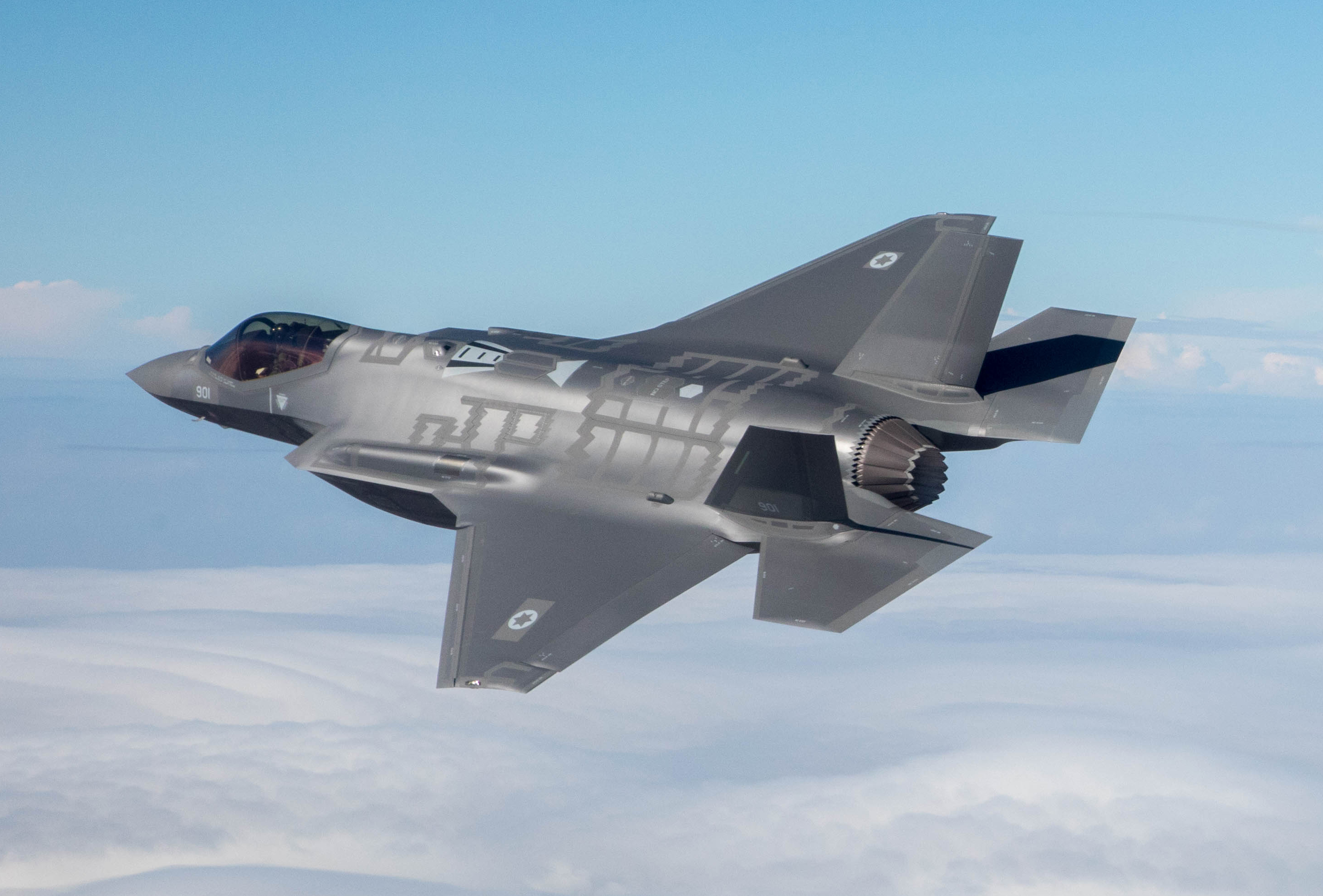
The Israeli version, the F-35I Adir (“Mighty One”), is a one-of-a-kind single-seat, single-engine, all-weather stealth multirole fighter designed to perform ground-attack and air-superiority missions. Its stealth technology allows Israeli pilots to execute top-secret missions without tipping off the enemy. Within 20 seconds of takeoff, a team on the ground can see the route data of the jet, letting the pilot fly at his or her best while knowing that they’ve got support on the ground.
Breaking Defense states, “One of the key capabilities of the F-35 is its capability to absorb electronic signals from radars and air defense systems and to quickly classify them, geolocate them, and display them to the pilot. Then the aircraft can distribute that data to other combatants.”
The F-35 does not need to point directly at its target for its weapons to be effective. Sensors can track and target a nearby aircraft from any orientation, relay information to the pilot through their helmet (so it is visible regardless of the pilot's line of sight), and provide the seeker head of a missile with sufficient data. Electronic warfare and electro-optical systems are designed to detect and scan aircraft, enabling engagement or evasion before a hostile aircraft is detected. The F-35 has external hardpoints to carry missiles, bombs, and drop tanks.
Eitan Ben Eliyahu, former commander of the IAF, told Breaking Defense that the F-35 would bring two main capabilities to the Israeli Air Force’s existing ones: “The stealth, of course, is the obvious one, and it is crucial in an area where different forces, deploy advanced anti-aircraft systems. The second capability is the one that allows this aircraft to receive and distribute all kinds of combat data from a long list of sensors,” which, he said, “is very important for an air force that is performing combat missions almost on a daily basis.”
Based at Nevatim Air Base in southern Israel, the fighters can strike targets in Syria, Iraq, Lebanon, Jordan, most of Egypt, Turkey, and Saudi Arabia without any aerial refueling.
Israel was the first to use the F-35 in a combat arena in 2018.
In 2020, Captain S. (full names are not allowed to be published) became the first female F-35 pilot in the IAF and is believed to be the second woman to fly the plane in combat.
The F-35 gives Israel the edge it needs to take on groups and armies, even those with the most advanced technology.
During the war with Hamas in 2023, F-35I Adir fighter jets shot down a cruise missile, the first known cruise missile intercept by the American-made stealth fighter.
Three planes were delivered in April 2025, bringing the total to 45. On January 18, 2026, Israel received three additional F-35I “Adir” aircraft, bringing its fleet to 48 of 50, all of which have been fully purchased. These aircraft were originally scheduled for delivery in late 2025 but were delayed; the last two are still due to be delivered later in 2026. In June 2024, Israel signed a contract to purchase 25 additional F-35s for $3 billion (from FMF), bringing the total to 75 and enabling a third squadron.
IDF Chief of Staff Lt.-Gen. Eyal Zamir called the integration of the latest additions a significant milestone in enhancing operational power.
The IDF receives additional F-35 fighter jets at the Nevatim Air Force Base. January 18, 2026. (credit: IDF SPOKESPERSON'S UNIT)

Striking Iran
Israel’s October 2024 deep-strike mission into Iran revealed breakthrough F-35 capabilities that astonished the Pentagon. Israeli F-35Is penetrated 1,700 km into Iran and Yemen without refueling, thanks to locally engineered conformal and external fuel tanks, solving a range problem the U.S. has struggled with. Israel’s U.S. ambassador Yechiel Leiter told Israel Hayom that Israel added extended-range fuel tanks to its F-35Is “without compromising stealth” and mounted four missiles on the wings — though analysts note external tanks and wing-mounted weapons typically negate stealth unless jettisoned before enemy airspace. The wing configuration, known as “beast mode,” was used during the June 2025 war with Iran. Leiter also claimed Israeli pilots have more F-35 flight hours than all other partner nations combined, and that Lockheed Martin’s CEO told him Israel’s contributions “are worth many billions to my company.”
The Israeli squadrons also evaded and destroyed advanced Russian-made S-300 systems using a customized Israeli electronic-warfare suite, providing the U.S. with the first real-world validation that stealth jets can survive in heavily defended airspace. The mission produced combat data that now shapes American planning for the Indo-Pacific, where China fields similar air defenses and long-distance operations face the same tanker vulnerabilities.
Beyond combat performance, Israel demonstrated a sustainment model far superior to the U.S. system. While U.S. F-35s suffer a ~51% readiness rate, Israel maintains ~90%, even in wartime, because it built its own maintenance depots, repairs parts locally, and bypasses the Joint Program Office’s bureaucracy. Israel also has unique permission to modify F-35 software, enabling rapid, real-time updates based on combat missions. These “learning files” improve the aircraft’s performance faster than the U.S. system allows.
Collectively, Israel’s thousands of combat flight hours, more than all other F-35 operators combined, have created a feedback loop that feeds directly into U.S. doctrine. Their innovations in range extension, electronic warfare, network integration with older aircraft and air defenses, and high-tempo sustainment now inform American planning for high-intensity conflict, especially in the Pacific. The U.S. effectively gains a real-world testing partner whose battlefield experience accelerates its own readiness and modernization.
The F-35I “Adir” gave Israel a major advantage in the war by combining stealth, advanced sensors, and real-time intelligence. It could detect threats, gather information, and guide other aircraft, allowing Israeli fighters like F-15s and F-16s to operate more safely and strike more accurately. Rather than flying in tight groups, the F-35 led missions from a distance, sharing critical data about enemy defenses and incoming missiles. Acting as both a strike platform and a “force multiplier,” it played a central role in destroying Iranian air defenses and quickly establishing Israeli air superiority.
On March 4, 2026, an Israeli Air Force F-35I “Adir” shot down an Iranian Air Force Yak-130 over Tehran during Operation Roaring Lion. The incident marked the first time an F-35 had destroyed a crewed aircraft in air-to-air combat and the first Israeli shootdown of an enemy aircraft in more than four decades.
Sources: IDF.
“Lockheed Martin F-35 Lightning II,” Wikipedia.
“Lockheed Martin F-35 Lightning II Israeli procurement,” Wikipedia.
“The First F-35 Squadron,” Israel Defense, (October 1, 2015).
Arie Egozi, “Israelis To Boost F-35 Fleet’s Electronic Warfare,” Breaking Defense, (June 15, 2020).
Anna Ahronheim, “Israeli Air Force makes history: First female F-35 pilot,” Jerusalem Post, (September 18, 2020).
“Israel receives 3 new F-35 stealth jets,” China.org.cn, (September 27, 2021).
Jeremy M. Sharp, “U.S. Foreign Aid to Israel,” Congressional Research Service, (February 18, 2022).
“Three new F-35 fighter jets land in Israel,” Jerusalem Post, (November 13, 2022).
Dan Arkin, “Israel Receives Three New F-35 Fighter Jets,” Israel Defense, (July 23, 2023).
Seth J. Frantzman, “Israel uses F-35I to shoot down cruise missile, a first for Joint Strike Fighter,” Breaking Defense, (November 2, 2023).
Yonah Jeremy Bob, “Three new F-35 jets arrive in Israel, air force fleet grows to 48 aircraft,” Jerusalem Post, (January 18, 2026).
“‘Ready to defeat any challenge’: Zamir assesses IAF threat response amid Iran tensions,” Jerusalem Post, (January 21, 2026).
Emanuel Fabian, “Israeli envoy to US claims Israel’s F35I jets now have range-extending fuel tanks,” Times of Israel, (February 16, 2026).
Emanuel Fabian, “In world 1st, Israeli F-35 shoots down Iranian jet in air-to-air combat over Tehran,” Times of Israel, (March 4, 2026).
Guy Plopsky, “Rising Lion’s Air Offensive: Part I,” Foreign Policy Research Institute, (March 12, 2026).
Video: “Israel's F-35 Combat Secrets That Shocked the Pentagon,” Tactical Style.
Photo: Wikipedia.