
Israel faces a variety of military threats that test the Israel Defense Forces’ ability to protect civilians from attack. The Jewish State has defended itself no fewer than ten times on the battlefield, each victory reliant on its superiorly trained manpower and qualitative advantage over the enemy.
The proliferation of rockets and ballistic missiles across the Middle East - particularly in Iran, Syria, Lebanon, and the Palestinian territories - has forced Israel to strengthen a new aspect of its defense doctrine – active anti-missile technology. Given Israel’s small size, ballistic missiles represent an existential threat to Israel, and it must, therefore, have an antimissile defense network that provides protection for the entire population. The philosophy of active missile defense - involving the development of advanced anti-missile systems as well as grouping together air, rocket, and missile defense capabilities - underpins Israel’s defense doctrine, also including early-warning, passive defense, and counter-strike capabilities.
The missile threat is not confined to any single geographic region or rocket type. Israel, in collaboration with the United States, has created a multi-layered missile defense apparatus in order to combat the threat, and this defense system is considered one of the most advanced in the world.
The IDF began using an upgraded siren warning system for incoming projectiles in August 2017. Portable warning systems were deployed in areas not covered by existing sirens, and software upgrades were implemented to pinpoint danger.
U.S.-Israeli Missile Defense
($ millions)
Fiscal Year | Arrow II | Arrow III | David’s Sling | Iron Dome | Iron Beam | Total |
FY2006 | 122.866 | — | 10.0 | — | 132.866 | |
FY2007 | 117.494 | — | 20.4 | — | 137.894 | |
FY2008 | 98.572 | 20.0 | 37.0 | — | 155.572 | |
FY2009 | 74.342 | 30.0 | 72.895 | — | 177.237 | |
FY2010 | 72.306 | 50.036 | 80.092 | — | 202.434 | |
FY2011 | 66.427 | 58.966 | 84.722 | 205.000 | 415.115 | |
FY2012 | 58.955 | 66.220 | 110.525 | 70.000a | 305.700 | |
FY2013 After Sequestration | 40.800 | 74.700 | 137.500 | 194.000 | 447.000 | |
FY2014 | 44.363 | 74.707 | 149.712 | 460.309 (includes supp) | 729.091 | |
FY2015 | 56.201 | 74.707 | 137.934 | 350.972 | 619.814 | |
FY2016 | 56.519 | 89.550 | 286.526 | 55.000 | 487.595 | |
FY2017 | 67.331 | 204.893 | 266.511 | 62.000 | 600.735 | |
FY2018 | 82.300 | 310.000 | 221.500 | 92.000 | 705.800 | |
FY2019 | 163.000 | 80.000 | 187.000 | 70.000 | 500.000 | |
FY2020 | 159.000 | 55.000 | 191.000 | 95.000 | 500.000 | |
FY2021 | 173.000 | 77.000 | 177.000 | 73.000 | 500.000 | |
FY2022 | 173.000 | 62.000 | 157.000 | 1,108.00b | 1,500.000 | |
FY2023 | 173.000 | 80.000 | 167.000 | 80.000 | 500.000 | |
FY2024 | 173.000 | 80.000 | 167.000 | 80.000 | 500.000 | |
FY2024 Supplement | 1,000.000 | 3,000.000 | 1,200.000 | 5,200.000 | ||
FY2025 | 173.000 | 80.000 | 167.000 | 80.000 | 500.000 | |
Total | 2,145.476 | 1,567.779 | 3,828.317 | 6,075.281 | 1,200.00 | 14,816.853 |
a. These funds were not appropriated by Congress but reprogrammed by the Obama Administration from other Department of Defense accounts.
b. P.L. 117-103, the FY2022 Consolidated Appropriations Act provided $108 million in Iron Dome appropriations from the Defense Department's Procurement, Defense-Wide and Research, Development, Test and Evaluation Defense-Wide accounts. Section 8142 of the act also provided $1 billion in supplemental aid for Iron Dome for FY2022-FY2024.
*P.L. 117-103, the FY2022 Consolidated Appropriations Act provided $108 million in Iron Dome appropriations from the Defense Department’s Procurement, Defense-Wide and Research, Development, Test and Evaluation Defense-Wide accounts. Section 8142 of the act also provided $1 billion in supplemental aid for Iron Dome for fiscal years 2022-2024.
Click here to read about the Iron Dome missile defense system
Name: David’s Sling
 |
Developers: Rafael Advanced Defense Systems; Raytheon
Target: Medium- to long-range rockets (63-185 mile range)
Missile: Stunner 2-stage Interceptor with electro-optical sensor & radar targeting
Timetable: First Test - Nov. 2012; Second Test Interception – Nov. 2013
Budget: Approximately $3.83 billion in U.S. funding through FY2025
Overview: David’s Sling was developed as a flexible, multipurpose weapon system capable of engaging aircraft, cruise missiles, ballistic and guided missiles. Its Stunner interceptor missile is designed for land-based, maritime, and airborne applications and is fitted with a dual-band imaging infrared and radio-frequency seeker, as well as a multi-pulse rocket motor enabling all-weather operation. David’s Sling was designed to target incoming missiles during their terminal phase, unlike the Iron Dome, which intercepts missiles at their highest trajectory. Its primary role will be to intercept medium- and long-range ballistic and guided rockets, such as the Iranian Fajr-5 and BM-25, as well as the Syrian M-600 and Yakhont supersonic cruise missile. It will bridge the Iron Dome (short-range interceptor) with the Arrow Theatre (long-range interceptor). The use of US parts in Israeli Missile Defense Systems is contingent on being provided a veto over the export of the missile systems. In May 2014, the United States used this veto to prevent the Israeli military from selling the David Sling to Poland. The US spending bill for FY 2015 provides $3.7 billion in military aid to Israel, including $268 million designated for David’s Sling and the Arrow defense systems. In December 2014, Ari Sacher of Rafael’s Air Superiority Systems Division stated in an interview with the Jerusalem Post that the new projectiles that they are testing for the David’s Sling system will be able to intercept projectiles from well beyond Israel’s borders. Sacher said that the missile system “has an interception range which ensures intercept before a threat enters Israeli territory.”
The U.S. Missile Defense Agency and the IDF carried out a successful test of the David’s Sling system in April 2015, stating that “Next year it’s going to be operational.” Israel Defense Minister Moshe Ya’alon held a press conference with U.S. House Speaker John Boehner, during which he praised the work of the engineers and individuals involved and called the successful test a “major milestone.”
Israel’s Defense Ministry and the Pentagon’s Missile Defense Agency completed the last phase of trials for the David’s Sling system on December 21, 2015. Agency leaders said David’s Sling met performance standards in several tests, calling the system “efficient, fast, and deadly.” The David’s Sling system is capable of destroying heavy long-range rockets, short-range ballistic missiles and mortars, and enemy aircraft. This was the fourth and final test of the system.
The Israeli Air Force began to take delivery of the David’s Sling missile system in early March 2016. Delivery of the system will be phased, according to the Defense Ministry, with phase one including the multimission radar, Stunner interceptor missiles, and the battle management center.
The David’s Sling system was announced as fully operational on April 2, 2017, in a ceremony at the Hatzor Air Force Base near Ashdod attended by Prime Minister Benjamin Netanyahu, Defense Minister Avigdor Liberman, and other top Israeli brass.
David’s Sling was deployed for the first time on July 24, 2018, when two missiles from the Syrian civil war entered Israeli airspace. Two David’s Sling interceptors were fired at the Syrian missiles, but they did not successfully destroy the targets. The missiles landed in Israel and no injuries or damage were reported.
During the regional escalation that followed October 7, 2023, David’s Sling operated as the middle tier of Israel’s layered air defense network, designed to counter medium- and long-range rockets, cruise missiles, and certain ballistic threats. The system was referenced as part of Israel’s defensive response during Iran’s April 2024 attack, working in coordination with Arrow and Iron Dome.
In 2026, the system successfully completed advanced operational testing conducted jointly with the U.S. Missile Defense Agency and Rafael Advanced Defense Systems. The tests, which simulated both current and emerging threats, including rockets, ballistic missiles, cruise missiles, aircraft, and drones, demonstrated significant upgrades to interception capabilities developed from real-world lessons learned during the war with Hamas, Hezbollah, the Houthis, and Iran. The system was upgraded in real time during the conflict. The latest testing focused on handling multiple simultaneous threats in high-intensity, multi-front scenarios, with officials noting that ongoing U.S.-Israel cooperation strengthens interoperability between the two countries’ defense systems.
David’s Sling missiles cost about $1 million each, compared to Iron Dome missiles, which run closer to $70,000.
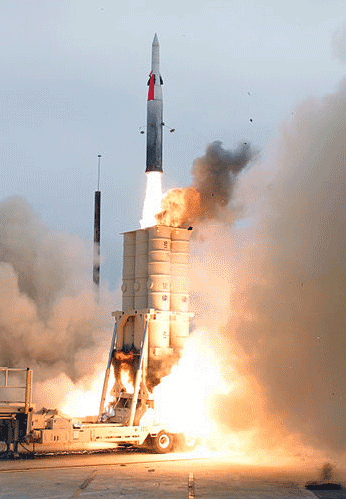 |
Name: Arrow Theatre System
Developers: Israel Aerospace Industries (IAI); Boeing
Target: Long-range ballistic missiles; high-altitude nuclear warheads (Arrow-3)
Cost: $3 million per unit
Budget: Approximately $3.71 billion in combined U.S. funding for Arrow II and Arrow III through FY2025 (Arrow II: $2.15B; Arrow III: $1.57B), in addition to ~$300 million from the Israeli government
Components: Interceptor; early-warning radar; command & control center; launcher
Firsts: Deployment (Arrow2)-October 2000; Test (Arrow3) – January 2012
Overview: The Arrow is designed to give Israel a full theatre ballistic missile defense capability. The original versions (Arrow-1 & -2) were initially greenlit in 1988 and became operational in 2000 to protect against long-range conventional missiles. In August 2008, the US and Israel began production of the Arrow-3, which is comprised of an exoatmospheric interceptor and proportional navigation to directly target an incoming missile outside of the earth’s atmosphere, thereby preventing collateral damage from impact with a nuclear warhead. The first successful test of the updated Arrow-3 system took place on February 19, 2018, following two unsuccessful tests due to adverse weather. Further tests of the system are planned on the Alaskan island of Kodiak, where the Israeli military and their American counterparts can conduct more realistic testing.
On October 31, 2023, Israel’s Arrow system carried out its first reported combat interception, downing a ballistic missile launched from Yemen toward southern Israel. The system was again employed during Iran’s April 13–14, 2024, direct missile attack on Israel, when Arrow-2 and Arrow-3 intercepted long-range ballistic threats as part of Israel’s layered air defense response.
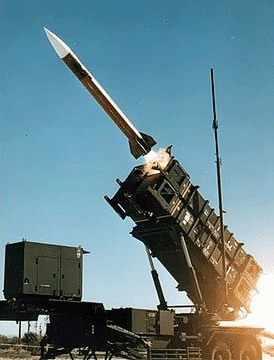 |
Name: Patriot
Developers: Raytheon; Hughes; RCA
Target: High-performance aircraft; mid- and long-range tactical ballistic missiles
Missile: Surface-to-Air Interceptor (SAM)
Components: Stationary launcher (4 missiles); radar; command & control center
Timetable: First deployment (US) – 1984; First Activity (Israel) – 1991
Overview: The Patriot missile system was first used in Israel during the Gulf War when Saddam Hussein fired Scud missiles at Israel, and it had a 40% claimed success rate in shooting down incoming missiles. The Israeli government was dissatisfied with the system's performance and has worked to update it and phase it out in favor of David’s Sling. The upgraded versions, PAC-2 and -3, provide a more reliable and lethal capability to defeat advanced threats – including aircraft, tactical ballistic missiles, cruise missiles, and UAVs – in almost all operational combat environments. The latest Israeli version is set to replace the four-missile stationary launcher with a 16-missile launcher, making it better equipped to contend with a prolonged barrage of missiles. In 2006, Israel stationed a Patriot battery in Haifa to protect from Hezbollah rockets. Another was placed in the north in 2012. In August 2013, the Israeli Air Force planned to place a Patriot battery in the Galilee to protect against threats from Syria. Israel purchased four Patriot missile batteries from Germany in May 2015.
During the war period following October 7, Patriot batteries remained part of Israel’s air-defense network. However, Israeli officials announced in 2024 that the aging system would be phased out after decades of limited operational use, as newer systems such as David’s Sling assumed greater roles in missile and UAV interception.
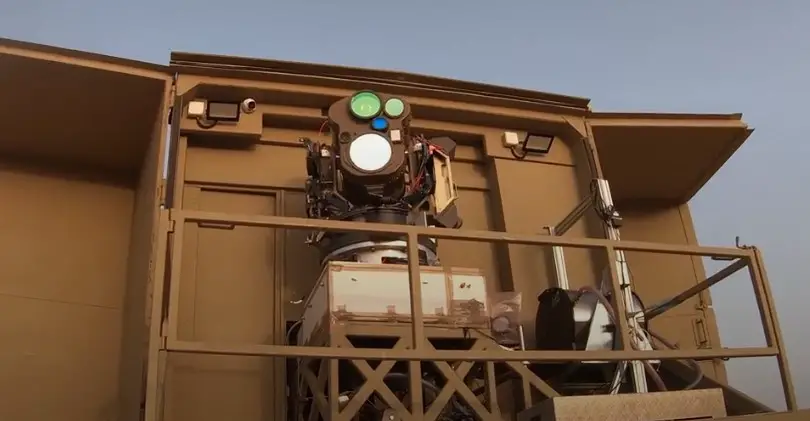 |
Name: Iron Beam
Developers: Raytheon; Ministry of Defense
Target: Rockets, mortars, drones, unguided projectiles, and anti-tank guided missiles.
Budget: Approximately $1.2 billion in U.S. funding through FY2025
Missile: None
Components: Fiber laser
Timetable: Deployment by 2024
Iron Beam (Hebrew: קֶרֶן בַּרְזֶל, keren barzel) is a directed-energy air-defense weapon system unveiled at the Singapore Airshow on February 11, 2014, and deployed by Israeli defense contractor Rafael Advanced Defense Systems on August 17, 2020. The system is designed to destroy short-range rockets, artillery, drones, and mortars; it has a range of up to 4.3 miles, too close for the Iron Dome system to intercept projectiles effectively.
Iron Beam uses a fiber laser to destroy an airborne target within 4–5 seconds of firing. Whether operating as a stand-alone system or with external cueing as part of an air-defense system, a surveillance system detects a threat and tracks vehicle platforms to engage. The main benefits of using a directed energy weapon over conventional missile interceptors are lower per-shot cost, unlimited firings, lower operational costs, and reduced manpower. There is also no interceptor debris to fall on the area protected.
The war that began on October 7 accelerated efforts to operationalize Iron Beam as a cost-effective complement to interceptor-based systems. The U.S. FY2024 supplemental security package included $1.2 billion for Iron Beam procurement. In December 2025, Rafael announced delivery of the first operational high-power laser system to the IDF following successful testing and readiness milestones.
Name: Barak-8
Developers: Israel Aerospace Industries
Target: Aerial platforms and munitions, including aircraft, helicopters, unmanned aircraft, and sea-skimming missiles
Components: Phased-array multi-mission radar, two-way data link, and command and control system
Timetable: Deployed
Israel has a system to protect against cruise missiles like the ones used by Iran to attack oil installations in Saudi Arabia. The Barak-8ER system, developed by Israel Aerospace Industries (IAI), enhances anti-tactical ballistic missile capabilities, enabling it to intercept a wide range of missiles and is highly immune to electronic countermeasures. The Barak-8 interceptor is part of the Barak MX System. The interceptors boast vertical-launch capabilities, 360-degree coverage, rapid response, short ranges, and an active, high-end RF seeker for targets with low radar cross-section (RCS) and high maneuverability. The regular ship-based Barak-8 has an effective range of roughly 50 miles. The ER version, with its add-on booster, has a range of nearly 100 miles.
During the post-October 7 multi-front conflict, naval variants of the Barak air-defense system were employed to intercept aerial threats, including UAVs launched toward Israel. In June 2025, the IDF reported the first operational deployment of the Barak Magen and Long-Range Air Defense (LRAD) systems to intercept aerial threats as part of Israel’s layered defense network.
Sources: IDF Spokesperson.
Raytheon Company.
Department of Defense.
CRS Report.
Space Daily.
Missile Monitor.
MissileThreat.Com.
Defense Industry Daily.
StraFor.
CIA Proliferation Report.
Gill Cohen, “Defense Minister Ya’alon: Israel recieved 4 Patriot missile batteries from Germany,” Haaretz, (May 10, 2015).
Barbara Opall-Rome, “US, Israel Start Delivering David’s Sling System to Israel Air Force,” DefenseNews, (March 2, 2016).
Rebecca Shimoni Stoil, “US House okays funding boost for Israel’s missile defense,” Times of Israel (June 17, 2016).
Anna Aronheim, “David’s Sling comes online as latest component to Israel’s air defense shield,”Jerusalem Post, (April 2, 2017).
Shoshana Solomon, IDF upgrades siren system to pinpoint incoming rocket alerts, Times of Israel, (August 3, 2017).
Anna Aronheim, Israel Successfully Carries out Arrow 3 Test, Jerusalem Post, (February 19, 2018).
Israel thanks US for ‘record-breaking’ missile defense aid, ABC News, (March 26, 2018).
Arie Egozi, “Israel Boasts New Operational Cruise Missile Defense,” Breaking Defense, (October 24, 2019).
Jeremy M. Sharp, “U.S. Foreign Aid to Israel,” Congressional Research Service, (February 18, 2022).
Seth J. Frantzman, “In first, Israel’s Arrow 2 air defense system intercepts ballistic missile near Red Sea: IDF,” Breaking Defense, (October 31, 2023).
Gerry Doyle, Mariano Zafra, Adolfo Arranz, Jitesh Chowdhury, “Israel’s Iron Dome,” Reuters, (April 18, 2024).
Emanuel Fabian, “Patriot air defenses to be mothballed after decades of mostly gathering dust,” Times of Israel, (April 30, 2024).
Emanuel Fabian, “IAF says over 150 enemy drones intercepted during war; detecting them a challenge,” Times of Israel, (June 10, 2024).
“‘David’s Sling’ and ‘Arrow’ anti-missile systems: How Israel defends against Iranian retaliation,” ABC News, (June 13, 2025).
“What is Israel’s multi-layered defence against Iranian missiles?” Reuters, (June 16, 2025).
“For the First Time, the 'Barak Magen' Aerial Defense System and the Long-Range Air Defense System 'LRAD' Were Operationally Employed,” IDF, (June 16, 2025).
Steven Scheer, “Israeli anti-missile laser system 'Iron Beam' ready for military use this year,” Reuters, (September 18, 2025).
“Rafael Delivers 1st Operational High-Power Laser System - Iron Beam to the IDF,” Rafael, (December 28, 2025).