Operation Opera - Raid on Iraqi Nuclear Reactor
(June 7, 1981)
Operation Opera is the codename for the 1981 Israeli Air Force raid that completely destroyed the Iraqi nuclear reactor at Osirak.
- Overview
- Diplomacy Fails
- Internal Opposition
- Psychological Factors
- Logistics & Mission
Overview
(Click to Enlarge) |
American and coalition forces may have faced
a nuclear-armed Iraq during the Persian
Gulf War in 1991, and again during the U.S. invasion of Iraq in 2003, had Israel not destroyed Iraq’s nuclear reactor in 1981.
The attack, codenamed “Operation Opera,”
surprised the Iraqis and the rest of the world, though for Israel it had long been in
planning. It was only after the failures on the diplomatic front, and
the consultation of military and intelligence experts with Prime Minister Menachem Begin’s cabinet,
that Israel chose to go ahead with the attack on the Iraqi reactor.
Iraq established its nuclear program in the 1960s,
but was unable to make significant progress on it until the late 1970s.
In the 1970s, Iraq attempted to purchase a plutonium production reactor
from France. Iraq also wanted to purchase a reprocessing reactor. France
denied these requests but, instead, agreed to build a research reactor
and research laboratories. With French support, Iraq began construction
of a 40-megawatt light-water nuclear reactor at the Al Tuwaitha Nuclear
Center. The type of reactor was named Osiris, after the Egyptian god
of the dead. The French renamed the reactor they were providing to Iraq
the Osiraq, to include the name of Iraq in the title. The Iraqis called
it “Tammuz” after the month in the Arabic calendar that the
Baath party came to power in 1968. 1
During the Iran-Iraq war, on September 30, 1980, a pair of Iranian Phantom jets, part of
a group of aircraft that were attacking a nearby conventional power
plant, bombed the Osirak reactor but only light damage was reported.
Israeli intelligence confirmed Iraq’s intentions
to develop nuclear weapons at the Osirak nuclear reactor and were aware
of Iraqi threats against Israel. While, in 1981, some estimates showed
Iraq was five to ten years away from building nuclear weapons, other
intelligence reports estimated that Iraq could have a bomb within a
year or two.2 It was
later proven that Iraq was within a year of obtaining nuclear weapons.3
Israel engaged in an intense diplomatic effort to try
to halt French financing and support for the Iraqi project. The Israelis
knew that time was short because, if diplomatic efforts failed, they
would have to launch a military strike before the reactor was loaded
with nuclear material to avoid the danger of nuclear fallout from the
attack.4
The decision to use military means to destroy the Iraqi
reactor was not taken lightly.
Diplomacy Fails
When the Israelis learned of the Iraqi threat, during Yitzhak Rabin’s term,
they began diplomatic negotiations. Upon Begin’s election as Prime
Minister, he appointed Moshe
Dayan as Foreign Minister. Dayan engaged in a feverish diplomatic
battle to try to avert a nuclear-armed Iraq.5
Israeli diplomacy engaged France, Italy (the main suppliers
to the reactor) and the United States. A high-level Israeli negotiating
team, led by then-Minister of Foreign Affairs, Yitzchak
Shamir, negotiated with French presidents Valery Giscard-D’Estaing
and his successor François Mitterand. The French proved intransigent,
looking out for their own economic interests as Iraq was by far their
top customer for military hardware. The payments to France came mostly
in the form of oil. According to Shamir, French Minister for Foreign
Affairs Claude Cheysson told him that there were only two major Arab
powers: Iraq and the PLO.
Despite Shamir’s personal affinity toward the French, as they had
sheltered him while he was a member of the pre-state uprising against
the British occupation of Israel,
he was extremely disappointed when he realized that France was unwilling
to cooperate and prevent Saddam
Hussein’s Iraq from becoming a nuclear state, despite urgent
and emotional pleas by the Israelis that Iraq was preparing a nuclear
holocaust against Israel and the Jewish people.6
Shamir reported that the Italians, a significant consumer
of Iraqi oil, were equally uncooperative. They denied any involvement
in Osirak and responded to the Israeli appeals with indifference.7 Any hope that the nuclear threat to Israel could be contained
by diplomatic means rested solely on American cooperation.
In meetings with the Defense Secretary Casper Weinberger
and Secretary of State Alexander Haig, there was agreement about the
Israeli assessment regarding the Iraqi nuclear threat. American representatives
even verified Israeli assessments that Iraq was working to reach nuclear
capability and would exploit the ability to influence and destroy Israel.
Despite the American consensus, the Americans refused to act, perhaps
because they did not truly grasp the danger, or because they did not
want to upset Iraq, then fighting America’s enemy, Iran. 8 According to Moshe
Nissim, then Israeli Minister of Justice, had Iraq obtained nuclear
weapons, it would have been wooed by the U.S. and the Soviet Union.9
Internal Opposition
Despite the failure of diplomacy, the Israeli government
still engaged in a debate over the advisability of military action against
the reactor. According to Yitzchak
Shamir, some “greatly exaggerated the backlash that Israel
would face.” Shimon Peres,
then chairman of the Labor Alignment in the Knesset,
tried to deter the government from carrying out the attack, claiming
that Israel would be like a “thistle in the wilderness” after
the operation.10
Peres was not alone in opposing the raid at Osirak.
In deliberations before the Cabinet, opponents of the attack represented
about half of those who engaged in discussions. They argued that the
attack would unite the Arab world, be considered an act of war, would
harm the peace agreement with Egypt,
would result in the destruction of Israel’s nuclear reactor in
Dimona, encourage an arms buildup in the Arab world, and lead to a European
and American embargo on Israel.11
According to Moshe Nissim, it was the need to contend
with the danger of an atom bomb in the hands of a dangerous and irresponsible
Arab ruler who would not hesitate to use it against Israel that convinced
Begin of the urgency and necessity to destroy the Iraqi reactor.12 In addition, Begin knew the Likud had a chance of
losing the upcoming elections. If Labor,
led by Shimon Peres, came
into power, Begin feared the plans to prevent Iraq from obtaining a
nuclear arsenal would be shelved. Begin, however, was not about to let
Israel’s security be weakened due to election considerations.13
Psychological Factors
The psychology of the Holocaust played an important role in Menachem Begin’s decision making. According
to Rafael Eitan, chief
of staff at the time of the attack, Begin insisted that he “will
not be the man in whose time there will be a second Holocaust.”14
Before the decision was made, Israel investigated a
variety of options for destroying the reactor – commandos, paratroopers,
helicopters and Phantom jets.
The Israelis faced myriad obstacles. They did not know the capability
of Iraq’s aerial defenses. The distance between Israel and Iraq
was also a challenge – to fly over enemy territory undetected without
refueling posed numerous difficulties. In 1979, however, the Israelis
discovered that their recently acquired F-16s were capable of carrying two one-ton bombs at low altitude without refueling.
Yet when Israel discovered that it had the capability
to launch the attack, it did not jump into it. Instead, in an unconventional
move, Chief of Staff Rafi Eitan instead allowed the officers of the General Staff and Intelligence to
express their views on the merits of such an attack. At the time, supporters
and opponents were equally divided but, according to Eitan, those who
opposed the operation in 1981 now realize that they were wrong.15
The Cabinet received word that “a shipment of
90 kilograms of enriched uranium fuel rods is expected from France to
Iraq, ready for radiation.” The moment that the rods were placed
in the reactor, there would be a danger of radiation fallout if the
reactor was attacked. This was tthe decisive factor for Deputy Prime
Minister Yigael Yadin, who
had initially opposed the plan, but changed his mind after receiving
the news about the fuel rods.16
Logistics
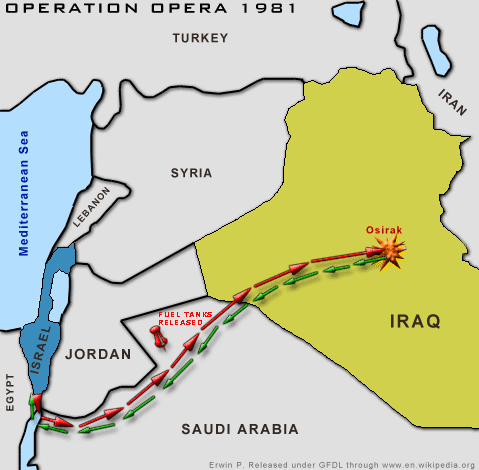
The Israelis had to remove some of the F-16s' fuel
tanks to make room for the heavy munitions necessary for the attack.
They also needed to assign F-15s to guard the bombers in case there was need to engage the Iraqis. The
mission was aborted once and the date of the attack was rescheduled
for the next month.
On June 7, 1981, the mission was given a green light. IDF ChiefofStaff, Lt. Gen. Rafael Eitan, briefed the pilots personally. Displaying unusual
emotion, he told them: “The alternative is our destruction.” With that speech in mind, fourteen F-15s and F-16s flew off
the runway of Etzion Air Force base in the Negev, and proceeded to pass over Jordanian, Saudi, and Iraqi airspace, to
attack the French-built Iraqi nuclear reactor. The flight to Iraq was done low-level so as to minimize the possibility of being spotted by aircraft radar in any of the Arab nations the planes flew over.
King
Hussein of Jordan was vacationing in Aqaba during the attack. Seeing
the planes pass over his head, he immediately notified the Iraqis to
warn them that they may be the targets of an Israeli attack. It appears
that Iraq never got the message as communication errors prevented the
message from reaching Iraq.17 18
Without King Hussein's warning, Iraqi defenses were caught completely by surprise and opened fire too late.
In one minute and twenty seconds, the reactor lay in ruins.
The attack was universally criticized. The United States voted for a Security Council resolution condemning Israel and, as a punishment, delayed a shipment of aircraft
to Israel that had already been authorized.
The destruction of the reactor helped numerous countries
besides Israel. Had Iraq obtained nuclear weapons they might have been able to achieve regional
hegemony.19 Ten years after the attack, the American
government noted this. In June 1991, during a visit to Israel after
the Gulf War, then-Defense
Secretary Richard Cheney gave Major General David
Ivry, then commander of the Israeli
Air Force, a satellite photograph of the destroyed reactor. On the
photograph, Cheney wrote, “For General David Ivri, with thanks
and appreciation for the outstanding job he did on the Iraqi Nuclear
Program in 1981, which made our job much easier in Desert Storm.”20
Professor Louis Rene Beres wrote that, “Israel’s
citizens, together with Jews and Arabs, American, and other coalition
soldiers who fought in the Gulf
War may owe their lives to Israel’s courage, skill, and foresight
in June 1981. Had it not been for the brilliant raid at Osiraq, Saddam’s
forces might have been equipped with atomic warheads in 1991. Ironically,
the Saudis, too, are in Jerusalem’s debt. Had it not been for Prime
Minister Begin’s resolve to protect the Israeli people in 1981,
Iraq’s SCUDs falling on Saudi
Arabia might have spawned immense casualties and lethal irradiation.” 21
According to Yitzhak Shamir, “Deterrence was not
attained by other countries – France and Italy – and even
the United States. It was attained by the State of Israel and its Prime
Minster who decided, acted and created a fact that no one in the world
today – with the exception of our enemies – regrets.”22
Sources: Federation
of American Scientists, Israel's Strike Against the Iraqi Nuclear
Reactor 7 June, 1981, Jerusalem: Menachem Begin Heritage Center, 2003.
1 “Osiraq/Tammuz
I,” WMD Around the World, Federation of American Scientists
2 Ibid
3 Maj. Gen. (res.) David Ivry, “The Attack
on the Osiraq Nuclear Reactor – Looking Back 21 Years Later,” Israel’s Strike Against the Iraqi Nuclear Reactor 7 June,
1981, Jerusalem: Menachem Begin Heritage Center: 2003, 35.
4 “Osiraq/Tammuz I.”
5 Dr. Arye Naor, “Analysis of the Decision-Making
Process,” Israel’s Strike Against the Iraqi Nuclear Reactor
7 June, 1981, Jerusalem: Menachem Begin Heritage Center: 2003,
26
6 Yitzhak Shamir, “The Failure of Diplomacy,” Israel’s Strike Against the Iraqi Nuclear Reactor 7 June,
1981, Jerusalem: Menachem Begin Heritage Center: 2003, 13-14.
7 Ibid 15.
8 Ibid.
9 Moshe Nissim, “Leadership and Daring in the
Destruction of the Israeli Reactor,” Israel’s Strike
Against the Iraqi Nuclear Reactor 7 June, 1981, Jerusalem: Menachem
Begin Heritage Center: 2003, 21.
10 Shamir, 15-16.
11 Nissim, 19.
12 Ibid 20.
13 Ibid 22-23.
14 Ibid 31.
15 Rafael Eitan, “The Raid on the Reactor
from the Point of View of the Chief of Staff,” Israel’s
Strike Against the Iraqi Nuclear Reactor 7 June, 1981, Jerusalem:
Menachem Begin Heritage Center: 2003, 31-32
16 Ibid 32.
17 Ibid 33.
18 Shlomo Nakdimon, “Comments and Insights
on ‘Operation Opera,’” Israel’s Strike Against
the Iraqi Nuclear Reactor 7 June, 1981, Jerusalem: Menachem Begin
Heritage Center: 2003, 65.
19 Major General (res.) Yaakov Amidror, “Intelligence
and the Raid on the Reactor,” Israel’s Strike Against
the Iraqi Nuclear Reactor 7 June, 1981, Jerusalem: Menachem Begin
Heritage Center: 2003, 48
20 David Ivri, 35.
21 Louis Rene Beres and Tsiddon-Chatto, Col. (res.)
Yoash, “Reconsidering Israel’s Destruction of Iraq’s
Osiraq Nuclear Reactor,” Temple International and Comparitive
Law Journal 9(2), 1995. Reprinted in Israel’s Strike Against
the Iraqi Nuclear Reactor 7 June, 1981, Jerusalem: Menachem Begin
Heritage Center: 2003, 60.
22 Yitzhak Shamir, “The Failure of Diplomacy,” Israel’s Strike Against the Iraqi Nuclear Reactor 7 June,
1981, Jerusalem: Menachem Begin Heritage Center: 2003, 16-17.
|