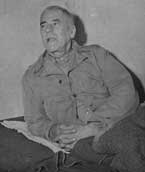
Wilhelm Frick
A. FRICK'S POLITICAL CAREER.
Frick's important contribution to the Nazi conspiracy was in the field
of government administration. He was the administrative brain who organized
the German state for Nazism and who geared the machinery of the state
for aggressive war. It was Frick who transformed the plans and programs
of his fellow conspirators into political action. He was the manager
of the Nazi conspiracy. He was entrusted with broad discretion, exercised
great power, and knew the criminal purpose of the acts he committed.
The conspiratorial activities of Frick cover a period of 25 years,
beginning as early as 1920 (086-PS).
A brief summary of Frick's activities will show how extensive was his
contribution to the Nazi conspiracy. He took part in Hitler's Munich
Beer Hall Putsch of November 1923, and was sentenced for his participation.
He helped Hitler become a German citizen. To maintain the Nazi regime
in the first 2 years of its existence and to achieve some of its most
important immediate purposes, Frick signed 235 laws and decrees during
that period, most of which are published in the Reichsgesetzblatt.
For the first time in German history a uniform police system for the
whole German Reich was created. Frick was its creator and its supreme
head. He appointed the Gestapo chief, Heinrich Himmler, Chief of the
German Police. Frick was the highest controlling authority over concentration
camps. He personally inspected these camps. His Ministry of the Interior
made the necessary legal arrangements for acquiring land for the Auschwitz
Concentration Camp. Through his Medical Division, Frick controlled the
Nazi asylums and so-called medical institutions in which forced sterilizations
and murders of thousands of Germans and of foreign laborers were carried
out. The racial legislation, including the Nurnberg Laws, was drafted
by Frick and administered under his jurisdiction. Frick introduced the
Yellow Star as a sign of stigmatization of the Jews.
In the course of his active participation in the Nazi conspiracy, Frick
occupied a number of important positions. Among his Nazi Party positions
are the following: member of the Nazi Party from 1925 to 1945; Reich
Leader of the Nazi Party from 1933 to 1945; floor leader of the Nazi
Party in the Reichstag from 1928 to 1945. His governmental positions
were: chief of a division of the Munich Police Department from 1917
to 10 November 1923, 2 days after Hitler's Putsch; Nazi Minister of
the I Interior and of Education in the German State of Thuringia from
January 1930 to April 1931; Reichsminister of the Interior from 30 January
1933 to 20 August 1943; member of the Reich Defense Council as General
Plenipotentiary for the Administration of the Reich from 21 May 1935
to 20 August 1943. On 20 August 1943, Frick was appointed Reich Protector
of Bohemia and Moravia, and he held this last position until 1945. (2978-PS)
B. FRICK'S PARTICIPATION IN PROMOTING THE NAZI
CONSPIRATORS' ACCESSION TO POWER.
Frick has admitted that he was one of the men who helped Hitler to
power (3043-PS).
(1) Frick's activities in early days of conspiracy. In the very
beginning of the Nazi Party and its conspiracy, Frick misused his various
governmental positions in order to hold a "protecting hand over
the National Socialist Party and Hitler." This he stated solemnly
in his speech before the Munich People's Court during the Putsch trial
(3119-PS; see "The Hitler Trial Before the People's Court in Munich"
(Der Hitler Prozess vor dem Volksgericht in Muenchen), published by
Knorr & Hirth, G.M.B.H., Muenchen, 1924.)
When Hitler was arrested during those early revolutionary days, Frick
used his position in the Munich Police Department to release him under
his own authority (3124-PS).
Frick participated in the Nazi Beer Hall Putsch of 8 November 1923-9
November 1923, and was tried with Hitler on a charge of complicity in
treason. He was convicted and received a suspended sentence of one year
and three months in a fortress (3132-PS).
Hitler's appreciation of Frick's assistance during those years is demonstrated
by the fact that Hitler honored Frick by mentioning his name in Mein
Kampf, the Nazi bible. Only two other defendants in this proceeding,
Hess and Streicher, share that honor. In this reference Hitler said
of Frick:
"He [Munich Police President Poehner] and his coworker Dr. Frick
are in my estimation the only men in government positions, who have
the right to collaborate in the establishment of a Bavarian Nation."
(2) Frick's activities as member of Reichstag. Having been elected
to the Reichstag on 4 May 1924, Frick stated that it was his task not
to "support, but to undermine the parliamentary system" (2742-PS)
In the Reichstag Frick immediately proposed those discriminatory measures
against the Jews which were enacted after he and the other Nazi conspirators
had come into power in 1933. On 25 August 1924 Frick demanded in the
Reichstag that all Jews be removed from public office (3128-PS). Two
days later he returned with a motion calling for "special legislation
for all embers of the Jewish race"
In 1930, a significant investigative report was prepared by the Prussian
Ministry of the Interior (2513-PS). This official report analyzed the
criminal activities of Hitler, Frick, and other Nazis. It stated that
Frick had to be regarded as the most influential leader of the NSDAP
next to Hitler. This document reported that at the 1927 Party Congress
in Nurnberg, Frick said that the Nazi Party would first infiltrate into
parliament and misuse its privileges, then abolish it and thus open
the way for racial dictatorship. The document also reported that Frick
stated in a speech in 1929 at Pyrite that this fateful struggle would
first be taken up with the ballot, but that this could not continue
indefinitely, for history had taught that in a battle "blood must
be had and iron broken." As early as 1929, according to this same
report, Frick announced that a Special Peoples' Court would be created,
in which the enemies of the Nazi Party would be called to account for
their political acts (2513-PS).
(3) Frick's activities as Minister of Interior and Education in
Thuringia. Frick's prominent role in helping to bring the Nazis
to power was recognized when on 23 January 1930 he was appointed Minister
of the Interior and Education in the German State of Thuringia, the
first ministerial appointment controlled by the National Socialists
It was in this capacity that Frick began his manipulation to provide
Adolf Hitler with German citizenship, an essential step toward the realization
of the Nazi conspiracy. It must be remembered that Hitler at that time
was not a German citizen and was regarded by the Prussian police administration
as an undesirable alien. This lack of German citizenship was most damaging
to the cause of the Nazi Party because, as an alien, Hitler could not
become a candidate for the Reich Presidency in Germany.
In the beginning, Frick was unsuccessful when he tried to grant Hitler
German citizenship by appointing Hitler as police officer in Thuringia,
thus conferring German citizenship automatically. Later he succeeded
with a similar maneuver. This was expressly confirmed by Otto Meissner,
former State Secretary and Chief of Hitler's Presidential Chancellery,
in an affidavit which reads in part as follows:
"Frick also, in collaboration with Klagges, Minister of Brunswick,
succeeded in naturalizing Hitler as a German citizen in 1932 by having
him appointed a Brunswick government official (Counsellor of Government).
This was done in order to make it possible for Hitler to run as a
candidate for the office of President of the Reich." (3564-PS)
During his tenure as State Minister in Thuringia, Frick again misused
his official authority in order to advance the Nazi conspiracy through
measures designed to establish Nazi control over the police, and over
the administration and curriculum of universities and schools. Three
of his measures are specially note-worthy:
(a) Appointment of the Nazi race theoretician, Dr. Guenther, as Professor
at the University of Jena, against the wishes of the faculty.
(b) Compulsory introduction in the schools of Nazi prayers whose nationalistic,
militaristic, and blasphemous character was such that three out of the
five were declared unconstitutional by the German Constitutional Court
on 11 July 1930.
(c) Infiltration of Nazis in the Police, which twice provoked a rupture
in the administrative relations between the State of Thuringia and the
Reich Ministry of the Interior, and resulted in the withdrawal of the
important police subsidy payment of the Reich to the State. (3122-PS;
3128-PS)
C. FRICK'S PARTICIPATION IN THE ESTABLISHMENT OF TOTALITARIAN
CONTROL OVER GERMANY
Frick's appointment as Reichminister of the Interior in the first Hitler
Cabinet of 30 January 1933 gave him the task of "strengthening
the power of the government and to secure the New Regime" (3128-PS).
(1) Powers of Frick as Minister of Interior. To this task his
Ministry was perfectly suited. As Minister of the Interior Frick became
responsible for the realization of a large part of the conspirators'
program, through both legislation and administration. His Ministry was
charged especially with the following tasks:
(a) Internal Administration (State and local governments; State and
Local Civil Service).
(b) Relations between Nazi Party and State.
(c) Elections.
(d) Citizenship.
(e) Racial Law and Policy (Jewish Question, Eugenics)
(f) Armed Forces and Reich Defense (Conscription).
(g) Establishment of the New Order in occupied and annexed territories.
(h) Legislation, Constitutional Law (civil liberties).
(i) Police Forces (including Gestapo, protective custody, concentration
camps). (3303-PS; 3475-PS)
The names of the men who, according to (3475-PS), worked under Frick's
supervision are significant. Among the subordinates of Frick were "Reich
Health Leader, Dr. Conti," "Reich Fuehrer SS and Chief of
the German Police, Heinrich Himmler," and "Reich Labor Service
Leader, Konstantin Hierl." Frick was, therefore, supreme commander
of three important pillars of the Nazi state: The Nazi Public Health
Service, the Police System, and the Labor Service.
The wide variety of the activities of Frick as Reich Minister of the
Interior can be judged from the following catalogue of his functions:
He had final authority on constitutional questions, drafted legislation,
had jurisdiction over governmental administration and civil defense,
and was the final arbiter of questions concerning race and citizenship.
The Manual for Administrative Officials also lists sections of his ministry
concerned with administrative problems for the occupied territories,
including annexed Bohemia and Moravia, and the New Order in the East
(3475-PS).
The Ministry of the Interior also had considerable authority over the
civil service, including such matters as appointment, tenure, promotion
and discharge. The Manual for Administrative Officials (3475-PS) states
that Frick's functions included supervision of the general law of civil
servants, civil servants' policies, civil service aspirants, education
and training of civil servants and political and other officials. Frick's
Ministry also had extensive jurisdiction over the German civil servants
detailed to the administration of the occupied countries. This fact
was admitted by Wilhelm Stuckart, former Under Secretary of Frick's
Ministry of the Interior, who stated in an interrogation:
"As far as I know, the officials for the new territories were
selected by the Personnel Office [of the Ministry of the Interior]
according to their qualifications, their physical condition and maybe
also their knowledge of the language." (3570-PS)
In the full use of these broad powers, Frick made his essential contribution
to the advancement of the conspiracy.
(2) Nazi seizure of power of German States. His first act after
the Conspirators' accession to power was to install Nazi governments
and administrations in all German States where they were not already
in power. The State governments which refused to hand over their constitutional
authority to the Nazi successors designated by Frick were removed on
Frick's orders. This was the case in Bavaria, Hamburg, Bremen, Lueback,
Hessen, Baden, Wuerttemberg, and Saxony.
The manner and purpose of this program was clearly stated in the book,
"Dr. Frick and his Ministry," which was published by his Under-Secretary
Wilhelm Pfundner for Frick's 60th birthday in order to establish the
full scope of his contribution to the creation of the Nazis' "Thousand-Year
Reich"
"While Marxism in Prussia was crushed by the hard fist of the
Prussian Prime Minister, Hermann Goering, and a gigantic wave of propaganda
was initiated for the Reichstag elections of 5 March 1933, Dr. Frick
prepared the complete seizure of power in all states of the Reich.
All at once the political opposition disappeared. All at once the
Main [River] line was eliminated. From this time on only one will
and one leadership reigned in the German Reich." (3119 PS; 3132-
PS)
(3) Abolition of political opposition. Frick then proceeded
to destroy all opposition parties in order to establish the political
monopoly of the Nazi Party over Germany. Here again he acted by legislative
fiat against all parties which did not dissolve voluntarily. Among the
laws which he initiated for this purpose were the law of 26 May 1933
confiscating Communists' property (1396-PS); the law of 14 July 1933
confiscating property inimical to nation and state (1388-PS); the law
of 7 July 1933 voiding the mandates of all Social Democrat candidates
elected to Reich state and local diets (2058-PS); and the law of 14
July 1933 outlawing all political parties other than the Nazi Party
(1388-A-PS; see 2403-PS).
Frick drafted and administered the laws which assured the control of
the Nazi Party over the State and "placed the government machinery
*** at the disposal of the Party." Chief among these enactments
were the Law to Secure the Unity of Party and State, of 1 December 1933,
which provided that all government agencies should "lend legal
and administrative aid to the Party agencies" (195-PS), and the
law of 1 August 1934 consolidating the positions of Chief of State and
Leader of the Party (2003-PS; see 3119-PS).
The success of this series of measures was accurately described b Frick
himself in the following terms:
"In National Socialist Germany, leadership is in the hands of
an organized community, the National Socialist Party; and as the latter
represents the will of the nation, the policy adopted by it in harmony
with the vital interests of the nation is at the same time, the policy
adopted by the country ***." (3258-PS)
(4) Consolidation of power in Reich Cabinet. Frick's next task
was to consolidate the executive and legislative control thus achieved.
First he drafted the law of 24 March 1933, which gave the Reich Cabinet
the power to legislate by decree. This law marked the end of parliamentary
government in Germany (2001-PS).
As a further step in the same direction, Frick prepared a series of
laws which destroyed all autonomous State and local government. Through
these laws, all governmental power in Germany was consolidated in the
Reich Cabinet. Administration of these laws was placed in the hands
of Frick. These enactments include the Temporary Law for the Coordination
of the States with the Reich, of 3/31/1933 (2004-PS); the Law the Coordination
of the States with the Reich, of 7 April 1933 (2005-PS); the law of
30 January 1934 transferring the sovereignty of the states to the Reich;
the first ordinance under the law of 30 January 1934 subjecting state
legislation to Reich approval, 2 February 1934; the second Reich Governor
Law of 30 January 1935; the German Municipality Act of 30 January 1935
(2008-PS); and the law of 14 February 1934 abolishing the Reichsrat.
(see 3119-PS;
Frick drafted the laws which abolished the independence of the civil
service, including functionaries of the Reich and the States, judges,
and university teachers. As Reichsminister of the Interior, he was charged
with the administration of these laws. Among these laws was the Civil
Service Act of 7 April 1933, paragraphs 3 and 4 of which provided for
the elimination of civil servants on the basis of religious or political
beliefs (1397-PS; see 3119-PS).
This complete subjection of the civil servants to the Nazi controlled
Ministry of Interior was well illustrated by an order of Frick demanding
a report on civil servants who had failed to vote in the Reichstag elections
of 29 March 1936 (D-43).
(5) Establishment of the Police State. Having thus taken possession
of the entire government machinery, Frick organized a huge Reich police
in order to maintain the conspirators' power against all opposition.
It should be emphasized that before this time there was no unified
Reich police system; each individual German State had a police force
of its own. Even then, Frick had complete control over the police forces,
through the Reich Governor Act which subjected the State governments
to the authority of the Reich government, in the person of the Reich
Minister of the Interior (2005-PS; L-82).
The decisive change-over to centralized totalitarianism was effected
by the Act of 17 June 1936 (RGBl, 1936, Part I, p. 87), which was signed
by Frick and Hitler (2073-PS). Section 1 of this decree reads as
"For the unification of police duties in the Reich, a Chief
of German Police is instituted in the German Ministry of the Interior,
to whom is assigned the direction and conduct of all police affairs."
Section 2 shows that it was Frick and Hitler, the signers of the decree,
who appointed Himmler as Chief of the German Police. Paragraph 2, section
2 of the decree states that Himmler was "subordinated individually
and directly to the Reich and Prussian Minister of the Interior"
(2073-PS). In other words, Frick not only appointed Himmler but himself
became, pursuant to this decree, the supreme commander of the Reich
police system in his capacity as Reich and Prussian Minister of the
Interior.
The official chart of the German police system (1852-PS; see Chart
Number 16) clearly shows the position of Reichsminister of the Interior
Frick as the head of the entire German police system.
This includes the notorious RSHA, of which Kaltenbrunner became chief
under Frick in January 1943 (3119-PS).
Frick used this newly created authority for the promotion of the Nazi
conspiracy. By his decree of 12 February 1936 he established in detail
the jurisdiction of the Secret State Police (Gestapo) especially over
the concentration camps and in the field of political police information
(2108-PS).
By his decree of 20 September 1936, published in the Ministerial Gazette
of the Reich (Ministerialblatt des Reichs-und Preussischen Ministerium
des Innern), 1936, page 1343, (2245-PS), Frick reserved for himself
the authority to appoint inspectors of security police and ordered their
close cooperation with the Party and with the Army. Furthermore, in
an ordinance dated 18 March 1938 (RGBl, 1938, Part I, page 262) (1437-PS)
concerning the reunion of Austria with the Reich, Frick authorized Himmler
to take security measures in Austria without regard to previous legal
limitations. Similarly, in his Decree of 11 November 1938 Frick ordered
that all authorities cooperate closely with the SD and RSHA under Himmler
(1638-PS).
Frick's direct control over Himmler's Reich police can also be shown
in numerous other instances. It is necessary only to mention Himmler's
order of 26 June 1936 by which he authorized Reinhard Heydrich, Chief
of the SD, and Kurt Daluege, Chief of the regular police, to sign "By
order of the Minister of the Interior" (1551-PS; 1680-PS).
As a result, the Police and part of Himmler's SS became in fact merged
under Frick's jurisdiction. An order by Hitler dated 17 August 1938
regulated the functions of the SS, which "have entered into close
connection with the duties of the German police" in the Ministry
of Interior (647-PS; see 1637-PS).
Similarly, Frick gave direct orders to the State Gestapo offices. Thus
on 6 November 1934 Frick issued an order addressed, among others, to
the Prussian Gestapo, prohibiting the publication of Protestant church
announcements (1498-PS), and also issued a secret circular addressed,
among others, to the Prussian (Gestapo, subjecting Catholic youth organizations
to severe restrictions (1482-PS).
It is not necessary here to repeat the evidence concerning the criminal
activities of the German police, over which Frick had supreme authority.
Reference is made to Chapter XI on Concentration Camps, Chapter XII
on Persecution of the Jews, Section 6, Chapter VII on Persecution of
the Church, and Chapter XV on the criminal organizations, such as the
SA, SS, the Gestapo, and SD. Frick's personal familiarity with these
illegal activities may be illustrated by two striking instances. The
first instance is contained in a synopsis of correspondence between
the Reich Ministry of the Interior and its field offices from November
1942 through August 1943, concerning the legal aspects of the confiscation
of property by the SS for the enlargement of the concentration camp
at Auschwitz (1643-PS). This document contains the minutes of a meeting
held on 17 December 1942 and 18 December 1942 concerning the confiscation
of this property. These minutes indicate that a further discussion was
to be held on this subject on 21 December 1942, between the representatives
of the Reichsminister of the Interior and the Reichsfuehrer SS. There
is also a summary of a teletype letter, 22 January 1943, from Dr. Hoffman,
representing the Reichsminister of the Interior, to the Regierungspraesident
in Kattowitz, a provincial administrator under the direct jurisdiction
of the Reichsminister of the Interior. The summary begins significantly
with the sentence:
"The territory of the Auschwitz Concentration Camp will be changed
into an independent estate." (1643-PS)
A second illustration of Frick's personal interest in the activities
of Himmler's police and SS is the fact that in 1943 Frick visited the
concentration camp at Dachau? where he personally acquainted himself
with the forced malaria inoculation of healthy camp inmates and with
other experiments on human beings carried out by Dr. Rascher. This is
borne out by the affidavit of Dr. Franz Blaha, a former inmate of the
concentration camp at Dachau, who has stated that Frick made a special
tour of inspection of the malaria and cooling experimental stations
at Dachau (3249-PS).
(6) Suppression and terrorization of opponents. Having established
this powerful police organization under his command, Frick used it especially
in order to suppress all internal opposition. That this would be his
aim he had repeatedly announced even in the years before 1933, when
he declared that he was ready to establish the power of the conspirators
with terror and violence (2513-PS).
As early as 1932, Frick threatened his opponents in the Reichstag with
these words:
"Don't worry, when we are in power we shall put all of you guys
in concentration camps." (L-83)
In pursuance of this long-planned campaign of political terrorism,
Frick drafted and signed a series of decrees legalizing all those uses
of the political police which he considered necessary in order to establish
the dictatorial power of the conspirators within Germany.
Five days after the accession of the conspirators to power Frick signed
the first law limiting the freedom of assembly and of the press in Germany.
Then, on 28 February 1933, the day after the Reichstag fire, civil rights
in Germany were abolished altogether by decree signed by Frick (1390-PS).
The preamble of this decree, which was published on the morning after
the Reichstag fire, stated that the suspension of civil rights was decreed
as a defense measure against Communist acts of violence endangering
the State. At the time of publication of this decree, the Nazi government
announced that a thorough investigation had proven that the Communists
had set fire to the Reichstag building. It is not necessary here to
go into the controversial question of who set fire to the Reichstag,
but it should be stressed that the official Nazi statement that the
Communists had set fire to the building, on which Frick's law was predicated,
was issued without any investigation. Proof of this fact is contained
in an interrogation of Goering on 13 October 1945, which contains the
following passage:
"Q. How could you tell your press agent, one hour after the
Reichstag caught fire, that the Communists did it, without investigation?
A. Did the public relations officer say that I said that?
Q. Yes. He said you said it.
A. It is possible when I came to the Reichstag, the Fuehrer and his
gentlemen were there. I was doubtful at the time but it was their
opinion that the Communists had started the fire.
Q. But you were the highest law enforcement official in a certain
sense. Daluege was your subordinate. Looking back at it now, and not
in the excitement that was there once, wasn't it too early to say
without any investigation that the Communists had started the fire?
A. Yes, that is possible, but the Fuehrer wanted it this way.
Q. Why did the Fuehrer want to issue at once a statement that the
Communists had started the fire?
A. He was convinced of it.
Q. It is right when I say he was convinced without having any evidence
or any proof of that at this moment?
A. That is right, but you must take into account that at that time
the Communist activity was extremely strong, that our new government
as such was not very secure." (3593-PS)
This Act of 28 February 1933 also constituted the basis for the establishment
of the concentration camps. Frick himself established in detail the
handling of so-called "protective custody' under which inmates
were held in concentration camps (779-PS; 1723-PS; L-302).
Frick also signed two laws designed specifically to suppress all criticism
and opposition to the Government and the Nazi Party (1652-PS; 1393-PS).
Frick also signed the laws which brought about the suppression of independent
labor unions as a potential source of opposition inside Germany to the
progress of the Nazi conspiracy (405-PS; 1861-PS; 1770-PS). Among these
decrees was the law providing for the confiscation of all labor union
property in favor of the German Labor Front (1403-PS).
Furthermore, Frick and his subordinates took an active part in the
persecution of the independent churches. An order of the Reich Minister
of the Interior dated 6 November 1934 prohibited the publication of
Protestant church announcements (1498-PS); likewise Frick issued a circular
letter to Reich officials imposing severe restrictions on Catholic youth
organizations (1482-PS). Frick further on 5 May 1938 wrote to the heads
of government agencies proposing methods for invalidating the concordat
between Austria and the Holy See (680 PS). His Ministry was also in
correspondence with the SD from 1940-1942 concerning the confiscation
of church property (R-101-A, through R-101-D).
D. FRICK'S PROMOTION OF RACIAL PERSECUTION AND RACISM.
Frick promoted the program of racial persecution and racism, involving
the wiping out of the Jews, and the killing of the allegedly insane
and others for whom the German war machine had no further use.
In addition to its many other responsibilities, the vast administrative
empire of Frick controlled the enactment and administration of racial
and eugenic legislation. The "Manual for German Administrative
Officials" (3475-PS) shows the following additional functions of
Frick's Ministry: Health Administration, Social Hygiene; Heredity and
Racial Welfare; Reich Plenipotentiary for Sanitaria and Nursing Homes;
Board for the Examination of Physicians, Dentists and Pharmacists; and
Reich Committee for Public Hygiene. Accordingly, Frick was the administrative
guardian and protector of the German race.
1) Persecution of Jews. Frick took charge of the legislative
and administrative program through which the Nazi conspirators sought
to wipe out the "non-Aryan" part of the German population.
Here again he drafted, signed, and administered the basic legislation.
Among these discriminatory enactments were e following: the Reich Citizens
Law of 15 September 1935 deceiving Jews of their citizenship rights
(116-PS); the law for the protection of German blood and honor, 15 September
1935, prohibiting mixed marriages (2000-PS); the first ordinance der
the Reich Citizens Law, 14 November 1935, depriving Jews of the right
to vote (1417-PS); the Civil Service Act of 7 April 1933 providing for
the elimination of non-Aryan government workers (1397-PS); the decree
of 20 May 1938 introducing Nurnberg laws in Austria; the decree of 31
May 1941 introducing the Nurnberg laws in the annexed eastern territories
(see 3119-PS).
Extending his program of persecution even to the religious practices
of the Jews, Frick signed the decree which outlawed ritual
But the activities of Frick's Ministry were not restricted to commission
of such crimes, camouflaged in the form of legislation. The police field
offices, subordinates to Frick, participated in the organization of
such terroristic activities as the pogrom of 9 November 1938. The pogrom
was organized through a series of secret teletype orders issued by Heydrich
(374-PS; 3051-PS). Afterward Heydrich reported on the loss of Jewish
life and property resulting from the pogrom (3058-PS).
The pogroms gave the Nazi conspirators occasion to proceed to the complete
elimination of the Jews from economic life and the confiscation of most
of their property (1662-PS; 1409-PS).
Three days after this pogrom of 9 November 1938 Frick, his undersecretary
Stuckart, and his subordinates Heydrich and Daluege, participated in
a conference on the Jewish question under the chairmanship of Goering.
At this meeting various measures were discussed which the individual
governmental departments should initiate against the Jews. Goering's
concluding remark in that conference was:
"Also the Minister of the Interior and the Police will have
to think over what measures will have to be taken." (1816-PS).
It was, accordingly, Frick's duty to follow up by administrative action
the pogrom organized by Frick's own subordinates.
Thereafter, Frick signed the Law of 23 July 1938 ordering a special
registration for all Jews, in order to establish the strictest possible
control over the Jewish population.
After the outbreak of the war Heydrich issued an order in Frick's name,
compelling all Jews to wear a yellow star in public (2118-PS).
Among the Ordinances which Frick issued under the Reich Citizen Law
of 15 September 1935, special mention should be made of the 11th Ordinance
of 25 November 1941, which ordered the confiscation of the property
of all deported or emigrated Jews; and the 13th Ordinance, under which
the Jews were deprived of all legal protection and completely handed
over to the jurisdiction of the police (1422-PS; 3085-PS).
Stuckart, Under-Secretary in the Ministry of Interior, characterized
this legislation as the essential preparation for the "final solution
of the Jewish question" (3131-PS).
(2) Measures against "Inferior Racial Stock." The
Public Health Service was administered as a division of Frick's Ministry.
One of its subdivisions was devoted to race and heredity problems (13123-PS).
In his capacity as chief of this service Frick drafted the basic law
controlling sterilization of persons afflicted with "hereditary
diseases" (3067-PS). Its administration was in the hands of his
Ministry (D-181; L-305).
E. FRICK'S PARTICIPATION IN THE PREPARATIONS FOR AGGRESSIVE WAR.
Frick wholeheartedly supported the conspirators' preparations for war.
It was his position that:
"Germany would observe her. international undertakings only
so long as it suited Germany's interests to do so." (385-PS)
Frick, as Reich Minister of the Interior, was
"The 'civilian' defense minister and as such cooperated prominently
*** in the important field of 'defense legislation' and thereby in
the development of *** Germany's armed forces." (3119-PS)
Frick's Ministry had a division entitled "Armed Forces and Reich
Defense" (3303-PS).
(1) Rearmament and reinstitution of military service. Frick
took a leading part in Germany's rearmament in violation of the Versailles
Treaty. He drafted the basic laws on military service. These include
the law of 16 March 1935 reintroducing universal military conscription
(1654-PS); the decree of 6 March 1936 extending military and labor service
to German citizens abroad; the decree of 16 June 1938 extending the
military service law to Austria (1660-PS); and the decree of 30 April
1940 extending the Military Service Law to the incorporated eastern
territories (see 3043-PS; 1589-PS; 388-PS, item 20).
Frick also supported the military training program of the SA, the financing
of which his Ministry of Interior was called upon to supply funds (1850-PS).
Additional evidence that Frick contributed to Germany's rearmament
for aggressive war is contained in a secret order, 25 July 1933, from
the Supreme Command of the SA on the subject, "Publications of
the SA." This order states that several days before 25 July 1933
the Reich Ministry of the Interior at the request of the Foreign Office
gave strict instructions to all Reich authorities that the most severe
control was to be exercised over all publications which might give other
countries an opportunity construe German activities as infringements
of the Versailles Treaty (D-44).
(2) Fifth column activities abroad. In further preparation for
the aggressive wars planned by the conspirators, Frick used his power,
prestige, and funds as Minister of the Interior in order to command
support for the organization of a Fifth Column abroad among foreign
nationals of German ancestry. In a circular of 24 February 1933 issued
less than a month after the conspirators had taken over the government
of Germany, Frick ordered all State governments to support, especially
financially, the organization work of the League for Germandom Abroad
among the
"30 million Germans in foreign countries [Auslands- deutschen]
outside of the present contracted borders of the Reich [who] are an
integral part of the entire German people." (3258-PS)
Frick at a later date stated even more clearly the true purpose this
German Fifth Column he was helping to organize abroad. In his speech
at the twentieth annual meeting of the official German Foreign Institute
held in Stuttgart, on 11- 15 August 1937, Frick stated that
"the new Germany has recognized that its attention and devotion
to the welfare of the millions of Germans who have not the fortune
to owe political allegiance to Germany, but who are condemned to live
abroad, are not merely a matter of natural sympathy and solidarity,
but are in a higher degree dictated by the strong political and economic
interests of the Reich." (258-PS)
(3) Organization of civilian agencies for war. Frick's principal
contribution to the war preparations of the Nazi conspirators lay in
his role as General Plenipotentiary for the Administration of the Reich.
He occupied this position as a member of the Reich Defense Council,
beginning on 21 May 1935 (2978-PS).
In this capacity, Frick had complete authority over
"the uniform direction of the nonmilitary administration with
the exception of the economic administrations."
He was given control over the Ministries of Interior, Justice, Education,
Churches, and the Office for Spatial Planning, in order to direct their
entire planning activities in preparation of war (2986-PS; 2194-PS).
This was Frick's responsibility during the more than 4 years that elapsed
before the actual launching of the conspirators' first aggressive war.
As General Plenipotentiary for the Administration, Frick was a member
of the so-called Three-Man Committee, with Schacht, later Funk (Economy),
and Keitel (OKW). This small group, which was empowered to legislate
by decree on all matters relating to war preparedness, represented during
these decisive years, from 1935 to 1939, a compact, powerful body in
which could be concentrated the conspirators' preparations for war (2986-PS;
see also Section 3, chapter XV on the Reich Cabinet).
In a speech made on 7 March 1940 at the University of Freiburg, Frick
admitted the significant part he played in the preparations for war
and as a member of the triumvirate created by the secret Reich Defense
" *** The organization of the nonmilitary national defense fits
organically into the entire structure of the National Socialist government
and administration. This -state of affairs is not exceptional, but
a necessary and planned part of the National Socialist order. Thus,
the conversion of our administration and economy to wartime conditions
has been accomplished very quickly and without any friction -- avoiding
the otherwise very dangerous changes of the entire structure of the
State.
The planned preparation of the administration for the possibility of
a war has already been carried out during the peace. For this purpose,
the Fuehrer appointed a Plenipotentiary General for the Reich Administration
and a Plenipotentiary General for the Economy. The Plenipotentiary General
for the Administration was placed in charge of the coordination of the
nonmilitary administrations, with the exception of the Administration
of Economics." (2608-PS)
F. FRICK'S PARTICIPATION IN THE CONSPIRACY TO COMMIT WAR CRIMES.
Frick, as Minister of the Interior, was charged with the administrative
policy for all occupied and annexed territories. For this purpose, the
Ministry contained a Division for Incorporated Territories, with Subdivisions
entitled Reorganization in the South-East, the Protectorate, the East,
and the West (3475-PS).
When the Nazi conspirators embarked on their program of "bloodless"
territorial aggrandizement, Frick was in control of the incorporation
and administration of these territories. Thus, it was Frick's Ministry
which introduced the German New Order and German law throughout the
territories of Europe occupied by the German Armed Forces. Frick exercised
these powers in the Saar; in Austria (2307- PS, 075-PS); in the Sudetenland
(3076-PS); in Bohemia and Moravia (2119-PS); in Memel; and in Danzig
(077-PS).
When the conspirators started their aggressive wars, Frick was specifically
charged with the organization and integration of the territories illegally
annexed by Germany. Among the territories over which Frick was given
control were the Incorporated Eastern Territories, the Gouvernment-
General of Poland, Eupen, Malmedy, and Moresnot, and Norway.
In the exercise of this over-all administrative control:
(1) Frick provided in detail for the administration of occupied
Polish Territory. It was Frick who was responsible for the installation
of an SS Chief in the Territory in charge of the Police and the forced
resettlement program (3304-PS).
(2) Frick provided the administrative personnel for the government
of these occupied territories. Thus, he arranged for the selection
and assignment of hundreds of occupation officials for Russia before
the invasion had even begun (1039-PS).
Similarly, Wilhelm Stuckart, former Under-Secretary of the Interior
under Frick, has stated in an interrogation:
"As far as I knew, the officials for the new territories were
selected by the Personnel Office [of the Ministry of the Interior]
according to their qualifications, their physical condition, and maybe
also their knowledge of the language." (3570-PS)
(3) Frick had complete charge of the program of denationalization,
under which certain groups of citizens in annexed territories were forced
during the progress of the war to abandon their original national allegiance
and to accept German nationality. The decree of 4 March 1941 established
a German Racial Registry under which allied nationals of German stock
were required to accept German nationality and to remove to German territory
(2917-PS). Among the conquered territories in which these activities
of Frick were felt were Bohemia and Moravia, Upper Corinthia and Lower
Styria, Eupen, Malmedy, and Moresnot, and the Incorporated Eastern Territories.
These measures place upon Frick a full share of responsibility for
the war crimes committed by the conspiracy in the occupied and annexed
territories.
G. FRICK'S PARTICIPATION IN THE CONSPIRACY TO COMMIT CRIMES AGAINST
HUMANITY.
Frick actively participated in the execution of the conspirators' program
of atrocities and Crimes against Humanity. Even without such personal
participation, however, Frick has admitted that he could properly be
charged with having for 12 years continued in the Reich Cabinet, after
he had realized the direction the conspiracy was taking (3043- PS).
The scope of Frick's personal and direct responsibility for Nazi Crimes
against Humanity is so broad that reference need be made only to a few
of the most significant instances.
(1) Gestapo atrocities and concentration camps. Frick, as jurisdictional
head of the German Police Administration, is responsible for the crimes
and atrocities perpetrated by the German police, especially the Gestapo
and SS, inside and outside of Germany. (See 1643-PS; also Chapter XI
on Concentration Camps.)
As already stated, Frick demonstrated particular interest in the "medical"
experiments carried on in the concentration camps under the personal
direction of Himmler. Frick paid a personal visit to Germany's oldest
concentration camp, Dachau, in 1943, for the purpose of inspecting the
malaria station and Dr. Rascher's Experimental Station (3249-PS). There
he could personally acquaint himself with the forced subjection of healthy
camp inmates to malarial mosquitos and the air-pressure and freezing
experiments on human beings carried on by Dr. Rascher.
(2) Oppression of inhabitants of occupied territories. As administrative
head of the occupied territories, Frick issued decrees depriving the
inhabitants of their rights and subjecting them to a cruel and discriminatory
regime. Among these enactments were the decree of 4 December 1941 establishing
a special penal law or the Polish and Jewish inhabitants of the Gouvernment
General (R-96), (1249-PS); the decree of 1 July 1943 depriving Jews
of rights remaining to them under the decree of 4 December 1941 (1422-PS);
and the Himmler ordinance of 3 July 1943 charging the Gestapo with the
execution of the decree of 1 July 1943 (published in Frick's Ministry
of Interior Gazette 1943, p. 1085) (3085-PS) .
Similarly, the Decree on the Utilization of Eastern Workers, Which
required that they be paid salaries substantially below those fixed
for German workers holding similar jobs, was signed by Frick's name
by his Secretary of State.
(3) Systematic killing of insane, ill, aged, and incapacitated foreign
slave laborers. Frick's greatest guilt perhaps rests on his responsibility,
as Reich Minister of the Interior, for the systematic killing of the
insane, the sick, and the aged, including those foreign forced laborers
who were no longer able to work. These killings were carried out in
nursing homes, hospitals, and asylums. Frick, in his capacity of Reichsminister
of the Interior, had full jurisdiction over all these institutions (3475-PS).
Proof that the Reichministry of the Interior under Frick actually exercised
this jurisdiction is to be found in a letter of 2 October 1940 (621-PS)
from the Chief of the Reich Chancellery, Dr. Lammers, to the Reichsminister
of Justice. The letter informed the Minister of Justice that the Chief
Prosecutors' reports concerning the death of inmates of nursing homes
had been transmitted to the Reichsminister of the Interior for further
action (621-PS). Through other correspondence Frick's Ministry of the
Interior was informed of the unexplained deaths of insane persons (1696-PS;
1969-PS).
The most striking example of the continued killings in these institutions,
which were under Frick's jurisdiction, is the famous Hadamar case. Systematic
killing started at the Hadamar nursing home as early as 1939. At least
as early as 1941 Frick was officially acquainted with the fact that
these killings had become public knowledge. Proof is found in a letter
from the Bishop of Limburg of 13 August 1941 to the Reichsminister of
Justice, copies of which were sent to the Reichsminister of the Interior
and the Reichsminister for Church Affairs. The letter reads in part
as follows:
"About 8 kilometers from Limburg, in the little town of Hadamar,
on a hill overlooking the town, there is an institution which had
formerly served various purposes and of late had been used as a nursing
home; this institution was renovated and furnished as a place in which,
by consensus of opinion, the above-mentioned Euthenasia has been systematically
practiced for months -- approximately since February 1941. The fact
has become known beyond the administrative district of Wiesbaden,
because death certificates from a Registry Hadamar-Moenchberg are
sent to the home communities. ***
"Several times a week buses arrive in Hadamar with a considerable
number of such victims. School children of the vicinity know this
vehicle and say: 'There comes the murder-box again.' After the arrival
of the vehicle, the citizens of Hadamar watch the smoke rise out of
the chimney and are tortured with the ever- present thought of the
miserable victims, especially when repulsive odors annoy them, depending
on the direction of the wind.
"The effect of the principles at work here are: Children call
each other names and say, 'You're crazy; you'll be sent to the baking
oven in Hadamar.' Those who do not want to marry, or find no opportunity,
say 'Marry, never! Bring children into the world so they can be put
into the bottling machine!' You hear old folks say, 'Don't send me
to a state hospital! After the feeble-minded have been finished off,
the next useless eaters whose turn will come are the old people.'
" The population cannot grasp that systematic actions are carried
out which in accordance with Par. 211 of the German criminal code
are punishable with death ! ***
"Officials of the Secret State Police, it is said, are trying
to suppress discussion of the Hadamar occurrences by means of severe
threats. In the interest of public peace, this may be well intended.
But the knowledge and the conviction and the indignation of the population
cannot be changed by it; the conviction will be increased with the
bitter realization that discussion is prohibited with threats but
that the actions themselves are not prosecuted under penal law.
"Facta loquuntur.
"I beg you most humbly, Herr Reich Minister, in the sense of
the report of the Episcopate of July 16 of this year, to prevent further
transgressions of the Fifth Commandment of God.
"Signed) Dr. Hilfrich" (615-PS).
Nevertheless the killings in these institutions continued year after
year. This is shown by a certified copy of the charge, specifications
and findings of the US Military Commission at Wiesbaden, against the
individuals who operated the Hadamar Sanitarium where many Russians
and Poles were done away with. In this particular proceeding, seven
defendants were charged with the murder in 1944 and 1945 of 400 persons
of Polish and Russian nationality. Three of the defendants were sentenced
to be hanged; the other four were sentenced to confinement at hard labor
(3592-PS).
But the murdering in Hadamar was only part of a systematic program.
The official report of the Czechoslovak War Crimes commission, entitled
"Detailed Statement on the Murdering of Ill and Aged People in
Germany," shows that Frick was one of the originators of the secret
law of 1940, which authorized the killing of sick and aged persons and
under which the Hadamar "murder mill" was operated until 1945.
The first 3 paragraphs that report read as follows:
"1. The murdering can be traced back to a secret law which was
released some time in the summer of 1940.
"2. Besides the Chief Physician of the Reich, Dr. L. Conti,
the Reichsfuehrer SS Himmler, the Reichsminister of the Interior Dr.
Frick, as well as other men, the following participated in the introduction
of this secret law ***
"3. As I have already stated, there were -- after careful calculation
-- at least 200,000 mainly mentally deficient, imbeciles, besides
neurological cases and medically unfit people these were not only
incurable cases -- and at least 75,000 aged people." (1556-PS).
Thus, Frick bears full responsibility for the systematic killing of
the "unproductive eater," for whom the Nazi war machine had
no use.
(4) Oppression in Bohemia and Moravia. The final phase of Frick's
criminal activities began with his appointment as Protector in Bohemia
and Moravia, on 20 August 1943 (3086- PS).
His authority was clearly defined in a Secret Decree issued on 29 August
1943. That Decree provided that the Reich Protector was "the representative
of the Fuehrer in his capacity as Chief of State." In addition
to this over-all authority, Frick was given jurisdiction "to confirm
the members of the government of the Protectorate to appoint, dismiss
and retire the German civil servants in the Protectorate." He was
given full power "to grant pardons and to quash proceedings in
all cases except in cases before the Military and SS Police Courts"
(1366-PS).
These broad powers establish the clear responsibility of Frick for
the crimes committed in the Protectorate under his administration during
the last 20 months of the War. As representative of the Fuehrer in the
Protectorate, he covered these criminal acts with Hitler's name and
absolute power.
As a single example of these crimes, reference may be made to Supplement
6 to the official Czechoslovak Report on German Crimes Against Czechoslovakia:
"During the tenure of office of defendant Wilhelm Frick as Reich
Protector of Bohemia and Moravia from August 1943 until the liberation
of Czechoslovakia in 1945, many thousands of Czechoslovak Jews were
transported from the Terezin ghetto in Czechoslovakia to the concentration
camp at Oswiecziem (Auschwitz) in Poland and were there killed in the
gas chambers." (3589-PS).
Frick was also fully responsible for the multiple and notorious miscarriages
of justice by which the population of the Protectorate was systematically
persecuted and oppressed. His failure to correct these miscarriages
of justice through the exercise of his right to grant pardons and to
quash legal proceedings is tantamount to a confirmation of the cruel
and illegal sentences imposed upon the inhabitants of the Protectorate
(1556-PS; 3589-PS).
Frick's specific responsibility on these counts must be added to the
over-all responsibility which he bears because of the fact that he was
in power as Reich Protector while such Crimes against Humanity were
committed against the population of Bohemia and Moravia.
H. CONCLUSION.
Frick, who joined the Nazi conspiracy at its early beginning, played
within the conspiracy the role of expert administrator and coordinator
of State and Party affairs. Misusing his governmental positions in the
pre-Hitler era, he gave aid and protection to the conspirators when
they were still weak. He supported them in their first attempt to come
into power by force, expecting to gain high office from their success.
He was the first to carry their revolutionary program from the-Beer
Hall to the Reichstag Rostrum. As their earliest important office-holder
(in Thuringia), he developed for the first time their totalitarian and
terroristic methods of political and intellectual control.
Upon the accession to power of the Nazi conspirators on 30 January
1933, Frick took over the vital Ministry of Interior. From this position
he directed the realization of the entire domestic program of the conspiracy.
He took complete charge of the successive destruction of the parliamentary
system, of autonomous State and local government, and of the career
civil service. He planned and executed the measures which subjected
the government itself to the domination of the Nazi Party. He then proceeded
to establish a huge Reich Police Force under Himmler, which became the
instrument with which the Nazi conspirators terrorized and ultimately
"liquidated" all opposition inside and outside Germany in
concentration and extermination camps.
In order to give the semblance of law to the criminal acts of the conspirators,
Frick drafted legislation to withdraw constitutional protection from
the rights and liberties which they had determined to wipe out. He participated
in the relentless and violent persecution of all persons and groups
who were considered as actual or potential opponents of the conspirators'
plans. Among these were the churches, the free trade unions, and especially
the Jews.
Having secured absolute control over Germany for the conspirators,
Frick proceeded to bring the German people and State to readiness for
the wars of aggression planned by the conspirators. He established the
system of military and labor service on which the Wehrmacht was to rest.
He took over the planning of Germany's civilian wartime administration,
which was to back it up. In this capacity he organized and supervised
the killing of the useless eaters, the insane, crippled, aged, and such
foreign forced laborers who were no longer able to work.
As the Nazi conspirators began to achieve their predatory aims, Frick
was active in the coordination of the administration of the territories
and peoples which fell into Nazi hands. He presided over the annexation
of territories and the denationalization of their inhabitants in violation
of the Hague Conventions. Wen the conspirators were ready to proceed
to the realization of their ultimate goals, especially the complete
enslavement and annihilation of conquered populations, Frick devised
the basic legislation for their disfranchisement and finally took personal
charge of one of the oppressed nations,
Thus, Frick was one of the principal artisans of the conspiracy throughout
its course. His contribution to its progress as essential in all its
phases, and decisive in many. He nurtured the conspiracy, directed its
followers, terrorized its opponents, and destroyed its victims.
I. POSITIONS HELD BY FRICK.
(1) Between 1932 and 1945 Frick held the following positions:
(a) Member of the Nazi Party, 1925-1945 (3127-PS).
(b) Reichsleiter (Member of the Party Directorate) in his capacity
as Fraktionsfuehrer (Floorleader) of NSDAP in the Reichstag.
(c) Member of the Reichstag, 7 December 1924-1945.
(d) Reich Minister of the Interior, 30 January 1933-20 August 1943
(2381-PS; 3086-PS).
(e) Prussian Minister of the Interior, 1 May 1934-20 August 1943 (3132-PS;
3086-PS).
(f) Reich Director of Elections, 30 January 1933-20 August 1943 (3223-PS;
3086-PS)
(g) General Plenipotentiary for the Administration of the Reich, 21
May 1935-20 August 1943 (2978-PS; 3086-PS).
(h) Head of the Central Office for the Reunification of Austria and
the German Reich (2307-PS; 1060-PS; 3123-PS).
(i) Director of the Central Office for the Incorporation of Sudetenland,
Memel, Danzig, the Eastern Incorporated Territories, Eupen, Malmedy,
and Moresnot (3076-PS; 3077- PS).
(j) Director of the Central Office for the Protectorate of Bohemia,
Moravia, the Government General, Lower Styria, Upper Carinthia, Norway,
Alsace, Lorraine, and all other occupied territories (2119-PS; 3123-PS)
(k) Reich Protector for Bohemia and Moravia, 20 August 1943- 1945 (3086-PS).
(2) Between 1917 and 1945, Wilhelm Frick held the additional following
positions:
(a) Chief of the Criminal (later the Political) Division of the Munich
Police Department, 1917-1923 (2381-PS).
(b) Fraktionsfuehrer (Floorleader) of the NSDAP in the Reichstag, 1927-1945
(2381-PS).
(c) Minister of the Interior and of Education of the Free State of
Thuringia, 23 January 1930-1 April 1931 (2381-PS).
(d) Member of the Reich Defense Council, 21 May 193-20 August 1943
(2978-PS).
(e) Member of the Ministerial Council for the Defense of the Reich,
30 August 1939-20 August 1943 (2018-PS).
(f) Reich Minister without Portfolio, 20 August 1943-1945 (3086-PS).
Sources: Nizkor.
Nazi Conspiracy & Aggression, Volume II,
Chapter XVI, pp.653-676. Photo taken in Frick's
cell at Nuremburg (USHMM).
|