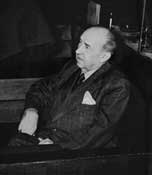
Walter Funk
A. FUNK ACTIVELY PROMOTED THE CONSPIRATORS' ACCESSION
TO POWER.
A recital of Funk's positions and activities is set forth in a statement
made by him (3533-PS). Although Funk signed this statement, he inserted
several reservations and denials with respect to certain positions and
activities. Funk's submissions in this connection, which are indicated
in his statement (3533-PS) should be evaluated in the light of the statements
set forth in the collection of relevant excerpts from German publications
(3563-PS)
An examination of these excerpts will reveal that the German publications
directly contradict every contention which Funk has made with respect
to his holding the positions and carrying on the activities listed in
his statement (3533-PS). For example, in his comment concerning item
(b) of his statement Funk denies that he was Hitler's Personal Economic
Adviser during the 1930's. On the other hand, there are four German
publications, each of which states unequivocally that Funk was Hitler's
Personal Economic Adviser (3563-PS).
As is indicated by these documents, Funk, soon after he joined the
Nazi Party in 1931, began to hold important positions in the Party and
soon qualified as one of the Nazi inner circle. Thus, he promptly became
not only Hitler's Personal Economic Adviser, but also Chief of the Economic
Division of the Central Nazi Party Directorate and Chairman of the Party's
Committee on Economic Policy (3533-PS). In these capacities, he advanced
the Party's drive for mass support by drafting its economic slogans.
In 1932, for example, he wrote a pamphlet entitled "Economic Reconstruction
Program of the NSDAP", which, after its approval by Hitler, became
the Party's official pronouncement on economic matters (3505-PS).
Funk also served as the liaison man between the Nazi Party and the
large industrialists, from whom he obtained financial and political
support on Hitler's behalf (3505-PS; 2828-PS). Thus, for example, he
was present at the meeting of approximately 25 leading industrialists
held in Berlin on 20 February 1933 (2828-PS). In the course of this
meeting, which was arranged by Goering and attended by Funk, among others,
and which was designed to obtain the industrialists' financial and political
support for the Nazi program, Hitler and Goering announced some of the
fundamental Nazi objectives: the destruction of the parliamentary system
in Germany; the crushing of all internal opposition by force, the restoration
of the power of the Wehrmacht. In addition, Hitler indicated that force
was to be used in solving problems with other nations (D-203). The financial
and political support for the Nazis which Funk secured from industry
promoted the campaign of force and terror by which the Nazis seized
and consolidated their control of Germany.
The importance of Funk's general contribution to the conspirators'
accession to power has been described in a book published by the Central
Publishing House of the Nazi Party:
"No less important than Funk's accomplishments in the programmatic
field in the years 1931 and 1932 was his activity of that time as
the Fuehrer's liaison man to the leading men of the German economy
in industry, trade, commerce and finance. On the basis of his past
work, his personal relations to the German economic leaders were broad
and extensive. He was now able to enlist them in the service of Adolf
Hitler, and not only to answer their questions authoritatively, but
to convince them and win their backing for the Party. At that time,
that was terribly important work. Every success achieved meant a moral,
political, and economic strengthening of the fighting force of the
Party and contributed toward destroying the prejudice that National
Socialism is merely a party of class hatred and class struggle."
(3505-PS)
After he had helped Hitler become Chancellor, Funk, as Reich Press
Chief, participated in the early cabinet meetings, in the course of
which the conspirators determined upon the means by which they would
secure the passage of the Enabling Act and destroy parliamentary government
in Germany (2962-PS; 2963-PS). This law destroyed civil liberties in
Germany and marked the conspirators' seizure of political control over
Germany.
B. FUNK, BY VIRTUE OF HIS ACTIVITIES IN THE MINISTRY OF PROPAGANDA,
ACTIVELY PARTICIPATED IN THE CONSOLIDATION OF THE CONSPIRATORS' CONTROL
OVER GERMANY.
The Nazis created a vast propaganda machine which they used to proclaim
the doctrine of the master race, to inveigh against the Jews, to impose
the leadership principle upon the German people, to glorify war as a
noble activity, to create the social cohesion necessary for war, and
to weaken the capacity and willingness of their intended victims to
resist aggression. (See Section 9 of Chapter VII on Propaganda, Censorship
and Supervision of Cultural Activities.)
The operation of this propaganda machine was principally the responsibility
of the Ministry of Public Enlightenment and Propaganda. Funk played
a significant role in the operations that Ministry and in related agencies
of the Nazi State. On January 1933, the day on which Hitler became Reich
Chancellor, Funk was appointed Press Chief of the Reich Government.
that capacity, and even after the establishment of the Ministry Public
Enlightenment and Propaganda, he reported regularly to Hitler and President
von Hindenburg (3505-PS; 3501-PS).
On 13 March 1933, the Reich Ministry of Public Enlightenment and Propaganda
was established with Goebbels as its Chief an d Funk as its under-Secretary
2029-PS; Voelkischer Beobachter 15 March 1933, p. 2. (South German Edition)).
In an interview with a reporter from the Voelkischer Beobachter on 30
March 1933, Funk made clear the importance which propaganda was to have
in the Nazi State. He stated:
"Propaganda is the most modern instrument of power and fighting
weapon of state policy. The establishing of the Propaganda Ministry
is vital, for the national political policy of the new State Leadership
is to be the general good of the whole people. Therefore, the total
political, artistic, cultural and spiritual life of the nation, must
be brought on to one level and directed from one central point."
(Voelkischer Beobachter, South German Edition, 31 March 1933).
In order to achieve this purpose, the Ministry of Enlightenment and
Propaganda was organized so as to reach and control every medium of
expression within Germany. In the language of the decree defining the
duties of the Minister of Propaganda, he was to have
"*** jurisdiction over the whole field of spiritual indoctrination
of the nation, of propagandizing the State, of cultural and economic
propaganda, of enlightenment of the public at home and abroad; furthermore,
he is in charge of all institutions serving these purposes."
(2030-PS).
Under this decree, the Ministry controlled propaganda abroad, propaganda
within Germany, the press, music, the theater, films, art, literature,
radio and all related institutions.
Funk discharged important responsibilities in the Ministry. As Undersecretary
he was Goebbels' chief aide. In this capacity he appears to have been
the primary organizer of the machine from which flowed Nazi propaganda.
This is made clear by the following excerpt from an affidavit dated
19 December 1945, and signed by Max Amann, who held the position of
Reich Leader of the Press and President of the Reich Press Chamber.
" *** In carrying out my duties and responsibilities, I became
familiar with the operations and the organization of the Reich Ministry
of Propaganda and Enlightenment.
"Walther Funk was the practical Minister of the Ministry of
Propaganda and Enlightenment and managed the Ministry. Funk was the
soul of the Ministry, and without him Goebbels could not have built
it up. Goebbels once stated to me that Funk was his 'most effective
man.' Funk exercised comprehensive control over all the media of expression
in Germany: over the press, the theater, radio and music. As Press
Chief of the Reich Government and subsequently as Under Secretary
of the Ministry, Funk held daily meetings with the Fuehrer and a daily
press conference in the course of which he issued the directives governing
the materials to be published by the German press". (3501-PS).
A note for the files prepared by one Sigismund, an SS Scharfuehrer,
also stresses the important role which Funk played in The Ministry of
Propaganda (3566-PS). That note records a discussion between Sigismund
and one Weinbrenner, an official of the Ministry of Propaganda, about
the selection of a General Manager for the German Radio. The note states:
"Weinbrenner made the following statement: *** it is almost
impossible to determine whom the Minister would name General Manager,
since Dr. Goebbels reaches most of the important decisions only by
agreement with Under Secretary Funk." (3566-PS).
In addition to his position as Undersecretary, Funk had many other
important responsibilities in subordinate offices of the Ministry for
Propaganda (3533-PS). In 1933, for example, he was appointed Vice President
of the Reich Chamber of Culture, whose President was Goebbels (3533-PS;
Reichsgesetzblatt, 1933, I, p. 798).
Funk's position as Vice President of the Reich Chamber of Culture was
related to his position as Undersecretary of the Ministry, since the
Chamber of Culture and the seven subordinate chambers were by law subject
to the control of the Ministry of Propaganda (2082-PS). This control
was insured in practice by placing officers of the Ministry of Propaganda
in the highest positions of the Chambers. Thus, for example, Goebbels
was its President and Funk its Vice President. By virtue of his dual
position, Funk directly promoted two fundamental and related Nazi policies:
(1) the regimentation of all creative activities in he interest of Nazi
political and military objectives; (2) the elimination of Jews and dissidents
from the so-called cultural professions.
The mechanics by which these policies were carried out have been described
in Section 9 of Chapter VII on Propaganda, Censorship and Supervision
of Cultural Activities. That description will be supplemented here only
by reference to the second decree the Execution of the Law of Reich
Chamber of Culture, dated 9 November 1933 (2872-PS). This decree, which
was signed by Funk, representing Goebbels, fixed the effective date
for the entire scheme for the domination and purging of the cultural
professions.
The control of the Ministry of Propaganda was based in part on the
requirement that persons engaged in so-called "cultural activities"
belong to the appropriate Chamber (1933 Reichsgesetzblatt, I p. 797).
Decrees were then passed which prescribed standards of admission to
these Chambers, which automatically excluded Jews. For example, in the
field of journalism, "only persons who were of Aryan descent and
not married to a person of non-Aryan descent" were permitted to
be so-called Schriftleiter, that is, to perform any work relating to
the contents a newspaper or a political magazine (2083-PS).
Similarly, newspaper publishers had to submit proof tracing their Aryan
descent (and that of their spouses) as far back as the year 1800 (Decree
24 April 1935, issued by the President of the Reich Press Chamber, Article
1, 3 and Article II, 1(f) and 2, reprinted in Karl Friedrich Schrieber
in "Das Recht der Reichskulturkammer", vol. 2, 1935, pp. 109-112;
Decrees 15 April 1936 and 2 May 1936 issued by the President of Reich
Press Chamber reprinted in Karl Friedrich Schrieber "Das Recht
der Reichskulturkammer", vol. 4, 1936, pp. 101-102, 120-122; see
also: Decree 17 September 1934 reprinted in Karl Friedrich Schrieber's
"Das Recht der Reichskulturkammer", vol. 2, 1935, p. 79).
In view of Funk's official positions and the policies which he advanced
it is natural that Nazi writers have stressed his contribution to the
perversion of German culture. Thus Oestreich's biography of Funk states:
"Besides, Funk had a special duty from his Ministry received
the task to take care of the cultural life. In this position he organized
quietly a tremendous concern which represented an investment of many
hundreds of millions. In close co-operation with the Reich Leader
of the Press, Max Amann, the economic fundamentals of the German press
were reconstructed according to the political necessities. The same
took place in the film industry and in other cultural fields."
The reconstruction of "the economic fundamentals of the German
press * ** and other cultural fields" was a biographer's euphemism
for the elimination of Jews and dissidents from the field of literature,
music, theater, journalism, broadcasting, and the arts.
The completeness with which the policy of cultural extermination was
carried out is made clear by a pamphlet entitled "The Reich Ministry
for Public Enlightenment and Propaganda", by Georg Wilhelm Mueller,
an official of the Ministry of Propaganda, which was published by the
German Academy for Politics as part of a series on the organization
of the Nazi Government. That pamphlet states:
"The Department Special Cultural Tasks (a department within
the Ministry of Propaganda) serves mainly the purpose to remove the
Jews from cultural professions. It reviews the political attitude
of all artistic or cultural workers and cultural economic enterprise
that are members of the seven individual chambers of the Reich Chamber
of Culture (except the Reich Chamber of the Press), it has to supervise
the removal of Jews in the entire field of the seven individual chambers
and settles as highest authority all complaints and appeals of cultural
workers whose membership was rejected by the Chamber because of lack
of proof of Aryan descent. At the same time, it is the task of this
department to supervise the activities of non-Aryans in the intellectual
and entire cultural field, therefore, also the supervision of the
only Jewish organization in the cultural field in the entire Reich
territory, that is, the 'Jewish Kulturbund' (Jewish Cultural Association).
"In this way this department also cooperates with all other
professional departments of the Ministry or the Chambers by consulting
the local officials of the party, the State police offices, etc, and
when supervising the Jewish 'cultural work' with the political police.
"It is mainly the merit of this department to 1937 a department
in the Managing Office of the Reich Chamber of Culturethat the purge
of the entire German cultural life from Jewish or other non-German
influences was completely accomplished according to the assignments
of the Minister." (Das Reichsministerim fuer Volksafklaerung
und Propaganda (Reich Ministry of Public Enlightenment and Propaganda)
pp. 30-31).
Funk contributed to the achievement of the Nazi propaganda program
in other capacities. Thus, in 1933, Goebbels appointed him Chairman
of the Board of Directors of the Reich Broadcasting Company (3505-PS).
That company was the coordinating authority for all German radio broadcasting
and supervised all German radio stations, with a view to insuring that
radio serve the political purposes of the Nazi State (Das Deutsche Fuehrerlexikon,
1934-193, p. 139; 3505-PS). Moreover, in 1933, Funk also was appointed
Vice-president of the Filmkreditbank. The Filmkreditbank was a government-controlled
financing corporation which influenced film production in the interests
of the Nazi program by granting financial assistance in connection with
only those films deemed desirable from the Nazi point of view (Seager,
"Der Film im Nationalsocialistischen Staat" ("The Film
in the National-Socialist State"), in Frank: "Nationalsozialistisches
Handbuch fuer Recht und Gesetzgebung" ("National Socialist
Handbook for Law and Legislation"), 1935, 2nd edition, p. 512).
It is lear from the foregoing that Funk was from 1933 until the end
of 1937 a versatile and key figure in the propaganda field. His activities
ranged from daily conferences with the Fuehrer and the organization
of a new large Ministry vital to the Nazi program to depriving the most
humble Jewish artist of his power to earn a livelihood. Funk appears
to have been what Goebbels said he was: Goebbels' "most effective
man" (3501-PS).
The control of the Ministry of Propaganda was based
in part on the requirement that persons engaged in so-called "cultural
activities" belong to the appropriate Chamber (1933 Reichsgesetzblatt,
I p. 797). Decrees were then passed which prescribed standards of admission
to these Chambers, which automatically excluded Jews. For example, in
the field of journalism, "only persons who were of Aryan descent
and not married to a person of non-Aryan descent" were permitted
to be so-called Schriftleiter, that is, to perform any work relating
to the contents a newspaper or a political magazine (2083-PS).
Similarly, newspaper publishers had to submit proof tracing their Aryan
descent (and that of their spouses) as far back as the year 1800 (Decree
24 April 1935, issued by the President of the Reich Press Chamber, Article
1, 3 and Article II, 1(f) and 2, reprinted in Karl Friedrich Schrieber
in "Das Recht der Reichskulturkammer", vol. 2, 1935, pp. 109-112;
Decrees 15 April 1936 and 2 May 1936 issued by the President of Reich
Press Chamber reprinted in Karl Friedrich Schrieber "Das Recht
der Reichskulturkammer", vol. 4, 1936, pp. 101-102, 120-122; see
also: Decree 17 September 1934 reprinted in Karl Friedrich Schrieber's
"Das Recht der Reichskulturkammer", vol. 2, 1935, p. 79).
In view of Funk's official positions and the policies which he advanced
it is natural that Nazi writers have stressed his contribution to the
perversion of German culture. Thus Oestreich's biography of Funk states:
"Besides, Funk had a special duty from his Ministry received
the task to take care of the cultural life. In this position he organized
quietly a tremendous concern which represented an investment of many
hundreds of millions. In close co-operation with the Reich Leader
of the Press, Max Amann, the economic fundamentals of the German press
were reconstructed according to the political necessities. The same
took place in the film industry and in other cultural fields."
The reconstruction of "the economic fundamentals of the German
press * ** and other cultural fields" was a biographer's euphemism
for the elimination of Jews and dissidents from the field of literature,
music, theater, journalism, broadcasting, and the arts.
The completeness with which the policy of cultural extermination was
carried out is made clear by a pamphlet entitled "The Reich Ministry
for Public Enlightenment and Propaganda", by Georg Wilhelm Mueller,
an official of the Ministry of Propaganda, which was published by the
German Academy for Politics as part of a series on the organization
of the Nazi Government. That pamphlet states:
"The Department Special Cultural Tasks (a department within
the Ministry of Propaganda) serves mainly the purpose to remove the
Jews from cultural professions. It reviews the political attitude
of all artistic or cultural workers and cultural economic enterprise
that are members of the seven individual chambers of the Reich Chamber
of Culture (except the Reich Chamber of the Press), it has to supervise
the removal of Jews in the entire field of the seven individual chambers
and settles as highest authority all complaints and appeals of cultural
workers whose membership was rejected by the Chamber because of lack
of proof of Aryan descent. At the same time, it is the task of this
department to supervise the activities of non-Aryans in the intellectual
and entire cultural field, therefore, also the supervision of the
only Jewish organization in the cultural field in the entire Reich
territory, that is, the 'Jewish Kulturbund' (Jewish Cultural Association).
"In this way this department also cooperates with all other
professional departments of the Ministry or the Chambers by consulting
the local officials of the party, the State police offices, etc, and
when supervising the Jewish 'cultural work' with the political police.
"It is mainly the merit of this department to 1937 a department
in the Managing Office of the Reich Chamber of Culturethat the purge
of the entire German cultural life from Jewish or other non-German
influences was completely accomplished according to the assignments
of the Minister." (Das Reichsministerim fuer Volksafklaerung
und Propaganda (Reich Ministry of Public Enlightenment and Propaganda)
pp. 30-31).
Funk contributed to the achievement of the Nazi propaganda program
in other capacities. Thus, in 1933, Goebbels appointed him Chairman
of the Board of Directors of the Reich Broadcasting Company (3505-PS).
That company was the coordinating authority for all German radio broadcasting
and supervised all German radio stations, with a view to insuring that
radio serve the political purposes of the Nazi State (Das Deutsche Fuehrerlexikon,
1934-193, p. 139; 3505-PS). Moreover, in 1933, Funk also was appointed
Vice-president of the Filmkreditbank. The Filmkreditbank was a government-controlled
financing corporation which influenced film production in the interests
of the Nazi program by granting financial assistance in connection with
only those films deemed desirable from the Nazi point of view (Seager,
"Der Film im Nationalsocialistischen Staat" ("The Film
in the National-Socialist State"), in Frank: "Nationalsozialistisches
Handbuch fuer Recht und Gesetzgebung" ("National Socialist
Handbook for Law and Legislation"), 1935, 2nd edition, p. 512).
It is lear from the foregoing that Funk was from 1933 until the end
of 1937 a versatile and key figure in the propaganda field. His activities
ranged from daily conferences with the Fuehrer and the organization
of a new large Ministry vital to the Nazi program to depriving the most
humble Jewish artist of his power to earn a livelihood. Funk appears
to have been what Goebbels said he was: Goebbels' "most effective
man" (3501-PS).
On 3 December 1938, Funk again advanced the policy
of economic extermination by signing a decree which carried out the
promise of the more severe anti-Jewish policy implied in his above speech
(1409-PS). This decree imposed additional and drastic economic disabilities
upon Jews and subjected their property to confiscation and forced liquidation.
It provided that: owners of Jewish enterprises could be ordered to sell
or liquidate their enterprises (Section 1); trustees could be appointed
for such enterprises, with the expenses of trusteeship borne by the
owner of the enterprise (Section 2); Jews could be ordered to sell their
property (real estate, etc.) (Section 6); Jews were prohibited from
acquiring any real estate (Section 7); governmental consent was required
for any disposition of real estate (Section 8); Jews were forced to
deposit all stocks, mining shares, bonds, and other securities with
specially designated banks, and accounts had to be marked "Jewish"
(Section 11); Jews were forbidden to acquire, to give as security, or
to sell objects made of gold, platinum, or silver, precious stones,
or pearls, etc. (Section 14); and Jews could be required to make certain
payments to the Reich before receiving the consent necessary for the
transfer of their property (Section 15). (1409-PS).
In addition, many other decrees aiming at the economic ruin of the
Jews were promulgated over the signature of the Minister of Economics.
For example:
Decree, 23 November 1938,198 Reichsgesetzblatt, I, p. 162, signed
by Brinkmann acting for Funk and containing detailed rules for the
liquidation of Jewish retail stores, etc.;
Decree, 14 December 1938,1938 Reichsgesetzblatt, 1, p. 1902, also
signed by Brinkmann acting for Funk, and providing detailed rules
for the elimination of Jews from industrial enterprises;
Decree, 8 May 1939,1939 Reichsgesetzblatt, 1, p. 895, signed by Dr.
Landfried acting for Funk, excluding Jews from the occupation of travel
agents;
Decree, 4 May 1940, 1940 Reichsgesetzblatt, 1, p. 730, also signed
by Dr. Landfried acting for Funk, concerning registration of transfers
of Jewish property;
Decree, 14 November 1940,1940 Reichsgesetzblatt, 1, p. 1520, also
signed by Dr. Landfried acting for Funk, establishing a procedure
for setting aside financial arrangements which Jews, discharged from
executive positions of industrial enterprises prior to 12 November
1938, had made with their companies.
Extending certain of the above-described decrees to Austria, see, e.g.:
Decree, 22 August 1942, 1942 Reichsgesetzblatt, 1, p. 537, signed
by von Hanneken, acting for Funk;
Decree, 4 December 1940,1940 Reichsgesetzblatt, 1, p. 1564, signed
by Dr. Landfried acting for Funk.
Funk had important responsibilities, not only in the formulation of
anti-Jewish policy and in the drafting of anti-Jewish legislation, but
also in the administration of the conspirators' anti-Jewish measures.
Funk was the person to whom appeals were made concerning action taken
by subordinate officials in the administration of the anti-Jewish economic
program. In fact, he as the paramount authority in this field; his decisions
were final and conclusive. For example, he had the final voice in the
administrative hierarchy set up for deciding whether an enterprise was
a Jewish enterprise within the meaning of the decree requiring the registration
of such enterprises (Decree of 14 June 1938, Section 9, 1938 Reichsgesetzblatt,
1, p. 628; see also decree of 3 December 1938, section 19, 1938 Reichsgesetzblatt,
1, p. 1711; decree, 14 November 1940,1940 Reichsgesetzblatt, 1, p. 1520).
Nazi publications have recognized the significant contribution made
by Funk to the anti-Jewish program. Thus Hans Queeke, an official of
the German Ministry of Economies, in describing the work of the Ministry
during Funk's incumbency, stated:
"A task of special political significance and economic importance
arose as an absolute necessity out of the National Socialist conception
of state and economy, namely, the eradication of Jewish influence
from the economy. In this connection, a wealth of legislative and
administrative work, though temporary, was created for the Ministry.
The steps of the work were as follows: definitions of the term 'Jewish
enterprise', registration of Jewish property, securing the 'deployment'
of such property in accordance with the interests of the German economy,
exclusion of Jewish employees from executive positions, and, finally,
re-examination of steps taken in the de- Judaization of enterprises
with a view to ordering payments to the Reich for the unjust profits
secured in the process of de-Judaization. That task can now be considered
as practically completed in the field of the industrial economy."
(Building of the Third Reich (Das Dritte Reich in Aufbau) Vol. 5,
pp. 318-319 (1941)).
Moreover, Funk himself, in the course of administering this program,
emphasized the importance of his new role. For example, on 6 February
1939, he issued a circular in connection with the administration of
the decree of 3 December 1938 which, as indicated, he himself signed.
In that circular, which was published in the Ministerial Gazette of
the Reich and Prussian Ministry of the Interior ("Ministerialblatt
des Reichsund Preussischen Minsteriums des Inneern"), for 1939,
No. 7, p. 265, Funk stressed (at p. 265) "the great political and
economic importance" of the anti-Jewish program and stated with
respect to the broad powers conferred by the decree of 3 December 1938,
that:
"*** The extent and speed with which they [the powers] will
be utilized, is dependent upon my orders, to be given under the general
direction of Goering."
In the same circular (at p. 265) Funk also emphasized the importance
of the laws for de-Judaization, stating:
"The execution of the laws for the economic de-Judaization will,
for a time, impose extraordinary burdens upon the administrative organization.
However, it is expected that the officers charged with the execution,
in view of the great political and economic importance of the tasks
assigned to them, will bend all their efforts to assure a most rapid,
efficient, and in every way faultless execution of the de-Judaization."
Funk, in an interrogation dated 22 October 1945, admitted and deplored
his responsibility for the economic persecution of the Jews:
"Q. All the decrees excluding the Jews from industry were yours,
were they not?
"A. *** So far as my participation in this Jewish affair is
concerned, that was my responsibility and I have regretted it later
on that I ever did participate. The Party had always brought pressure
to bear on me previously to make me agree to the confiscation of Jewish
property, and I had refused repeatedly. But later on, when the anti-Jewish
measures and the force used against the Jews came into force, something
legal had to be done to prevent the looting and confiscation of all
Jewish property.
"Q. You know that the looting and all that was done at the instigation
of the Party, don't you?
"(Here witness weeps)
"A. Yes, most certainly. That is when I should have left in
1938, of that I am guilty, I am guilty. I admit that I am a guilty
party here." (3544-PS)
D. FUNK WITH KNOWLEDGE OF THE CONSPIRATORS' PLANS FOR AGGRESSION,
ACTIVELY PARTICIPATED IN MOBILIZING THE GERMAN ECONOMY FOR AGGRESSIVE
WAR; HE ALSO PARTICIPATED IN THE WAGING OF AGGRESSIVE WARS AND WAS A
MEMBER OF WAR PLANNING AGENCIES WHICH WERE RESPONSIBLE FOR POLICIES
AND ACTS CONTRARY TO THE LAWS OF WAR.
Funk was vested with, and carried out, major responsibilities in connection
with the planning and execution of the Nazi program of economic mobilization
for aggression. Thus, in 1938 he succeeded Schacht as Minister of Economics
(3533-PS).
Immediately before Funk actually took over the Reich Ministry of Economics
there was a major reorganization of its functions, which integrated
the Ministry with the Four Year Plan as the Supreme Command of the German
military economy. The reorganization was accomplished by Goering, in
his capacity as Commissar for the Four Year Plan, by a decree dated
4 February 1938 ("The Four Year Plan" (Der Verjahresplan)
official monthly bulletin, issued by Goering, Vol. II, 1938, p. 105).
Under this decree, the jurisdiction of the Economics Ministry was defined
as covering the following fields of Germany's economy: German raw and
working materials, mining, iron industry, power industry, handicrafts,
finance and credit, foreign trade, devisen, and exports. As a result
of this decree, sectors of the German economy which were strategic in
the organization of war and armaments economy were placed under the
immediate control of Funk.
Furthermore the Reich Office for Economic Development, charged by the
decree, with "research, planning and execution of the Four Year
Plan", was incorporated into the Reich Ministry of Economics. Similarly,
the Reich Office for Soil Research and the Office of the Reich Commissar
for the exploitation of Scrap Materials were made subject to that Ministry.
Thus, it is clear that the reorganization decree concentrated significant
responsibilities in the hands of Funk and thereby made him one of the
chief agents of economic mobilization during a decisive period.
Subsequently, Funk was, by a secret law, expressly charged with the
task of mobilizing the German economy for war. On 4 September 1938,
while the conspirators were engaged in intensive planning for aggression
against Czechoslovakia, Hitler signed a revision of the so-called Reich
Defense Law (2194-PS). This law conferred upon Funk substantially the
same authority which had been vested in Schacht by the Reich Defense
Law of 21 May 1935 (2261-PS). The law of 4 September 1938 provided in
part:
"It is the task of the GBW [Chief Plenipotentiary for Economics]
to put all economic forces into the service of the Reich defense,
and to safeguard economically the life of the German nation. To him
are subordinate: the Reich Minister of Economics, the Reich Minister
of Nutrition and Agriculture, the Reich Minister of Work, the Reich
Chief of Forestry, the Reich Commissar for Price Control. He is furthermore
responsible for directing the financing of the Reich defense within
the realm of the Reich Finance Ministry and the Reich Bank.
"The GBW must carry out the demands of the OKW which are of
considerable importance for the armed forces; and he must insure the
economic conditions for the production of the armament industry directed
immediately by the OKW according to its demands. If the demands of
the armed forces cannot be brought into accord with the affairs of
economy, then the Fuehrer and Reich Chancellor decides.
"The GBW has the right within his sphere to issue laws with
the consent of the OKW and GBV which differ from the existing laws."
The law of 4 September 1938, which at the specific direction of Hitler
was not made public, was signed by Hitler and by Funk, among others,
as "Chief Plenipotentiary for Economics" (2194-PS).
Funk, in a speech which he delivered on 14 October 1939, explained
how he, as Chief Plenipotentiary for Economics, had, for a year and
a half prior to the launching of the aggression against Poland, advanced
Germany's economic preparation for war. He stated:
"Although all the economic and financial departments were harnessed
in the tasks and work of the Four Year Plan under the leadership of
Generalfeldmarschall Goering, the war economic preparation of Germany
has also been advanced in secret in another sector for well over a
year, namely, by means of the formation of a national guiding apparatus
for the special war economic tasks, which had to be mastered at that
moment, when the condition of war became a fact. For this work as
well all economic departments were combined into one administrative
authority, namely under the General Plenipotentiary for Economy, to
which position the Fuehrer appointed me one and a half years ago."
(3324- PS)
In his dual capacity of Chief Plenipotentiary for Economics and Minister
of Economics, Funk naturally was advised of the requirements which the
conspirators' program of aggression imposed on the economy. Thus, during
a conference in the Reich Aviation Ministry on 14 October 1938 under
the chairmanship of Goering, Goering referred to Hitler's orders for
an abnormal increase of armament, particularly weapons for attack, and
directed the Ministry of Economics to submit suggestions on how to finance
this rearmament by increasing exports.
The report of Goering's remarks states in part:
"General Field Marshal Goering opened the session by declaring
that he intended to give directives about the work for the next months.
Everybody knows from the press what the world situation looks like
and therefore the Fuehrer has issued an order to him to carry out
a gigantic program compared to which previous achievements are insignificant.
There are difficulties in the way which he will overcome with utmost
energy and ruthlessness.
"The amount of foreign exchange has completely dwindled on account
of the preparation for the Czech Enterprise and this makes it necessary
that it should be strongly increased immediately. Furthermore, the
foreign credits have been greatly overdrawn and thus the strongest
export activity stronger than up to nowis in the foreground. For the
-next weeks an increased export was first priority in order to improve
the foreign exchange situation. The Reich Ministry for Economy should
make a plan about raising the export activity by pushing aside the
current difficulties which prevent export.
"These gains made through the export are to be used for increased
armament. The armament should not be curtailed by the export activity.
He received the order from the Fuehrer to increase the armament to
an abnormal extent, the air force having first priority. Within the
shortest time the air force is to be increased five fold, also the
navy should get armed more rapidly and the army should procure large
amounts of offensive weapons at a faster rate, particularly heavy
artillery pieces and heavy tanks. Along with this manufactured armaments
must go; especially fuel, powder and explosives are moved into the
foreground. It should be coupled with the accelerated construction
of highways, canals, and particularly of the railroads." (1301-PS).
Goering's words were the words of one already at war. And the emphasis
on quintupling the Air Force and accelerating weapon manufacture for
attack, were the words of a man waging aggressive war.
Funk actively participated in the planning of wartime financial measures
(1301-PS). This was natural since Funk, after 1938, occupied three positions
crucial to finance: Minister of Economics, President of the Reichsbank
(to which he was appointed in January 1939), and Chief Plenipotentiary
for Economics. Funk's role in war financing is illustrated by a letter,
dated 1 June 1939, from the Chief Plenipotentiary for Economics (Funk),
signed on his behalf by Dr. Posse (3562-PS). This letter found in the
captured files of the Reich Ministry of Economics, transmitted the minutes
of a meeting concerning the financing of the war. This meeting had been
held under the chairmanship of Dr. Landfried, Funk's Undersecretary
in the Reich Ministry of Economics. The document bears a marginal note
in the bottom left hand corner, dated 5 June, stating that the document
was "to be shown to the Minister" [i.e., Funk]. Only eight
copies were made of the Minutes, which were marked "Top Secret".
Four of these copies were sent to officials directly subordinate to
Funk (two in the Reich Ministry of Economics, one in the Reichsbank,
and one in the Office of the Chief Plenipotentiary for Economics). During
the course of the meeting, which was attended by twelve officials, five
of whom were directly responsible to Funk in his various capacities,
the conferees discussed a memorandum regarding war finance which had
been prepared by the Chief Plenipotentiary for Economics on 9 May 1939.
The minutes of this meeting state:
" *** Then a report was made of the contents of the 'Notes on
the Question of Internal Financing of War', of 9 May of this year
(appendix to GBW 8/179/39 Top Secret), in which the figures given
to me by the Reichs Minister of Finance are also discussed. It was
pointed out that the General Plenipotentiary for the Economy is primarily
interested to introduce into the legislation for war finance, the
idea of financing war expenditures by anticipating future revenues,
to be expected after the war. ***
"Undersecretary Newman, first, submitted for discussion the
question whether the production would be able to meet to the assumed
extent, the demands of the Army, especially if the demands of the
Army, as stated in the above report, would increase to approximately
14 billions in the first three months of war. He stated that, if the
production potential of the present Reich territory is taken as a
basis, he doubts the possibility of such a production increase."
(3562-PS).
During the course of the meeting one of the representatives of the
High Command stated:
"The demands of the Army would probably be higher in the first
three months of war than during the further course of the war."
(3562-PS).
In the files of the Reich Ministry of Economics there was also found,
attached to the above letter and minutes, a Top Secret memorandum
entitled "Notes Concerning Financing of War." That memorandum
reveals the plans to use the resources of countries to be occupied
in the interest of the Nazi war machine.
"*** First, as concerns the scope of the total production, it
is clear that the economic power of the Protectorate and of other
territories, possibly to be acquired, must of course be completely
exhausted for the purposes of the conduct of the war. It is, however,
just as clear that these territories cannot obtain any compensation
from the economy of Greater Germany for the products which they will
have to give us during the war, because their power must be used fully
for the war and for supplying the civilian home population."
It is plain that Funk exercised comprehensive authority over large
areas of the German economy whose proper organization and direction
were critical to effective war preparation. The once powerful German
military machine, which rested on the foundation of thorough economic
preparation, reflected the contribution which Funk had made to Nazi
aggression.
Immediately before this machine was directed against Poland, the final
preparatory steps were taken, and the previous appointment of Funk as
Chief Plenipotentiary for Economics was made public. Thus on 27 August
1939, Funk, in this capacity, issued two decrees, one introducing general
rationing of consumers goods, the other setting up regional economic
authorities (1939 Reichsgesetzblatt, I, pp. 1495 and 1498).
Finally, on 30 August 1939, Hitler, Goering, and Lammers signed a decree
establishing the Ministerial Council for Reich Defense, composed of
Goering; Funk, and Hess, among others, to act as a War Cabinet (1939
Reichsgesetzblatt, I, p. 1532).
Funk mobilized the German economy for war with full knowledge of the
plans for military aggression. An irresistible inference of such knowledge
arises from the combination of several factors: from Funk's long and
intimate association with the Nazi inner circle; from the very nature
of his official functions; from the war- dominated setting of Nazi Germany;
from the fact that force and the threat of force had become the open
and primary instruments of Nazi policy; and finally from the fact that
at the same time that Funk was making economic preparations, specific
plans for aggressionlater to be carried outwere being formulated, plans
which could only be effective if they were synchronized with the complementary
economic
The inference of Funk's knowledge and intent is reinforced beyond question
by considering, in the light of the factors described above, the more
specific evidence of Funk's knowledge of aggressive plans. Thus, Funk,
at the very beginnings of the Nazi Government, had stated that the absorption
of Austria by Germany was a political and economic necessity, and that
it would be achieved by whatever means were necessary (1760-PS).
Goering had issued instructions to the Ministry of Economics in the
language of a man waging aggressive war (1301-PS). Moreover, Funk and
his subordinates in May 1939 were making detailed plans for financing
the war, that is, a particular war, the war against Poland. (3562-PS)
In connection with Funk's economic planning for aggression reference
should be made to other evidence of the preparatory work which Funk
carried on prior to the aggression against Poland. Shortly before the
attack on Poland, in a letter to Hitler dated 25 August 1939, Funk expressed
his gratification for his role in the "tremendous events"
of these days, and his thanks for Hitler's approval of his economic
war measures. He concluded by giving Hitler his pledge in that hour
(699-PS). The text of the letter is as follows:
"Reich Minister Walther Funk.
Berlin W. 8, 25 August 1939.
Unter Den Linden 13.
"For the congratulations which you transmitted to me on my birthday,
in such extremely friendly and kind fashion, I want to thank you from
the depths of my heart. How happy and how grateful we must be to you
to be favored to experience these colossal and world- moving times,
and that we can contribute to the tremendous events of these days.
"General-Field-Marshal Goering informed me, that last night you
-- my Fuehrer -- have approved in principle the measures prepared by
me for financing the war, for setting up the wage and price systems
and for carrying out the plan for an emergency contribution [Notopfer].
This news has made me deeply happy. I hereby most obediently report
to you that I have succeeded, through the provisions made already during
the last month, to make the German Reichsbank internally so strong and
so safe against attack from without that even the most serious disturbances
of the international currency and credit systems would be absolutely
unable to affect us.
"In the meantime I have in a wholly inconspicuous manner converted
into gold all assets of the Reichsbank and of the German economy abroad
on which we could possibly lay hands. With the proposals worked out
by me regarding a ruthless choking of any unessential consumption and
any public expenditure and project not necessary for war we will be
able to meet all financial and economic demands without any serious
reverberations.
"In my capacity as General Plenipotentiary for Economics, appointed
by you, my Fuehrer, I have regarded it as my duty to give you this report
and this pledge in this hour.
"Heil, my Fuehrer
"(signed) Walther Funk". (699-PS) .
Funk both personally and through duly designated representatives also
participated in the planning which preceded the aggression against the
USSR. Thus, in April 1941, Rosenberg, after he had been appointed deputy
for centralized treatment of problems concerning the Eastern Territories,
discussed with Funk the economic problems which would be raised when
the plans for aggression in the East were carried out (1039-PS). that
time Funk appointed Dr. Schlotterer as his deputy to work with Rosenberg
in connection with the exploitation of the Eastern Territories. Funk's
deputy met with Rosenberg almost daily.
E. FUNK WAS A MEMBER OF WAR-PLANNING AGENCIES WHICH WERE RESPONSIBLE
FOR POLICIES AND ACTS CONTRARY TO THE LAWS OF WAR.
After the launching of the Nazi aggression against Poland, Funk, in
his capacities as Minister of Economics, President of the Reichsbank,
and Chief Plenipotentiary for Economics, and as a member of the Central
Planning Board (to which he was appointed in September 1943), actively
participated in the waging of aggressive war on the economic front.
Moreover, by virtue of his membership in the Central Planning Board,
which formulated and directed the execution of the program for the enslavement,
exploitation, and degradation of millions of foreign workers, Funk shares
special responsibility for the Nazi Slave Labor Program. (See Chapter
X on the Slave Labor Program. This special aspect of Funk's responsibility
was left for development by the French prosecuting staff.)
F. CONCLUSION.
It is clear that Funk was a central figure in the Nazi conspiracy and
that, as a member of the Nazi inner circle, he helped formulate, was
aware of, and promoted the realization of, the conspirators' program.
He knew, moreover, that this program envisaged the use of terror and
force within and if necessary outside of Germany, and that it contemplated
the use of criminal means. Funk, by promoting the conspirators' accession
to power and the realization of their program, signified his approval
of such crimes.
The evidence has also established that, after the Nazi seizure of power,
Funk promoted the achievement of the conspirators' program by virtue
of his activities in the Ministry of Propaganda, activities which fomented
and carried out the persecution of Jews and dissidents; which psychologically
mobilized the German people for aggressive war; and which reduced the
willingness and capacity of the conspirators' intended victims to resist
aggression. Funk also participated, as Minister of Economics, in the
formulation and execution of the policy for the complete elimination
of the Jews from the German economy.
As Minister of Economics, President of the Reichsbank, and Chief Plenipotentiary
for Economics, Funk mobilized the German economy for aggressive war,
with full knowledge of the conspirators' plans for aggression. Moreover,
in these capacities, nd as a member of the Ministerial Council for the
Defense and the Central Planning Board, he also actively participated
in the waging of aggressive wars. Finally, by virtue of his membership
the Central Planning Board, which formulated and directed e execution
of the program for the enslavement, exploitation, and degradation of
millions of foreign workers, he bears a special responsibilitY for the
war crimes committed in the execution of that program.
Sources: Nizkor.
Nazi Conspiracy & Aggression, Volume II,
Chapter XVI, pp.715-735. Photo: Harry S. Truman
Library, courtesy of USHMM
Photo Archives
|