Following the U.S. Army's crossing of the
Rhine River and push into central Germany
, the SS camp administration at Dora-Mittelbau ordered
the evacuation of prisoners from the main
camp and a number of its affiliated subcamps
on April 3 and 4th. The goal was to transport
the inmates by train or by foot to the concentration
camps in Bergen-Belsen, Sachsenhausen,
or Neuengamme.
Within days, some 4,000 prisoners from Dora-Mittelbau,
its satellite camps, and a Neuengamme subcamp
arrived in the Gardelegen area, where they
had to dismount from the freight cars because
the trains could not advance any further
due to air raid damage to the rail lines.
Greatly outnumbered by the prisoners, the
SS guards began recruiting auxiliary forces
from the local fire department, the air force,
the aged home guard, the Hitler
Youth, and
other organizations to watch over the inmates.
On April 13 (less than a month from the end
of the Second
World War), more than a thousand prisoners,
many of them sick and too weak to march any
further, were taken from the town of Gardelegen
to a large barn on the Isenschnibbe estate
and forced inside the building. The assembled
guards then barricaded the doors and set
fire to gasoline-soaked straw.
As the heat and
flames expanded within the building, prisoners
sought to escape the conflagration by digging under
the barn's walls. They were killed by the guards.
The next day, the SS and
local auxiliaries returned to dispose of the evidence
of their crime. They planned to incinerate what
remained of the bodies and the barn, and kill any
survivors of the blaze. The swift advance of the 102nd
Infantry Division, however, prevented the SS and its accomplices from completely carrying out
this plan.
On April
14, the 102nd (405th
Regiment, 2d Battalion, F Company) entered
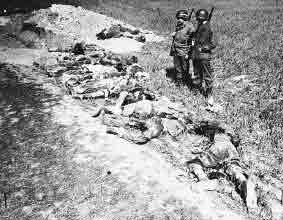
Gardelegen and, the following day, discovered
the atrocity. They found the corpses
of 1,016 prisoners in the still-smoldering
barn and nearby trenches, where the SS
had the charred remains dumped. The also
interviewed several of the prisoners
who had managed to escape the fire and
the shootings. Within days, U.S. Army
Signal Corps photographers arrived to
document the Nazi crime and by April
19, 1945, the story of the Gardelegen
massacre began appearing in the western
press. On that day, both the New York
Times and The Washington Post ran
stories on the massacre, quoting one
American soldier who stated:
I never was so sure before of exactly
what I was fighting for. Before this
you would have said those stories were
propaganda, but now you know they weren't.
There are the bodies and all those guys
are dead.
On April 21, 1945 , the local commander
of the 102nd ordered between 200 and 300
men from the town of Gardelegen to give
the murdered prisoners a proper burial.
Over the next few days, the German civilians
exhumed 586 bodies from the trenches and
recovered 430 bodies from the barn, placing
each in an individual grave. On April 25,
the 102nd carried out a ceremony to honor
the dead and erected a memorial tablet
to the victims, which stated that the townspeople
of Gardelegen are charged with the responsibility
that the “graves are forever kept
as green as the memory of these unfortunates
will be kept in the hearts of freedom-loving
men everywhere.” Also on April 25,
Colonel George Lynch addressed German civilians
at Gardelegen with the following statement:
The German people have been told that
stories of German atrocites were Allied
propaganda. Here, you can see for yourself.
Some will say that the Nazis were responsible
for this crime. Others will point to
the Gestapo. The responsibility rests
with neither -- it is the responsibility
of the German people....Your so-called
Master Race has demonstrated that it
is master only of crime, cruelty and
sadism. you have lost the respect of
the civilized world.
Discovery of the massacre
seems to have been by chance. Consensus is
that American Lieutenant Emerson Hunt, a
liaison officer between Ozark HQ and the
701st Tank Battalion was captured by German
forces on April 14, 1945. Lt. Hunt bluffed
the German forces defending the town of Gardelegen
into believing that American tanks were
approaching the city, leading the German
commander to surrender to American forces.
The Americans arrived at the site before
the Germans had time to bury all of the
bodies. An investigation was undertaken by
Lt. Col. Edward E. Cruise, Investigating
Officer, Ninth Army War Crimes Branch.
Gardelegen is now a national memorial.
The sign at the cemetery reads:
Gardelegen Military Cemetery
Here lie 1016 allied prisoners of war
who were murdered by their captors. They were buried
by citizens of Gardelegen, who are charged with responsibility
that graves are for- ever kept as green as the memory
of these unfortunates will be kept in the hearts of
freedom-loving men everywhere.______________
Established under supervision of 102d
Infantry Division. United States Army Vandalism will
be punished by maximum penalties under laws of military
government.
Frank A. Keating Major General, U.S.A.
Commanding