The Ark of the Covenant
As a general
rule, Judaism rejects physical manifestations of spirituality, preferring instead
to focus on actions and beliefs. Indeed, the story of Judaism begins
with Abraham who, according to ancient sources, shattered the idols that
were the conventional method of religious observance at the time. Worship
of graven images is harshly condemned throughout the Torah,
and perhaps the greatest sin the Israelites collectively committed was
the construction of the Golden Calf (in Ex.
32), intended to serve as a physical intermediary between them and God. Today, Jews do not venerate
any holy relics or man-made symbols.
But in the history of the Jewish people, there
was one exception to this rule. One man-made object was considered
intrinsically holy - the Ark of the Covenant.
Constructed during the
Israelites' wanderings in the desert and used until the destruction
of the First Temple,
the Ark was the most important symbol of the Jewish faith, and served as the
only physical manifestation of God on earth. The legends associated with this object - and the harsh penalties
ascribed for anyone who misuses it - confirm the Ark's centrality to
the Jewish faith of that period; the fact that Jews and non-Jews alike
continue to study and imitate it confirms its centrality even today.
- Building
the Ark
- The Role of the Ark
- History of the Ark
- The Ark's Whereabouts
- The Role of the Ark Today
Building
the Ark
The construction of the Ark is commanded by God to Moses while the Jews
were still camped at Sinai (Ex.
25:10-22; 37:1-9). The
Ark was a box with the dimensions of two-and-a-half cubits in length,
by one-and-a-half cubits in height, by one-and-a-half cubits in width
(a cubit is about 18 inches). It was constructed of acacia wood, and
was plated with pure gold, inside and out. On the bottom of the box,
four gold rings were attached, through which two poles, also made of
acacia and coated in gold, were put. The family of Kehath, of the tribe
of Levi, would carry the ark on their shoulders using these poles.
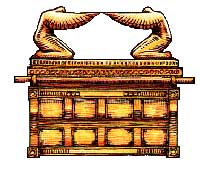 Artistic rendering of the Ark of the Covenant
 |
Covering
the box was the kapporet, a pure gold covering that was two-and-a-half
by one-and-a-half cubits. Attached to the kapporet were two sculpted
Cherubs, also made of pure gold. The two Cherubs faced one another,
and their wings, which wrapped around their bodies, touched between
them.
The contents of the Ark has been debated through the
centuries. The general consensus is that the first tablets containing
the Ten Commandments, which
were broken by Moses, and
the second tablets, which remained intact, were contained in the Ark
(Bava Batra 14b). According to one opinion in the Talmud,
both Tablets were together in the Ark; according to another, there were
two Arks, and each contained one set of Tablets (Berakhot 8b).
The Ark was built by Bezalel, son of Uri, son of Hur,
who constructed the entire Tabernacle – the portable Temple used
in the desert and during the conquest of the land of Israel. The Tabernacle
was the resting place for the Ark, and also contained other vessels
that were used in the physical worship of God. The Biblical commentators
argue over why God commanded Moses to build a Tabernacle
in the first place: According to Rashi (Ex.
31:18), God realized after the sin of the Golden Calf that the Israelites
needed an outlet for physical worship, and commanded that they build
the Tabernacle as a way of expressing their own need for physical representation
of God. According to Nachmanides (Ex. 25:1), however, the
Jews were commanded to build the Tabernacle even before the sin of the
Golden Calf; rather than filling a human need, the Tabernacle was God's
method of achieving continuous revelation in the Israelites' camp. These
two opinions as to whether the Tabernacles, and the Temples that followed
them, were an a priori necessity or a necessary evil demonstrate
the controversial role of physical worship in Judaism as a whole.
The Role
of the Ark
The Ark was used in the desert and in Israel proper
for a number of spiritual and pragmatic purposes. Practically, God used
the Ark as an indicator of when he wanted the nation to travel, and
when to stop. In the traveling formation in the desert, the Ark was
carried 2000 cubits ahead of the nation (Num. R. 2:9). According
to one midrash,
it would clear the path for the nation by burning snakes, scorpions,
and thorns with two jets of flame that shot from its underside (T.
VaYakhel, 7); another midrash says that rather than being carried by its bearers, the Ark in fact
carried its bearers inches above the ground (Sotah 35a). When
the Israelites went to war in the desert and during the conquering of
Canaan, the Ark accompanied them; whether its presence was symbolic,
to provide motivation for the Jews, or whether it actually aided them
in fighting, is debated by commentators.
Spiritually, the Ark was the manifestation of God's
physical presence on earth (the shekhina).
When God spoke with Moses in the Tent of Meeting in the desert, he did so from between the two
Cherubs (Num. 7:89). Once
the Ark was moved into the Holy of Holies in the Tabernacle, and later
in the Temple, it was
accessible only once a year, and then, only by one person. On Yom
Kippur, the High Priest (Kohen Gadol) could enter the Holy of Holies to ask forgiveness for himself
and for all the nation of Israel (Lev.
16:2).
The relationship between the Ark and the shekhina is reinforced by the recurring motif of clouds. God's presence is frequently
seen in the guise of a cloud in the Bible (Ex.
24:16), and the Ark is constantly accompanied by clouds: When God
spoke from between the Cherubs, there was a glowing cloud visible there
(Ex. 40:35); when the Jews
traveled, they were led by the Ark and a pillar of clouds (Num.
10:34); at night, the pillar of clouds was replaced by a pillar
of fire, another common descriptor of God's appearance (Ex.
24:17); and when the High Priest entered presence of the Ark on Yom Kippur, he did so only
under the cover of a cloud of incense, perhaps intended to mask the
sight of the shekhina in all its glory (Lev. 16:13).
The holiness of the Ark also made it dangerous to
those who came in contact with it. When Nadav and Avihu, the sons of Aaron, brought a foreign
flame to offer a sacrifice in the Tabernacle, they were devoured by
a fire that emanated "from the Lord" (Lev.
10:2). During the saga of the capture of the Ark by the Philistines,
numerous people, including some who merely looked at the Ark, were killed
by its power. Similarly, the Priests who served in the Tabernacle and
Temple were told that viewing the Ark at an improper time would result
in immediate death (Num. 4:20).
History
of the Ark
The Ark accompanied the Jews throughout their time
in the desert, traveling with them and accompanying them to their wars
with Emor and Midian. When the Jews crossed into the land of Canaan,
the waters of the Jordan River miraculously split and the Ark led them
through (Josh. 3). Throughout
their conquest of the land, the Jews were accompanied by the Ark. The
most dramatic demonstration of its power comes when the Jews breached
the walls of Jericho merely
by circling them, blowing horns and carrying the Ark (Josh.
6).
After the conquest was completed, the Ark, and the
entire Tabernacle, were set up in Shiloh (Josh.
18) . There they remained until the battles of the Jews with the
Philistines during the Priesthood of Eli. The Jews, after suffering
a defeat at the Philistines' hands, took the Ark from Shiloh to Even-Ezer
in hopes of winning the next battle. But the Jews were routed, and the
Ark was captured by the Philistines. Back in Shiloh, Eli, the High Priest,
immediately died upon hearing the news (I
Sam. 4).
The Philistines took the Ark back to Ashdod,
their capital city in the south of Canaan, where they placed it in the
temple of their god Dagon. The next day, however, they found the idol
fallen on its face. After replacing the statue, they found it the next
day decapitated, with only its trunk remaining, and soon afterward,
the entire city of Ashdod was struck with a plague. The Philistines moved the Ark to the city
of Gath, and from there to Ekron, but whatever city the Ark was in,
the inhabitants were struck with plague. After seven months, the Philistines
decided to send the Ark back to the Israelites, and accompanied it with
expensive gifts. The Ark was taken back to Beit Shemesh, and, according
to midrash, the oxen pulling the Ark burst into song as soon as it was
once again in Israel's possession (A.Z. 22b). The actual text
of the story, however, tells a much grimmer tale: The men of Beit Shemesh
were punished for staring disrespectfully at the Ark, and many were
killed with a plague.
 The Church of St. Mary. The
Treasury that is said to contain the Ark is in the background on the
left.
The Church of St. Mary. The
Treasury that is said to contain the Ark is in the background on the
left.
|
From Beit Shemesh, the Ark was transported to Kiryat
Yearim, where it remained for twenty years. From there, King
David transported it to Jerusalem.
En route, however, the oxen pulling it stumbled, and when Uzzah reached
out to steady the Ark, he died immediately. As a result of this tragedy, David decided to leave the
Ark at the home of Obed-edom the Gittite. Three months later, he moved
it to Jerusalem, the seat of
his kingdom, where it remained until the construction of the First
Temple by David's son Solomon (I
Sam. 5-6). When the Ark was finally placed in the Temple,
the midrash reports that the golden tree decorations that adorned the walls blossomed
with fruit that grew continuously until the Temple's destruction (Yoma 39b).
The Ark's
Whereabouts
The
Ark remained in the Temple until its destruction at the hand of the Babylonian empire, led by Nebuchadnezzar. What happened to it afterward is unknown,
and has been debated and pondered for centuries. It is unlikely that
the Babylonians took
it, as they did the other vessels of the Temple,
because the detailed lists of what they took make no mention of the
Ark. According to some sources, Josiah, one of the final kings to reign
in the First Temple period,
learned of the impending invasion of the Babylonians and hid the Ark.
Where he hid it is also questionable – according to one midrash,
he dug a hole under the wood storehouse on the Temple
Mount and buried it there (Yoma 53b). Another account says
that Solomon foresaw the
eventual destruction of the Temple, and set aside a cave near the Dead
Sea, in which Josiah eventually hid the Ark (Maimonides, Laws of the Temple, 4:1).
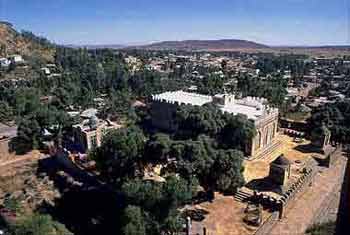 St. Mary Church in Axum, Ethiopia.
|
One
of the most fascinating possibilities is advanced by Ethiopian Christians
who claim that they have the Ark today. In Axum, Ethiopia, it is widely
believed that the Ark is currently being held in the Church of Saint
Mary of Zion, guarded by a monk known as the "Keeper of the Ark,"
who claims to have it in his possesion. According to the Axum Christian
community, they acquired the Ark during the reign of Solomon,
when his son Menelik, whose mother was the Queen of Sheba, stole the
Ark after a visit to Jerusalem.
While in the not-so-distant past the "Ark" has been brought
out for Christian holidays, its keeper has not done so for several years
due to the tumultuous political situation in the country. The claim
has thus been impossible to verify, for no one but the monk is allowed
into the tent.
A more plausible claim is that of archaeologist Leen
Ritmeyer, who has conducted research on the Temple
Mount and inside the Dome
of the Rock. He claims to have found the spot on the Mount where
the Holy of Holies was located during the First
Temple period. In the precise center of that spot is a section of
bedrock cut out in dimensions that may match those of the Ark as reported
in Exodus. This section
of the mount, incidentally, is the one from which the creation of the
world began, according to midrash (T. Kedoshim, 10). Based on his findings, Ritmeyer has postulated
that the Ark may be buried deep inside the Temple
Mount. However, it is unlikely that any excavation will ever be
allowed on the Mount by the Muslim or Israeli authorities.
The Role
of the Ark Today
The Ark remains a topic of study even today, over 2000 years after it
was last seen. A great deal of research has attempted to explain the
wonders that are attributed to the Ark in the Bible. One recent study
suggests the possibility that the Ark represented man's first harnessing
of electricity. The accounts given of peoples' sudden deaths from touching
the Ark are consistent with death by a high voltage, lethal electrical
charge. Such a charge could have resulted from the constant exposure
of the box to static electricity, which builds up quickly in a hot,
dry climate like the Middle East. The materials that the Ark was made
of further support this theory: gold is one of the most powerful electrical
conductors, and wood is an excellent insulator.
The
only remnant of the Ark in Jewish life today is the
Holy Ark in which Torah scrolls are kept in synagogues.
These Arks often are decorated with copies of the Tablets,
reminiscent of the contents of the actual Ark of ancient
times. The Ark itself plays no role in Jewish life today.
Nonetheless, it remains a potent symbol of the Jewish
peoples' past, and of the messianic
era many believe is waiting in the future.
Ironically, the Ark is most famous today as the subject
of the 1981 film "Indiana Jones and the Raiders of the Lost Ark."
The movie tells of a hero's attempt to prevent the Ark from falling
into the hands of the Nazis, who would harness its power for evil. While
there is no evidence of Hitler ever having had an interest in the Ark, the movie does an admirable
job of capturing the mystique of one of the worlds' most ancient unsolved
mysteries.
Sources:Graham Hancock. The
Sign and the Seal : The Quest for the Lost Ark of the
Covenant. Touchstone Books, 1993; Encyclopedia
Judaica. "Ark of the Covenant."; Ritmeyer, L., 1996. "The Ark of the Covenant: Where
it Stood in Solomon's Temple". Biblical Archaeology
Review 22/1: 46-55, 70-73; The
Discovery Channel Online. "The Lost Ark."
Photo Credits: Painting courtesy of Bible
Topics; Movie poster courtesy of Tim
Dirks; Ethiopia photos courtesy of Your
Dot Com for Africa
|
