The Meaning of Resolution 242
On November 22, 1967, the UN
Security Council unanimously adopted Resolution
242, establishing the principles that
were to guide the negotiations for an Arab-Israeli
peace settlement. This resolution was
a tortuously negotiated compromise between
competing proposals. By examining what was
discarded as well as the language that appears,
it is possible to discern the Security Council's
intent.
The first point addressed by the resolution is the "inadmissability
of the acquisition of territory by war." Some people read 242 as
though it ends here and the case for requiring a total Israeli
withdrawal from the territories is proven. On the contrary, this
clause does no such thing, because the reference clearly applies only
to an offensive war. If not, the resolution would provide an incentive
for aggression. If one country attacks another, and the defender
repels the attack and acquires territory in the process, the former
interpretation would require the defender to return the land it took.
Thus, aggressors would have little to lose because they would be
insured against the main consequence of defeat.
The ultimate goal of 242, as expressed in paragraph 3, is the
achievement of a "peaceful and accepted settlement." This
means a negotiated agreement based on the resolution's principles
rather than one imposed upon the parties. This is also the implication
of Resolution 338, according
to Arthur Goldberg, the
American ambassador who led the delegation to the UN in 1967. That
resolution, adopted after the 1973
war, called for negotiations between the parties to start
immediately and concurrently with the ceasefire.
Withdrawal from Territories
The most controversial clause in Resolution 242 is the call for the
"Withdrawal of Israeli armed forces from territories occupied in
the recent conflict." This is linked to the second unambiguous
clause calling for "termination of all claims or states of
belligerency" and the recognition that "every State in the
area" has the "right to live in peace within secure and
recognized boundaries free from threats or acts of force."
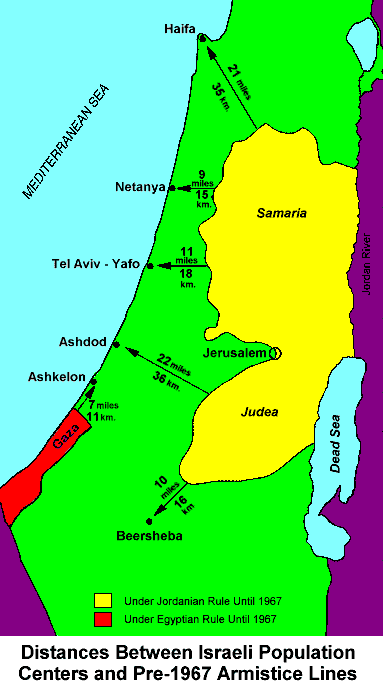 |
The resolution does not make Israeli withdrawal a prerequisite for
Arab action. Moreover, it does not specify how much territory Israel
is required to give up. The Security Council did not say Israel must
withdraw from "all the" territories occupied after the Six-Day
war. This was quite deliberate. The Soviet delegate wanted the
inclusion of those words and said that their exclusion meant
"that part of these territories can remain in Israeli
hands." The Arab states pushed for the word "all" to be
included, but this was rejected. They nevertheless asserted that they
would read the resolution as if it included the word "all."
The British Ambassador who drafted the approved resolution, Lord
Caradon, declared after the vote: "It is only the resolution that
will bind us, and we regard its wording as clear."
This literal interpretation was repeatedly declared to be the
correct one by those involved in drafting the resolution. On October
29, 1969, for example, the British Foreign Secretary told the House of
Commons the withdrawal envisaged by the resolution would not be from
"all the territories." When asked to explain the British
position later, Lord Caradon said: "It would have been wrong to
demand that Israel return to its positions of June 4, 1967, because
those positions were undesirable and artificial."
Similarly, Amb. Goldberg explained: "The notable
omissions-which were not accidental-in regard to withdrawal are the
words 'the' or 'all' and 'the June
5, 1967 lines'....the resolution speaks of withdrawal from
occupied territories without defining the extent of withdrawal."
The resolutions clearly call on the Arab states to make peace with
Israel. The principal condition is that Israel withdraw from
"territories occupied" in 1967, which means that Israel must
withdraw from some, all, or none of the territories still occupied.
Since Israel withdrew from 91% of the territories when it gave
up the Sinai, it has already partially, if not wholly, fulfilled
its obligation under 242.
The Arab states also objected to the call for "secure and
recognized boundaries" because they feared this implied
negotiations with Israel. The Arab League explicitly ruled this out at Khartoum in August 1967,
when it proclaimed the three "noes." Amb. Goldberg explained
that this phrase was specifically included because the parties were
expected to make "territorial adjustments in their peace
settlement encompassing less than a complete withdrawal of Israeli
forces from occupied territories, inasmuch as Israel's prior frontiers
had proved to be notably insecure."
The question, then, is whether Israel has to give up any additional
territory. Now that peace agreements have been signed with Egypt and Jordan, the only
remaining territorial disputes are with Lebanon and Syria. Israel's conflict
with Lebanon is a result of fighting after 1967 and is therefore
irrelevant to 242 (Israel has said it would withdraw to the
international border if a treaty is signed and the central government
takes control of northern border areas currently in the hands of
terrorist groups).
The dispute with Syria is over the Golan
Heights. Israeli Prime Minister Yitzhak
Rabin expressed a willingness to negotiate a compromise in
exchange for peace; however, President Hafez Assad refused to consider
even a limited peace treaty unless Israel first agreed to a complete
withdrawal. Under 242, Israel has no obligation to withdraw from any
part of the Golan in the absence of a peace accord with Syria.
It is also important to realize that other Arab states that
continue to maintain a state of war with Israel, or have refused to
grant Israel diplomatic recognition, such as Saudi
Arabia, Iraq and Libya have no territorial disputes with Israel. They have nevertheless
conditioned their relations (at least rhetorically) on an Israeli
withdrawal to the pre-1967 borders.
Although ignored by most analysts, Resolution 242 does have other
provisions. One requirement in that section is that freedom of
navigation be guaranteed. It is important to remind people this clause
was included because a principal cause of the 1967 war was Egypt's
blockade of the Strait of Tiran.
Israel's Obligations to the Palestinians
The Palestinians are not mentioned anywhere in Resolution 242. They
are only alluded to in the second clause of the second article of 242,
which calls for "a just settlement of the refugee problem."
Nowhere does it require that Palestinians be given any political
rights or territory. In fact, the use of the generic term "refugee"
was a deliberate acknowledgment that two refugee problems were
products of the conflict-one Arab and another Jewish. In the case of
the latter, almost as many Jews fled Arab countries as Palestinians
left Israel. The Jews, however, were never compensated by the Arab
states, nor were any UN organizations ever established to help them.
In a statement to the General
Assembly October 15, 1968, the PLO,
rejecting Resolution 242, said "the implementation of said
resolution will lead to the loss of every hope for the establishment
of peace and security in Palestine and the Middle East region."
By contrast, Amb. Abba Eban expressed Israel's position to the Security
Council on May 1, 1968: "My government has indicated its
acceptance of the Security Council resolution for the promotion of
agreement on the establishment of a just and lasting peace. I am also
authorized to reaffirm that we are willing to seek agreement with each
Arab State on all matters included in that resolution."
It took nearly a quarter century, but the PLO finally agreed that
Resolutions 242 and 338 should be the basis for negotiations with
Israel when it signed the Declaration of
Principles in September 1993.
|