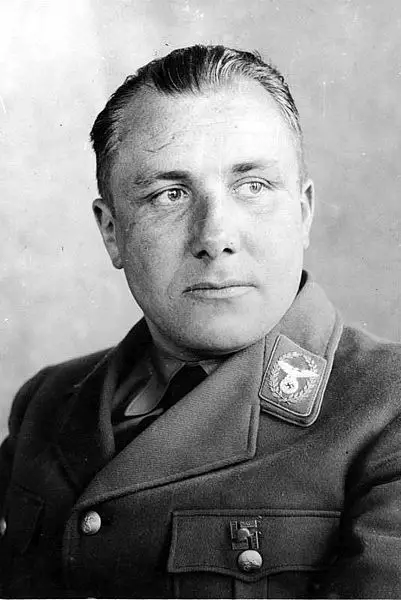
Martin Bormann was head of the Party Chancellery and private secretary of Adolf Hitler,
who by the end of World War II had become second only to the Fuhrer himself in terms of real political power.
Bormann (born June 17, 1900; death unknown) was born in Halberstadt, Germany. The son of a former Prussian regimental sergeant-major who later became a
post-office employee, Bormann dropped out of school to work on a farming estate in
Mecklenburg. After serving briefly as a cannoneer in a field artillery regiment at the
end of World War I, Bormann subsequently joined the rightist Rossbach Freikorps in
Mecklenburg and was connected with the so-called 'Feme' murders.
In March 1924, Bormann was sentenced to one year's imprisonment as an accomplice of
Rudolf Hoss in the brutal, vengeance murder of Walther Kadow (his former teacher
at elementary school), who had supposedly betrayed the proto-Nazi martyr Leo Schlageter
to the French occupation authorities in the Ruhr.
After his release he entered the Nazi Party, becoming its regional press officer in Thuringia
and then business manager in 1928. From 1928 to 1930, Bormann was attached to the SA Supreme
Command and in October 1933 he became a Reichsleiter of the NSDAP. A month later he was
elected as a Nazi delegate to the Reichstag. From July 1933 until 1941, Bormann was the
Chief of Cabinet in the Office of the Deputy Fuhrer, Rudolf Hess , acting as his
personal secretary and right-hand man.
During this period, the 'model secretary', diligent, adaptable and efficient, began his
silent, imperceptible rise to the centre of the power apparatus, slowly acquiring master
of the bureaucratic mechanism and Hitler's personal trust.
He developed and administered the Adolf Hitler Endowment Fund of German industry, a huge
fund of 'voluntary' contributions by successful business entrepreneurs to the Fuhrer,
which Bormann then reallocated as gifts to almost all the top Party functionaries.
In addition to administering Hitler's personal finances, buying the Berghof at Berchtesgaden and running it as well as the whole complex of properties on the Obersalzberg, Bormann acquired the power to control the living standards of Gauleiters and Reichsleiters, not to speak of members of the Fuhrer's intimate circle. Bormann's brutality, coarseness, lack of culture and his apparent insignificance led the Nazi Old Guard to underestimate his silent persistence and ability to make himself indispensable. Rudolf Hess's flight to Britain opened the way for the 'Brown Eminence' to step into his shoes on 12 May 1941 as head of the Parteikanzlei and to gather the reins of the Party into his own hands and steadily undermine all his rivals for power.
Until the end of the war, the short, squat Bormann, working in the anonymity of his
seemingly unimportant office, proved himself a master of intrigue, manipulation and
political in-fighting. Always the 'narrow Party man' and a fierce guardian of Nazi
orthodoxy (he was an arch-fanatic when it came to racial policy, anti-semitism and the
Kirchenkampf [war between the churches]), Bormann strengthened the position of the Party
against the Wehrmacht and the SS, and increased his grip on domestic policy.
Increasingly he controlled all questions concerning the security of the regime, acts of
legislation, appointments and promotions, especially if they concerned Party personnel.
He also established espionage in the army, getting younger officers promoted to spy on
the political attitudes of their colleagues. He reopened the fight against the Christian
churches, declaring in a confidential memo to Gauleiters in 1942 that their power 'must absolutely and finally be broken.' Nazism, based as it was on a 'scientific' world-view,
was completely incompatible with Christianity whose influence was regarded by Bormann
as a serious obstacle to totalitarian rule. The sharpest anti-cleric in the Nazi
leadership (he collected all the files of cases against the clergy that he could lay
his hands on), Bormann was the driving force of the Kirchenkampf, which Hitler for
tactical reasons had wished to postpone until after the war.
Bormann was invariably the advocate of extremely harsh, radical measures when it came
to the treatment of Jews, of the conquered eastern peoples or prisoners of war.
He signed the decree of 9 October 1942 prescribing that "the permanent elimination of
the Jews from the territories of Greater Germany can no longer be carried out by
emigration but by the use of ruthless force in the special camps of the East."
A further decree, signed by Bormann on 1 July 1943, gave Adolf Eichmann absolute powers over Jews, who now came under the exclusive jurisdiction of the
Gestapo.
Bormann's memos concerning the Slavs make it clear that he regarded them as a
'Sovietized mass' of sub-humans who had no claim to national independence. In a
brutal memo of 19 August 1942 he wrote: "The Slavs are to work for us. In so far
as we do not need them, they may die. Slav fertility is not desirable."
By the end of
1942 Bormann was virtually Hitler's deputy and his closest collaborator, showing
an uncanny ability to exploit his weaknesses and personal peculiarities in order to
increase his own power. Always in attendance on the Fuhrer, taking care of tiresome
administrative detail and skilfully steering Hitler into approval of his own schemes,
Bormann acquired the inside track for displacing dangerous rivals like Goering , Goebbels, Speer and even Himmler, whose access to the Fuhrer was controlled by him.
Bormann exploited his position of trust to build a Chinese wall against reality,
in which Hitler could indulge his fantasies and in which more sensible, conciliatory
proposals from other members of the Party were screened from him. Bormann reduced
everything to simple, administrative formulae that freed Hitler from the burdens of
paper work. He drew up his appointments calendar and decided whom he should see and
whom he should not. Hitler rewarded these and other services by the trust he placed
in Bormann, whom he once called 'my most loyal Party comrade'. He was made
executive head of the Volkssturm, the desperate levy en masse of the German civilian
population organized as the Allies stood poised to invade the Reich.
By now virtually
the secret ruler of Germany, Bormann did not cease his Machiavellian bureaucratic
intrigues against his rivals.
As a result of his machinations Hitler dismissed Goering and Himmler's influence was
severely curtailed. It was the indispensable Bormann, the most mysterious and sinister
figure in the Third Reich, who signed Hitler's political testament, who acted as the
witness to his marriage to Eva Braun and watched his
Fuhrer commit suicide in the Chancellery bunker. Ordered by Hitler 'to put the
interests of the nation before his own feelings' and to save himself, Bormann left the
Fuhrerbunker on 30 April 1945. Accounts of what happened afterwards vary widely.
According to Erich Kempka (Hitler's chauffeur), Bormann was killed trying to cross
the Russian lines by an anti-tank shell which hit the tank in which they were trying
to escape, causing it to burst into flames. Kempka, who was temporarily blinded at
the time, claimed nonetheless to have seen Bormann's dead body. Hitler Youth Leader,
Artur Axmann, on the other hand, believed that Bormann committed suicide and
claimed to have seen Bormann's body on 2 May 1945 in the Invalidenstrasse, north of the
River Spree in Berlin.
Doubts, however, have persisted and numerous sightings of
Bormann have been reported, beginning in 1946 when his presence in a North Italian
monastery was announced. In the same year, his wife Gerda (a rabid Nazi and daughter
of Supreme Party Judge, Walter Buch) died of cancer in South Tyrol, though his
ten children survived the war. It was then alleged that Bormann had escaped (like
other loyal Nazis) via Rome to South America. Rumoured to have settled in Argentina
where he was living secretly as a millionaire, allegedly spotted in Brazil and also in
Chile, Bormann's traces proved as elusive as the anonymity in which he first rose to
power.
Having been sentenced to death in absentia at Nuremberg on 1 October 1946,
he was formally pronounced dead by a West German court in April 1973 but his precise
fate remains unknown.