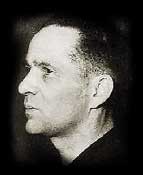
Rudolf Franz Ferdinand Höss was the Nazi commandant of the
Auschwitz
extermination camp.
Höss (born November 25, 1900; died April 16, 1947) was born
in Baden-Baden, a town in southwest Germany. In high school, he trained for the priesthood yet his father's death and the outset of World War I changed those career plans. In 1916, he joined the German army where he would be wounded three times and was twice awarded the Iron Cross. In 1920, Hoss joined the East Prussian Free Corps (Freikorps) and took part in the suppression of disturbances in Latvia and in quelling workers who were staging a revolt in the Ruhr. It was through the Freikorps, in early 1922, that Hoss was first introduced to Adolf Hitler.
Hoss immediately joined the Nazi Party and renounced his affiliation with the Catholic Church. When France and Belgium entered and occupied the Upper Rhine region in January 1923, Höss participated in the assassination of Freikorpsman Walter Kadow and was captured and sentenced to 10 years in prison. He was released in 1928 as part of the general amnesty.
In 1933, Hoss joined the SS and in 1934 he was attached to the SS
at Dachau.
On August 1, 1938, Hoss was appointed as adjutant of the Sachsenhausen concentration camp until his appointment as
Kommandant of the newly-built camp at Auschwitz in early 1940.
In May 1941, SS commander Heinrich
Himmler told Höss that Hitler had given
orders for the final
solution of the Jewish question and that "I have
chosen the Auschwitz camp for this purpose."
Höss converted Auschwitz into an extermination
camp and installed gas
chambers and crematoria that were capable of killing 2,000 people every hour. Counting corpses with the
cool dedication of a trained bookkeeper, he
went home each night to the loving embrace
of his own family who lived on the camp grounds.
Watching millions of innocent
human beings dissolve in the gas chambers,
burn in the crematoriums and their teeth
melt into gold bars, Höss wrote poetry
about the "beauty" of Auschwitz.
Nazi leader Adolf
Eichmann recounted in his memoirs how
he was assigned in early 1942 to visit the Auschwitz death camp and report back to superiors on the
killing of Jews. He wrote that the methods for killing were still crude, but
these represented a gruesome foretaste of the factory-style
gas chambers and crematoria that were to follow:
"Höss, the Kommandant,
told me that he used sulfuric acid to kill.
Round cotton wool filters were soaked with
this poison and thrown into the rooms where
the Jews were assembled. The poison was
instantly fatal. He burned the corpses on
an iron grill, in the open air. He led me
to a shallow ditch where a large number
of corpses had just been burned."
Höss eventually found that
gassing by carbon monoxide was inefficient and introduced the
cyanide gas Zyklon
B. He later recalled:
"The gassing was carried
out in the detention cells of Block 11.
Proctected by a gas mask, I watched the
killing myself. In the crowded cells, death
came instantaneously the moment the Zyklon
B was thrown in. A short, almost smothered
cry, and it was all over... I must even
admit that this gassing set my mind at rest,
for the mass extermination of the Jews was
to start soon, and at that time neither
Eichmann nor I was certain as to how these
mass killings were to be carried out. It
would be by gas, but we did not know which
gas and how it was to be used. Now we had
the gas, and we had established a procedure."
Auschwitz became the killing centre where the
largest numbers of European Jews were killed.
After an experimental gassing there in September
1941 of 850 malnourished prisoners,
mass murder became a daily routine. By mid 1942,
mass gassing of Jews using Zyklon-B began at Auschwitz, where extermination was
conducted on an industrial scale with 2.5 million
persons eventually killed through gassing, starvation,
disease, shooting, and burning.
At Auschwitz, so called camp
doctors also performed vile and lethal medical
experiments on concentration camps inmates,
torturing Jewish children, Gypsy children and many others. "Patients"
were put into pressure chambers, tested with
drugs, castrated, frozen to death, and exposed
to various other traumas.
In late 1943, Höss was appointed chief
inspector of the concentration
camps and worked hard to improve the 'efficiency'
of the other extermination centres. He performed
his job so well that he was commended in a 1944
SS report that called him 'a true pioneer in
this area because of his new ideas and educational
methods.'
At the
approach of the Red Army in 1945, Höss fled Auschwitz and went into hiding
in Germany under the name Franz Lang. He was tracked down by Hanns Alexander, a German Jew who had fled Berlin in the 1930's, and was
arrested by the Allied military police in 1946,
who handed him over to the Polish authorities. In 1947, Hoss was tried and was sentenced to death. He was returned to Auschwitz to be hanged on
a one-person gallows built outside the entrance
to the gas chamber.
Before his execution, Höss related how he
often felt weak-kneed at having to push hundreds
of screaming, pleading children into the gas
chambers:
"I did, however, always feel
ashamed of this weakness of mine after I talked
to Adolf Eichmann. He explained to me that
it was especially the children who have to
be killed first, because where was the logic
in killing a generation of older people and
leaving alive a generation of young people
who can be possible avengers of their parents
and can constitute a new biological cell for
the reemerging of this people."
His last words acknowledged his responsibility for all that occurred in Auschwitz and he did not appeal for leniency. He only asked for permission to send a farewell letter to his family and to return his wedding ring to his wife. On the morning of April 16, 1947, several dozen yards from his former villa near Crematorium I in the main camp, Rudolf Höss was hanged.
These are excerpts from Höss' signed testimony
given at the Post-War Nuremberg War Crime trials:
RUDOLF FRANZ FERDINAND HÖSS, being first duly
sworn, depose and say as follows:
"I am fortysix years old, and
have been a member of the NSDAPI since 1922;
a member of the SS since 1934; a member
of the WaffenSS since 1939. I was a
member from 1 December 1934 of the SS Guard
Unit, the socalled Deathshead Formation
(Totenkopf Verband).
I have been constantly associated with
the administration of concentration camps
since 1934, serving at Dachau until 1938;
then as Adjutant in Sachsenhausen from 1938
- 5/1/1940, when I was appointed Kommandant
of Auschwitz. I commanded Auschwitz until
12/1/1943 and estimate that at least 2.5
million victims were executed and exterminated
there by gassing and burning, and at least
another half million succumbed to starvation
and disease making a total dead of about
3 million. This figure represents about
70-80% of all persons sent to Auschwitz
as prisoners, the remainder having been
selected and used for slave labor in the
concentration camp industries; included
among the executed and burned were approximately
20,000 Russian prisoners of war (previously
screened out of prisoner-of-war cages by
the Gestapo) who were delivered at Auschwitz
in Wehrmacht transports operated by regular
Wehrmacht officers and men. The remainder
of the total number of victims included
about 100,000 German Jews, and great numbers
of citizens, mostly Jewish, from Holland,
France, Belgium, Poland, Hungary, Czechoslovakia,
Greece, or other countries. We executed
about 400,000 Hungarian Jews alone at Auschwitz
in the summer of 1944.
until 12/1/1943 and know by reason of
my continued duties in the Inspectorate
of Concentration Camps, WVHA, that these
mass executions continued as stated above.
All mass executions by gassing took place
under the direct order, supervision, and
responsibility of RSHA. I received all orders
for carrying out these mass executions directly
from RSHA.
The 'Final Solution' of the Jewish question
meant the complete extermination of all
Jews in Europe. I was ordered to establish
extermination facilities at Auschwitz in
6/1941. At that time, there were already
in the General Government three other extermination
camps: Belzek, Treblinka and Wolzek. These
camps were under the Einsatzkommando of
the Security Police and SD. I visited Treblinka
to find out how they carried out their exterminations.
The camp commandant at Treblinka told me
that he had liquidated 80,000 in the course
of one-half year. He was principally concerned
with liquidating all the Jews from the Warsaw
Ghetto. He used monoxide gas, and I did
not think that his methods were very efficient.
So when I set up the extermination building
at Auschwitz, I used Zyklon B, which was
a crystallized prussic acid which we dropped
into the death chamber from a small opening.
It took from 3-15 minutes to kill the people
in the death chamber, depending upon climatic
conditions. We knew when the people were
dead because their screaming stopped. We
usually waited about one-half hour before
we opened the doors and removed the bodies.
After the bodies were removed our special
Kommandos took off the rings and extracted
the gold from the teeth of the corpses.
Another improvement we made over Treblinka
was that we built our gas chamber to accommodate
2000 people at one time whereas at Treblinka
their 10 gas chambers only accommodated
200 people each. The way we selected our
victims was as follows: We had two SS doctors
on duty at Auschwitz to examine the incoming
transports of prisoners. The prisoners would
be marched by one of the doctors who would
make spot decisions as they walked by. Those
who were fit for work were sent into the
camp. Others were sent immediately to the
extermination plants. Children of tender
years were invariably exterminated since
by reason of their youth they were unable
to work. Still another improvement we made
over Treblinka was that at Treblinka the
victims almost always knew that they were
to be exterminated and at Auschwitz we endeavored
to fool the victims into thinking that they
were to go through a delousing process.
Of course, frequently they realized our
true intentions and we sometimes had riots
and difficulties due to that fact. Very
frequently women would hide their children
under the clothes, but of course when we
found them we would send the children in
to be exterminated. We were required to
carry out these exterminations in secrecy
but of course the foul and nauseating stench
from the continuous burning of bodies permeated
the entire area and all of the people living
in the surrounding communities knew that
exterminations were going on at Auschwitz.
We received from time to time special prisoners
from the local Gestapo office. The SS doctors
killed such prisoners by injections of benzine.
Doctors had orders to write ordinary death
certificates and could put down any reason
at all for the cause of death.
From time to time we conducted medical
experiments on women inmates, including
sterilization and experiments relating to
cancer. Most of the people who died under
these experiments had been already condemned
to death by the Gestapo.
I understand English as it is written
above. The above statements are true; this
declaration is made by me voluntarily and
without compulsion; after reading over the
statement I have signed and executed the
same at Nuremberg, Germany, on the 4/5/1946.
- Rudolf Höss."