|
[By: Alden Oreck]
Jews likely first settled in modern Belgium during the early-13th century, although the exact date of their settlement there cannot be ascertained. Today, the Jewish population of Belgium numbers approximately 30,000 - the 15th largest Jewish community in the world.
- Early History
- 16th-19th Centuries
- The Holocaust Era
- Post-World War II
- Modern Community
- Major Cities
Early History
 |
Much of Jewish settlement in Europe began with the Roman conquests. Jews followed the path of the Roman legions to Belgium in
the years 53-57 CE. Written evidence, however, only dates back to the
13th century. Hebrew tombstones and street names like "rue des
Juifs" have been traced to 1255. Other sources mention Jews as
early as 1200 in the Brabant province. Anti-Jewish measures can also
be traced back to the 13th century.
In his 1261 will, Duke Henry III
ordered all Jews and usurers to be expelled from the Brabant province.
At about the same time, theologian Thomas Aquinas suggested the Jews
be taxed and forced to perform manual labor to prevent them from becoming
wealthy as usurers. Although these measures did not adversely affect
the Jewish population in Belgium, the 1309 crusade did. Jews who refused baptism were massacred.
Under the protection of Duke John II, the Jewish community was able
to rebuild and by 1311 had its own rabbi. The community grew even larger
when expelled Jews from France began settling in different parts of Belgium. However, more than three
decades later, all this progress was erased with the onset and aftermath
of the Black Death (1348-49). The Jews who did not perish from sickness
were slaughtered by the populace or the authorities who blamed them
for poisoning the wells to cause the plague. Only a handful of families
survived, most of whom were burned at the stake in 1370 charged with
desecrating the Host (the wafers used in communion).
16th-19th Centuries
Jews returned to Belgium in the early 16th century after the Spanish and Portuguese expulsions
of 1490s. Many Sephardim enjoyed rights and safety as "New
Christians" (coverts to Christianity, many of whom still secretly
practiced Judaism) and concentrated their presence in Antwerp, bringing
with them the skills of the diamond trade. Marranos who settled in Antwerp at the end of the 15th and the beginning of the
16th century played an important economic and financial role there as key figures in opening up the precious-stones industry, including diamonds and pearls, and developing the sugar trade as well as the first international stock exchange in Europe in 1536.
Between 1650 and 1694 a secret synagogue conducted services in Antwerp.
When Austria began
ruling Belgium in 1713, it allowed for a more open society, attracting Ashkenazi Jews. Nevertheless,
Jews still had to pay special taxes. Under French (1794-1814) and later
Dutch (1814-30) rule, Jews enjoyed greater freedoms.
Belgium became independent in 1831 and officially recognized Judaism
immediately. Brussels, with a more French influenced Jewish community,
had a higher rate of assimilation, while Antwerp, influenced by Yiddish and Flemish, retained traditional forms of Jewish life, a trend that
remains today. Belgium's Jewish population grew significantly after
1880, when Eastern European
Jews began fleeing hostile areas and settling in Belgium. Antwerp's Jewish community grew from 8,000 people in 1880 to 50,000 in 1939, comprising twenty percent of the total population. The community thrived as more and more synagogues, religious schools, and Zionist organizations were created.
The Holocaust Era
At the outset of World War II, more than 100,000 Jews were in Belgium,
including 55,000 in Antwerp and 35,000 in Brussels, with smaller communities
in Ghent, Liege, Arlon, Mons, Charleroi, Namur and Oostende. At least
20,000 were German refugees, who, along with thousands of others, hoped
to flee to the United States.
On May 10, 1940, Nazi Germany invaded Belgium, taking just 18 days to put the country under military
rule which lasted until liberation in September 1944.
Anti-Jewish measures began in the autumn of 1940 and grew worse over
time. The first prohibitions included ritual slaughter and other religious
rites. Other discriminatory actions followed with the Nazis prohibiting
Jews from certain professions, such as the fields of law and education.
By 1941, authorities started to confiscate property, including the diamond exchange, to set up curfews
and to confine Jews to cities. The Nazis ordered Jews to wear yellow badges
in early 1942 and, in September of that same year, began rounding them
up by the thousands and deporting them, mostly to Auschwitz.
Very few Belgian Jews survived concentration
camps.
An active resistance movement, supported by both Jews and non-Jews
prevented a higher death toll. The exiled Belgian government, as well
as the Catholic Church and the Belgian populace, still upset by the
German occupation in World War I, resisted a second German occupation.
A higher proportion of Jews were saved in Belgium than most other occupied
countries. Initially, when the Germans had trouble identifying Jews
because the Belgian constitution does not permit mention of religion
on civil documents, most Belgians never assisted. In fact, many actually
helped Jews. Christian families hid Jewish children and usually honored
their requests against baptism. And after the war, almost all Jewish
children were returned to their families. In 1942, the Nazis had difficulty
finding Belgian police officers to help them put yellow
badges on Jews. With the help of the Jewish Resistance, about 800 Jews were able to hide in the city of Antwerp.
The largest Jewish movement, the Committee for Jewish Defense (CJD),
affiliated with the national Belgian resistance movement, worked on
several levels. The organization hid Jews, fought as partisans, forged
identity papers and food ration tickets, obtained funds and set up escape
routes. In the cultural realm, CJD distributed information and propaganda
material, established a lending library, and maintained a Jewish press,
printing in Yiddish,
French and Flemish.
Ultimately, the Belgian resistance was not strong enough to fend off
the Nazis and their collaborators. Between 1942-44, more than 25,000
Belgian Jews perished in the Holocaust.
Post-World War II
In the decades after World War II, thousands of Jewish refugees from
Eastern and Central Europe made their way though Belgium, most awaiting
immigration permits to other countries of permanent settlement. Belgium
slowly rebuilt its infrastructure, the Jewish community included. In
1947, Belguim voted for the partition of Palestine and the creation
of a Jewish State at the United Nations General Assembly. Belgium was
also among the first countries to establish diplomatic relations with
Israel.
By 1970, Belgium's Jewish population numbered about 40,000, primarily
in Antwerp and Brussels. The 1970s saw the rise of Jewish political
activism in Belgium. Several Belgian Jewish organizations came together
to host the "World Conference of Jewish Communities on Soviet Jewry"
twice in the 1970s. In 1976, 5,000 Jews enrolled in the Belgian Zionist
Federation, A year later, the largest Jewish organizations merged into
Coordinating Committee of Belgian Jewish Organizations.
Between 1979-1981, there were a number of Arab terrorist attacks on Jews, including a car-bomb, hand grenade thrown into a crowd
of Jewish children and an attack on El Al passengers at the Brussels
airport. The Jewish population dipped to approximately 30,000, split
between French and Flemish speaking areas, but almost 50% (14,000) attended
synagogue during the High Holidays. The Consistoire Central Israelit
of Belgium, a state-recognized Jewish body reported 15 religious communities
in seven cities. The liberal community grew as well, opening new congregations.
During the 1980s, more than 6,500 students received some sort of Jewish
education, either in a Jewish day school or synagogue. Trade with Israel
increased dramatically, so that by 1980, exports from Belgium to Israel
were $404 million, while imports from Israel were $236 million.
Despite the rise of right-wing parties in the late 1980s and early
1990s in Belgium and elsewhere in Europe, Belgium remained committed
to its Jewish community. In response to the growth of these parties,
the mainstream parties enacted laws prohibiting Holocaust denial (1995)
and strengthened existing laws against intolerance. In addition, several
monuments were erected and museums opened in a campaign to remember
the Holocaust. The Ministry of education launched a nationwide awareness
program called "Democracy or Barbary...50 Years after," which
included plays, movies and operas.
Belgium has long-recognized Judaism as an official state religion and
continues to subsidize the general studies curriculum at several Jewish
schools. The government even pays the salary of Belgium's chief rabbi
and funds the country's main synagogue in Brussels. The Jews of Belgium
also have a working relationship with the Catholic Church. The Jewish
Consistoire works with a number of Christian organizations to promote
interfaith dialogue. A Judeo-Christian Consultation Group was organized
to further this goal.
Modern Community
Today, the total Jewish population in Belgium is approximately
30,000, with a high concentration in Brussels and Antwerp. Small Jewish
communities exist in Charleroi, Oostende, Ghent, Liege, Mons, Arlon,
Waterloo and Knokke. Jewish culture remains strong throughout Belgium.
There are more than a dozen Jewish schools, five Jewish newspapers and
more than 45 active synagogues. Most Belgian Jews belongs to the middle
class and are active in the fur, textile, leather and diamond industries.
In 2002, as anti-Semitism flared throughout Europe and immigrants were rioting in Antwerp, some
violence was directed at Jews in Belgium. In late November, a Molotov
cocktail was thrown at a synagogue in Antwerp (Jerusalem
Post, November 30, 2002).
Tensions also were raised in the binational relationship
between Israel and Belgium when efforts were made to try Ariel
Sharon in Belgium as a war criminal for his actions during the Lebanon
War. The Belgian Supreme Court ultimately ruled Sharon could not be
charged while he is Prime Minister but left open the possibility of
doing so later. This led Israel to withdraw its ambassador and to advise
many Israelis in and out of government to avoid traveling to Belgium
to avoid the risk of being arrested and charged with some alleged past
crime.
Classic revolutionary or social anti-Semitism is common within leftist groups in Belgium. This type of anti-Semitism sees capitalist Israel, supported by the capitalist United States, as one of the major evils in the world, and the Arabs as the main victims of capitalism. Such views are expressed in the publications of almost all leftist groups and explain the close ties between radical leftist groups, like the Marxist-Leninist PTB/PVDA (Parti du Travail de Belgique), and radical Muslim groups, like the AEL.
In 2000, historian Lievan Saerens published information revealing the role that Antwerp’s municipal police played in the deportation of Jews during World War II. Yet the Belgian political world seems unready to confront the realities of its past. In January 2005, the Belgian prime minister failed to make an official statement at the commemoration of the 60th anniversary of the liberation of Auschwitz. The first official statement made acknowledging the Belgian authorities’ participation in the deportation of Belgian Jews to Auschwitz was made on February 17, 2005 by Philippe Moureaux, mayor of Brussel’s Molenbeek-Saint-Jean district and president of the Brussel’s Federation of the Socialist Party, when he expressed his and his administrations apologies for those crimes committed during World War II. He was the first politician of his rank to officially recognize the responsibility of those Belgian officials who had assisted in the deportation.
Due to the large Arab-Muslim community in Belgium (20% of Brussels' citizens were born in Muslim countries), the Middle East conflict has become a domestic political issue with most political parties expressing support for the Palestinians in an effort to secure the Arab-Muslim vote. However, the government was forced to recognize the presence of Arab/Muslim anti-Semitism following a violent anti-Semitic demonstration at an Israeli-Belgian soccer game.
In January 2013, the Belgian Senate issued a strengthened version of an official resolution recognizing Holocaust-era complicity in the persecution of Jews. “The Senate hereby enacts the government’s statement made on Sept. 9, 2012, by Prime Minister Elio Di Rupo, who acknowledged the responsibility of Belgian authorities, and through it that of the Belgian state, in the persecution of Jews in Belgium,” the resolution now reads.
The resolution revamps one that was based on a text passed by a Senate committee earlier in January 2012 that spoke only of “responsibility of Belgian authorities” without reference to the state or the authorities who had or had not cooperated with the Nazi occupation forces. Several Belgian Jewish groups, including the CCOJB umbrella group, called on the Senate to reformulate the resolution, as they found it minimized the role of the Belgian state as described in a report from 2007.
2014 has seen multiple anti-semitic attacks carried out against the Jewish community in Belgium. On Saturday May 24 a suspect later identified as Mehdi Nemmouche opened fire at the Jewish Museum in Brussels in an attack identified by authorities as a clear act of anti-semitism and terrorism. Nemmouche is a known terrorist thought to have spent time fighting and training with ISIS in Syria. Ex-hostages claim that he was known as "Abu Omar the hitter" and carried out unspeakable acts after kidnapping individuals for ISIS, including murdering a newborn child. The attack occured inside of the museum and left four Jewish individuals dead and was approached as a racially and religiously motivated attack by the Belgian authorities. The gunman drove up to the museum, walked inside and fired shots with a Kalishnakov rifle, killing an Israeli couple, a French woman, and a Belgian man. The museum repoened it's doors on Sunday September 14 after 4 months of not being open to the public.
An attack carried out on a Synagogue in Brussels on September 16 is being treated as an arson by Belgian authorities. Belgian fire services have stated that the initial investigation is pointing towards a racially motivated attack, after a fire broke out on the second floor of Machzikei Hadath synagogue. The Belgian League Against Anti-Semitism released a statement that the Torah scrolls and documents inside of the synagogue were unharmed, and the caretaker of the synagogue's wife and two children were injured by smoke inhalation and required medical attention. They will make a full recovery. The fire was set in four different places in the hopes that it would catch fire quickly and destroy the synagogue.
Two Israelis were injured in the March 22, 2016 terror attack on an airport and train station in Brussels, Belgium. Multiple suicide bomb blasts rocked the Belgium national airport and the Maelbeek train station, killing 31 and injuring more than 250. The wounded Israelis, Chaim Winternitz and Mendy Farkash, were waiting to board a flight to Israel after visiting Brussels for a wedding, when the bombs went off. Their injuriess were non life-threatening, and they were flown back in Israel nine days after the attack.
Following the airport attack, in November 2016 Belgian Deputy Prime Minister and Security Minister Jan Jambon travelled to Israel with a delegation of security officials to view and learn from Israeli airport security. Jambon said that vehicle checkpoints with license-plate scanners will be installed at the Brussels airport soon, similar to the ones present at Ben-Gurion airport in Tel Aviv.
In 2015, 287 Belgian Jews made Aliyah to Israel, the greatest number of Belgian immigrants recorded in a decade. From 2010-2015, an average of 234 Belgian Jews made Aliyah annually, and from 2005-2009, 133 Belgian Jews on average made Aliyah annually.
Major Cities
Brussels
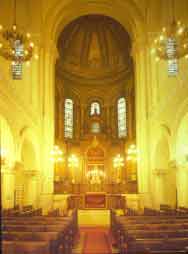 The Great Synagogue
 |
Approximately 15,000 Jews live in the French-speaking capital of Belgium.
The population has stabilized in recent years due to a low birth-rate
and a high rate of assimilation. Nevertheless, Brussels has more than
a dozen synagogues, respresenting
all streams of faith, from Reform to Orthodox and both Ashkenazi and Sephardi. There are
three Jewish schools. Brussels is home to Regards, the leading Jewish newspaper, and Radio Judaica, the first European Jewish radio station.
Brussels is also the headquarters of the European Union of Jewish Students and the Comite de Coordination des Organisations Juives de Belgique (Coordinating Committee of Jewish Organizations in Belgium (CCOJB), the Belgian Jewish communities' roof organization.
Most
of the Jewish sites are located in the middle
of the city. The Great Synagogue on Rue de
la Regence, often described as a "stately
Romanesque" building, was designed by
Christian architect Desire DeKeyser and completed
in 1878. The facade features a three-storied
gabled midsection flanked by four-story towers.
This ornate building also houses several Jewish
organizations, including the Consistoire and
the Communaute Israelite de Bruxelles, as
well as the Belgian Jewish museum. The rest
of the synagogues are scattered throughout
Brussels.
The National Monument to
the Jewish Martyrs of Belgium is on the corner
of Rue Emile Carpentier and Rue Goujond, in
the middle of a residential neighborhood.
The monument depicts a menorah made of chains
and a wall bearing the names of more than
23,000 Belgian Jews killed in the Holocaust.
Close by is a smaller memorial to the Jews
who fought in the Belgian Resistance. A number
of other memorials in Brussels honor Jews,
such as the Louis Bernheim Monument in Square
Marie-Louise. Bernheim was a Jewish general
who became a World War I hero. The Jewish
community of Brussels sponsors cultural events
such as lectures, a Yiddish theater, concerts
and art exhibits at several locations, but
most often at the Centre Communautaire Laic
Juifs at 52 Rue Hotel des Monnaies and the
Martin Buber Institute at 44 Avenue Jeanne.
Antwerp
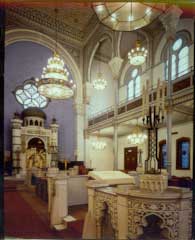 The Hollandse Synagogue
 |
Flemish-speaking Antwerp
(18,000 Jews) has one of the largest ultra-Orthodox communities in the Diaspora. And for this
reason, Antwerp is sometimes regarded as the
last shtetl in Europe. The city's 30 synagogues are all Orthodox.
These include the Hollandse Synagogue on Bouwmeesterstraat,
which was built in 1893, and the Oosten Synagogue
on Oostenstraat, which was constructed in
1913-1914. The Chassidic
Jews follow the traditions of Belz,
Ger, Satmar, Lubavitch, Vishnitz and Czortkow. Kosher food can be easily found in Antwerp; there
are several kosher delis, restaurants and
grocery stores.
Approximately 95% of Jewish
children in Antwerp attend Jewish day schools
and receive intensive religious education.
While Flemish is often the language of instruction,
most students know French, Belgium's second
language, as well as Hebrew and Yiddish, for
prayer and cultural purposes and English,
increasingly a necessity in the international
diamond trade, a popular profession for Jews
in Antwerp.
Jewish Antwerp is a self-contained entity, mostly on Pelikaanstraat and
the surrounding streets. Pelikaanstraat begins at the central railroad
station and runs six blocks parallel to the train tracks. Just around
the corner from the train station is Diamondland, the diamond center,
where visitors can view the different preparation processes of diamonds.
More than 80% of the city's Jews are involved in the diamond trade and
Yiddish is the main language spoken at the diamond exchange. It is common
for both Jews and non-Jews to say mazel u'bracha (luck and blessing)
after reaching a deal. Further down Pelkinstraat, at number 106, are
the offices of the largest Jewish newspaper in Belgium, Belgisch
Israelitisch Weekblad. This weekly reaches every Jewish household
in the country. Nearby, at 12 Nervierstraat, is the Romi Goldmuntz Center,
which hosts Jewish cultural events such as Israeli folk dancing, lectures
and concerts.
Sources: “Belgium takes tips from Israel to step up Brussels airport security,” Yahoo News, (November 22, 2016);
"Three Injured After Suspected Arson Attack on Brussels Synagogue," Haaretz (September 16, 2014);
Reuters, "Brussels Museum Reopens Four Months After Shooting That Killed Four," The Jerusalem Post (September 14, 2014);
Chazan, David, "Brussels Museum Shooting Suspect Beheaded Baby," Telegraph (September 7, 2014);
Encyclopedia
Judaica;
Tigay, Alan M. (ed.). The
Jewish Traveler. Jason Aronson, Inc. 1994;
Beker, Dr. Avi. (ed.) Jewish
Communities of the World. Lerner Publication
Co. 1998;
Zaidner, Michael (ed.). Jewish
Travel Guide 2000. Vallentine Mitchell &
Co. 2000 ;
The Stephen Roth Institute for the Study of Contemporary
Anti-Semitism and Racism, Annual Report 2005, Belgium;
Hecht, Esther. "Antwerp" Hadassah Magazine. (April 2007);
Photos copyright Belgian
Tourist Office - NYC/USA;
"Belgian Senate Strengthens Text on Nation's Holocaust-era Complicity," JTA (January 24, 2013).
|
