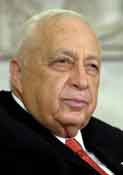
Ariel "Arik" Sharon was an Israeli statesman, former Prime Minister and retired Major-General who served in the IDF for more than 25 years.
Sharon (born February 26, 1928; died January 11, 2014) was born at Kfar Malal in Pre-State Israel. He joined the Haganah at the age of 14 in 1942 and during the 1948
Israeli War of Independence, he commanded an
infantry company in the Alexandroni Brigade.
In 1953, he founded and led the “101”
special commando unit which carried out
retaliatory operations against Palestinian fedayeen. Sharon was appointed commander
of a Paratroop
Corps in 1956 and fought in the Sinai
Campaign. In 1957, he attended the
Camberley Staff College in Great Britain.
Between 1958 and 1962, Sharon served as Infantry
Brigade Commander and then Infantry School Commander,
and then attended Law School at Tel
Aviv University. He was
appointed Head of the Northern Command Staff in 1964
and Head of the Army Training Department in 1966. He
participated in the 1967
Six Day War as commander of an armored division.
In 1969 he was appointed Head of the Southern Command
Staff.
Sharon resigned from the
army in June 1972, but was recalled to active
military service in the 1973 Yom
Kippur War to command an armored division.
He led the crossing of the Suez Canal which
helped secure an Israeli victory in
the war and eventual peace
with Egypt.
Ariel Sharon was elected to the Knesset in December 1973, but resigned a year later, serving
as Security Adviser to Prime Minister Yitzhak
Rabin (1975). He was elected to the Knesset in 1977 on the Shlomzion ticket. Following the elections,
he joined the Herut party and was appointed Minister of Agriculture in Menachem
Begin's first government (1977-81). One of his priorities
was to pursue agricultural cooperation with Egypt.
In 1981, Ariel Sharon was
appointed Defense Minister, serving in this
post during the Lebanon
War, which brought about the destruction
of the PLO terrorist
infrastructure in Lebanon.
In the realm of international relations,
he was instrumental in renewing diplomatic
relations with the African nations which
had broken off ties with Israel during the Yom
Kippur War. In November 1981, he brought
about the first strategic
cooperation agreement with the U.S. and
widened defense ties between Israel and
many nations. He also helped bring thousands
of Jews from Ethiopia through Sudan.
In 1983, Sharon resigned
as Defense Minister after a government
commission found him indirectly responsible
for the September 1982 massacre of Palestinians
at the Sabra
and Shatila refugee camps by Lebanese
Phalangists.
Sharon remained in the government as
a minister without portfolio and then served as Minister
of Industry and Trade from 1984-90. In this capacity,
he concluded the Free
Trade Agreement with the U.S. in 1985.
From 1990-1992, he served as Minister
of Construction and Housing and Chairman of the Ministerial
Committee on Immigration and Absorption. Following the
fall of the Soviet Union and the waves of immigration
from Russia, he initiated and carried out a program
to absorb the immigrants throughout the country, including
the construction of 144,000 apartments.
From 1992-1996, he served as a member
of the Knesset Foreign Affairs and Defense Committee.
In 1996, Ariel Sharon was appointed
Minister of National Infrastructure and was involved
in fostering joint ventures with Jordan, Egypt and
the Palestinians.
He also served as Chairman of the Ministerial Committee
for Bedouin advancement.
In 1998, Ariel Sharon was appointed Foreign Minister and headed the permanent
status negotiations with the Palestinian
Authority.
While serving as Foreign Minister,
Sharon met with U.S., European, Palestinian and Arab
leaders to advance the peace process. He worked mostly
to create and advance projects such as the Flagship
Water Project funded by the international community
to find a long-term solution to the region's water
crisis and a basis to peaceful relations between
Israel, Jordan, the Palestinians and other Middle Eastern
countries.
Following the election of Ehud
Barak as Prime Minister in May 1999, Ariel Sharon
was called upon to become interim Likud party leader following the resignation of Benjamin
Netanyahu. In September 1999, he was elected Chairman
of the Likud.
He also served as a member of the Foreign Affairs and
Defense Committee in the Knesset.
On September 28, 2000, Sharon
made a visit to the Temple
Mount in Jerusalem,
the holiest place in Judaism to
emphasize Israel's claim to sovereignty
over the Temple Mount. Palestinians maintained
that Sharon came with “thousands of Israeli
soldiers” and defiled a Muslim holy place,
when in fact, Israel's Internal Security
Minister Shlomo
Ben-Ami permitted Sharon to visit the
Temple Mount only after calling Palestinian
security chief Jabril
Rajoub and receiving his assurance
that if Sharon did not enter the mosques,
no problems would arise. Sharon did not
attempt to enter any mosques and his
34 minute visit was conducted during normal
hours when the area is open to tourists.
Palestinian youths —
eventually numbering around 1,500 — shouted
slogans in an attempt to inflame the situation.
Some 1,500 Israeli police were present at
the scene to forestall violence.
Following Sharon's Temple
Mount visit, the Palestinians, under the
direction of Yasser
Arafat, launched an unprecendented wave
of violence and terror against Israelis,
dubbed the “al-Aksa
Intifada” by the Palestinians
for its association with the al-Aksa
Mosque located on the Temple Mount.
Palestinian leaders claim that Sharon's
visit sparked the violence, but on November
7, 2000, an investigatory committee led
by former U.S. Senator George Mitchell
was established to determine the causes
of the violence and to make recommendations
for calming the situation. The
Mitchell Report issued in April 30,
2001, concluded “the Sharon visit did
not cuase the “al-Aksa intifada.”
In a special
election held February 6, 2001, Ariel Sharon was
elected Prime Minister. He presented his government
to the Knesset on March 7, 2001. After calling early elections to the 16th Knesset,
which were held on January 28, 2003, Ariel Sharon was
charged by the president with the task of forming a
government and presented his new government to the Knesset
on February 27, 2003.
After several years of bloodshed,
terror, and stalled peace talks with the
Palestinians, Sharon devised a bold plan that would ensure a higher degree of security
for Israelis, and improve the lives of Palestinians.
While Palestinian terrorism against Israelis was at its peak, and going
virtually unchecked by Arafat and other
Palestinian leaders, Sharon decided that
Israel should act unilaterally to improve
its security situation and reduce bloodshed.
This plan, known as the disengagement
plan, called for the complete withdrawal
of Israeli troops and settlers in
the Gaza
Strip, as well as the dismantlement
of all settlements in the area, including four settlements in
northen Samaria.
Between August 16 and August 30, 2005, Israel
safely evacuated more than 8,500 Israeli
settlers and, on September 11, 2005, Israeli
soldiers left Gaza, ending Israel's 38-year
presence in the area.
The implementation
of the disengagement plan was viewed as a
success by most of the Israeli public, although
it sparked bitter protests from ministers
of Sharon's Likud Party, causing a party
schism. Facing bitter infighting in Likud,
Sharon formally resigned from the party to
form a new
centrist party, “Kadima,” or “Forward”
on November 21, 2005.
Following the Likud Party spilt, Sharon
outlined the goals of his new party. One, he said, is
to closely follow the United States-backed road
map plan for peace with the Palestinians. Sharon
declared that there will be no more unilateral withdrawals
from the West Bank, and insisted that Palestinian terrorist
groups be disarmed and dismantled. The Kadima party
platform calls for “maximum security and assuring
that Israel be a Jewish national home and that another
state that shall arise be demilitarized, with terrorists
disarmed.”
In mid-December, 2005, Sharon
spent two days in a hospital after suffering
a minor stroke, which doctors said caused
no irreparable brain damage. However, on
January 4, 2006, Sharon was rushed to the
hospital following another, more serious
stroke. Sharon suffered a
massive brain hemorrhage, which caused extensive
cerebral bleeding.
In response to his medical predicament, U.S. President George
W. Bush said that Sharon was “a man
of courage and peace,” and that “on behalf
of all Americans, we send our best wishes
and hopes to the prime minister and his
family.” Prime Minsterial duties
were then turned over to Ehud
Olmert, who held a cabinet meeting on
January 5, 2006, to signal the transfer
of power.
From January 2006, Sharon remained hospitalized and in a vegetative state. He passed away on January 11, 2014, with his family by his bedside.
Ariel Sharon had been present
at, or involved in, practically every seminal moment
in modern Israel's history. From pre-state
Israel and Israel's wars of survival, to
politics and the disengagement plan, Sharon
played a highly significant role in
shaping Israel's future. Although once considered
a hardline politician who was the “father
of the settlement movement,” and
a brilliant leader in the wartime, Sharon
devoted his last years in politics to pursuing
peace with security for Israel and its neighbors.
Sharon is survived by his two sons,
Omri and Gilad.