Background & Overview
(1982 - 1985)
Burgeoning Violence
Israel has long sought a
peaceful northern border. But Lebanon's position as a haven for terrorist groups has made this impossible. In
March 1978, PLO terrorists infiltrated Israel. After murdering an American tourist walking near
an Israeli beach, they hijacked a civilian bus. The terrorists shot
through the windows as the bus traveled down the highway. When Israeli
troops intercepted the bus, the terrorists opened fire. A total of 34
hostages died in the attack. In response, Israeli forces crossed into
Lebanon and overran terrorist bases in the southern part of that country,
pushing the terrorists away from the border. The Israel
Defense Forces (IDF) withdrew after two months, allowing United
Nations forces to enter. But UN troops were unable to prevent terrorists
from reinfiltrating the region and introducing new, more dangerous arms.
Violence escalated with a series of PLO attacks and Israeli reprisals. Finally, the United States helped
broker a ceasefire agreement in July 1981. The PLO repeatedly violated the cease-fire over the ensuing 11 months. Israel
charged that the PLO staged 270 terrorist actions in Israel, the West
Bank and Gaza, and along
the Lebanese and Jordanian borders. Twentynine Israelis died and
more than 300 were injured in the attacks.
Meanwhile, a force of some 15-18,000 PLO members was encamped in scores of locations in Lebanon. About
5,000-6,000 were foreign mercenaries, coming from such countries as
Libya, Iraq, India, Sri Lanka, Chad and Mozambique. Israel later
discovered enough light arms and other weapons in Lebanon to equip
five brigades. The PLO arsenal included mortars, Katyusha rockets and an extensive antiaircraft
network. The PLO also
brought hundreds of T34 tanks into the area. Syria, which permitted
Lebanon to become a haven for the PLO and other terrorist groups, brought surface-to-air missiles into that
country, creating yet another danger for Israel.
Israeli strikes and commando raids were unable to
stem the growth of this PLO army. The situation in the Galilee became intolerable as the frequency
of attacks forced thousands of residents to flee their homes or to
spend large amounts of time in bomb shelters. Israel was not prepared
to wait for more deadly attacks to be launched against its civilian
population before acting against the terrorists.
The Last Straw
The final provocation occurred in June 1982 when a
Palestinian terrorist group led by Abu Nidal attempted to assassinate
Israel's Ambassador to Great Britain, Shlomo Argov. The IDF subsequently attacked Lebanon again on June 4-5, 1982. The PLO
responded with a massive artillery and mortar attack on the Israeli
population of the Galilee. On June 6, the IDF moved into Lebanon to drive out the terrorists in "Operation
Peace for Galilee."
Former Secretary of State Henry
Kissinger defended the Israeli operation: "No sovereign state
can tolerate indefinitely the buildup along its borders of a military
force dedicated to its destruction and implementing its objectives by
periodic shellings and raids" (Washington Post, June 16,
1982).
"On Lebanon, it is clear that we and Israel
both seek an end to the violence there, and a sovereign, independent
Lebanon," President Reagan said June 21, 1982. "We agree
that Israel must not be subjected to violence from the north."
The initial success of the Israeli operation led
officials to broaden the objective to expel the PLO from Lebanon and induce the country's leaders to sign a peace treaty.
In 1983, Lebanon's President, Amin Gemayel, signed a peace treaty with
Israel. A year later, Syria forced Gemayel to renege on the agreement.
The war then became drawn out as the IDF captured Beirut and surrounded Yasser
Arafat and his guerrillas.
PLO Tyranny in Lebanon
For Arab residents of south Lebanon, PLO rule was a nightmare. After the PLO was expelled from Jordan by King
Hussein in 1970, many of its cadres went to Lebanon. The PLO seized whole areas of the country, where it brutalized the population
and usurped Lebanese government authority.
On October 14, 1976, Lebanese Ambassador Edward Ghorra
told the UN General Assembly the PLO was bringing ruin upon
his country: “Palestinian elements belonging to various splinter
organizations resorted to kidnaping Lebanese, and sometimes foreigners,
holding them prisoners, questioning them, and even sometimes killing
them.”
Columnists Rowland Evans and Robert Novak, not
known for being sympathetic toward Israel, declared after touring
south Lebanon and Beirut that the facts "tend to support Israel's
claim that the PLO has become permeated by thugs and adventurers"
(Washington Post, June 25, 1982). Countless Lebanese told
harrowing tales of rape, mutilation and murders committed by PLO
forces.
New York Times correspondent David Shipler
visited Damour, a Christian village near Beirut, which had been
occupied by the PLO since
1976, when Palestinians and Lebanese leftists sacked the city and
massacred hundreds of its inhabitants. The PLO, Shipler wrote, had
turned the town into a military base, "using its churches as
strongholds and armories" (New York Times, June 21, 1982).
When the IDF drove the PLO out of Damour in June 1982, Prime Minister Menachem Begin announced
that the town's Christian residents could come home and rebuild.
Returning villagers found their former homes littered with
spray-painted Palestinian nationalist slogans, Fatah literature and
posters of Yasir Arafat. They told Shipler how happy they were that
Israel had liberated them.
The PLO's Reluctant Retreat
When the IDF captured Beirut, the civilian
population was forced to suffer because of the PLO's refusal to
surrender. By mid-June, Israeli troops had surrounded 6,000-9,000
terrorists who had taken up positions amid the civilian population of
West Beirut. To prevent civilian casualties, Israel agreed to a
cease-fire to enable an American diplomat, Ambassador Philip Habib, to
mediate a peaceful PLO withdrawal from Lebanon. As a gesture of flexibility, Israel agreed to
permit PLO forces to
leave Beirut with their personal weapons. But the PLO continued to make new demands.
The PLO also adopted a strategy of controlled
violations of the ceasefire, with the purpose of inflicting
casualties on Israel and provoking Israeli retaliation sufficient to
get the IDF blamed for disrupting the negotiations and harming
civilians. For more than a month, the PLO tried to extract a political victory from its military defeat. Arafat
declared his willingness "in principle" to leave Beirut,
then refused to go to any other country. Arafat also tried to push the
U.S. to recognize the PLO. Throughout the siege, the PLO hid behind innocent civilians, accurately calculating that if Israel
were to attack, it would be internationally condemned.
"The Israelis bombed buildings, innocent
looking on the outside, where their intelligence told them that PLO offices were hidden," wrote Middle East analyst Joshua Muravchik
("Misreporting Lebanon," Policy Review, Winter 1983).
"Their intelligence also told them of the huge network of
underground PLO storage
facilities for arms and munitions that was later uncovered by the
Lebanese Army. No doubt the Israelis dropped some bombs hoping to
penetrate those facilities and detonate the dumps. The PLO had both artillery and antiaircraft [equipment] truck mounted. These
would fire at the Israelis and then move." The Israelis would
fire back and sometimes miss, inadvertently hitting civilian targets.
In numerous instances, the media mistakenly
reported that Israel was hitting civilian targets in areas where no
military ones were nearby. On one night in July, Israeli shells hit
seven embassies in Beirut. NBC aired a report that appeared to lend
credence to PLO claims it
had no military positions in the area. Israel, Muravchik noted,
"soon released reconnaissance photos showing the embassy area
honeycombed with tanks, mortars, heavy machine guns and antiaircraft
positions."
The Lebanon war provoked intense debate within
Israel. For the first time in Israel's history, a consensus for war
did not exist (though it did at the outset). Prime Minister Menachem
Begin resigned as demands for an end to the fighting grew louder.
The national coalition government that took office in 1984 decided to
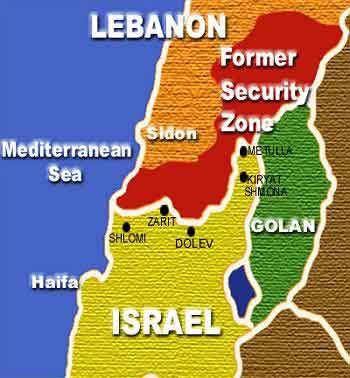
withdraw from Lebanon, leaving behind a token force to help the South
Lebanese Army (which Israel had long supported) patrol a security zone
near Israel's border.
Though the IDF succeeded in driving the PLO out of Lebanon, it did not end the terrorist threats from that
country. The war was also costly, 1,216 soldiers died between June 5,
1982, and May 31, 1985.
Ongoing Violence
Jerusalem repeatedly stressed that Israel did not covet
a single inch of Lebanese territory. Israel's 1985 withdrawal from Lebanon
confirmed that. The small 1,000-man Israeli force, deployed in a strip
of territory extending eight miles into south Lebanon, protects towns
and villages in northern Israel from attack. Israel also repeatedly
said it would completely withdraw from Lebanon in return for a stable
security situation on its northern border.
Most of the terrorist groups that threaten Israel have
not been disarmed. For example, several thousand terrorists currently
in Lebanon are members of Hezbollah.
The group receives financial support and arms from Iran, usually via
Damascus. Hezbollah - which had initially confined itself to launching Katyusha rocket
attacks on northern Israel and ambushing Israeli troops in the security
zone-has in recent years stepped up its atta cks on Israeli civilians.
In April 1996, the IDF mounted "Operation Grapes of Wrath" to halt Hezbollah's
bombardment of Israel's northern frontier. During the operation,
Israeli artillery mistakenly hit a UN base in Kafr Kana, killing
nearly 100 civilians. Afterward, a Joint Monitoring Machinery,
including American, French, Syrian and Lebanese representatives,
was created to prohibit unprovoked attacks on civilian populations
and the use of civilians as shields for terrorist activities.
The Syrian-backed Lebanese Army has yet to take action against
Hezbollah, or other terrorist
organizations, such as the Popular
Front for the Liberation of Palestine (PFLP), Popular Front for
the Liberation of Palestine-General Command (PFLP-GC) or Democratic
Front for the Liberation of Palestine (DFLP), which have bases in the
Syrian-controlled Bekaa Valley in eastern Lebanon. Syria, in fact, declared
its unqualified support for stepped-up violence in the area. Consequently,
attacks against Israeli troops in the Security Zone and civilians in
northern Israel continued.
Israel Withdraws
Israel pulled all its troops out of southern
Lebanon on May 24, 2000, ending a 22-year military presence there. All
Israel Defense Force and South Lebanon Army outposts were evacuated.
The Israeli withdrawal was
conducted in coordination with the UN, and constituted an Israeli
fulfillment of its obligations under Security
Council Resolution 425 (1978).
|