Ehud Barak
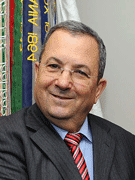
(1942 - )
Ehud Barak is a former Israeli special forces commando, IDF Chief of Staff and Israeli government minister, including Prime Minister.
Barak was born in 1942 in
Kibbutz Mishmar Hasharon.He joined the Israel Defense Forces in 1959, and served as a soldier and commander
of an elite unit, and in various other command positions including Tank
Brigade Commander and Armored Division Commander, and General Staff
positions, including Head of the IDF Intelligence Branch. During the 1967 Six-Day War, Barak
served as a reconnaissance group commander, and in the 1973 Yom Kippur War as a tank battalion commander on the southern
front in Sinai. In January 1982, he was appointed Head of the IDF Planning
Branch and promoted to Major General. During the 1982 “Peace for Galilee” operation, Major General Barak
served as Deputy Commander of the Israeli force in Lebanon.
In April 1983, Maj.Gen. Barak
was appointed Head of the Intelligence Branch at the IDF General Headquarters.
In January 1986, he was appointed Commander of the IDF Central Command,
and in May 1987 was appointed Deputy Chief-of-Staff.
In April 1991, he assumed the
post of the 14th Chief
of the General Staff and was promoted to the rank of Lt. General,
the highest in the Israeli military.
Following the May 1994 signing
of the Gaza-Jericho agreement with the Palestinians, Lt. General Barak oversaw the IDF's redeployment
in the Gaza Strip and Jericho. He played a central role in finalizing
the peace treaty with Jordan,
signed in 1994, and met with his Syrian counterpart as part of the Syrian-Israeli negotiations.
General Barak was awarded the
"Distinguished Service Medal" and four other citations for
courage and operational excellence.
Barak holds a B.Sc. in Physics
and Mathematics from the Hebrew University in Jerusalem (1976), and
an M.Sc. in Engineering-Economic Systems from Stanford University, California
(1978).
He served as Minister of the
Interior from July-November 1995 and as Minister of Foreign Affairs
from November 1995 until June 1996.
Elected to the Knesset in 1996, he served as a Member of the Knesset Foreign Affairs and Defense
Committee.
In 1996, Barak was elected Chairman
of the Labor Party and in
1999 formed the One Israel Party from the Labor, Gesher and Meimad factions.
Barak was elected Prime Minister of Israel on May 17, 1999. He presented his government
to the Knesset on July 6, 1999, assuming office as Prime Minister and
Minister of Defense.
On December 10, 2000, Barak shocked the Israeli people by announcing his resignation from the premiereship yet calling for special elections, in which he would run again, to determine a new Prime Minister. In a press conference, Barak said: "I will officially
advise the president of my resignation (and) in 60 days ... go to
special elections for prime minister... Due to the emergency
situation the country is in ... and the need to continue reducing the
violence and moving forward the chances of peace negotiations, I have
decided to ask again for the mandate of the people of Israel."
Barak's decision to resign and schedule a special election came after it became clear the
Knesset was going to call new elections. It was viewed as a
shrewd political move because according to the Basic
Law: The government, only current Knesset members, whose party is represented with at least 10 seats, are allowed to run in a special election. By calling for such an election, Barak effectively removed his principal challeneger, Benjamin Netanyahu, who was not at the time a Knesset member. Barak assumed he could then defeat Likud Party head Ariel Sharon.
However, sixty days later, Sharon defeated Barak in the special election. Barak completed his term as Prime Minister on March 7, 2001.
In June 2007, Ehud Barak was elected to head the Labor
Party, and was subsequently appointed Deputy Prime Minister and Minister
of Defense. He was appointed Deputy Prime Minister
and Minister of Defense in the Netanyahu government in March 2009.
In January 2011, Barak formed a breakaway party with
other Labor Party legislators called Atzmaut (Independence). In November
2012, Barak announced he will leave political life after the January
2013 Israeli elections.
He is married and the father of three children.
Sources: Israel
Ministry of Foreign Affairs |