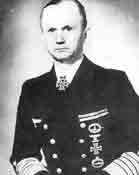
Karl Dönitz was a
German naval leader, famous for his command
of the Kriegsmarine during World
War II and
for his twenty-three day term as President
of Germany after Adolf
Hitler’s suicide.
Dönitz was born near Berlin.
He entered the Kaiserliche Marine (Imperial
Navy) in 1911. During World
War I, he served on surface ships before
transferring to submarines. He ended the war
a prisoner-of-war of the British. He remained
in the navy after the war's conclusion and
rose in the ranks of the Reichsmarine and Kriegsmarine,
becoming a Grand Admiral (Großadmiral)
and serving as Commander of Submarines (Befehlshaber
der Unterseeboote, B.d.U.) and later Commander-in-Chief
of the German Navy (Oberbefehlshaber der Kriegsmarine)
despite never joining the Nazi
Party.
Following Hitler’s accession
to power, Doenitz supervised the clandestine
building of Nazi Germany's U-boat fleet iin
direct violation of the Versailles Treaty
clauses still in effect. Under his command,
the U-boat fleet fought the famous Battle
of the Atlantic. In 1936,
he was appointed by Hitler to
be Commander-in-Chief of the U-Boat fleet.
From 1940-42,
he waged an unsuccessful campaign to destroy
the British merchant marine and starve out
the British isles. But protected by British
and U.S. naval armed escort, Britain's lifelines
in foodstuffs, ammunition, and raw materials
enable her to continue waging war against
Germany while drawing the United States ever
closer into the conflict, as U-boat commanders
repeatedly damage or sink U.S. ships. In 1943,
Doenitz replaced Admiral
Erich Raeder as Commander-in-Chief
of the Kriegsmarine.
On July 20, 1944, Doenitz
rushed to Hitler’s side
to reaffirm the navy's and his personal oath
of unquestioning loyalty to Germany's fuehrer.
Doenitz publicly heaps adoring praise over Hitler and
condemns the July
20th conspirators as a criminal and
cowardly gang of traitors.
On May 2, 1945, according
to Hitler's
last will and testament,
Doenitz succeeded Hitler as
Reich head of state after the fuehrer committed
suicide in his bunker deep underneath Berlin's
Chancellery on April 30. As Reich head
of state, Doenitz signed
the Allied terms for Nazi Germany's unconditional
surrender on May 8, 1945
After the war
he was charged
and convicted of “crimes
against peace” and “war crimes” and
served ten years. He was released in 1956.
On his repatriation he moved to a small village
near Hamburg. During his later years he wrote
two autobiographies covering different periods
in his life. He died of a heart attack on
Christmas Eve 1980.