David Einhorn
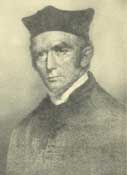
(1809-1879)
David Einhorn was born in
Bavaria in 1809. He studied rabbinics and
philosophy. He was one of the early Reformers and was greatly influenced by both Abraham
Geiger and Samuel Holdheim. In 1842, he
supported Geiger and publicly stated that
there the Talmud had no divine authority. At the Frankfort
Rabbinical Conference in 1845, he enthusiastically
pushed for having the service in the vernacular
and for cutting out all references to the
restoration of the sacrifices and a Jewish
state.
Einhorn’s positions were considered so radical that even though congregations
selected him to serve as their rabbi, the Bavarian government refused
to confirm his appointments.
In 1847, Einhorn succeeded Samuel Holdheim as chief rabbi of Mecklenburg-Schwerin.
He got involved in a series of controversies, realized he had little
future as a rabbi in Europe, and headed for the country of liberal opportunity,
America.
His arrival in the United
States coincided with the Cleveland Rabbinical
Conference, which, under the leadership of Isaac
Mayer Wise, adopted a platform designed
to permit a broadly based union among the
various tendencies in American Judaism. Einhorn
regarded this platform as treachery to the
cause of Reform and denounced it violently.
This marked the beginning of a bitter feud
between Einhorn, the uncompromising Reformer,
and Rabbi
Isaac Mayer Wise, who was ready to moderate
his Reform in the interests of unity. Einhorn
became rabbi at Har Sinai Congregation of
Baltimore in 1855. He wrote a new Reform Jewish prayer book with the majority of the text in
German called Olat Tamid. Unlike Minchag America
(Isaac
Mayer Wise’s prayer book), Olat Tamid
not only shortened the traditional service;
it was a creative work expressing Einhorn’s
Reform ideal of the universality of humanity
with an anti-particularistic strain. In its
modern approach to worship, it cut out Kol
Nidrei; it utilized various Sephardic piyyutim (religious poems); it dropped
the Musaf service entirely; it did not include
blessings for the blowing of shofar or the
lighting of Chanukah lights; it de-emphasized Israel as the Chosen
People; and it removed all references
to a personal Messiah,
a return to Israel, or the resumption of the
sacrificial cult.
Einhorn’s rabbinate in Baltimore, Maryland, a pro-slavery state, was
cut short in 1861 when his outraged denunciation of slavery placed him
in danger. A mob threatened to tar and feather him, and he had to flee
north. He became rabbi of Congregation Kenesseth Israel in Philadelphia.
In 1866 he moved to New York, where he became rabbi of Congregation
Adath Israel.
In 1869, he attended the Philadelphia Rabbinical Conference. A powerful
and fiery speaker, he influenced that group to adopt a radical, Reform
platform, alienating the more traditional American Jewish groups.
Although Isaac Mayer Wise’s
more moderate positions eventually became
the norm for American Reform Jewish institutions,
Einhorn's more radical view of Reform
Judaism greatly influenced Kaufman Kohler,
his son-in-law and disciple. Kohler formulated
the Pittsburgh
Platform of 1885, which became the basis
for American Reform. Kohler was also instrumental
in writing The Union Prayer Book, which
he based on Einhorn’s Olat Tamid.
Sources: Gates
of Jewish Heritage. Photo from “Sinai,” Vol. VI, Translated from the German, p. 2-22,
Baltimore, 1861, by Mrs. Kaufmann Kohler. |