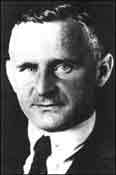
Carl Goerdeler, the son of a Prussian district judge,
was born in Schneidemuell on July 31,1884. After studying law he became
a local civil servant.
In 1930 Goerdeler became mayor of Leipzig. He also
became price commissioner in the government of Heinrich Brüning
and remained in office when Adolf
Hitler came to power in 1933. Goerdeler resigned in 1934 after disagreement
with Hitler over his
policies.
Goerdeler publically opposed German rearmament and
the Nuremberg Laws.
As mayor of Leipzig, he refused to pull down the statue of the Jewish
composer Felix Mendelssohn or to fly the swastika flag over the city hall.
Goerdeler resigned as mayor of Leipzig in 1937 and
spent the next two years travelling around Europe as overseas representative
of the Bosche company. In 1938, he met Winston Churchill and other important
political figures in Britain and France. Goerdeler provided
information about Nazi Germany and encouraged governments not to make
too many concessions to Hitler. He was appalled by the Munich
Agreement which he saw as "out-and-out capitulation" and
claimed that it would lead to a war in Europe.
During the Second World War, Goerdeler advocated a
negotiated peace with the Allies. However, he was deeply disappointed
when his political contacts in Britain told him that the war would only
come to an end if Germany unconditionally surrendered.
By 1940, Goerdeler had become convinced that only
the German armed forces could overthrow Hitler.
He made contact with Ludwig Beck but they were unable to find enough senior military leaders to take
part in a coup.
In 1944, Goerdeler became involved in the July
Plot and he agreed to become chancellor after Hitler's assassination.
On July 18, 1944, Goerdeler was warned that the Gestapo had discovered that he was involved in a conspiracy to kill Hitler.
He went into hiding but was arrested the following month on August 12.
Carl Goerdeler was interrogated and tortured for five months before
being executed on February 2, 1945.