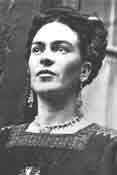
Frida Kahlo was born Magdalena Carmen Frieda Kahlo
y Calderón in her parents' house in Coyoacán, which at
the time was a small town on the outskirts of Mexico
City. Her father was a painter and photographer of alleged German-Jewish
background, whose family originated from Oradea, Romania. Genealogical research in the 21st century indicated however that her father was not in fact Jewish, but was instead a Lutheran.
Following a crippling traffic accident in 1925, Kahlo
turned her attention from a medical career to painting. Drawing on her
personal experiences, her works are often shocking in their stark portrayal
of pain and the harsh lives of women. Fifty-five of her 143 paintings
are self-portraits that incorporate personal symbolism, complete with
graphic anatomical references. She was also influenced by indigenous
Mexican culture, aspects of which she portrayed in bright colors, with
a mixture of realism and symbolism.
Her paintings attracted the attention of the artist
Diego Rivera, whom she later married, divorced, and re-married. An active
Communist supporter, she allegedly had an affair with Leon Trotsky,
who was assassinated at his home in Mexico City by agents of Stalin in 1940. After Trotsky's death, Frida denounced him and became a Stalinist/Anti-Revisionist,
calling Mao's China “the new socialist hope.” Her home was
decorated with lots of Socialist Art, including the faces of Marx,
Engels, Stalin, and Mao.
Although Kahlo's work is sometimes classified as surrealist and she
did exhibit several times with European surrealists, she disputed the
label. Her preoccupation with female themes and the figurative candor
with which she expressed them made her something of a feminist cult
figure in the last decades of the 20th century.
Kahlo died on July 13, 1954, of a pulmonary embolism
. Her ashes were placed in a pre-Columbian urn which is on display in
her former home La Casa Azul in Coyoacán, which has been turned
into a museum containing a number of her works.
A biographical documentary containing archival footage,
entitled Frida Kahlo, was released in 1982, in Germany. In 1984,
director Paul Le Duc released the film Frida, naturaleza viva,
which stars Ofelia Medina as Frida Kahlo. In 2002, Miramax released
a motion picture titled Frida, starring Salma Hayek in the title
role.
Kahlo was noted for her unconventional appearance,
including pronounced eyebrows (a unibrow) and a thin moustache which
she did not remove.