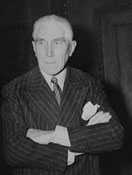
Franz von Papen was born to a wealthy Catholic family in Westphalia. He served as a
soldier on the Turkish front in World War I. Returning to Germany,
he entered politics, joining the Catholic Centre Party, in which the
monarchist Papen formed part of the far right wing. On June 1, 1932,
he was plucked from relative obscurity when President Paul
von Hindenburg chose him as Chancellor to replace Heinrich Brüning,
the leader of Papen's own party. This was largely due to the influence
of General Kurt von Schleicher,
at the time Hindenburg's closest advisor.
Papen, who was expelled from the Centre Party for his
betrayal of Brüning, had practically no support in Reichstag except
from the Conservative German National People's Party (DNVP). Papen ruled
in an authoritarian manner, launching a coup against the Social Democratic
led government of Prussia, and repealing his predecessor's ban on the
SA as a way to appease the Nazis,
whom he hoped to lure into supporting his government. Ultimately, after
two Reichstag elections only increased the Nazis' strength in the Reichstag
without substantially increasing Papen's own parliamentary support,
he was forced to resign as Chancellor, and was replaced on December
4, 1932 by Schleicher, who hoped to establish a broad coalition government
by gaining the support of both Nazi and Social Democratic trade unionists.
As it became increasingly obvious that Schleicher's
maneuvering to find a Reichstag majority would be unsuccessful, Papen
and DNVP leader Alfred Hugenberg came to an agreement with Hitler to allow him to become Chancellor of a coalition government with the
Nationalists, and with Papen serving as Vice-Chancellor. Papen used
his personal ties with the aged Von Hindenburg to persuade the President,
who had previously vowed never to allow Hitler to become Chancellor,
to fire Schleicher and appoint Hitler to the post on January 30, 1933.
Once Hitler was in power, Von Papen and his allies
were quickly marginalized, and he retired from the Vice-Chancellorship
in 1934, following
the Night of the Long Knives,
when many of Hitler's enemies inside and outside the party (including
Schleicher) were murdered. Von Papen was arrested and put under house
arrest for three days but his secretary, Herbert von Bose, and his speech
writer, Edgar Julius Jung, were murdered. Later, Papen served the Nazi
government as Ambassador to Austria from 1934 to 1938 and Ambassador to Turkey from 1939 to 1944.
Papen was captured by the allies after the war and
was one of the defendants at the main Nuremberg
War Crimes Trial, but was acquitted.
He tried unsuccessfully to re-start his political career in the 1950s.
He was made a papal Geheimkämmerer by Pope John
XXIII in 1959.