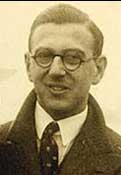
In 1939, the English stockbroker Nicholas Winton rescued
669 Czech children from their doomed fate in the Nazi death camps, but
his achievement went unrecognised for more than half a century. For
fifty years most of the children did not know to whom they owed their
lives. The story of Nicholas Winton only emerged when his wife Greta
came across an old leather briefcase in an attic and found lists of
the children and letters from their parents. He hadn't even told her
of his role during the war.
Nicholas Winton, a 30-year-old clerk
at the London stock exchange, visited Prague,
Czechoslovakia, in late 1938 at the invitation
of a friend at the British Embassy. When he
arrived, the British team working in newly
erected refugee camps asked him to lend a
hand.
He spent a few months in Prague,
and was alarmed by the influx of refugees
endangered by the imminent Nazi invasion.
He immediately recognized the advancing danger
and decided to make every effort
to get the children outside the reach of Nazi
power.
'The commission was dealing with the elderly
and vulnerable and people in the camps kept
telling me that nobody was doing anything
for the children,' Nicholas Winton later recalled.
Word
spread about the 'Englishman of Wenceslas Square'
and parents flocked to the hotel to try to
persuade him to put their children on the
list, desperate to get them out of the country before the
Nazis invaded. 'It seemed hopeless,' he said
years later, 'each group felt that they were
the most urgent.' But Winton managed to set
up the organisation for the Czech Kindertransport
in Prague in early 1939 before he went back
to London to handle all the necessary matters
from Britain.
Iin London, Winton began organizing
transports to get the children out of the country in cooperation with the British Committee for Refugees
from Czechoslovakia and the Czechoslovak travel
agency Cedok. He was required to find a foster family for each child that could produce a 50 pound guarentee. He also raised money to help
pay for the transportation for the children of poorer families.
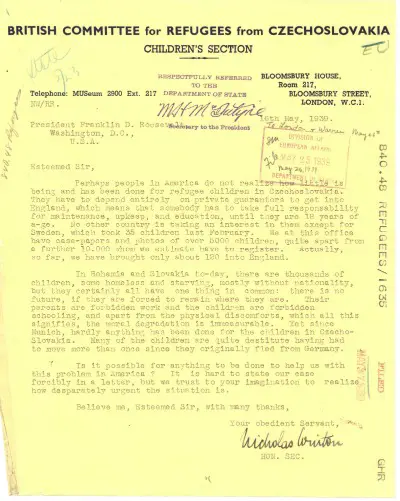
During an interview on CBS's "60 Minutes" in April 2014, Winton said he tried to send children to the U.S. as well, who refused. He said he wrote a letter to then-President Franklin D. Roosevelt explaining the urgent need to transport children out of the country, and asked for any support the U.S. could provide.
As the war continued, Nicholas Winton managed to arrange
for 669 children to leave on eight different trains from
Prague to London (a small group of 15 were
flown out via Sweden). The ninth train - the
biggest transport - was to leave Prague on
September 3, 1939, the day Britain entered
the war - but the train never left the station.
'Within hours of the announcement, the train
disappeared,' Winton later recalled. 'None
of the 250 children on board was seen again.
We had 250 families waiting at Liverpool Street
that day in vain. If the train had been a
day earlier, it would have come through. Not
a single one of those children was heard of
again, which is an awful feeling.'
None of the children set to flee that day
survived the following years. Later, more
than 15,000 Czech children were also killed.
Winton never forgot the sight when
the exhausted children from Czechoslovakia piled
out of the trains at London's Liverpool Street
station. All wore name tags around their necks.
One by one, English foster parents collected
the refugee children and took them home, keeping
them safe from the war and the genocide that
was about to consume their families back home.
Winton, who gave these children the gift
of life, watched from a distance.
Winton, one of the unsung heroes of World War II, known as the Schindler of Britain,
is still revered as the father who saved scores of his 'children' from
Nazi death camps.
Vera Gissing, one of the children saved by
Winton, has written his biography and scripted
the film, Power of Humanity. She says:
'He rescued the greater part of the Jewish
children of my generation in Czechoslovakia.
Very few of us met our parents again: they
perished in concentration camps. Had we not
been spirited away, we would have been murdered
alongside them.'
In September, 2001, Nicholas Winton was the guest of honour at the film
premiere of his story in Prague. Winton was invited by Czech president
Vaclav Havel and around 250 of the 664 people he saved were expected at
the event. The biography, Nicholas Winton and the Rescued Generation,
by Muriel Emmanuel and Vera Gissing (Vallentine Mithchell Press) was published
in 2001. A Slovakian film entitled: Nicholas J. Winton - Power of Good is also in the works.
Winton insists he wasn't anything special,
adding, 'I just saw what was going on and
did what I could to help.'
But survivor Vera Gissing said: 'I owe him
my life and those of my children and grandchildren.
I was lucky to get out when I did and having
the chance to thank Nicky was the most precious
moment in my life.'
The survivors, though many are now grandparents, still
call themselves 'Winton's children.' Among the children saved were Dagmar
Simova, cousin of the Czech-born U.S. Secretary of State Madeleine Albright.
Lady Milena Grenfell-Baines, whose father, Rudolf Fleischmann saved
Thomas Mann by assisting him to gain Czech citizenship for his self-imposed
exile from Germany after the rise of Hitler. Joe Schlesinger, the CBC
correspondent. Julius Sidon from California, the brother to Chief Rabbi
Karol E. Sidon of the Czech Republic. Lord Dubs, a Member of Parliament.
Hugo Merom, the ex-Israel air force pilot and consultant who specialises
in airport planning. And acclaimed film director Karel Reisz. Forty-five
years later Reisz actually met Nicholas Winton at the first reunion.
'I had never heard of him. I thought the Red Cross had organised it,'
he said. 'I took my children and grandchildren - I think it brought
it alive to them to learn where their grandfather came from. It was
very emotional ."
Winton currently resides in Maidenhead, Great Britain.
He was honored as a Member of the British Empire (MBE)
in 1983 for his charitable work the Abbeyfield Houses, a large elderly care home. He was honored in the summerr of 1998 at an event called
"Thank You Britain," which was sponsored by the Czech ambassador
to Britain. On October 28, 1998, Vaclav Havel, President of the Czech
Republic, awarded him the Order of T. G. Marsaryk in a grand ceremony
in Hradcany Castle. In December 2002, Winton received a knighthood from
Queen Elizabeth II.
Winton was born to Jewish parents who converted and
baptized him. (He insists that his genealogy has no connection with
his willingness to transport the 200 youngsters from Czechoslovakia
to Britain in 1938). Because of this, Israel has never recognized him as one of the Righteous
Gentiles at Yad Vashem.
Not that it matters to Winton: As far as he is concerned, his actions
weren't anything extraordinary.
Winton passed away peacefully at age 106 on July 1, 2015, with his daughter and his grandchildren at his side.
Sources:Associated Press. “Nicholas Winton, who saved Jewish children during the Holocaust, dies at 106,” Haaretz, (July 1, 2015)
Poizner, Susan. "Winton's Wartime Gesture," The Holocaust.
The
Jerusalem Report, (August 31, 1998),
"Honor for `British Schindler," BBC
News,(September 26, 2002);
"British `Schindler'
gets knighthood," CNN, (December 31, 2002)